Dec 29, 2013

The Triplets of Belleville: Jazz-Age Lesbians and the Androgynous M

In the animated Triplets of Belleville (2003), professional bicyclist Champion is kidnapped during the Tour de France, so his grandmother, Madame Souza, goes off to search for him.

In the bustling city of Belleville, she encounters the Triplets, a famous jazz act of the 1930s now fallen on bad times.   They eke out a living as a novelty "acoustic" band, making music with a refrigerator, vacuum cleaner, and newspaper.  Madame Souza joins the act with a bicycle wheel, and eventually they become successful again.


Oh, and they rescue Champion in a colorful chase sequence.  The movie ends much too abruptly, with the now elderly Champion reminiscing about the adventure.

There is very little dialogue.  The characters are drawn grotesquely, so there's no beefcake.  So what's the gay connection?

1. No one expresses the slightest heterosexual interest, ever.


2. The Triplets, who have been living and working together for 70 years, can be read as a lesbian family rather than blood relatives.

3. Flashbacks show them performing in a Jazz Age nightclub, along with gay and bisexual icons like Josephine Baker, Glenn Gould, and Hoagy Carmichael.

4. Androgynous singer Mathieu Chedid, known as M, recorded a music video of the song "Belleville Rendez-vous."

He tells a psychiatrist about various ways to spend the last years of his life: in Singapore eating petit-fours, in Katmandu playing a "dou," and most significantly, in Acapulco, dancing with a gigolo ( a male prostitute).  

The English lyrics closet the verse to "dancing cheek-to-cheek."

But then he decides that he wants to be "wicked, twisted, swinging," like a Triplet of Belleville.

This irks the psychiatrist, who straitjackets him and gives him a tranquilizer injection.  That's the fate of those who try to escape gender and sexual confomity, like the Triplets of Belleville.

Dec 26, 2013

David Barry Gray: Not as Homophobic as Chevy Chase, Probably

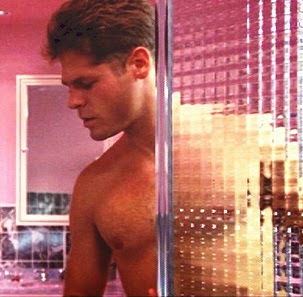
Chevy Chase may be one of the more homophobic actors in Hollywood, as his cast mates from Saturday Night Live and the National Lampoon's Vacation movies can attest, but the naked man on top of him, David Barry Gray, is not.  Not very, anyway.

Not as homophobic as Chevy Chase.

Probably.
The New York City native, heir to the Pepsi Cola fortune,  has appeared on many tv series, beginning as a teenager with William Tell (1987-88); he played William's son, Matthew.  Other series include 21 Jump Street, The Client, JAG, Medium, Ghost Whisperer, and Rizzoli & Isles.

Not a lot of gay subtext vehicles, although you could include his role in S.F.W. (1994), as the brother of hostage-survivor Stephen Dorf, and the "rescuing people from Southeast Asia" movie Soldier Boys (1995), as Lamb, who steps on a land mine (sacrificial lamb -- get it?).

Man-mountain Michael Dudikoff stars.


No gay characters, although he did star in the mega-homophobic Lawn Dogs (1997):

A lonely ten-year old girl and her only friend, the reclusive Trent (Sam Rockwell), both have problems with unwelcome sexual advances from a couple of sleazoid roommates: the girl from Brett (David), and Trent from Sean (Eric Mabius).  Not to worry, the evil gay guy is killed, but the pedophile isn't.

So he played the teenage version of homophobic President Richard Nixon, and more recently, Todd Palin, husband of homophobic Alaska Governor and VP contender Sarah Palin.  That doesn't mean he's personally homophobic.

Does it?

His sister-in-law, Ariel Winter, stars in the gay-positive Modern Family as the brainy teenager Alex Dunphy.

Doesn't that suggest that David is gay-positive?

No?

Well, at least he has a nicely toned physique.

Dec 21, 2013

Earle C. Liederman: The Grandfather of Modern Bodybuilding

Everyone's heard of bodybuilding entrepreneur, Charles Atlas, who sold thousands of "dynamic tension" resistance-training regiments from the 1930s through the 1960s with the comic strip ad, "The Insult that Made a Man out of Mac."

But few people, even bodybuilding aficionados, realize that before Charles Atlas, the mail-order muscle-building market was dominated by Earle E. Liederman (1886-1970), an associate of Eugen Sadow who advertised "Become a giant among men!" to the wimpy office boys of the Jazz Age.

The former physical education teacher, Vaudeville strongman, and professional acrobat began distributing his book, Muscle Development, in 1920, and continued with The Science of Wrestling and Secrets of Strength.  


But where Charles Atlas promised men that muscles would help them get girls, Liederman's ads were usually more inclusive, promising that muscles would make you "a business and social favorite."  And the health benefits of bodybuilding, he noted expansively, would apply to both men and women.

His lessons were typewritten, addressed personally to the student, and tailored to his/her individual needs (actually ghost-written by one of his army of assistants), with practical advice like "don't invest in many collars, as your neck size will increase dramatically."

One of his students, he claimed, was Charles Atlas himself.  Liederman himself provided the illustrations, displaying a massive physique even in his fifties.


During the Depression, he was eclipsed by Charles Atlas's graphic-savvy showmanship, and lost everything.  He hosted a physical-fitness exercise program, and in 1945 moved to Los Angeles to edit Joe Weider's new magazine, Muscle Power.  

His column, "Let's Gossip," with its dish on the sun-and-surf hijinks of the glitterati, is credited with drawing hundreds of young muscle enthusiasts to L.A., where many posed for the gay-vague Physique Pictorial and were discovered by gay casting agent Henry Willson.


After a falling-out with Joe Weider, Liederman went to work for a rival bodybuilding magazine, and died in 1970, the elder statesman of the bodybuilding movement.

I don't know if he was gay.  When you read his columns, he comes across as very fey, a drag queen Auntie, sweetie darling.  But he was married to Miss Alaska for awhile,  so I can't tell.

His course is still available online.


Dec 20, 2013

James Marsden: Former Teen Idol Plays Gay, with Kissing and Everything

You don't need a face shot to distinguish James and Jason Masden.  James has a more ripped physique, which he tends to display with constant semi-nude scenes, plus full nudity in Death at a Funeral (2010).  (Jason is cute too, of course).


A popular teen idol of the 1990s, James appearing on teencoms like Saved by the Bell: The New Class and its Canadian clone, Boogie's Diner.  His first starring role came in Second Noah (1996-97), a dramedy about a family (including the Torgerson Twins) who live near Busch Gardens in Florida.

His most famous dramatic role as a teen idol was Disturbing Behavior (1998): the new kid in town (Marsden) teams up with his new buddy (fellow teen idol Nick Stahl) and The Girl to uncover a plot to turn all of the kids into perfect Stepford Teens.

Gossip (2000) is about a college student (Marsden) and his roommates, a boy and a girl, concocting gossip for a class project. But are his roommates really his friends?


As an adult, he is probably most famous for the X-Men series, where he plays Cyclops, but he has also done some serious dramatic roles, such as The Notebook.

The Oklahoma-born actor was "a little uncomfortable" around gay people when he first moved to Los Angeles, but he soon got over it: he hangs out in gay bars, he's been interviewed in The Advocate and Out, and he's played gay characters twice, with kissing and everything.


The 24th Day (2004): Dan (Marsden) and Tom (Scott Speedman) have a one-night stand that goes wrong.

Heights (2005): a Manhattan lawyer (Marsden) about to marry a woman finds his world turned upside down when his photographer ex shows up with an exhibition about the men he's been with "on the downlow."


He also had a noteworthy appearance on Modern Family, as a free spirit who befriends Cam and Mitchell.


Dec 17, 2013

The Last Picture Show: Small Town Melodrama with Nudity and Gay Subtexts

I saw The Last Picture Show (1971) when I was trapped in Texas, and found it immeasurably depressing, in spite of the infinite number of gay subtexts.

It's about depressed young people in a dismal, windswept Texas town in the 1950s.  They try to find meaning in their sad little lives through tawdry affairs with people they hate and going to the movies, but they can't perform during the affairs, the movie theater is closing, and they're all leaving or dying.


Sad-eyed high school seniors Sonny (Timothy Bottoms) and Duane (Jeff Bridges) are obviously into each other, no matter how much they try to triangulate their romance with girlfriends whom they can't perform for and affairs with older women whom they hate.  They split up when Sonny goes off to die in the Korean War.


Sonny has an affair with the depressed middle-aged Ruth Popper (Cloris Leachman).  Why is she depressed?  Other than being trapped in a horrible small town, I mean. Because her husband, Coach Popper (Bill Thurman), is unable to...well, you know, and likes to smack his student athletes on the butt.  Gay, right?  You couldn't state it openly in 1971, but it's implied.

For that matter, an awful lot of the men in town are unwilling or unable to...well, you know.  It's as if the quiet desperation of their lives has resulted in impotence.  And a lot of gay subtexts.

Rich boy Bobby (Gary Brockette) invites them all to his house for a skinny-dipping party (he has a famous frontal nude scene that got the movie banned as obscene in several places).  He wants a girlfriend, but not if she's a virgin.  He doesn't want to have to worry about any of that icky sex stuff.


They take the young street sweeper Billy (Sam Bottoms) to a prostitute to lose his virginity, but it doesn't work out, probably because he's not into girls.  He is into Duane, however.  At the end of the movie, he's killed as he sweeps the streets, thus convincing Duane to return to the girlfriend he hates.  Is it because the only two eligible guys in town are gone?

Several of the performers, including Timothy Bottoms, Cloris Leachman, and Cybil Shepherd (Jacey, who dates both Sonny and Duane), have become strong gay allies. Jeff Bridges went on to play in several gay-subtext dramas.

See also: The Fabulous Bottoms Boys.


Dec 8, 2013

Buffy the Vampire Slayer

My partner is making me watch the entire series of Buffy the Vampire Slayer (1997-2003) on DVD, in order, for the second time. And I already saw many episodes when it originally aired, so the third time. That's a record broken only by Seinfeld and maybe Gilligan's Island when I was a kid.

The premise: Buffy (Sarah Michelle Gellar), an ordinary teenager at Sunnydale High, discovers that she is The Slayer, one girl out of all the world given the super powers necessary to kill vampires and other demonic beings.  She and her allies make wisecracks and discuss trivial home-and-school issues as they fight the monster of the week.

Every season has a story arc with an Apocalyptic threat by the "the worst enemy we have ever encountered" (by the later seasons, the hyperbole becomes tedious).  Also lots of romantic entanglements.


Her team, facetiously called the Scooby Gang, includes (not all at the same time):
1.-3. "Regular guy" Xander (Nicholas Brendon, top photo), who dates snobbish Cordelia, and then Anya, a 1000-year old vengeance demon
4.-6.  Computer whiz/witch Willow, who dates the sardonic werewolf Oz (Seth Green), and then the mousy Wiccan Tara.
7.-8. Watchers (professional Slayer mentors) Giles and Wesley
9-11. Buffy's boyfriends, reformed vampires Angel and Spike and military vampire-hunter Riley (Marc Blucas, below)
12,  Her sister Dawn.


Beefcake: Quite a lot.  The boyfriend characters don't seem to own shirts, Oz is always naked when he finishes "wolfing out," and Xander displays a respectable physique.

Male bonding: Not much.  The primarily relationships are always male-female or female-female.  The male Scoobies treat each other as cordial coworkers.

Gay characters: Two minor gay male:
1. Larry, a football star, originally accused of being a werewolf in Season 2.  Xander discovers his "real" secret, and freaks out.  He reappears several times, out and proud, during Season 3.


2. Andrew, the only survivor of a trio of nerd-villains in the last season, becomes the gang's gay-vague hostage-mascot.  No one ever says that he's gay, but it seems obvious that that's how Tom Lenk is playing the character.

He appears in the spinoff Angel with a blatant crush on reformed vampire Spike (James Marsters, left).  But later, he appears surrounded by beautiful women and comments: "People change." Creator Joss Whedon explains that Andrew wasn't supposed to say the line -- it was to go to a female character, who was supposed to be surrounded by beautiful people.

Three major lesbian:


1.-3. Willow (Allison Hannigan, left) spent three seasons hot for guys, notably her werewolf-boyfriend Oz.  Then at the beginning of Season 4, she meets Tara, something clicks, and she's a lesbian.  But she hasn't discovered her true sexual identity; she states repeatedly that she has "turned" lesbian.  They're a couple through Season 6, when Tara is killed (I know, the gay person always dies).

In Season 7, Willow gets a new girlfriend, streetwise Slayer-in-training Kennedy.

Dec 6, 2013

Robert Gant: Gay Action Hero

In the 1950s, there were no "openly" gay actors.  To make a public proclamation was unthinkable -- even a rumor could mean the end of your career.

Today agents, casting directors, producers, directors, and costars still encourage gay actors to pretend to be heterosexual -- at least until they're famous.  Being "openly" gay will stall your career at the start.


Robert Gant was openly gay from the start.  A practicing attorney, he broke into acting in 1994, with some guest spots on Friends, Ellen, Silk Stalkings, Popular, and Caroline in the City.  

Mostly heterosexual or unspecified characters, but he played an iconic gay character in Queer as Folk (20002-2005): Ben Bruckner, college professor, partner of central character Michael (Hal Sparks).

And in Save Me (2007), he plays Scott, a resident of an "ex-gay" halfway house who starts a relationship with another resident, drug addict Mark (Chad Allen).

And in Kiss Me Deadly (2008), he plays Jacob Keane, a spy who happens to be gay -- probably the first "openly" gay action-adventure hero in movie history, and the only one to date.


There have been lots more tv guest spots since, on Hot in Cleveland, Bones, Mike and Molly, Baby Daddy, and Sean Saves the World.  Sometimes gay characters, sometimes not.  Sitcom casting directors don't seem to care who he's dating, as long as he has a square jaw, a muscular physique, and comedic timing.

Not a lot of movie roles.  Maybe movie casting directors are still thinking "our target audience is homophobic, so.."


Dec 2, 2013

Blake McIver: A Gay Little Rascal Speaks Out Against Bullying

If you saw the 1993 retread of the classic Little Rascals, you probably remember Blake McIver as Waldo, who stole Darla from Alfalfa.

He also played Derek, Michelle's antagonist on three seasons of the TGIF sitcom Full House (1992-1995).


Like many child stars, especially those who are gay, Blake found the transition to adult roles difficult.  He did some voice work, such as Menlow on the Disney Channel's Recess (1997-2000), and Eugene on Nickelodeon's Hey, Arnold (2001-03).  And then the roles dried up altogether.

He was depressed, had body issues, contemplated suicide.

No reason for body issues now.  The 28-year old has been working as a semi-nude dancer at gay clubs in Los Angeles for the last year, and has made enough money to release an album.

And to spread an anti-bullying message on the internet.  He says: "I believe we must raise awareness to protect the LGBT teens who are still being physically and verbally assaulted and fear for their lives every day. We also have a responsibility to end this suicide epidemic."


Nov 30, 2013

Seth Green: Werewolf, Gay Party Boy, or Homophobic Robot?

Although Seth Green had been appearing on tv and in movies since 1984, when he was 10 years old, I didn't notice him until Buffy the Vampire Slayer (1997-2000): he played Oz, the laconic high school werewolf who dated Willow before she "turned" lesbian.

Ok, I thought: nice guy, and Buffy is a pro-gay program.  Seth must be pro-gay himself.

Next I saw him as Scott Evil, son of Austin Powers' nemesis Dr. Evil in Goldfinger (2002).

Ok, I thought: Goldfinger isn't exactly gay-inclusive, but it's not homophobic, either. Seth is probably pro gay.

Besides, he played in the gay-themed Nunzio's Second Cousin (2004) and Boys Life 2. 

But then the homophobia started.


Party Monster (2003): A swishy New York partyboy is almost "saved" from is "destructive lifestyle" through the love of a good woman.

Without a Paddle (2004): three guys are stranded in the wilderness, and must do sick, disgusting, horrifying things in order to survive.  Like cuddle.

Sex Drive (2008): A guy crosses the country to hook up with the Girl of His Dreams after stealing a car from his homophobic brother (who turns out to be a swish).

Old Dogs (2009): Haven't seen it, but anything starring Robin Williams and John Travolta has to be terrible, and it was listed in Yahoo! as one of the "most homophobic movies you've seen."

Then there's the ongoing homophobia of his tv series, Robot Chicken (2005-2013), Family Guy (1999-), and most recently costarring with Giovanni Ribisi on  Dads (2013), reviled by critics as the most homophobic (and racist, and sexist) program on tv.  After Family Guy, that's saying a lot.

So is Seth Green pro-gay or homophobic?  Or a pro-gay homophobe?  Or is he just oblivious to the cultural impact of the roles he takes?

Nov 24, 2013

Chris Gorham: Sometimes Gay, Sometimes Blind, Always an Ally

Back in 1999, the WB tried to get on the teencom bandwagon with Popular (1999-2001), about two high schoolers, the popular Brooke and the outcast Sam, who become unwilling siblings when their parents marry. It was actually more of a dramedy, with suicides and life-threatening illnesses, and some storylines of gay interest: a boy wants to become a cheerleader; their shop teacher has a "sex change"; a gay student gets harassed.  It ended on a cliffhanger, with Brooke apparently killed by her rival Nicole.

It was not very popular, but that may be because the target audience of adolescents was not home on Friday nights, but it did give us the hunky Christopher Gorham as the dying Harrison John.


Chris had already played a gay character, the "sexually confused" Elliott on Party of Five, went on to star in other gay-positive tv series: Felicity (2001-2002), Out of Practice (2005-2006), and Ugly Betty (2006-2010).

It was while playing Henry the nerdish accountant on Ugly Betty that Chris first took his shirt off on camera.  Many viewers were shocked by his buffed physique, and assumed that there was some special-effects trick going one.

This angered Chris's wife, Anel Lopez Gorham: "You've looked like this forever," she complained.  Why is it so hard to believe that he has a great physique?

Don't worry, his clothes have come off a lot since.


The Ledge (2011) is about the fundamentalist Christian Joe (Patrick Wilson), who doesn't like his wife's lover (Charlie Hunnam, left), especially the fact that he's an atheist, so he forces him onto the ledge of a high rise to see if he is still an atheist when facing death.  Chris (right) plays Gavin's roommate, whom Joe doesn't like because he's gay.


Chris is currently starring in Covert Affairs (2010-), as a blind CIA agent who takes off his shirt a lot.

He and his wife are strong supporters of marriage equality.  He explains: "We’re an inter-racial couple. It wasn’t that long ago that it was illegal for us to marry. So we’re huge supporters of the right to marry.

Nov 16, 2013

Shannon Kook-Chun: The Gay Footballer from Degrassi

Do you think the muscular Asian guy on the left is gay?

Nope, heterosexual.


No, really.  I can prove it.  You wouldn't believe what I erased from this photo of him and a few friends doing tequila shots.

He's Shannon Kook-Chun, a Canadian actor of Chinese and South African ancestry.  Millions of teens know him as Zane Park, one of the gay students on Degrassi: The Next Generation (2010-2011) a footballer in a relationship with Riley Stavros (Argirris Karras).

Before Degrassi, he had recurring roles on the Canadian tv series Baxter and Durham County.


And in the short film Verona (2010), a gay Romeo-and-Juliet story set in a contemporary college.  Two members of rival fraternities (Shannon, John Bregar) fall in love.


Look for Shanon in Hunting Season (2013), about five friends who "must fight for survival, salvation, and sanity" while being hunted in the Canadian northwoods. I haven't seen it, but there's bound to be some gay subtexts, if not a "real" gay character.

He's playing a heterosexual character in Home Again (2013), and most likely in Dirty Singles (2013), but he had a good run.


Nov 12, 2013

Sergi Lopez: Gay Characters and Frontal Nudity in Three Languages

You probably remember Sergi Lopez as the evil Captain Vidal in Pan's Labyrinth (2006).  The polyglot actor (fluent in Spanish and French as well as his native Catalan) has appeared in over 60 movies, specializing in psychotic killers, amoral conmen, and other evil types.


But he also plays gay-subtext characters.  In With a Friend Like Harry (2000), his Harry reunites with high school friend Michel (Laurent Lucas), seduces him, and takes over his life.

In Parc (2008), a chance meeting between two married heterosexual men in the park (Sergi, Jean-Marc Barr) turns into a cat-and-mouse game of manipulation and desire.


And gay characters.  In Les derniers jours du monde ("Happy End," 2009), as the end of the world approaches, Theo (Sergi) confesses his love for his straight friend Robinson (Mathieu Almaric), and then commits suicide. I know, the gay gay always dies, but to be fair, Robinson and everybody else on Earth also dies.  And there's a frontal-nude shot of Sergi that's more than worth sitting through the angst.


Sergi doesn't play a gay character in Pa negre ("Black Bread," 2010), but he does play the mayor of a town where a gay boy uncovers a dark secret.


Nov 4, 2013

It Happened in Athens: The End of 1950s Gay Hollywood

During the late 1950s and early 1960s, there was a fad of movies set in modern Greece, where people (reputedly) spent their time dancing, drinking ouzo, breaking plates, and having colorful sexual adventures: Zorba the Greek, The Island of Love, Boy on a Dolphin, The Moon Spinners.  And with the summer Olympics coming up, the executives at 20th Century Fox got an idea for a sure-fire hit: a movie set during the first modern Olympics, in Athens in 1896!

It was titled It Happened in Athens to sound like a sequel to It Happened in Rome (1957).

They got the Hungarian Laszlo Vadnay to write a script about the poor shepherd Spiridon, who falls in love with the famous actress Eleni while competing in the 26-mile marathon.  Script tweaking added Christina, a poor girl for Spiridon to choose in the end, and Lt. Vinardos, a wealthy competitor in both the race and the love affair.  It was all very convoluted -- audiences would love it!


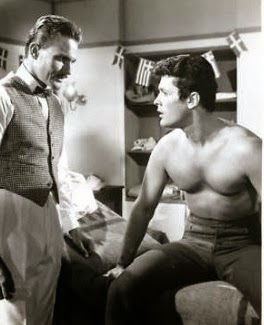
Greek hunk Nico Minardos would play Vinardos (get it?), and Eleni would be played by Jayne Mansfield, a big box office draw due primarily to her cleavage.  For the star, Spiridon, they cast Trax Colton, a new contract player discovered by Henry Willson.

Henry Willson discovered and nurtured dozens of beefcake stars during the 1950s, everyone from Rock Hudson to John Saxon.  But he fell on hard times after being outed -- he was gay, so his discoveries must be gay, too, anathema in 1950s Hollywood!  Old clients abandoned him, and he had a hard time getting new clients -- even those who were gay or bisexual didn't want the negative association.  He had to make do with the most eager or the most clueless -- like 30-year old used car salesman Louis Morelli.

Trax had no previous film credits, but studio execs felt that his good looks were enough to make the movie a success and catapult him to stardom as the next Rock Hudson.

Then someone made the Henry Willson connection.  The last thing they needed was another decade of paying off tabloids and arranging fake dates to keep a gay star in the closet.

Besides, he couldn't act.  And the film: overblown, convoluted, with a significant gay subtext between the two competitors.

 It sat on the shelf for two years and was finally released in 1962.  Trax Colton played a small part in the sex comedy The Marriage Go Round (1961) before being released from his contract and disappearing from Hollywood.

Ironically, he was probably heterosexual in real life -- he and Jayne Mansfield had an affair during the filming.  And probably too out-of-the-loop to be aware that signing on with Henry Willson would label him gay.

By the way, he has the smallest personal website I've ever seen, consisting of 6 photos and a 1-paragraph bio.


Related Posts Plugin for WordPress, Blogger...