Jun 18, 2021

A Gay Couple Arrives on "Sesame Street" (No, Not Bert and Ernie)


 "Sesame Street’ Drops Special ‘Family Day’ Episode Featuring Two Gay Dads." Wait -- why did they drop it?  Kowtowing to the pressure from homophobic groups who scream "The homosexual agenda!  You can't show two gay men on tv with kids watching!" 

Wait -- "drops" is apparently the new word for "broadcasts."  The show already aired on June 17th.  It's available on youtube.


Elmo introduces Family Day on the Street with a banner and a gaggle of human and muppet characters that I don't recognize.  The adult Alan(Alan Muraoka) says that his cousin is coming by  bus all the way from California.  Another adult, Nina (Suki Lopez), that her brother and his family are driving in.  Big Bird is sad because his grandma won't be there -- she's old and doesn't fly, even by airplane.

Whoops -- the moment he leaves, Grandma comes in -- Big Bird in drag, with a Southern accent!  She wants her visit to be a surprise.

Next, Nina's brother Dave arrives with his family -- his husband Frank and their daughter Mia. They haven't shown up before, so introductions all around.  Then the party is about to start, so they go help set up.  On the way, they are introduced to a Muppet named Maggie, who says she has heard a lot about them.

The plot shifts to trying to keep Big Bird from knowing that his Grandma is there before the party begins.

Inside, Dave and Frank unpack the vegetable lasagna they brought, while everyone exclaims about how DELICIOUS!!!! it smells (I guess over-enthusiasm is characteristic of Sesame Street).  Mia explains that they make it together, as a family. 


Grandma brought birdseed cupcakes. Then Big Bird arrives, and they have to hide her.  Strange -- Big Bird was not there when Dave and Frank arrived, but he doesn't ask for an introduction.  Plot hole!

Switch to the Arbor, where Dave, Frank, Mia, and Big Bird are arranging flowers for the party.  Big Bird is still depressed over his Grandma not being there.  

Switch to a lot of new characters: Nuclear families: humans Mary and Victor, muppets Emmett and Mae.  A mixed fairy-monster family.  Alan's cousin Andy. A child muppet exclaims "Wow, the families look so different."  Frank says: "There are all kinds of families."  Finally Grandma appears.  I'm not sure that the surprise was worth all the stress it caused Big Bird, but you have to have some sort of conflict, or it be lousy story.

We close to photos of various human and muppet families. Looks like some single parents, a lesbian couple, some interracial couples, and Alan and his cousin.

8:43 minutes.  I don't know if this was a stand-alone special or a segment from the show, but I missed Oscar the Grouch, Cookie Monster, Ernie and Bert (they'd make a good family photo), and the theme song: "Sunny day, sweeping the clouds away.  On my way to where the air is sweet..."  And the various uses of the Letter L.  


But there was definitely a gay couple on Sesame Street.  And on Duck Tales.  And Arthur.  Can the Marvel Universe be far behind?  I'm looking at you, Bucky Barnes.

See also: What's Gay About Sesame Street?


More "Vanya and Sonia and Masha and Spike" Beefcake

Vanya and Sonia and Masha and Spike is a 2012 play about two middle-aged siblings living in one of those Chekhov plays about nouveau-poor aristocrats struggling to survive financially on a doddering estate (it doesn't matter which one -- they're basically all like that).  Their movie-star younger sister arrives with her boytoy Spike, who strips to his unmentionables and draws everyone's erotic interest.

It won't be playing on the high school circuit anytime soon, but it's popular in colleges and community theaters.  The trick is finding a Spike who is hot enough to realistically draw the attention of all three siblings.

1. Jefferson Farber at the Arena Stage in Washington DC has the basket and biceps, but the tattoos are a definite drawback, and what's with the smirk?


2.  The Gulfshore Playhouse in Naples, Florida tells us who all of the other actors are, but refuses to reveal the actor who plays Spike.  Pity -- handsome face, sculpted physique, hangs to the left.


3.  Joburg Theatre in South Africa.  Nice pecs and abs, nice hair, no basket.


4. Citadel Theater in Illinois.  Is this the boytoy or the brother?


5. The Arts Commons in Calgary.  Nice muscular frame, impressive basket, but he's got to do something about that hair.


6.  Jefferson McDonald as a shaggy-handsome prince Spike in Cincinnati.


7. Berkeley Rep.  He sort of looks like Dick Sargent from Bewitched, who used to go cruising with my friend Randall the Muscle Bear.


8. Palisades Theater. Kyle Jordan is practically perfect.


9. Harlequin Theatre, Olympia, Washington.  Too skinny.


10. Stephan Mark Lucas in Smithtown, New York. 


See also: Vanya and Sonia and Masha and Spike

Jun 17, 2021

"Black Summer," Season 2: Bury Your Hunks


I watched the first season of Black Summer when it appeared on Netflix two years ago: the first days of a zombie Apocalypse (very fast-moving zombies, not the Walking Dead kind).  Everyone is rushing through the ruins of Calgary, trying to "find my husband!" or "find my wife!"  No gay characters, no gay subtexts, only the tiniest bits of buddy-bonding that come crashing down when one or both of the guys gets monsterized.

Did I expect anything better from the second season?  I went through each episode until it was impossible to stomach, and then depended on plot synopses.

1. The Cold.  A man drives a car through a zombie-infested park.  He drives past a couple of men asking for help, but stops for a lady.  Sure, he stops for the girl.  But it's a trick: she has a partner (Kelsey Flower)
who kills him so they can steal the car.  

The rest of the episode is mostly about people asking other people for help, and being killed.

2. Prelude.  Officer Ray Nazeri (Bobby Naderi) quickly packs his stuff, while saying "Don't worry, babies.  It will just be a few more minutes." But his kids have already turned into zombies.  He leaves.

The kids look to be in their early teens.  I have never heard any father refer to any children over the age of 5 as "babies."

Meanwhile, two guys are  scavenging in a store.  Anna comes to the door: "Please let me in!"  They do.  So, in the Apocalypse, men are zombie chow, but women can get whatever they want?  But it's a trick -- Anna lets her group in (Rose, Spear, and Sun) to take all their supplies.

Later, Spear (Justin Chu Cary, top photo) is shot, so the rest of the group throw him down an embankment to die.  Sun, who speaks no English, is separated from the group.  Rose and Anna, a mother and daughter, approach a mansion.


3. The Card Game. 
 Freddie (G. Michael Gray), Sonny (Dakota Daulby, left), and their mother are holed up in the mansion.  Anna comes to the door and yells "Please let me in!  I'm a girl!"  They argue, but decide that since she's a girl and therefore precious in the Apocalypse, ok. They play cards, go on a supply run, and eventually Anna and Rose kill Sonny and the mother.  Freddie survives. .

4. Cold War.  Officer Ray's faction ties up Sun and tells her to approach the mansion, yelling "Please let me in.  I'm a girl!"  Another faction shows up, and everybody fights.  Everybody dies except for Officer Ray, Sun, Anna, Rose, and a guy who says he'll help them find an airplane and fly to safety.

5. White Horse.  The injured Spears, in the woods, meets...another guy!  Wait -- I thought men only met women in this world.   "The name is Braithewaite (Bechir Sylvain).  I know you." "Are we dead?"  "I don't think so.  Anyway, I got a place in the woods we can go to."

After initial misgivings, Spears decides to trust him.  On the way, they see a mysterious person on a pale horse.  Must be one of the Four Horsemen of the Apocalypse: the Pale Horse represents death.  

They build a fire,  talk, fight, fight zombies, take refuge in a crazy guy's house, kill the crazy guy for his supplies.  Eventually Spears remembers that, back in the hood, he killed Braithewaite.  Or thought he did -- two bullets weren't enough.  Braithewaite sees the pale horse again, just as Spears prepares to finish the job. Boo!  The only two guys together in the whole series, and they're enemies!

6. Currency.  Mance's group -- two guys, two girls, of course -- rush through the snowy woods to a cache of supplies parachuted down from an airplane.  Sam, who has a previous claim, suggest that they work together to drag it out of the valley, then split it equally.  Ray's group shows up, and everybody fights over the cache and dies.

IMDB lists only the main cast, and the episode credits just lists "guest cast" without telling which actor played which character, so I can't track down any more beefcake photos.


7. The Lodge
.  Rose, Anna, and Boone,  the man who offered to  guide them to the airplane find a mountain resort that has electricity, heat, food -- hot water for showers!  No zombies, and it hasn't been trashed.  Too good to be true. Spears joins them.  They have dinner, glaring at each other suspiciously.  

While Rose is in the kitchen, making a cake for dessert, she hears gunshots.  Anna has killed Spears.  She explains that he was infected, and about to turn.  Boo!  Bury your hunks!

8. The Plane.  Rose and Anna, Ray's group,  and Mance's group all converge on an airplane hanger.  A plane lands to rescue them.  Of course, it doesn't work out that way.  Everybody attacks each other, dies, gets zombified, and attacks each other some more, until no one makes it onto the plane except for Sun, who speaks only Korean.  Hey, the pilot speaks Korean!  Uh-oh, this is too good to be true.  She's dead, right?

Beefcake: No.

Gay Characters: No.

Gay Subtexts: No.  I thought Braithewaite and Spears would have one, but no.

Everybody dies: Yes.

My Grade: F

Jun 13, 2021

"Call Me By Your Name": Or Better Yet, Don't Call Me At All

 I didn't want to see Call Me By Your Name (2017).  Movies about teenagers struggling with same-sex desire in a world where gay culture doesn't exist are so 1990s -- Edge of 17, Beautiful Thing, Ernesto.  Plus the whole "call me by your name" thing makes me sick to my stomach, evoking the old homophobic myth that gay people are all narcissists, falling in love with themselves.

But Bob ordered it for movie night, as a break from the endless rounds of superheroes.  

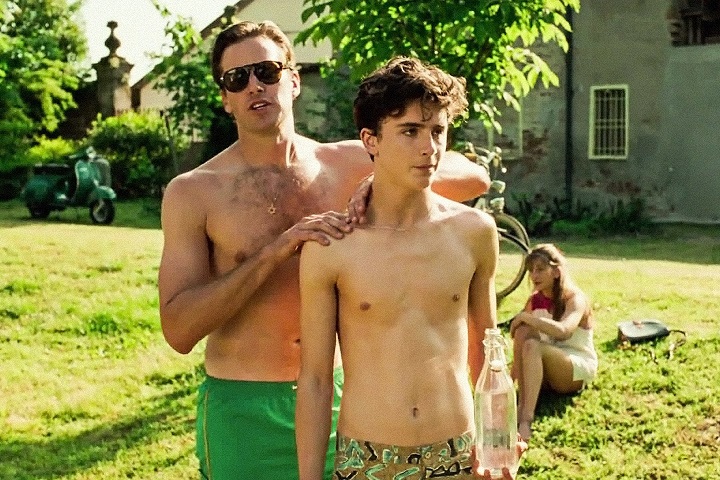
It's 1983.  A wealthy (as in two servants), multinational, multilingual family is spending the summer in their huge house in Tuscany, where Dad dredges up archaeological artifacts and writes books that for some reason reference Heidegger (what does the meaning of ontology have to do with underwater archaeology?).  Mom has some sort of job translating Medieval French romances from German into English.  16 year old Elio (Timothee Chalamant) spends his time his time writing and transcribing music, usually while swimming so the paper gets all wet, and playing Bach through the lens of Chopin or something.  


Elio does not own a shirt, and the camera positively drools over his body.  Granted, some teenage physiques are attractive, but the actor kept playing Elio as so aggressively childlike that I couldn't think of him as anything but a little kid.  

There is no gay culture in this world, but Mom and Dad are ultra-laid back about gay people.  When a gay couple comes over for dinner, Elio snidely refers to them as Sonny and Cher, and Dad berates him for homophobia: one of them knows more about economics than anyone else in the world.  Who cares if he's gay?  He's important!

When 24-year old Oliver (Armie Hammer) arrives, Mom, Dad, and an unspecified friend fawn over him so exuberantly that I thought he was a famous movie star.  Turns out they're just absurdly over-enthusiastic about Dad's new research assistant, staying with them for six weeks to help catalogue some of his archaeological finds or edit the Heidegger out of his latest manuscript or dispute the Greek-Latin-Arabic etymology of the word apricot.  But Oliver doesn't do much work; he spends most of his time swimming, playing volleyball, going to village dances, and riding his bicycle endlessly through the countryside.

Elio instantly falls head-over-heels for the "arrogant" American.  It's unclear whether he has experienced same-sex attraction before, but he tries to counter by having sex with two girls (or with the same girl twice, I'm not sure).  


Oliver, busily courting a girl of his own (or it might be the same girl), pretends not to notice Elio's flirtation.  Then he says "We can't talk about this.  We just can't."  Finally he permits a kiss, but refuses to go farther: "We've been good so far.  We haven't done anything wrong.  But this has to stop here."

I was confused, and I'm still confused.  Why can't they date?  Is it the gay thing or the age thing?  Same-sex acts have been legal in Italy since 1890, and the age of consent is 14.  

Finally Oliver permits a sneaky clandestine relationship, which includes sex (while the camera shifts to a potted plant) and that "call me by your name" thing, which made me sick to my stomach to watch.

Oliver gets a little aggressive, forcing Elio to eat an apricot that he's just...um, never mind...and saying "Come here. Drop your pants," which gave me a bad feeling.  There's already a power differential, and now he's borderline abusive, after just one date?

Mom and Dad deduce that the two are dating, and are absurdly supportive.  Dad welcomes Oliver to the family.  Mom arranges for the two to go on a romantic vacation together.  But Oliver obviously wasn't planning on settling down with a 16-year old life partner; when his research assistant job ends, he says "it's been real" and high-tails it back to America.  


Six months later, he calls to tell Elio that he is getting married to a woman.  Dad tries to cheer Elio up with a long, rambling, convoluted heart-to-heart, but it doesn't work.  He sits by the fire and cries.  The end.

The movie is beautifully shot, with lots of scenes of the Italian countryside (no cities), but very, very long.  The two hours and 15 minutes drag and drag, as nothing happens, then nothing happens, then nothing happens. And I still don't understand why Oliver was so resistant: the gay thing, the age thing, or "I'm not into relationships.  With guys, anyway."   

Final thought: it's 1983  Why have I never heard of any of the songs they listen to?  

My grade: C+.

Related Posts Plugin for WordPress, Blogger...