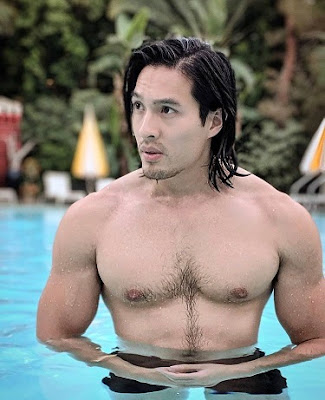
Beefcake, gay subtexts, and queer representation in tv and other pop culture from the 1950s to the present
Dec 30, 2021
Seven Brothers: Homoerotic Rowdiness in a Finnish Sauna
But the Second Greatest Work is about seven guys alone in the woods. What's not to like?
Seven Brothers (Seitsemän veljestä, 1870), by Aleksis Kivi, is about guys who are perfectly happy living alone on their farm near Toukola. They are rowdy, crude, and given to practical jokes. They like to hunt and fish and get drunk and hang around nude in the sauna. But then they discover that they must be civilized: they must learn to read, which will result in being confirmed into the Lutheran Church, which will result in wives!
I heard that often enough while growing up: "Your childhood will end, and your real life will begin, when you find a wife."
Faced with a vision of their fun ending, definitively, at the wedding altar, they rebel. They light out for the territory and build themselves a house in the wilderness of Impivaara, where they can continue to be rowdy and crude and play practical jokes, and hang out nude in the sauna.
There are perils: they fight a giant bear and wild boars. There are hardships: farming is tough; their house burns down, and they must rebuild. But in the end, they prosper.
Actually, after ten years in the woods, they return to Toukala, join the church, and get married (except for Simeoni, who stays single). You can't hold out forever.
But no one remembers the civilizing. The images that stick with you are the seven guys in the woods, being crude and rowdy, needing no one else.
There have been many film versions, two operas (by Tauno Martinnen and Launas Armis), and a ballet (by Marjo Kuusela). Some versions, such as the 1989 tv miniseries by Joukku Turka, make Simeoni gay, but really a gay identity isn't necessary. The whole work revels in the homoeroticism behind male bonding.
Dec 28, 2021
The Top 10 Dead Hunks of "The Witcher"
Bob liked the first episode of The Witcher, so we've...ugh...continued to watch. It gets better -- the color palette expands, so we see mountains and forests; there's some comedic relief; there's less bragging about strangling people and puppies. I still don't like it: jumping back and forth in time between the interlocking stories of three sets of characters, so you're constantly confused ("does this take place years before or just after the previous scene"); naked girls everywhere; not a single gay hint -- even a giant orgy consists entirely of male-female couples; and the annoying habit of introducing cute guys, only to have them garrotted in the next scene.
Here are the top 10 dead hunks (I could only list the ones named in the episode or on the Witcher wiki; many other nameless hunks bit the dust):
The first plot arc features the Witcher traveling from kingdom to kingdom, where he kills monsters that are "impossible to kill" and has sex wtih ladies. He eventually encounters the people in the second and third plotlines, at various time periods in their history. Meanwhile, his comic relief sidekick, the Bard, tries to pick up every lady he sees, and has to constantly flee from the irate husbands and boyfriends of the men he's cuckolded.
Their corpses include:
1. Mikal (Bogdan Iancu, top photo), from the kingdom of Timeria, is killed by a werewolf-type monster.
2. The Witcher Remus (Gudmundur Thorvaldsson, the one with his tongue out) offers to do the killing, but fails.
3. Lord Urcheon (Bart Edwards)a knight cursed with a hedgehog face, dies off-camera immediately after being introduced.
In the second plot, a girl named Yennifer trains to become a mage (a magician who advises kings). Although she is the most powerful mage in the history of the universe, she is underemployed as a babysitter to kings' neglected wives and boorish sons. Eventually, after 30 years of this (shown in various scenes that aren't in chronological sequence), she goes rogue, conjures up a lot of orgies, has sex with lots of men, and tries to find her destiny. And maybe hook up with her first boyfriend, or was that a scene from earlier in her history? Who knows?
Her corpses include:
4. Prince Eyk (Jordan Renzo) whom she is babysitting and flirting with, gets his throat cut on a dragon-hunting expedition.
5. Atlan Kirk, a fellow mage, is killed during one of the climactic battles.
The third plot features Ciri, the Chosen One, destined to become the most powerful being in the universe, but so far just a princess who goes into hiding when her kingdom is conquered and the entire royal family commits suicide. Some scenes take place before the kingdom-genocide, some immediately after, and some long after. She gets a boyfriend at one point, but he dumps her because of all the "death and destruction" that follows her around.
Her corpses include:
6. Sir Lazlo (Maciej Musial), her bodyguard, dies during the first-episode genocide (see previous article).
7. King Eist (Bjorn Haraldsson), her father, likewise.
8. Adon (Kriztian Czakvari) invites Ciri to stay with his family in a refugee camp, and is promptly skewered to death.
9. Anton (Rob Malone), a friend of her childhood, now blaming her for causing the kingdom to fall, gets blasted by a magical scream.
10. Nadbor (Jack Wolfe) the son of a farm family that has taken Ciri in, gets blasted by a fireball five minutes after meeting her.
See also: The Witcher: Everyone Dies.
Dec 23, 2021
"With Love": Hispanic Comedy Romcom with Gay, Bisexual and Nonbinary Characters
With Love on Amazon Prime. Dumb title for a Christmas romcom, but I thought I saw two guys hugging on the icon, so we'll give it a try.
Scene 1: Establishing shot of Portland, Oregon. Nochebuena (Christmas Eve) Mass en Español. Lily covers for her brother Jorge, who missed the service, so Abuela doesn't freak out. Jorge is played by a grown-up Mark Indelicato (below), the gay kid on Ugly Betty.
Scene 2: Preparing the Nochebuena dinner. Wait -- don't Catholics have Mass at midnight on Christmas Eve? It's got to be 2:00 am! Abuela tells her daughters that Grandpa tried to have sex with her in the shower earlier. Horny Aunt Gladys tells her sister, Lily's Mom, that it's obvious she's not getting any, and would she like a vibrator? This is not your grandmother's romcom.
Scene 3: At the liquor store. Santiago (Rome Flynn, top photo) is shopping for a "2010 or 2012 Left Bank Bourdeaux." Clerk Henry helps him, and tries to flirt. Santiago puts his hand on his shoulder, but otherwise rejects him: "We don't have to talk." Henry is played by Vincent Rodriguez III, who had a heterosexual character on My Crazy Ex-Girlfriend but is gay in real life.
Scene 4: Lily going on a wine run. She's upset because she just broke up with her boyfriend, but excited because Jorgito is finally going to introduce them to his boyfriend! Ten to one it's Henry from the Liquor Store.
She tries to meet-cute Santiago coming out of the store, but he rejects her and moves on. Psych! Next she flirts her butt off with Henry. They were both recently dumped. She asks him to be her date for Nochebuena Dinner, but he refuses (duh, he's working). Well, what about next week? She hands him her phone number. Um....
Scene 5: Jorge's apartment. Hot Roommate (Desmond Chiam) walking around shirtless (sigh...). He offers to become Lily's new boyfriend, but she refuses. Apparently they've been friends for 10 years, and she always refuses. I'd give him a tumble
Jorge is freaking out about bringing his boyfriend to Nochebuena Dinner, where 3,000 relatives will judge him. Lily consoles him: "Don't worry -- everyone will love Henry." Henry!!!! The plot thickens. Then why did he say he was recently dumped? And why did he accept Lily's phone number?
Knock on the door. It's Henry! He pretends not to know Lily. Why not say "We met earlier at the liquor store?" What is he trying to hide?
Scene 6: Walking to the dinner, they go over their strategies for pretending that they were at Mass earlier, and just missed Abuela. Henry feels bad about lying to their grandmother. Jorge explains: they're fine with him being gay, but not going to church is a mortal sin. Mom, who knows their dirty secret, even greets them as "My favorite sinners!"
They greet Mom, Dad (Benito Martinez), and Sol, who presents as female and uses they/them pronouns. Sol chastises Jorge for not going to church:
Jorge: God doesn't like people like us.
Sol: Some people don't like people like us. God is all about love.
The big scandal is apparently Lily being boyfriend-less, alone and lonely at her age! Innumerable tias complain, offer advice, and try to fix her up with various nerds and grandpas ("he's 62! You'll be an abuela!").
Scene 7: Lily sitting on the toilet. When Sol comes in to change clothes, she reveals the biggest scandal: the boyfriend didn't dump her, she dumped him! But why? He's a lawyer who owns his own house -- the perfect man! Sol suggests that she win him back with a big romantic gesture.
Scene 8: Sol had to skip dinner to go to work at the hospital. They brought some empanadas. Hot Doctor (Todd Grinnell) flirts with them.
They stop into a hospital room, and -- wait for it -- Santiago from the liquor store is there! He gives them the bottle of wine he bought, as a thanks for taking care of his dying mother (they're pulling the plug tonight, on Nochebuena because it was her favorite holiday).
Scene 9: Back at the house, Henry reveals that he's actually bisexual, and had a girlfriend before meeting Jorge. Everyone is shocked, and peppers him with questions. So gay and nonbinary relatives, no big deal, but bisexuals are weird and exotic?
Scene 10: Back at the hospital. Hot Doctor points out that they've been flirting for months; why not go on a date? But Sol will only date Catholics. I don't believe that for a second. Are they afraid of physical intimacy? But Hot Doctor already knows that they are nonbinary -- he must be ok what not knowing what kind of genitals they have.
Scene 11: Lily's grand romantic gesture to win back her ex-boyfriend (Peter Porte). It's just standing outside his house in a Santa hat and singing. But he refuses to take her back: "We liked each other, but we were never in love. But your True Love is waiting out there." Why isn't she wearing a coat? In December in Portland the temperature is in the 20s and 30s.
Scene 12: Santiago standing outside in the dark, being sad over his mother's death. Sol, not wearing coat, consoles him. He suggests that they date the Hot Doctor. Why not? He's cute and nice, and "you deserve a little love and happiness." Hey, Santiago, not everyone wants a romantic partner.
Scene 13: Dad saw Jorge and Henry kiss. Now he's fuming in the back yard. Apparently he's not as gay-friendly as he thought. Jorge comes out to ask why he's been so distant all evening. Psych! He's got no problem with the kissing. He feels bad because he wasn't able to teach his son about the "gay love stuff." He wanted to give Jorge a "facts of life" talk about blow jobs?
Scene 14: Lily wants to tell Jorge "something important," but she loses her nerve. Not about flirting with Henry at the liquor store. People flirt -- get over it.
Scene 15: Back at the hospital, it's time for Sol to flip the switch and let Mom die. Santiago and his Dad cry.
Scene 16: Lily's Mom is wondering if her husband won't have sex with her because she's getting old (remember that subplot?). But it's time for the talent show. Hot Roommate and Horny Aunt Gladys sing "I Need a Hero." Henry and Abuela: "I Will Survive." Jorge and Lily: "A Whole New World."
Scene 17: At the hospital, Sol decides to take a risk and give Hot Doctor their phone number.
Scene 18: The party is finally over, gracias a Dios! Lily, Jorge (left), Henry, and Hot Roommate walk home. They decide to dance in the street while singing "Feliz Navidad." Santiago and his Dad happens to be driving by. Santiago: "It's hard to hear that song now." Dad: "Your mother would be heartbroken if she knew this was making you sad." Sad about her death? Really? I want people wailing and crying.
Scene 19: Mom and Dad get ready for bed. He still refuses sex. Well, it's 4:00 am and he's been hosting a party for 16 hours. He might be a little tired.
Scene 20: At the apartment, Lily is preparing to sleep on the couch. She doesn't live there? Why doesn't she just go home? She asks Henry why he didn't reveal their meeting at the liquor store. He says he felt guilty. He flirts with customers all the time, to get better tips (wait -- you don't tip sales clerks). But with Lily it was...sad. I don't buy that. He was considering cheating on Jorge.
Hot Roommate comes out in his pajama bottoms. Lily reveals that she didn't say anything at the party because it was Jorge's night, but she's sad. Because she's never been in love. They start kissing, and head to the bedroom.
Beefcake: Hot Roommate.
LGBTQ Characters: Jorge and Henry and Sol.
Endless Parties: Future episodes take place on the major holidays of the year: New Year's Eve, Valentine's Day, the Fourth of July, and the Dia de los Muertos. I imagine that each will involve an endless party.
Who Ends Up with Whom: No way to tell. The main cast appears in every episode. If Henry dumps Jorge for Lily, I'm leaving.
Will I Keep Watching: Why not?
Dec 21, 2021
"That Wilkin Boy" and Other Beefcake Wonders of the Archie Universe
But occasionally you hit a comic in the same recognizable style, same recognizable pals and gals, but with different names and maybe a change of costume. Riverdale and the regular gang is far in the background, or altogether absent. Apparently John Goldwater thought that a new crop of teen characters would expand the market.
Expand the market, when The Big Five (Archie, Jughead, Betty, Veronica, Reggie) and a dozen or so supporting players had personalities malleable enough to fit thousands of plotlines, in every genre imaginable, from teen angst to wacky adventure to mystery to superhero spoof?
Apparently.
Reading them was an eerie experience, like a dream where the people you know are a little off. But they had some beefcake joys of their own.
Wilbur (1944-1965) is the oldest, appearing only a few years after Archie himself, and the closest to the Riverdale gang.
Wilbur is blond, not a redhead, but he has all of the other Archie characteristics, including a sardonic best friend, a nemesis, and two girlfriends, the girl-next-door and the it-girl. Except in this case "Betty" is a brunette and "Veronica" is blonde.
Not much of beefcake interest. Wilbur was portrayed as rather scrawny, like the 1940s Archie.
And no crossovers into the Archie universe. No wonder -- the characters would be looking at their doppelgangers.
Bingo, That Wilkin Boy (1969-1982), was a modernized version of Wilbur (both of them have the last name Wilkin, no "s"): a 1960s guitar-strumming, bell bottom wearing hippie with a talking dog named Rebel and a with-it sidekick (more Reggie than Jughead).
Also notable, his girlfriend's father is not an industrialist, like Mr. Lodge, but a bodybuilder. It was always nice to see a chest and abs on someone over 16.
Sabrina the Teenage Witch (1971-1983) was the most popular of the non-Archie characters, allowing the introduction of magic into the plotlines. There weren't a lot of continuing teen characters, just Sabrina and her hapless boyfriend Harvey.
Harvey was always scrawny, never particularly muscular. You could see more beefcake with the Archie comics in the summertime beach issues.
At first they were portrayed as living in Riverdale, just with a different group of friends, so the Archie gang was in the background (here she talks boys with Archie supporting character Ethel). Later the setting shifted to Greendale, and the Archies vanished.
Sabrina has spun off into several tv series, most recently The Chilling Adventures of Sabrina, with the hunky Ross Lynch (top photo) miscast as Harvey.
Josie (1963-1982) started out as a distaff Archie, a red-headed Everygirl bookended by the "that's not a good idea" Pepper and the walking id Melody (who sang all of her lines, musical notes filling the speech balloons). They all had boyfriends, and butted heads with an obnoxious rich twin-set, Alex and Alexandra Cabot, drawn identically to Veronica and Reggie.In 1969 the book was completely revamped into Josie and the Pussycats, a musical group consisting of Josie, Melody, and the with-it African-American Valerie. The boyfriends vanished, although Josie started dating the muscular Alan M (the reason for the refusal to use his last name is never explained). Alexander Cabot became their manager, and Alexandra remained their chief foil, out to destroy them because they refused to let her join the group (because she insisted on renaming it Alexandra's Cool-Time Cats). Oh, and she got witchcraft powers somehow.
The group traveled all over the world to perform, but their home base was Midvale (no competition with Archie's rock group). But later they moved to Riverdale, so Archie and the gang could occasionally appear.
Alan M. became more muscular as the series progressed, until in the spin-off tv series he was completely ripped (plus he sported an ascot like Fred on Scooby Doo).
In the 2001 Josie and the Pussycats movie, Gabriel Mann (right) played Alan, and his last name is revealed: Mayberry.
I can see why he went by Alan M.
Dec 20, 2021
The Magic Sword
It was something about a young knight in a Prince Valiant haircut, who sneaks out on his witch-mother, goes on a quest to rescue a princess, gains companions who die in various gruesome ways, and then is captured by a wizard in an genie outfit. Everyone looks frightfully embarrassed.
The witch had a rather cute servant, whose two heads spoke in unison.
The wizard was accompanied by a woman with an ugly face, who collected "little people for the stew."
There was also an egg-headed servant with a doleful expression.
It was dreamlike and surreal, like watching a story that everyone in the world knows intimately, but you've never heard of.
But I endured the craziness for a scene near the end, when the boy is strung up in the dungeon, his shirt torn off. A stunning smooth glowing chest, tightly muscled arms and shoulders.
Twenty years later, when Mystery Science Theater 3000 riffed it, I finally discovered that the movie was The Magic Sword (1962), a loose adaptation of the legend of Sir George and the Dragon. The witch was played by famous British actress Estelle Winwood, and the wizard by Basil Rathbone, who was well known for starring in a series of Sherlock Holmes movies in the 1930s and 1940s.
The boy strung up in the dungeon was 25-year old Gary Lockwood, who would enjoy a long acting career. He is probably most famous for developing psychic powers on a 1965 episode of Star Trek and getting chucked out of the spaceship in 2001: A Space Odyssey (1968). And, of course, for providing a glimpse of beauty on dull Saturday afternoons when there was no sports match on.
General Whitman and his Cold War Boyfriend
So I could only get away with reading only if I could convince them that it was required for school. That made General Whitman's Adventures ideal.
General Whitman's Adventures in Exciting Africa
General Whitman, a "global troubleshooter for the armed forces," was a thin, middle aged white guy carrying a globe.
In each story, he traveled across the designated continent with his assistant, Lieutenant Scott, on on a top secret assignment. In South America, for instance, he was assigned to inspect rivers that might provide "juice for mission control centers, "and to select likely sites for camouflaged missile silos."
This was during the Cold War, after all.
Meanwhile he pontificated about the continent's history and geography -- with what today seems a very paternistic, Orientalist superiority complex: "Before this continent was discovered, the poor savages were uncivilized."
And Lieutenant Scott expressed constant disgust or amazement over local customs. In Tibet, he exclaimed: "That lady's making a sandwich out of her face!"
"Butter is often used as a beauty aid here," the General explains. "The Tibetans are too primitive to have our modern scientific cosmetics."
And I could claim "research for my geography class."
Dec 10, 2021
Charles Vandervaart: Everyone's Favorite Younger Brother Beefs Up
Charles Vandervaart may not be handsome, but he's got a jaw-dropping physique. His IMDB biography tells us that he acquired his muscles: "playing hockey, rock climbing, basketball, soccer, football, swimming, kayaking, sailing, cross country running, triathlons and combat training." How do you play combat training? Born in 2000, he's been on screen since 2010, but I'm only going to check out his performances since 2017 for gay roles or subtexts.
Lost in Space (2021): a remake of the classic sci-fi series about a family of colonists getting lost en route to their new life in Alpha Centauri. Charles plays Liam Tufeld, one of the competitors for daughter Penny's attention.
Holly Hobbie (2018-2021): Wasn't there a Holly Hobbie doll in the 1970s? This is a live-action teencom on Hulu starring a girl with Big Dreams in a small Canadian town. Charles plays her brother, Robbie Hollie. I watched his only centric episode: "Heather suspects that Robbie is hiding a secret." No, not being gay. He's secretly making artisanal jams, like blueberry-bacon.
The Murdoch Mysteries (2013-2021): Charles plays John Brackenreid in 22 episodes. In "The Republic of Murdoch," his father believes that his interest in the arts signifies that he's gay, and forces him to fight to prove that he's actually straight. Dismal.
The Craft: Legacy (2020): Some high school girls are witches. Charles plays the brother of the main witch. He's got a closeted older brother and a bisexual buddy (Nicholas Galitzine, left), who is murdered (not for being bi).
Every Day (2018): A teenage girl falls in love with a disembodied spirit named A, who inhabits a new body every day. Boy and girl bodies, cisgender and transgender, but she ends up with Owen Teague. Personally, I'd rather date Colin Ford (left). Charles isn't one of the bodies.
The Stanley Dynamic (2014-2017). A Canadian teencom with an odd gimmick: Twin brothers, one live-action (Charles), the other a toon (Taylor Abrahamse). Apparently both are retro girl-crazy.
Dec 8, 2021
T.S. Eliot. Oh, Swallow, Swallow!
1. Ulysses, by James Joyce
2. The Waste Land, by T.S. Elliot
3. The Tin Drum, by Gunter Grass
4. The Sound and the Fury, by William Faulkner
5. A Confederacy of Dunces, by John Kennedy Toole
And maybe a little Shakespeare. Everything else was footnotes or hack work.
I hated all of the pretentious rot, but I loved to hate The Waste Land the most. The only way my friend Viju and I could get through it at all was to imagine a gay theme.
It begins with a quote in Latin in which the Cumaean Sybill speaks Greek. I knew smalle Latin and lesse Greek (see, I can be pretentious, too), but we assumed that anyone speaking Greek is talking about gay people.
Tom (T.S.'s real name) is watching the sunlight over the Starnbergersee (in Munich), saying "We're not Russian" (in German), and calling someone the Hyacinth Girl. Hyacinth was the gay lover of the Greek god Apollo, so we assumed the Hyacinth Girl is a boy.
Then, wandering around London, Tom sees a guy he knows and asks if the dead bodies he's buried have risen yet. Tom calls him "mon semblable,—mon frère!" My double -- my brother! Charles Baudelaire, who was probably bisexual, wrote it in the gay-themed Fleurs du Mal.
After a chess game and an elitist dig at pop culture, Tom meets with Lil. Her husband Albert keeps wanting sex, but she won't put out because she keeps getting pregnant. Meanwhile someone keeps saying "Hurry up, it's time" (presumably time to die). Aha! A critique of the futility of heterosexual marriage!
Tom wanders around London, saying bad words in Elizabethan English. Mr. Eugenides, who has a pocket full of currants (or maybe he's just happy to see Tom) invites him to a weekend at the Metropole. Presumably that's a gay hotel, so he wants a homoerotic liaison.
![]() |
| Illustration to Eliot's "Animula" (1927) |
Then he takes a barge down the Thames and says "Highbury bore me." It bores me, too.
A dead guy, Phlebas the Phoenician, floats by. Tom thinks "he was once handsome and tall." We were all for depictions of masculine beauty, even in a poem about how we're all going to die.
Then Tom goes to a dry desert where everybody is dead, and wonders if the person walking next to him is a man or a woman. Androgynous, huh? Or maybe a drag queen?
![]() |
| The young Tom Eliot |
So sex is the meaning of life?
Or is it surrendering to passion: "your heart would have responded gaily, when invited, beating obedient to controlling hands."
Then everything goes crazy. People say things in Italian, Latin, French, and Sanskrit. Come on, Tom, you were born in St. Louis, and everybody knows it.
Somebody quotes an obscure Elizabethan playwright and a 19th century French Romantic poet. Tom responds "oh, swallow, swallow."
At this point, Viju and I couldn't stop giggling.
This interpretation might not be orthodox, but it did get us through a late-night study session.
We were too shy to walk up to random guys and say "Oh, swallow, swallow!"
By the way, some contemporary biographers think that Tom was gay, but deeply closeted.
Dec 6, 2021
The Guys Who Made Harvey Comics Gay-Friendly
It didn't hurt that I usually read them while spending the night with my Cousin Buster in the trailer in the dark woods.
I also read Harvey Comics set in the real world, about kids with weird obsessions: Richie Rich, Little Lotta, Little Dot. They were evocative, but didn't provide the magic of the ghosts.
It never occurred to me, by the way, that the stories were supposed to be humor. Jokes detracted from my deadly serious quest to find a "good place," where boys could live together without being forced to express an interest in girls every five seconds.
The Harvey character style was instantly recognizable. Male or female, ghost or human, they were all drawn the same:Disproportionately huge heads (especially when compared with real boys)
No necks.
Pear-shaped heads, large oval eyes with black pupils, pug noses, mouths curving downward a little lower than on a real person.
I was confused by some stories with a different character style: far less attractive: fat, dumpy, with a bigger head and bigger head and bigger eyes.
Eventually I realized that those stories were reprints from the 1950s and early 1960s. The house style changed abruptly in 1966.
There was a change in the plotlines, too. In the early stories, Casper and company visit mythological and fairy-tale creatures. The Milky Way is full of actual milk, and the sun is a sentient being.
Later stories are mostly realistic science fiction, with mad scientists and alien invaders. In 1972, Casper goes to the moon on the Apollo 16 (he was, in fact, the mission mascot).
The same thing happened to the human Harvey characters. In 1966, Richie Richie Rich became slimmer, with smaller eyes, and a smaller tie.
By the 1970s, he even had a muscular physique, and he had moved from humor stories to adventure, espionage, and science fiction.
Harvey Comics never divulged the writers or artists, so it wasn't until many years later that I discovered who was responsible for the change: Sid Jacobson who began working at Harvey in the 1950s, and became story editor in 1964. He tried to modernize the Harvey stories for the space-oriented 1960s.
Meanwhile Warren Kremer, the art editor, spearheaded a new, attractive, "hip" character style.
Ernie Colon, who joined Harvey in 1967, completed the transformation. He and Sid Jacobson collaborated on most of stories for the next 15 years, until Harvey stopped publishing comics in 1982.
When Harvey Comics folded, Colon moved to DC Comics, where he worked on such projects as Arak, Son of Thunder, Arion, Prince of Atlantis, and the graphic novel Ax.
He and Sid Jacobsen collaborated on several graphic novels, including, a history of the African-American experience, the story of Anne Frank, and The 9/11 Report: A Graphic Adaption.
Kremer moved on to Star Comics, where he created two new characters, Planet Terry and Royal Roy.
I don't know if any of them were gay, but they certainly helped some gay kids find meaning in the homophobic 1970s.
See also: Casper the Friendly Ghost; Spooky the Tuff Little Ghost; Lesbian Subtexts in the Harvey Girls; Richie Rich Joins a Gym.
Dec 5, 2021
Koloman Moser: The Male Nudity of "Wayfarers"
I was drawn to this cover to Knut Hamsun's Wayfarers (Landstrykere, 1927): a hard-muscled guy, naked, striding across the world. But the stupid story turned out to be about a guy named Edvard who wanders around, living off the land and getting crushes on unsuspecting women.
(Trond Peter Stamsø Munch, top photo, who played Edvard in the 1990 film adaption, also starred in the Disney movie Shipwrecked.)
Ok, so maybe the artist was gay?
He was Koloman Moser (1868-1918), an Austrian artist who specialized in graphic design. His work is reminiscent of tBritish Decadents like Aubrey Beardsley, with some Art Deco thrown in.
His repertoire contains a lot of female nudes, but also quite a few male nudes. That walking figure appears again and again, in various poses.
Here a golden boy with a very small penis wins a fight.
The Battle of the Titans from Greek mythology becomes a lot of naked, swaying men throwing rocks at each other.
You even see male nudity in unexpected places, as in this scene of Wotan and Brunhilde from the Ring of the Nibelungs. Notice how cleverly the god's cloak has been torn away to reveal his sex organs.
Moser didn't marry until he was 37, and his wife turned out to be the wealthy Editha Mautner-Markhof.
The verdict: Impossible to tell if he was gay in real life or not. But he did produce some nicely homoerotic paintings.