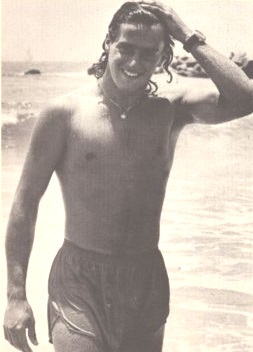
Speaking of show biz dynasties, Dick Van Patten's three sons and his younger brother all began appearing on screen at the same time in the late 1970s and early 1980s, producing a quadruple-threat of sandy-haired hunks.
Jimmy Van Patten, born in 1956, played a surfer in the beefcake-heavy Lifeguard (1976), and had guest spots on Gunsmoke, Three for the Road with his brother Vince, Happy Days, and Eight is Enough with his Dad.
Here he is displaying his assets in Roller Boogie (1979), standing next to androgynous romantic lead, Jim Bray.
Jimmy also starred in the buddy-bonding Lunch Wagon (1981) with his brother Nels, and the actioner High Powder (1982) with Dick, Tim, Nels, and Ralph Macchio. Today he is a writer, director, and producer.
Vince Van Patten, born in 1957, began acting as a kid in 1970, and starred in the warm family comedy Apple's Way (1974-75), Three for the Road (1975) with up-and-coming teen idol Leif Garrett, and Rock and Roll High School (1979).
He hung out in his underwear in the homoerotic horror movie Hell Night (1981), and posed for Playgirl before becoming a professional tennis player and a semi-pro poker player. More recently, he produced and starred in The Break (1995), about a washed-up tennis pro who coaches a rookie (Ben Jorgensen).
Eldest brother Nels (born in 1955) starred mostly in his brothers' vehicles, but he can also be seen in Summer School (1987) with Mark Harmon and Grotesque (1988) with Tab Hunter. And he appears as Farrah Fawcett's tennis instructor in the reality series Chasing Farrah (2005).
The youngest of the group, Tim Van Patten (born in 1959) is Dick's younger brother, so technically the uncle to Jimmy, Vince, and Nels. He starred as a high school basketball player named Salami in The White Shadow (1978-81) and the actioner High Powder (1982). More recently he's had roles on St. Elsewhere and True Blue, and he's directed episodes of Sex and the City, The Sopranos, and Boardwalk Empire.
See also: Timothy Van Patten, Tony Danza, and Robert Wagner on a Cold Winter Night; Duke Van Patten
Beefcake, gay subtexts, and queer representation in tv and other pop culture from the 1950s to the present
Feb 19, 2020
Feb 16, 2020
Pudge and Bum, the Beefcake Buddies of Yale University
I saw the name Pudge Heffelfinger online the other day.
Ok, "pudge" means fat, and a "heffelfinger" is a sex act, so..surely this was a made-up name, from a humorous story or satire.
But no, there really is a Heffelfinger family, with a member named Pudge.
Obviously I have to write a post about him. Someone with such a distinctive name must have some gay connection.
Pudge Heffelfinger (1867-1951) played baseball and football in high school in Minnesota, then went to Yale, where he became all-American three times in a row (I don't know what that means).
I couldn't find any shirtless pics, but he fills out this Yale sweater well. He was 6'3 and 200 lbs, a giant in his era.
After graduation, he played for the Chicago and Allegheny Leagues, where, in 1892, he was paid $500 for a game against Pittsburgh, becoming the first professional football player in history.
Later he coached the California Golden Bears, the Lehigh Brown and White, and the Minnesota Golden Gophers, plus returning to Yale as a guest player and coach. He appeared in exhibition games through his life -- the last time he played was in 1930, when he was 63).
Meanwhile, he published sales booklets for sports equipment and an annual book, Pudge Hefferfinger's Football Facts.
He produced a sports quiz radio program, plus a spy show, Secret Agent K-7.
For a career, Pudge worked in the shoe business and real estate, and spent twenty years as the Hennepin County, Minnesota Commissioner. In 1930 he ran unsuccessfully for Congress.
He died in Blessing, Texas in 1954, leaving a wife and four children.
But being married with children doesn't necessarily mean that Pudge was straight. What about this intimate pose in a cabinet photo from his Yale days?
The moustached guy with feminine hand thing and his wrist an inch or so from Pudge's crotch is Bum McClung, aka Thomas Lee McClung (1870-1914), three years younger, a "frosh" who became a football star in his own right, and, like Pudge, returned to Yale to coach throughout his life.
After graduation, Bum became the treasurer of Yale University, and in 1909 the United States Treasurer under President Taft.
When he died unexpectedly from an illness in 1914, an obituary called him "a remarkable athlete, a wonderful football player, a lovable classmate, a diligent student, a manly man–a type Yale men idealize for emulation."
You'd never make it to a high office in the U.S. today without being married, but Bum managed.
The late 19th century was the "era of the bachelor," when many men who liked women feared the loss of freedom that came with marriage, as well as the debilitating effect of the sex act itself. Being unmarried doesn't necessarily mean that Bum was gay.
Still...
Maybe he and Pudge....
Here's another picture of Bum McClung with an unidentified friend. He's doing that feminine hand thing again.
.
Ok, "pudge" means fat, and a "heffelfinger" is a sex act, so..surely this was a made-up name, from a humorous story or satire.
But no, there really is a Heffelfinger family, with a member named Pudge.
Obviously I have to write a post about him. Someone with such a distinctive name must have some gay connection.
Pudge Heffelfinger (1867-1951) played baseball and football in high school in Minnesota, then went to Yale, where he became all-American three times in a row (I don't know what that means).
I couldn't find any shirtless pics, but he fills out this Yale sweater well. He was 6'3 and 200 lbs, a giant in his era.
Later he coached the California Golden Bears, the Lehigh Brown and White, and the Minnesota Golden Gophers, plus returning to Yale as a guest player and coach. He appeared in exhibition games through his life -- the last time he played was in 1930, when he was 63).
Meanwhile, he published sales booklets for sports equipment and an annual book, Pudge Hefferfinger's Football Facts. He produced a sports quiz radio program, plus a spy show, Secret Agent K-7.
For a career, Pudge worked in the shoe business and real estate, and spent twenty years as the Hennepin County, Minnesota Commissioner. In 1930 he ran unsuccessfully for Congress.
He died in Blessing, Texas in 1954, leaving a wife and four children.
But being married with children doesn't necessarily mean that Pudge was straight. What about this intimate pose in a cabinet photo from his Yale days?
The moustached guy with feminine hand thing and his wrist an inch or so from Pudge's crotch is Bum McClung, aka Thomas Lee McClung (1870-1914), three years younger, a "frosh" who became a football star in his own right, and, like Pudge, returned to Yale to coach throughout his life.
After graduation, Bum became the treasurer of Yale University, and in 1909 the United States Treasurer under President Taft.
When he died unexpectedly from an illness in 1914, an obituary called him "a remarkable athlete, a wonderful football player, a lovable classmate, a diligent student, a manly man–a type Yale men idealize for emulation."
You'd never make it to a high office in the U.S. today without being married, but Bum managed.
The late 19th century was the "era of the bachelor," when many men who liked women feared the loss of freedom that came with marriage, as well as the debilitating effect of the sex act itself. Being unmarried doesn't necessarily mean that Bum was gay.
Still...Maybe he and Pudge....
Here's another picture of Bum McClung with an unidentified friend. He's doing that feminine hand thing again.
.
Feb 13, 2020
Connor Jessup: The Gay Actor Playing the Semi-Straight Guy on "Locke and Key"
Did anybody else get a gay vibe in Episode 7 of Locke and Key? Sam hugging Tyler, sobbing, and complaining about how much he screwed things up? (Yeah, he killed Tyler's father and threatened him and his family).
In flashbacks, Sam never displays any interest in girls. Instead, he is shown saying goodbye to his Dad as he leaves to "hang out" with Tyler, and then being upset when he learns that Tyler was just pretending to be interested.
Tyler has a girlfriend, sort of, but he could be into guys, too. There are some hints. A teacher comments on his closeness to his new friend Javi. And the scene where he interrupted during sex by a vision of Sam and couldn't perform.
So who are these gay-subtext actors?
26 year old Connor Jessup (Tyler) has been acting since age 11.
And taking off his shirt on camera for almost as long. Here he stars as a troubled teen in Blackbird (2012).
And playing gay teenagers for almost as long. Here a hypochondriac gay teenager smooches with the class stud in Fragments (2015).
His characters also get -- or lose -- boyfriends in Closet Monster (2015) and Crazy House (2015)
Connor's most popular acting role to date is Ben Mason in Falling Skies (2011-2015), a freedom-fighter in the war against alien invaders. Ben gets a girlfriend, unfortunately, but at least he takes his shirt off a lot
Connor also starred in two seassons of the anthology series American Crime
Season 2: Taylor Blaine, a gay high school boy who is sexually assaulted by his boyfriend.
Season 4: Coy Henson, a gay drug addict trying to get clean.
In 2019, Connor made a public announcement that he was gay. announced that he was gay. He knew at age 11, but he kept closeted for years, worrying that it would hurt his career.
While auditioning for every gay role listed in The Hollywood Reporter.
Now if only we could get a flashback scene confirming that Tyler and Sam were boyfriends before things went wrong on Locke and Key.
In flashbacks, Sam never displays any interest in girls. Instead, he is shown saying goodbye to his Dad as he leaves to "hang out" with Tyler, and then being upset when he learns that Tyler was just pretending to be interested.
Tyler has a girlfriend, sort of, but he could be into guys, too. There are some hints. A teacher comments on his closeness to his new friend Javi. And the scene where he interrupted during sex by a vision of Sam and couldn't perform.
So who are these gay-subtext actors?
26 year old Connor Jessup (Tyler) has been acting since age 11.
And taking off his shirt on camera for almost as long. Here he stars as a troubled teen in Blackbird (2012).
And playing gay teenagers for almost as long. Here a hypochondriac gay teenager smooches with the class stud in Fragments (2015).
His characters also get -- or lose -- boyfriends in Closet Monster (2015) and Crazy House (2015)
Connor's most popular acting role to date is Ben Mason in Falling Skies (2011-2015), a freedom-fighter in the war against alien invaders. Ben gets a girlfriend, unfortunately, but at least he takes his shirt off a lot
Connor also starred in two seassons of the anthology series American Crime
Season 2: Taylor Blaine, a gay high school boy who is sexually assaulted by his boyfriend.
Season 4: Coy Henson, a gay drug addict trying to get clean.
In 2019, Connor made a public announcement that he was gay. announced that he was gay. He knew at age 11, but he kept closeted for years, worrying that it would hurt his career.
While auditioning for every gay role listed in The Hollywood Reporter.
Now if only we could get a flashback scene confirming that Tyler and Sam were boyfriends before things went wrong on Locke and Key.
Feb 4, 2020
The Drew Carey Show: Why was this my favorite program in 1999?
When I was living in New York, my favorite tv program was The Drew Carey Show (1995-2004). I'm still not sure why.
Not because of the beefcake: Diedrich Bader (left) rarely disrobed on screen, and the other male characters were not particularly attractive.
It starred dumpy, nerd-eyeglassed comedian Drew Carey as a human resources drone at the Winfred-Louder Department Store in Cleveland.
His work life is bedeviled by a series of horrible bosses and his worst enemy, the over-made up, abrasive Mimi (Kathy Kinney).
At home, he has three friends: Kate (Christa Miller), with whom he has the obligatory "will they or won't they?" quasi-romance; and slackers Oswald and Lewis (Ryan Styles, Diedrich Bader).
Heterosexism was everywhere:
1. One of the theme songs, "Five O'Clock World," was about how all of the little miseries of the workday get better when the man goes home to his wife.
2. Drew was supremely attractive to women. His show, his rules.
3. Oswald and Lewis had been living together for 20 years, yet no one ever treated them as a couple. In one episode Mom showed up and tried to fix them up with women, explaining, "I don't want you to be alone," Um...they weren't alone.
4. Drew's brother Steve (John Carroll Lynch) was probably the only heterosexual crossdresser on tv at the time. But when he arrives for a date with Mimi in drag, she is upset: a date is a boy-girl activity, and she's the girl, so he should dress as a boy, right?
Hey, Mimi, gay people go on dates, too!
When the romance with Mimi blossoms, the drag is summarily abandoned, and never mentioned again.
5. Gay characters appeared only in the standard 1990s sitcom plotlines:
Oswald dates a guy for two weeks without realizing it (come on, two weeks without any physical attention?)
Drew is mistaken for gay.
The guys pretend to be gay to get some of the wonderful "privileges" that gay people enjoy.
So why did I like The Drew Carey Show so much?
Maybe because I was homesick for West Hollywood, and Drew Carey was all about finding a home.
Or because it was set in Cleveland, one of my favorite cities.
Maybe it was Mimi and Drew's pleasantly weird sparring enemy-ship.
Or the cool musical numbers. Here a duel between the "old drag" of The Rocky Horror Picture Show and the "new drag" of Priscilla Queen of the Desert.
Or maybe it because of the beefcake after all.
Not because of the beefcake: Diedrich Bader (left) rarely disrobed on screen, and the other male characters were not particularly attractive.
It starred dumpy, nerd-eyeglassed comedian Drew Carey as a human resources drone at the Winfred-Louder Department Store in Cleveland.
His work life is bedeviled by a series of horrible bosses and his worst enemy, the over-made up, abrasive Mimi (Kathy Kinney).
At home, he has three friends: Kate (Christa Miller), with whom he has the obligatory "will they or won't they?" quasi-romance; and slackers Oswald and Lewis (Ryan Styles, Diedrich Bader).
Heterosexism was everywhere:
1. One of the theme songs, "Five O'Clock World," was about how all of the little miseries of the workday get better when the man goes home to his wife.
2. Drew was supremely attractive to women. His show, his rules.
3. Oswald and Lewis had been living together for 20 years, yet no one ever treated them as a couple. In one episode Mom showed up and tried to fix them up with women, explaining, "I don't want you to be alone," Um...they weren't alone.
4. Drew's brother Steve (John Carroll Lynch) was probably the only heterosexual crossdresser on tv at the time. But when he arrives for a date with Mimi in drag, she is upset: a date is a boy-girl activity, and she's the girl, so he should dress as a boy, right?Hey, Mimi, gay people go on dates, too!
When the romance with Mimi blossoms, the drag is summarily abandoned, and never mentioned again.
5. Gay characters appeared only in the standard 1990s sitcom plotlines:
Oswald dates a guy for two weeks without realizing it (come on, two weeks without any physical attention?)
Drew is mistaken for gay.
The guys pretend to be gay to get some of the wonderful "privileges" that gay people enjoy.
So why did I like The Drew Carey Show so much?
Maybe because I was homesick for West Hollywood, and Drew Carey was all about finding a home.
Or because it was set in Cleveland, one of my favorite cities.
Maybe it was Mimi and Drew's pleasantly weird sparring enemy-ship.
Or the cool musical numbers. Here a duel between the "old drag" of The Rocky Horror Picture Show and the "new drag" of Priscilla Queen of the Desert.
Or maybe it because of the beefcake after all.
Subscribe to:
Posts (Atom)