Showing posts with label cavemen. Show all posts

Jun 16, 2026

The Blink-and-you-miss-them Non-Speaking Gay Couple of "Dawn of the Croods"


The Croods
(2013) is an animated comedy about a family of crude, not-quite-evolved homo sapiens who experience a generation gap caused by teenage daughter Eep's boyfriend, a more-evolved teen idol-type named Guy (voiced by Ryan Reynolds).


I didn't watch the movie, worrying that it would show a ridiculous ignorance of prehistory, like humans co-existing with dinosaurs (over 50% of the U.S. population believes that they did).  But apparently there are no gay subtexts.


A prequel tv series, Dawn of the Croods, streamed on Netflix from 2017 to 2020, with younger, cuter Croods immersed in an entire community: rich, poor, intelligent, stupid, bureaucrats, workers, sentient animals.  Yes, there are dinosaurs.  Guy isn't around, but not to worry, there's a Guy-like "dreamy boy" whom Eep gets a crush on (they don't date).  

In the last episode of the series, "This is an End," a meteor is headed toward the valley so everyone will die unless they come up with a plan.  We see flashbacks, strategic sessions, psychedelic drugs, a pteradactyl-powered space ship. Finally they accept their fate:  "Death is a part of life.  But it doesn't matter.  What matters is spending your life with family."

Then they get the idea of rolling a boulder into the volcano and shooting it at the meteor.  It works!  


Everyone celebrates by kissing and hugging.  Mostly boy-girl, but also two girls (hugging only), two men, a man kissing a pile of meat, a boy kissing his own image, and a man trying to kiss a dog monster, which eats him.

Wait -- two men?

Fans go wild.  A gay couple!  Gay representation on The Croods!

The producers confirm that they are indeed a gay couple, not one of the ridiculous kissing objects.

So who are these guys? Did they pop up out of nowhere, just to add gay representation at the last minute?

They are definitely not regular characters.  They appear in three episodes, and get only one line between them.


In "Voice Fail," Wal, the bald guy, appears alone in a crowd scene.    Later he is paired with fellow muscleman Mow for a hunt.

Wal and Loo appear together in "Weighting is the Hardest Part," but only Loo, the little guy, speaks.  He wants to know if he has made the hunting team, and gets marked down as "predator chow."  


In "Flowers for Munk," two guys are slacking off, and the boss, Amber, tells them to get back to work.  "No make Amber separate you two, like Wal and Loo."  (She's the only cave person who talks that way)

The two are standing on opposite sides of a line drawn in the dirt.  Loo "texts" an unhappy emoji on a slate, which Amber threatens to share with the whole hunting party.  

So there's was blink-and-you-miss-them non-speaking gay couple on Dawn of the Croods.  Is that enough representation for an entire tv series?

Feb 2, 2026

Muscleboys in French Class: the Signe de Piste

During my senior year in high school, I thought myself too mature for the boys' adventure books in the Green Library, so I asked my French teacher for something about "adventure" with "no girls in it."  She reached onto her bookshelf and gave me one of those pulpy French paperbacks: Guy de Larigaudie, Yug.  A boy living in prehistoric times who domesticates animals, discovers fire, and travels to distant lands.  And is drawn as a semi-n*de preteen.


Ok, that wasn't quite what I was looking for.  I was 16 years old, not really into kids.  Maybe two teenage boys together? 

Les tambours de l'ete (Summer of the Drums), by Theodore V. Olsen. Michigan Territory, 1832, settlers and Indians each mistrust each other.  Only two teenage boys. Kevin and the Indian To-Mah, can help them reconcile.

Both are drawn as slim, golden muscle gods in loincloths or altogether nude, clinging together in an idealized Old West.


Ok, but I didn't care for Westerns.  Something a tad more contemporary?

Mon Ami Carlo (My Friend Carlo), by Gine Victor.  A new boy arrives at a dull boarding school in Italy. A thin boy with a pale face, ebony hair, and eyes like stars.  Milo instantly fell in love with him.  They bedded down for the night in their underwear, their smooth hard chests glowing in the moonlight.

Now I had to ask: what was this publisher who specialized in teenagers in love, and who was this illustrator who created endless pages of muscle gods?

The publisher: Signe de Piste, a collection of boys' adventure novels published between 1937 and the 1990s, most with gay subtexts.


The illustrator: Pierre Joubert (1910-2002), who illustrated many scouting publications as well as many of the Signe de Piste series.  He  specialized in idealized semi-n*de teenagers, muscular, blonde when he could get away with it, enjoying the pleasures of "comradeship."

With Signe de Piste, the Green Library, Alix and Enak, Tintin, Corentin, and Spirou, how could gay boys growing up in France ever feel alone?


Jul 28, 2023

Alley Oop: The Time-Traveling Cave Man

When I was a kid in the 1960s and 1970s, the comics page of the Rock Island Argus was dismal -- no Peanuts, no Dennis the Menace, no Wizard of Id.  The Dispatch from the town next door got them, so all we had were bargain-basement knockoffs (like Winthrop) and relics from the Depression era that made no sense (like Out Our Way). The Golden Age of Newspaper Comics  (Little Nemo, Krazy Kat,  Buck Rogers) was thirty years past, and the Second Golden Age (Foxtrot, Pearls before Swine, Get Fuzzy) still thirty years in the future.

But at least there was some beefcake in Prince Valiant. And  I was intrigued by a cave man, square-headed, superbly muscled, with massive biceps and flat 8-pack abs, being held captive in a Middle Eastern palace.


What was a cave man doing in the Islamic Middle Ages?  Or in ancient Egypt, or among the Aztecs, or in the Wild West?


Eventually I discovered that the cave man was named Alley Oop, created in 1932 by V. T. Hamlin for a wacky-adventure strip set in a dinosaur-human prehistory (as in The Flintstones). But in 1939 he was zapped into the future by the grizzled Doctor Wonmug (a play on Einstein) and the young, black-haired G. Oscar Boom.  Unfazed by culture shock, Oop became a time-traveling research assistant for the duo, checking out whatever historical period the cartoonist found interesting.


Back in the prehistoric kingdom of Moo, Oop had a girlfriend, Oola; but during his time traveling adventures, he bonded mostly with men.  Often they were also semi-nude, with loving attention paid to their pecs and abs.


Oscar accompanied Oop on many of his adventures, sometimes an antagonist, sometimes a buddy.


At its heyday, the strip was a phenomenon, producing games, toys, Big-Little Books, comic books, and even a song, "Alley Oop," which charted at #15 in 1960. It still appears in 600 newspapers.  Modern continuities tend to bring Oola along as Oop's co-adventurer, but that doesn't eliminate the buddy-bonding.

Dec 6, 2021

The Guys Who Made Harvey Comics Gay-Friendly

When I was a kid, I loved Harvey Comics, especially Casper, Spooky, and Hot Stuff, the residents of the Enchanted Forest.  Their pacifist nonconformity and buddy-bonding gave me some of my first hints of gay potential.

It didn't hurt that I usually read them while spending the night with my Cousin Buster in the trailer in the dark woods.

I also read Harvey Comics set in the real world, about kids with weird obsessions: Richie Rich, Little Lotta, Little Dot.  They were evocative, but didn't provide the magic of the ghosts.

It never occurred to me, by the way, that the stories were supposed to be humor.  Jokes detracted from my deadly serious quest to find a "good place," where boys could live together without being forced to express an interest in girls every five seconds.

The Harvey character style was instantly recognizable. Male or female, ghost or human, they were all drawn the same:

Disproportionately huge heads (especially when compared with real boys)

No necks.

Pear-shaped heads, large oval eyes with black pupils, pug noses, mouths curving downward a little lower than on a real person.


I was confused by some stories with a different character style:  far less attractive: fat, dumpy, with a bigger head and bigger head and bigger eyes.

Eventually I realized that those stories were reprints from the 1950s and early 1960s.  The house style changed abruptly in 1966.


There was a change in the plotlines, too.  In the early stories, Casper and company visit mythological and fairy-tale creatures.  The Milky Way is full of actual milk, and the sun is a sentient being.

Later stories are mostly realistic science fiction, with mad scientists and alien invaders.  In 1972, Casper goes to the moon on the Apollo 16 (he was, in fact, the mission mascot).


The same thing happened to the human Harvey characters.  In 1966, Richie Richie Rich became slimmer, with smaller eyes, and a smaller tie.


By the 1970s, he even had a muscular physique, and he had moved from humor stories to adventure, espionage, and science fiction.

Harvey Comics never divulged the writers or artists, so it wasn't until many years later that I discovered who was responsible for the change: Sid Jacobson  who began working at Harvey in the 1950s, and became story editor in 1964.  He tried to modernize the Harvey stories for the space-oriented 1960s.

Meanwhile Warren Kremer, the art editor, spearheaded a new, attractive, "hip" character style.

Ernie Colon, who joined Harvey in 1967, completed the transformation.  He and Sid Jacobson collaborated on most of stories for the next 15 years, until Harvey stopped publishing comics in 1982.


When Harvey Comics folded, Colon moved to DC Comics, where he worked on such projects as Arak, Son of Thunder, Arion, Prince of Atlantis, and the graphic novel Ax.

  He and Sid Jacobsen collaborated on several graphic novels, including, a history of the African-American experience, the story of Anne Frank, and The 9/11 Report: A Graphic Adaption.

Kremer moved on to Star Comics, where he created two new characters, Planet Terry and Royal Roy.

I don't know if any of them were gay, but they certainly helped some gay kids find meaning in the homophobic 1970s.


See also: Casper the Friendly GhostSpooky the Tuff Little GhostLesbian Subtexts in the Harvey Girls; Richie Rich Joins a Gym.

Mar 1, 2021

Zandor, Tor, and Chuck: Saturday Morning Muscle

When I was a kid in the late 1960s, it was hard to find beefcake on tv.  Wild Wild West and Tarzan were reliable, there were shirtless teens on Maya, and otherwise you had to hope that an episode of That Girl would have Ann Marie befriending a boxer, or Kirk would get his shirt ripped off on Star Trek.  


But Saturday morning cartoons more than made up for it, with huge numbers of teenage boys and adult men with muscular bodies on display (mostly spandex and open shirts, however; nothing like the semi-nudity of today).  In the fall of 1967, for example:


At 8:30, The Herculoids (1967-69), about a nuclear family of blond space barbarians who defend their planet from alien invaders.  The kid, Dorno, was about my age, but with an amazing build, like Tommy Norden from Flipper.  The dad, Zandor, was even hunkier.


At 9:00, Shazzan (1967-69), about two teenagers trapped in an Arabian nights world with the titular magic genie (not to be confused with Shazam, the Michael Gray series).  Shazzan wore a black vest and no shirt, and the teenage boy, Chuck, wore a white shirt unbuttoned to his navel.  Note: the girl was his sister, not his girlfriend.


At 9:30, you had your choice of Space Ghost and Dino Boy (1966-68), about a boy trapped in a prehistoric world with a cave man guardian, or Samson and Goliath (1967-68), about a boy and dog who morph into superheroic Samson and his lion, Goliath.  I preferred Samson, who wore another shirt unbuttoned to his navel, plus no pants.


At 10:00, The Mighty Mightor (1967-69).  about a prehistoric teenager named Tor -- super hunky already, and a member of a tribe of bodybuilders  -- who morphs into the superheroic Mightor. Unfortunately, the girl in this picture was his sort-of girlfriend.

  At 11:00, reruns of Jonny Quest.


Then a quick lunch, a bit of playing outside, and it was time for an afternoon of The Magic Sword or an old Tarzan movie.

See also: Bamm-Bamm Rubble: Gay Promise on The Flintstones.

Jan 8, 2020

Astronauts and Cave Men: It's About Time

In November 1966 I turned six, a "big boy," with a later bedtime and the freedom to watch "good tv", shows about cute boys: The Monkees, Lost in Space, Tarzan, Get Smart, Hogan's Heroes, Run Buddy Run, Time Tunnel, Flipper .  On Sunday night we had church, but with a new baby in the house we often stayed home, and I could watch It's About Time (1966-67), a "trapped far from home" sitcom from Sherwood Schwartz, creator of the hugely successful Gilligan's Island.

It was about two astronauts who got zapped into prehistory, where cave men spoke in "ug-ug" broken English and fought dinosaurs.  They move in with a cave family played by comedy legends Imogene Coca and Joe E. Ross.

Mac (Frank Aletter, right) was a sitcom pro, already the star of Bringing Up Buddy and The Cara Williams Show.  He would go on to play Professor Hayden on Danger Island, with Jan-Michael Vincent.


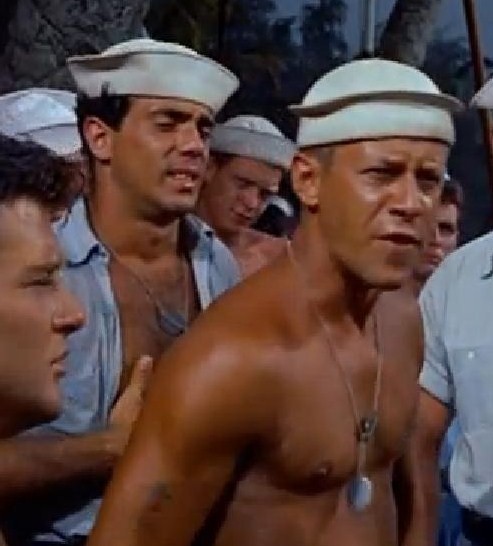
Hector (Jack Mullaney, left) was best known for his role in the beefcake-heavy musical South Pacific (1958), with Ken Clark as the voluminous Stewpot.  Mullaney never married and was reputedly gay.

Mac and Hector wore their astronaut costumes most of the time, but sometimes they wore animal skins that revealed tight, firm chests and shoulders.  The cave people also wore animal skins, and in spite of their fright wigs, many muscular bodies were visible in the background.


Here's another picture from South Pacific.  

There was significant bonding: the two astronauts bickered like a married couple, hugged, fell into each other's arms, and lived together, even when they returned to the twentieth century.

They gazed with tongue-lolling horniness at the cave family's daughter, but such minor concessions to heterosexism could be ignored.


And there was a "dreamy boy" for us to gaze at: Pat Cardi, who had just finished work on the dark comedy Let's Kill Uncle, played the cave family's fourteen year old son, Breen.  He wore a fright wing, but his animal skin was almost as revealing as the tight pants on Flipper.  

Unfortunately, It's About Time aired on Sunday nights, opposite the last halves of Voyage to the Bottom of the Sea and Walt Disney, so most of the intended kid audience was already occupied.


After 18 episodes, low ratings prompted a complete reversal of the premise: the astronauts return to 1960s America, bringing a cave family with them. It didn't help.  So in spite of the ecstatic tv ads and a full run of tie-in toys, games, coloring books, lunch boxes, and the like, It's About Time sank seven episodes later, and was lost to history.  Except for 60 year olds who can still recite the theme song:

It's about time,
It's about space,
About strange people in the strangest place.
It's about time,
It's about flight,
Traveling faster than the speed of light

Dec 6, 2019

John Hamill: The First Nude Physique Model

Born in 1947, the boyish, good-natured John Hamill began his career as a physique model, one of the first to pose fully nude.  Sometimes he even had a partner, in explicitly homoerotic scenes aimed at the increasingly visible gay male audience.  He also appeared in both gay and heterosexual "blue movies."

But he aspired to become a serious actor, so he studied at the Webber Douglas Academy of Dramatic Arts and began appearing on stage, notably in the gay-themed Boys in the Band in 1969 (presumably as the hustler hired to become a "birthday present").


His film career began in 1970, with starring roles in the thrillers The Beast in the Cellar (not as the beast), Trog (not as the rampaging caveman), and No Blade of Grass.  He also had some guest spots on tv series such as Paul Temple, The Befrienders, and Crossroads.  


But, like many bodybuilders, especially those with a "gay reputation," John found himself stuck in minor roles as threatening bad guys or inarticulate hunks.  In Tower of Evil (1972), for example, his character is introduced, takes off his clothes, flexes his muscles and gets killed, all in about thirty seconds.


Anxious for work, he agreed to star in the sex comedy Girls Come First (1975), as an artist asked to paint nude models.  Released in both hardcore and softcore versions, it was popular enough to lead to two sequels, and parts in similar movies, like Hardcore (1977).

But nothing else.  After a two-parter on Space: 1999 in 1978, he retired from acting and became a furniture refinisher.


Being so open about sex, and so nonchalant about both male and female partners, limited John's career, but left him -- and his fans -- with many fond memories.

You can see the nude photos on Tales of West Hollywood.

Mar 19, 2018

Land of the Lost: Yet another teenager trapped far from home, with Sleestaks

Saturday morning tv in the 1960s and 1970s was full of teenage boys trapped far from home.   From 1974 to 1977, that boy was a hot teenager named Will (Wesley Eure), who was on a "routine expedition" with his hot dad Rick (Spencer Milligan) and kid sister Holly (Kathy Coleman), when they zapped through a time-space portal into a jungle world crowded with dinosaurs, reptilian aliens named Sleestaks, and cute gibbering primates named Pakuni.  After a couple of seasons, Rick vanished, replaced by hot Uncle Jack (Ron Harper).

There wasn't much bonding, since the only available males were close relatives.  Nor much beefcake; you'd think after three years in the humid jungle, the guys would start wearing Tarzan-style loincloths, but no, only one episode featured Will shirtless, in painted-on jeans.


Otherwise gay boys had to make do with shirts unbuttoned to his navel.

But at least there was an utter lack of mentioned or displayed heterosexual interest in any of the characters, ever.


And Wesley Eure made up for his lack of shirtless shots later, as Mike Horton on Days of Our Lives.  

In 2009, he finally made one of the obligatory "coming out" statements, informing the world that he was gay via afterelton.com,  but he was never really in.  While on Land of the Lost, he was dating Richard Chamberlain.


Jan 10, 2016

Sean Astin

Speaking of John Astin, his adopted son Sean, born in 1971, was a reliable teen idol through the 1980s, with iconic roles in The Goonies (1985), White Water Summer (1987), and The War of the Roses (1989). (Meanwhile his brother Mackenzie was starring in The Facts of Life).


But Sean's gay subtexts began in earnest with starring roles in Memphis Belle (1990), a "boys alone" movie about a World War II airforce squadron (with Matthew Modine, Tate Donovan, and D. B. Sweeney).

 In the beefcake-heavy Toy Soldiers (1991), about boys alone in a private school.

In Where the Day Takes You (1992), as homeless drug addict Greg, who is partnered with Little J (Balthazar Getty).


And in Encino Man (1992), about college student Dave (Sean) and his slacker buddy Stony (Paulie Shore) unfreezing a cave man (Brendan Frasier) trapped in the ice.

In the late 1990s, Sean was mostly involved in boy-meets-girl-comedies and heterosexist actioners, but he returned to gay subtexts in a big way in The Lord of the Rings trilogy (2001-2003): his Sam Gamgee was achingly in love with Frodo Baggins (Elijah Wood), in spite of the marrying-a-girl conclusion.


Today he is a little beefy, but he can still fill out a Speedo.

Although he is a supporter of gay marriage, Sean's only gay character, in  Stay Cool (2009), was a homophobic stereotype, a swishy hairdresser named Big Girl.
Related Posts Plugin for WordPress, Blogger...