Showing posts with label gay comix. Show all posts

Sep 18, 2025

Gay Comics of the 1980s

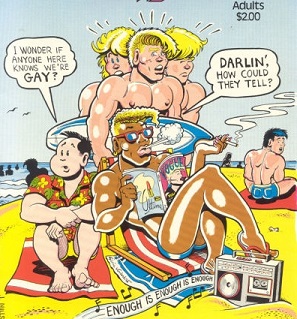
When I moved to West Hollywood in 1985, I was astonished.  There were no gay characters in any comic book or comic strip I had ever seen before, even in gay magazines, except for an occasional Donelan cartoon or Tom of Finland erotic drawing,  but here there were entire strips with all-gay casts (except for the occasional heterosexual villain). In Frontiers, the weekly news magazine. In the monthly anthology Gay Comix (1980-1988), by Kitchen Sink Press.  In the Meatmen anthology of trade paperbacks, edited by Winston Leyland (1989-1999).

During the late 1980s, they stopped being called "comix" (underground, radical) and became "comics" (mainstream).

Here are my favorite gay comic titles:

1. Murphy's Manor (Kurt Erichsen), about a regular guy who works as a librarian in Black Swamp, Ohio, and his various gay and lesbian friends.

The Sparkle Spinsters, led by the flamboyant Duchess (right), sometimes appeared in a separate feature.


2. Jayson, by Jeffrey A. Krell.  Jason Callohide is an underemployed liberal arts graduate sharing a single apartment in Philadelphia with his straight gal pal, Arena Stage. They are drawn in the clean, spare style of Archie Comics.

 Jeffrey A. Krell has published several trade paperbacks of Jayson's adventures, the most recent in 2012.  He also produced an off-Broadway musical, Jayson


3. Poppers, by Jerry Mills, set right in the heart of West Hollywood, starring Yves, a regular guy who works in a bookstore, his hunky best friend Billy, and the flamboyant Andre. It features all of the glitz, glamour, sex, and drugs that you expect in the pre-AIDS era of sexual liberation (it's even named after a psychotropic drug, amyl nitrite)

But beneath all that it's about friends sticking together in a hostile world, about the search for a place where you belong.

Jerry Mills died of AIDS in 1993.

You can get gay comics now on Amazon -- they arrive in mail, hidden from view in a brown box -- but that can't match the immediacy of walking down to the Different Light Bookstore on Larrabee and Santa Monica and grabbing them right off the shelf.

See also: Donelan; Howard Cruse; and Tom of Finland.

Apr 9, 2025

Donelan: It's a Gay Life

When I was in grad school in Bloomington, I was able to get copies of The Advocate at the adult bookstore.  One of my favorite features was a series of single-panel New Yorker-style cartoons, "It's a Gay Life," by Donelan,  lampooning the culture of 1970s gay neighborhoods: brunch, boyfriends, leathermen, queens, cruising, decorating, activism....

"Oh, please, girlfriend.  Isn't brunch a little too early for attitude?"


Some cartoons were about the reaction of straights, those who knew -- and were ok with it.  In a clueless, stereotyping way.

"I know a homosexual.  George knows a homosexual.  You must have so much in common.  So here we are.


Others who didn't know, and didn't want to know.

"Did your roommate just say he was going to 'freshen his makeup'?"


I was most drawn to the cartoons depicting gay men in pairs and groups.  There was a whole society out there somewhere, a place where being gay was commonplace, even expected, where straights were the interlopers and strangers.

"I'd be more impressed if you could name me one man here you haven't dated."

I wanted that world.


Gerald P. Donelan grew up in Plymouth, Massachusetts, and moved to San Francisco in the 1970s.  He published "It's a Gay Life" from 1978 to 1993.  There were two  reprints of his cartoons: Drawing on the Gay Experience (1987) and Donelan's Back (1988).  His work also appeared in Frontiers and in the Meatmen series of gay comic anthologies.

Today his work seems a bit dated, keying into feminine stereotypes a bit too much.  But in the height of the homophobic 1980s, it was a revelation.

"Tell me again the difference between eclectic and tacky."

See also: Howard Cruse.


Oct 11, 2023

Leonard and Larry

I moved to West Hollywood in 1985 in the midst of a Renaissance of gay comics.  Humor and not-so humorous strips were appearing in Frontiers and the Advocate, in the Gay Comics magazine, and in the annual Meatmen anthologies.  My favorites were:

Murphy's Manor, by Kurt Erichsen.
Jayson, by Jeffrey A. Krell
Poppers, by Jerry Mills
Dykes to Watch Out For, by Alison Bechtel
The single-panel Donelan cartoons.
And of course the erotic comics of Tom of Finland, Sean, and Cavello.

I wasn't a big fan of Howard Cruise's depressing Wendell, and even less of a fan of Tim Barela's Leonard and Larry.

Maybe I was just jealous of Tim Barela, who my boyfriend Lane had a crush on.  When Tim said "Jump," Lane said "How high?"  I was pretty sure that if Tim ever asked Lane to move in, the U-Haul would be packed and ready to go in five minutes.

But even without the real-life drama, I didn't like Leonard and Larry.

1. Leonard Goodman and Larry Evans are a middle-aged bear couple, one short and Jewish, the other tall and redhaired -- ok, that sounds a little like Lane and me.  Except they live in a house in a straight neighborhood somewhere in Los Angeles, they have mostly straight friends, Larry has kids from a previous heterosexual marriage, and so on and so on.  Way, way too assimilated!

Aside from an occasional depressing encounter with homophobia, they could be Hi and Lois, or Blondie and Dagwood.  What's interesting about that?


2. All of the characters look alike: white, with long faces, sharp noses, and prominent eyebrows. The men all have facial hair.

These are the plumbers, but the guy on the left could be Leonard's brother, and the guy on the right is Leonard's twin.


Ok, so Tim Barela likes a certain facial type, but everyone looks like a clone of the same person, like the Bizarro World in Superman comics.  It's hard to tell who the characters are, who's talking.  And how about a little ethnic diversity?

3. It wasn't funny.  Of course, a lot of gay comics weren't supposed to be funny -- Howard Cruise expected his stuff to elicit anguished wails, not belly-laughs..  But Tim Barela always claimed that he was drawing a humor strip, and there were indeed occasional wry observations on the annoyances of everyday life in the Straight World.  But wry is not the same thing as funny. 


By the way, when I was googling for Tim Barela, I found another one, a 16-year old gymnast from Bochum, Germany (10 in this photo).  The kid has a bright future ahead of him, as long as he doesn't decide to become a cartoonist.


See also: Gay Comix


Jan 24, 2023

Howard Cruse: Gay comics at their most depressing


I first heard of "Howard Cruise" in the early 1980s, when the Advocate featured his comic strip Wendel.  I thought that it was a nom-de-plume, a play on "cruising."  Turns out that it's really his name, but spelled "Cruse."

Wendel was an average-looking, not-too-bright, but extremely well-hung gay guy getting himself into mildly amusing situations as he negotiated life in the gay ghetto of New York.  Cruising, dating, romance...interspliced with homophobia, AIDS, despair, pain, sadness....

Soon the mildly amusing situations were overwhelmed by the grim and heartrending.  No character -- or reader -- ever smiled or laughed again, as Wendel faced gay-bashing, breakups, debilitating non-AIDS related illnesses, homophobia, AIDS, death, death, misery, depression, despair, heartache, pain, death, death, death.


This cover of a strip collection shows Wendel, his boyfriend, and their son watching in dismay as murderous hands approach, and the voice on the radio says: "We red-blooded, God-fearing Americans know what to do with the degenerates in our midst."

Who could stand to read the thing?

Eventually Cruse squeezed all of the tears he could get out of Wendel, and put him out to pasture, turning to other depressing projects.  In 1987, Dancing Nekkid with the Angels appeared: Comic Strips and Stories for Grownups.  

For grownups?  Does that mean that the gloves would come off, that the glimmers of humor that occasionally appeared in Wendel would be gone, replaced by "life is endless pain, unremitting agony!"

Sorry, there aren't enough antidepressants in the world to handle that.  I ran.

Next came a graphic novel, Stuck Rubber Baby published in 1995.

Ok, the title was disgusting -- who wants to read a graphic novel about a rubber baby with needles sticking out of it?

Upon research, I discovered the title is actually an incredibly obscure reference to what happens when a condom (aka rubber) gets "stuck," allowing semen to escape and conception to occur.  That's even more disgusting.   And it doesn't seem like a problem gay people have often.

It is the semi-autobiographical story of a boy experiencing the unremitting agony of life while growing up in the 1950s South.  Of course, most everyone he meets want to kick him out of the house, beat him up, arrest him, or kill him because he's gay, but that's only the tip of the iceberg of the gloom and despair:
1. His parents die in an auto accident, naturally.
2. He has sex with a woman to "cure" his gayness, and gives up the resulting child for adoption.
3. His friend is murdered.
4. A community center is bombed, killing lots of his friends.
5. His other friend is murdered.

Ok, I get it: gay people are doomed to lives of constant pain, unremitting agony, sadness, heartache, depression, despair, tragedy, gloom, death, death, death, death, death.

Or is it everybody, just the human condition?

I just bought From Headrack to Claude, a compendiu of  Cruse's 1970s Barefootz underground comix, Wendel (of course), some Stuck Rubber Baby, some depressing one-pagers, and a send-up of the 1950s comic book Little Lulu.

Her traumatic memories involve child molestation, drug addiction, masturbation, fetishes, and...well, you get the idea.

Claude is about how all religious people are violent homophobes who want to kill us.


Geez.

Look at this picture of a guy with washboard abs and huge veiny biceps.

Now try to convince yourself that life is unremitting agony.


Feb 23, 2015

The Mystery of Cavelo

When I was in grad school at Indiana University, the only place you could get gay books and magazines was in the adult bookstore.  Of course, they had porn, too.

I was particularly drawn to two albums from Zeus Studios featuring wordless comics drawn by someone named Cavelo:

The Cavelo Portfolio (1979).
Hercules (1981).

He drew buffed, fully nude men in mild bondage and S&M situations, usually in the historic past: ancient Rome, the old West, the French foreign legion.


The models had amazingly ripped physiques, drawn darker and with much more contrast than the characters around them.

There was no sex, no activity of any sort.  Cavelo always depicted the men in the moment before.

He published three albums, plus cartoons and illustrations in six issues of Drummer magazine, all between 1978 and 1985.  A limited repertoire, compared to his contemporaries, Sean and Tom of Finland.

Then his work ended, leaving fans to wonder: where did this spectacular beefcake artist come from?  Where did he go?

Thirty years later, they are still wondering.


Recently many of the great gay artists who published anonymously during the 1970s and 1980s have been identified, their stories told, their contributions lauded.  But Cavelo remains a mystery.

We know only that he lived in Los Angeles, and his real name was Leon Carvalho.

There's a Leon Carvalho living in Los Angeles today, a marine recruiter.  Probably not the same one.

See also: Tom of Finland; Sean and the World of Gay Leathermen


Related Posts Plugin for WordPress, Blogger...