Showing posts with label Fabian. Show all posts

Oct 13, 2023

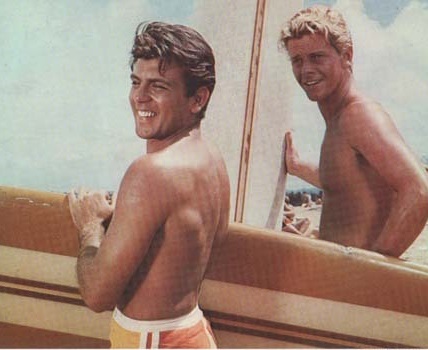
Fabian Forte at the Beach


Born in 1943, Fabian (he didn't need a last name) was a superstar by age 16.  He was a competent singer, but in a market flooded by teen singers, it was his curly hair, heavy-lidded gaze, and buffed physique that sold his records.  He practically created the teen magazine market, with beefcake pinups boosting the sales of Teen Magazine, Teen Live, Teen Illustrated, and many others.  He even got his own magazine, Fabian: Boy of Mystery.  

After his film debut in Hound Dog Man (1959), buddy bonding with Stuart Whitman, Fabian played androgynous, gay-vague, girl-crazy teens against any number of men's men: Robert Mitchum, Bing Crosby, Stewart Granger, John Wayne.


Surrounding a fey teen idol with all that brawn created a problem: the boy simply did not seem straight, in spite of his girl-ogling, especially when he sang.  So, when Henry Koester directed Fabian, he simply gave up.  

Mr. Hobbs Takes a Vacation (1962) has Fabian on stage for about five minutes, long enough to dance with Jimmy Stewart's daughter and sing "Cream Puff."


He gets slightly more screen time in Dear Brigitte (1965), but no songs, and though he buddies around with Jimmy Stewart's next daughter, he is never identified as her boyfriend and never gets physical with her.  Instead, his part of the plot involves exploiting math prodigy Erasmus Leaf (Billy Mumy) for capitalist gain.


Ride the Wild Surf (1964) capitalizes on the star's androgyny.  College student Jody (Fabian) hits Hawaii's North Shore with his buddies Steamer (Tab Hunter) and Chase (Peter Brown), to surf amid crowds of male surfers and spectators (only a few girls). Surfing becomes intensely homoerotic spectacle: they stand, their power distilled into a sharp thrust of surfboard, and explode toward the shore, all bronze chests and thick biceps, war-whooping a triumph over the elements that has nothing to do with heterosexist civilization.


Should Jody stay in Hawaii forever, luxuriating in the male beauty, living as a beach bum, or get a girl, go back to college, and settle for the staid heterosexist future of wife, kids, job, and house?  You know how it will end -- he picks the girl. Yet there is no fade out boy-girl kiss: Jody wins a surfing contest and is enveloped by his jubilant buddies, all hugging and hollering, a solid mass of men as the camera pans out to a wide-angle shot of surf and sky.

Fabian continued to act through the 1960s and 1970s, starring in Fireball 500  and Thunder Alley with Frankie Avalon, in an adaption of Agatha Christie's Ten Little Indians, in a cautionary tale about the dangers of marijuana.  And he continued to display his physique, including nude shots in Playgirl.  

You can see the nude photos on Tales of West Hollywood.

Today he is still performing, based out of Branson, Missouri.

Dec 10, 2022

Beach Movies: The Beefcake

The beach movie crazy began with Beach Party (1963), and lasted through Catalina Caper (1967).  During that 4 year period, American International Pictures churned out a dozen beach movies, starring former teen idol Frankie Avalon and former Mousketeer Annette Funicello, or if they were too busy, Dwayne Hickman, Tommy Kirk, Deborah Walley, and Yvonne Craig.  Other studios churned out their own teen-idols-in-Speedos movies, starring Bobby Vinton, Fabian, James Darren, Tab Hunter, and when they ran out of teen idols, Rod Lauren, Frankie Randall, Michael Callan, James Stacy, and Edd "Kookie" Burns.


The plot of the beach movie is the same in every installment: a gang of teenagers arrives in Malibu for a summer vacation.  Frankie and Annette (or their stand-ins) argue: she insists that they plan for marriage, the next step in embracing their heterosexual destiny, but he is too happy surfing, skydiving, and drag racing.

That is, he refuses to give up his homoerotic buddy-bonding with gay-vague chums.They separate, flirt with others, complain about each other to their friends, snipe at each other at the teen hangout, and walk forlornly on the beach.

Meanwhile a greedy corporation hopes to exploit the teenagers, or else salt-peter their heterosexual passions.  Maybe some juvenile delinquents cause trouble.  The climax comes in the form of a cartoonish teenagers vs. adults or delinquents brawl or car chase.  Frankie and Annette save the day, reconcile without resolving their disagreement, and head for home.


The teens are staggeringly affluent, white, and free from parental intervention of any sort.  They have all of the freedom of adulthood and none of the responsibilities.  They are living in their own surreal world of spies and saboteurs, drag races and skydiving contests, musclemen hanging from helicopters, gorillas riding surfboards.  There are Martians, mermaids, witch doctors, dime store Indians, bumbling crooks, and a girl whose gyrating hips cause volcanoes to erupt.

Every now and then Frankie mugs at the camera and asks "Can you believe this?"


And there is endless beefcake.  There are many girls in bikinis, but the beach is crowded with swimsuit boys; bulges are displayed as prominently as cleavage.  Jody McCrea's bulge makes a regular appearance.

John Ashley is dragged along the beach, the camera zooming in to capture the curve of his thighs, the tight muscles of his legs and calves, and even his frontside.

Tommy Kirk (left) wears a purple swimsuit so revealing that one can't imagine how it passed the sensors (not this photo).


Frankie doesn't bulge, but he is constantly shirtless, bedding down among his chums or standing tall and iconic beside his surfboard, his smooth, toned body preternaturally bright.

 In Fireball 500 (1966), which doesn't have a beach scene and only counts as a beach movie because it stars Frankie and Annette, Frankie spends a long scene shirtless, being interrogated by the police in his hotel room.  He never thinks to get dressed, though the officers stare at him, and one cheekily inserts his business card under Frankie's pendant, against his bare chest, like someone might insert a card into a woman's bosom.

Too bad the Disney Channel's Teen Beach Movie (2013) doesn't fare as well.

Next: The Duds

Nov 25, 2022

Jules Verne: The Disney Version

During the 1960s, every boy I knew loved Jules Verne -- journeys to distant corners of the world or to its center, lost civilizations, monsters, volcanoes, maelstroms, and nick-of-time escapes, all in an environment so masculine you could practically taste the homoerotic tension.

I read 20,000 Leagues Under the Sea, From the Earth to the Moon, Mysterious Island, and A Journey to the Center of the Earth in elementary school, in abridged Scholastic Book Club editions.  In high school, I read the originals, and collected some of the Ace paperbacks of Verne's lesser-known works: Michael StrogoffThe Begum's Fortune, The Carpathian Castle, Master of the World, The Village in the Tree-Tops.  

During the 1950s and early 1960s, "Disney" versions of these Verne classics appeared, with two important changes:
1. To draw the all-important Boomer audience, a teenager.
2. To ensure a Hollywood fade-out-kiss, heterosexual obsessions were added.

In 20,000 Leagues Under the Sea, the French scientist Pierre Aronnax, his assistant Conseil, and his Canadian friend Ned Land are captured by Captain Nemo, who holds them prisoner in his electronic submarine.  Nemo became an outcast after his wife died, but no other women are mentioned or longed for.

In the 1954 movie (the only one actually from Disney), Ned (Kirk Douglas, not a teenager) sings about "the girls I've loved on nights like this," whose kisses make him "bubble up like molten lava."


In A Journey to the Center of the Earth, Professor Lindenbrock, his nephew Axel, and their Icelandic guide Hans journey alone, although Axel does have a girlfriend waiting back home.  In the 1959 Disney version (actually from 20th Century Fox), the Professor meets a lady, and the girlfriend gets a more substantial role.  But at least there are substantial shirtless shots of teen idol Pat Boone as Alec (Axel).  And in the last scene he's completely nude except for a sheep.


In The Mysterious Island , five Civil War POWs escape in a hot-air balloon and end up on the mysterious island, where they fight giant bees and pirates, encounter Captain Nemo (Omar Sharif), and flee a volcano eruption. In the 1961 Disney version (actually from Columbia), there are women on the island for the men to fall in love with.

But at least they are shirtless or semi-nude most of the time, especially Herbert Brown (Michael Callan).  The scene where he and the girl hide from a giant bee in a honeycomb is still scary today.


In Five Weeks in a Balloon, three men explore Africa in a hot air balloon. Again, no women are mentioned or longed for.

The 1962 Disney version (actually from 20th Century Fox) changes the cast, adding pilot Jacques (teen idol Fabian Forte) and newspaper report O'Shay (Red Buttons).  Each falls in love with a woman en route; the movie ends with two couples enthusiastically kissing. And there's no beefcake (although Fabian, right, often appeared shirtless and nude in other productions).

This was also the era of the Disney Adventure Boys -- like Tommy Kirk, James MacArthur, and Kurt Russell -- hired to display Cold War masculinity, which meant two things: muscular physiques and heterosexual obsession.

Jun 30, 2018

The First Teen Idols, 1956-1963

Before 1955, most teens appropriated their music from Mom and Dad, who listened mostly to silky-voiced crooners like Nat King Cole and Frank Sinatra. Then rock and roll exploded onto the musical scene almost over night, and suddenly dozens of young rock and rollers were aimed directly at teenagers, through jukeboxes at teen hangouts, hysterical praise in teen magazines, teen-oriented radio stations, and appearances on teen-oriented tv programs: Elvis Presley and Pat Boone by 1956, Paul Anka and Ricky Nelson (1957, Ricky only after he sang on his father's tv sitcom), Frankie Avalon  (left) and James Darin (1958).


In all, 19 major teen idols appeared between 1956 and 1963, with 243 charting songs, mostly with the same pitch.   There was little word play, little metaphor, not a hint of irony or ambiguity to detract from the clarity of the pitch: if you are a boy, get a girl. If you are a girl, get a boy. That is your reason for living, period.

There was no rampant heterosexual desire in the pitch. In "Travelin' Man" (1961), Ricky Nelson has girls in every port, and in "The Wanderer" (1962), Dion insists that he'll have sex with any girl who offers. But usually sex is not on the teen idol's mind; he is looking for The One, the "mate that fate created me for" (Bobby Rydell). Paul Anka (left) cries every night for the gods to grant him The One, so that his life can have meaning.

After finding the One, the teen idol finds all other girls forever repulsive, or is simply unable to notice them.  And even more, he cannot find any joy in any other relationship, interest, or activity.  He goes to movies, drives a hot rod, surfs only to be near her.  He gets a job only to earn money to buy her gifts.  If it were possible, he would spend every moment for rest of his life literally staring into her eyes.  Nothing else matters.


The reason for the pitch is obvious: to promote a heterosexist future of marriage and family to the biggest generation of juveniles in the history of the planet.

In spite of the "teen angel" cliches, none of the 243 songs mourn dead girlfriends, but The One breaks up with the teen idol (like Fabian, left) quite often, due to a family move, parental disapproval, or simple rejection.  This loss is much more painful in the pitch than it would be in real life, since even after The One is gone, the teen idol still finds other girls repulsive, or is unable to notice them.  Thus, he is constitutionally unable to find anyone else.  He will never have another girlfriend for the rest of his life ("I'll Never Dance Again," Bobby Rydell tells us.)

But the tragedy gets even worse.  Single people can find happiness and contentment with family and friends, a career, leisure pursuits, political activism -- but The One was the teen idol's sole joy in life, his sole reason for living, so he will never find any joy in anything else, ever.  His life is over.


In the pitch, the teen idols inhabit a world that consists entirely of girls.  Only 27 of the 243 songs mention boys at all, and in 22 of them, including "Staying In" (Bobby Vee), "Johnny Will" (Pat Boone), and "Pin a Medal on Joey" (James Darin), boys are reviled competitors, lying in wait to steal The One.

Of the remaining five songs, three merely allow the teen idol a buddy to commiserate with over the loss of The One: "Poor Boy" (Elvis), "Ten Lonely Guys" (Pat Boone), and "Drip Drop" (Dion).

The other two, a pitiably small number, allude to same-sex desire or practice.


In "Jailhouse Rock" (1957), Elvis evokes a dance at the county jail, an all-male preserve, and specifices that the prisoners vie for the attention of the most attractive dance partners"  "Number 47 said to Number 3,  'You're the cutest jailbird I ever did see!'"

More homoromantic is Bobby Darin's "Nature Boy" (1961), about a "very strange enchanted boy" from far away, "a little shy and sad of eye," like the sad, shy gay boys who linger at the margins of heteronormative myth.

Nature Boy visits Bobby on "a magic day," and, during their time together, tells him "the greatest thing you'll ever learn is just to love and be loved in return."  Perhaps the song managed to pass into the pitch because the "boy" could be read as a little boy, advising Bobby to find a girl.

But the original song, written by Nat King Cole in 1948, is about an adult, one of the long-haired sandal-clad Nature Boys, forerunners of the hippies, who wandered L.A. in the 1940s.  And Nature Boy never says "get a girl!"  He wants Bobby to love him.


May 8, 2014

Peter Brown: Buddy-Bonding Cowboy of the 1950s

I never saw this massive chest before yesterday, that I remember, and he has a pretty common name, so sorry if I get the pictures wrong.

He's Peter Brown, a heart throb to the first generation of Baby Boomers.

Born in New York in 1935, he graduated from UCLA and hit Hollywood in 1957.  Guest bits on swinging detective and Western shows landed him his most famous role, Lawman (1958-62)


It starred John Russell (the one with the basket) as Marshall Dan Troup of Laramie, Wyoming (the name Laramie was taken).  Peter played his partner, deputy, and close friend Johnny McKay.

Sounds like a lot of gay subtext potential.  No wonder the first generation of Boomers remembers it fondly.

Next came some Disney movies, the sexploitation Kitten with a Whip (1964), and the surfing-buddy movie Ride the Wild Surf (1964), also starring teen crooner Fabian Forte.

I've already discussed its many gay subtexts.


In 1965-67 Peter returned to the Old West to star in Laredo with bodybuilder William Smith.

Then came more guest spots, soap operas, sexploitation movies like Teenage Tease (1971) and Foxy Brown (1974), and bad horror movies like Piranha (1972).  He was very busy as an actor, but his glory days were obviously past.


Peter been married five times, so I'm going to guess he's heterosexual.  But back when he was playing cowboys, his beefcake and homoerotic buddy-bonding kept lots of Boomer kids interested.

You can see more pictures of Peter Brown on Fabian Forte on the Beach.


Related Posts Plugin for WordPress, Blogger...