Dec 3, 2021

Aldo Ray: The Voice, Chest, and Endowment that Wowed Old Hollywood

Aldo Ray is on my list of gay and gay-friendly people born in 1926, but I didn't know anything else about him until I started looking for photos.

He was a blond, beefy screen hunk with a deep voice and a hairy chest, who took off his shirt at the drop of a script.

Born in Pennsylvania in 1926, he served in World War II, married, and was elected Crockett, California town constable before driving his brother to an audition for Saturday's Hero (1951) and getting cast himself.

Gay director George Cukor took a special interest in Ray, and upon seeing him naked (however that happened), made him a headliner at his legendary Sunday afternoon parties, where well-endowed hunks swam naked for the enjoyment of the guests.

Later Cukor cast Ray in Pat and Mike (1952), starring screen legends Spencer Tracy and Katherine Hepburn.  Scott Bowers, the legendary trotaconventos of old Hollywood, claims that that Spencer Tracy was only one of the stars who made good use of Ray's superheroic endowment.

Somehow Ray also found the time to hang out at Henry Willson's pool parties with a stable of gay, bi, gay-for-pay, and allied beefcake stars like Farley Granger, Robert Stack, Tony Curtis, John Bromfield, and Rock Hudson.

Ray starred in many movies of the 1950s and 1960s as an assortment of gruff, taciturn bad guys, soldiers, cops, and rednecks.  Among his most famous movies:

God's Little Acre (1958), as a taciturn farmer who has an affair with future Gilligan's Island star Tina Louise.

The Naked and the Dead (1958), as a soldier killed in action after bullying Cliff Robertson.

Four Desperate Men (1959), as a police officer dealing with a hostage situation in Sydney.

Johnny Nobody (1960), as an amnesiac murderer.

Dead Heat on a Merry-Go Round (1966).  Great title, whatever it's about.

What Did You Do In The War, Daddy? (1966), an anti-Vietnam farce.

The Green Berets (1968), a pro-Vietnam farce

Typecast as gruff and gravelly-voiced, Ray faced a career decline in the 1970s.  He appeared mostly in horror movies (Death Dimension, Human Experiments, Don't Go Near the Park, Terror in the Night) and on tv as the recognizable has-been guest star (Police Story, SWAT, Marcus Welby MD, CHIPS).


Aldo Ray died of throat cancer on March 27, 1991, survived by his third wife and four children, including actor Eric DaRe (Twin Peaks).

See also: Jerry Lewis Falls in Love; Henry Willson and Gay Hollywood.


Dec 2, 2021

Captain Underpants and the Perpetual Problem of Presenting Prepubescent Protagonists Who Are Probably Gay


I had no interest in The Epic Tales of Captain Underpants, with an icon of an oval-shaped being in his underwear, until I discovered that one of the main characters is gay.

The tv series is based on a series of illustrated children's books (1997-2015) staring two fourth grade best friends, Harold Hutchins (blond) and George Beard (black), who can make their sadistic, fun-hating principal transform into the titular superhero to fight grade-school supervillains.  Most of the villains have some connection to farting, belching, or pooping: Professor Poopypants, the Wedgie Woman, the Bionic Booger Boy, Tippy Tinkletrousers, Sir Stinks-a-Lot.  


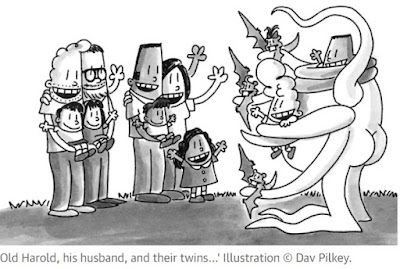
In the last book in the series, the boys travel forward in time to meet their future selves and their families: George has a wife, and Harold has a husband.  They both have kids. This is no big reveal -- "Wow, you mean Harold was gay all along?"  The partners are presented matter-of-factly, without surprise or commentary.

I suspect that author Dav Pilkey didn't plan on Harold being gay from the start;it was just what made sense as he was bringing the series to a close.  But to see if there are glimpses into Harold's sexual identity early on, I checked out Season 2, Episode 8 of the tv series (the only episode that mentions a girl).  


Scene 1:
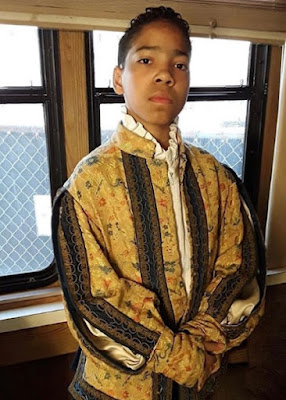
The narrator (Sean Astin) identifies the two boys: George (Ramone Hamilton, below) with a flat top, and Harold (Jay Gragnani) with wavy blond hair.  They're showing Erica their ideas for a new comic book character, Plungerina.  She disapproves, which makes them recoil in self-doubt: "I'm a hack!  I'm no good!  I should give up comics!"  Finally she likes one of the ideas.

Scene 2: We see the comic book. At a sports stadium, the toilets are all clogged.  A clog-monster climbs out of a toilet and attacks.  Captain Underpants (Nat Faxon, top photo) fights him, and is defeated.  Superhero Plungerina saves the day.

Scene 3:  At school, everyone is reading the new comic book.  Erica claims that Plungerina is even better than Captain Underpants, which causes the boys to screech to a halt.  "How can you say that?"  To prove that Captain Underpants is superior, they clog all the toilets at school (thankfully not with poop) so a real-life clog monster will emerge and Principal Krupp will morph into Captain Underpants and save them.

But Principal Krupp and Melvinborg (a future cyborg version of their enemy Melvin) are attending a principal's convention far away.  The school is helpless!

Scene 4: Teacher Mr. Rected (all teacher names are puns) uses the bathroom, flushes the toilet, and is inundated by water, transforming into Cloggernaut.  And Captain Underpants isn't around to save them.   Fortunately, a real-life Plungerina arrives to clobber Cloggernaut.  Erica was right -- Plungerina is superior!  If their comic book stories always come to life, could they conjure up some high grades, or pizzas, or cute boys/girls?

Scene 5: Who is Plungerina?  An adult, so not Erica.  The boys interrogate their  teachers: Miss Anthrope, Miss Heard, the Lunch Lady -- but find no suspects.

Mr. Rected returns to the bathroom.  The toilet is still clogged, so he morphs into Cloggernaut again!

I'll stop the scene-by-scene there.

Beefcake: No.  The characters are all stylized.

Heterosexism:  None.  No one expresses any romantic or erotic interest of any sort.  Erica is a big sister/antagonist, not an object of desire.

Gay Characters:  No one expresses any same sex interest. The only boys shown are antagonists as well.

What about Harold and George?  Usually inseparable best friends have a strong gay subtext, but here I didn't notice anything.  The boys are not differentiated in any way; they have no distinctive personality traits, no disagreements about strategy, nothing that would provide conflict.  Maybe a gay subtext requires conflict?


Gay Actors: 
No information on Nat Flaxon or Jay Gragnani.  Ramone Hamilton lives in West Hollywood, but since he's only 15 years old, it probably wasn't his idea.

Toilet Humor: Incessant.

My Suggestion:  Wait for the boys to grow up.

Dec 1, 2021

"Snatch": Caper Movie With Two Unintentional Gay Subtexts


Snatch (2000) has a complicated plot with lots of unlikely coincidences, people surviving multiple lethal injuries, and impenetrable dialogue, even with subtitles.

I gathered that there are two interconnected plot arcs: first, something to do with a "diamond as big as the Ritz," which was stolen from a jeweler in Belgium, and passes from hand to hand as everyone tries to track it down; second, a member of the Irish "traveler" (nomadic) community who is a proficient bare-knuckles boxer (played by Brad Pitt, who is frequently shirtless, but his physique is ruined by multiple rings and huge tattoos).

Every pair of criminal partners has a gay-subtext relationship, but here two stand out:


1. Turkish (Jason Statham, top photo) and Tommy (Stephen Graham, left) handle the Irish traveler plotline, but they also run afoul of the diamond several times, and end up with it (and a dog).  Turkish explains that although they're partners, they "don't hold hands or walk along the beach."  Nevertheless, their bond is physical and permanent.


2. Small-time crooks Vinny (Robbie Gee, left) and Sol, (Lenny James, below) mostly handle the diamond plot arc, which means they get into more trouble: they are captured by various bad guys (erm...worse guys, I mean) and are nearly killed several times. Finally they are arrested when the police find several bodies in their trunk (although they didn't actually kill anyone). 


 They have an extremely physical relationship, including hugging, laying heads on shoulders, and at one point holding hands (I think).

Adding to the subtexts is the total lack of heterosexual desire or romance.  There are no major female characters; no one is shown having sex with a woman or ogling a woman. Only the minor character Franky Four-Fingers is even shown with women, and then only in a split-second shot.  There are some naked ladies in photos and calendars on the wall, and once in a pack of playing cards, and that's it. Considering that gangster movies usually feature incessant shots of gangster gals and strippers on poles, this is amazing.


An article from 2000 reveals that Paul O'Boyle, who played the minor character Patrick,  "shocked" Brad Pitt, Lenny James, and director Guy Ritchie during filming, when he mentioned that he was going away for a vacation with his partner.  They asked "What's her name?" "Gareth."  "Funny name for a girl," they responded in heteronormative ignorance, before catching on and being shocked. 

Guy Ritchie didn't fire him on the spot, but I gather from his shocked reaction that the gay subtexts are unintentinal.


Related Posts Plugin for WordPress, Blogger...