Showing posts with label children's book. Show all posts

Feb 10, 2026

My Boyfriend and I Play "Fighting Prince of Donegal"

This is the Scholastic Book Club edition of Fighting Prince of Donegal, by Robert T. Reilly.

It may not look like much now, but when I was in fourth grade at Denkmann Elementary School, it appeared among the selections offered by the Scholastic Book Club.  I was entranced.

This was no wimpy fairy-tale prince in love with a princess.  He was a Fighting Prince, strong and powerful.  I had never heard of Donegal, but it was obviously a mystical, distant country with castles on high mountains, outlined against an orange moon.

My boyfriend Bill and I both ordered copies.  They wouldn't arrive for four to six weeks.

We talked about the book every day.  Would the Prince have muscles?  Would he have a best man?  Would he rescue his best man, who would then sigh "My hero?" and melt into his arms?


We made swords out of cardboard and played "Fighting Prince of Donegal."  My brother got to be the villain, who would lock Bill in the dungeon (the lilac bushes outside my house) so I could rescue him.

We often talked about what the Prince looked like.  If you read the ad very carefully, you could see that the book was originally published in 1958 and called Red Hugh, Prince of Donegal.  That meant a red-head.  He must look something like this.


Or, from an adult point of view:

We looked up Donegal in the Golden Book Encyclopedia.  It was a county in Ireland, on the northeast coast.

There was a book in the Denkmann Library called Donegal Stories, but it was all fairy tales, which we  hated.

Would those books ever arrive?


Bill's big brother Tom told us that a couple of years ago, Disney made a movie version of The Fighting Prince of Donegal, starring Peter McEnery.

"Did he rescue a boy or a girl?" I asked expectantly.

More after the break

Sep 20, 2023

The Last Straight Kids on Earth

42 days after a zombie  AND giant monster apocalypse destroys his town and probably the world, teenage video-game addict Jack (Nick Wolfhard, left) seems to be coping well.

The monsters and zombies can be easily outrun, there is plenty of food and other supplies to scavenge, and he has his technogeek bud Quint (Garland Whit) for company.  There's only one thing missing:

The Girl.

That's right, only 1 1/2 minutes into The Last Kids on Earth (2019), and Jack is summoning The Girl as the meaning of life, the key to his dreaming, the only thing missing in the apocalypse.

Sigh.  Why is it always the Eternal Feminine?

I suppose I shouldn't be surprised, but after watching Twelve Forever and reading Welcome to Wanderland, a series dedicated to finding The Girl seems old fashioned and even offensive. 

The tv series is based on a series of children's books by Max Brallier, who although cute, doesn't appear to have any sexual or gender diversity in his works.

He does admit that "there are gay kids out there" in response to a homophobic comment on his twitter page.  Just none among The Last Kids on Earth.

To be fair, only Jack expresses heterosexual interest.  The other characters could be gay, just closeted.

The Girl is June (Montse Hernandez), all-around athlete, top student, editor of the school newspaper, practically perfect in every way, whom Joe was crushing on before the world ended.  In the first episode, Joe and Quint discover that she has survived the apocalypse by hiding in the school.

What a coincidence?

They also hook up with the school bully Dirk (Charles Demers).  The four "last kids on Earth" (and a friendly cat-monster named Rover) move into a decked-out treehouse with a zombie-proof moat and get down to the business of survival.

According to Netflix, this is a tv series, but there is only one "episode," 67 minutes long, online.  IMDB lists six episodes, perhaps covering the five books in the series, where the kids learn more about their situation, and eventually have to fight to save the world.  There is some stunt casting, including Bruce Campbell from The Evil Dead series and Mark Hamill.

And maybe they'll find someone gay along the way.


Sep 17, 2023

Wild Things: The Gay Art of Maurice Sendak

Adults like to think of childhood as a blissful Eden, a period of endless joy, unblemished by anxieties over money or sex or death.  But they're wrong.  Childhood is terrifying and painful, crowded with anxieties over money, sex, and death, dismemberment, abandonment, anger, friendship,  and desire.  Author and illustrator Maurice Sendak (1928-2012) inhabited this world better than any other writer.


He was gay, so several of his books can be read as the struggle of a gay child to make sense of the world, and two are about gay couples.

1. Where the Wild Things Are (1963): Max threatens to eat his mother, and while being punished, runs away to the world of the Wild Things.  He stares them down, becomes their king, and decrees that a Wild Rumpus begin. But he gets homesick and goes home. The 2009 movie added some hetero-romance, among the Wild Things, not Max (Max Records).  There have also been stage plays and a ballet.


2. In the Night Kitchen (1970). An amazingly vivid, scary story of Mickey, who sneaks out of his bed to a surreal night kitchen, where three chefs (all of whom look like Oliver Hardy) are making the breakfast "cake."  He helps them, meanwhile wondering about where his body ends and the natural world begins: "I'm in the milk and the milk's in me."

It has been banned in many schools because the toddler is naked -- don't want five-year olds knowing that five-year olds sometimes have a penis.

Sendak's art for adults often contains penises as well, but never to be salacious, to depict vulnerability rather than desirability.


3. We are All in the Dumps with Jack and Guy (1993) is a traditional nursery rhyme with a gay family twist.  Gay partners Jack and Guy find a little boy with "one black eye," a victim of bullying or abuse.  Jack wants to "knock him on the head," continuing the abuse, but Guy suggests that they buy him some bread instead, and "We'll bring him up as other folks do."


4. My Brother's Book (2012). Two brothers are torn apart when a falling star crashes to the earth.  It's a love letter to his partner of fifty years, psychiatrist Eugene Glynn, who died in 2007.  With beautiful watercolors inspired by William Blake.

Mar 15, 2023

The Gay Villages of Sonia and Tim Gidal


When I was little, my search for a "good place" often led me to the My Village books.  Tim Gidal (1909-1996) was a a pioneer in the field of photojournalism and a respected academic at the New School for Social Research.  In the interest of fostering international understanding, he and his wife Sonia published My Village in India (1956), a photo-story about the everyday life of a real ten-year old boy in a rural village.

It became so popular that they started scouting out villages in other countries, eventually traveling to 23:

1956: Austria
1957: Yugoslavia, Ireland
1958: Norway
1959: Israel, Lapps (Norway)
1960: Bedouins (Jordan), Greece
1961: Switzerland
1962: Spain, Italy
1963: Denmark, England
1964: Germany, Morocco
1965: France
1966: Finland, Japan
1968: Korea, Brazil
1969: Ghana
1970: Thailand
They only stopped when the couple divorced.


Each story was written in present tense and covered a few days in the life of a 10-12 year old boy: shepherding in Yugoslavia, fishing in Norway, tending to a vineyard in France.  He also went to school, played with his friends, talked to other villagers, went to a festival or took a field trip to a big city, and sometimes solved a minor mystery.  On the way you learned something about the history, language, and culture of the country (probably for the first time).

No gay people or same-sex romances were ever mentioned.  So why did these books offer a glimpse of a "good place"?


1. The boys were all exceptionally cute, from my preteen vantage point, and in warm climates they often stripped down to swim or fish or frolic.  Even in cold climates: the Norwegian boy stripped down for bed, and the Finnish boy was photographed completely nude in a sauna.


2. Their fathers, older brothers, and neighbors all lived off the land: they were farmers, shepherds, fishermen, loggers.  That meant endless photographs of muscular adult men.


3. American media of the 1960s was full of preteen boys "discovering" girls.  But the Village boys never expressed the slightest interest in girls.  Indeed, they didn't seem to know any, other than their sisters.

4. However, they often came in pairs that were extremely expressive by American standards: always hugging, wrapping their arms around each other, lying side by side, even kissing each other on the cheek.  To my preteen mind, it was obvious that they were boyfriends.

See also: Looking for Love in the Encyclopedia

Feb 12, 2022

Bobbseys, Boxcars, and Beefcake

I was never much of a fan of the mystery genre, but many gay kids liked the gentle, pre-Hardy Boys exploits of The Famous Five or their American counterparts, the Bobbsey Twins and the Boxcar Children.

Laura Lee Hope’s Bobbsey Twins series lasted through 72 installments from 1904 to 1979.  Originally the two sets of twin siblings aged normally, but when the series was revised and extensively rewritten during the 1960s, Bert and Nan remained twelve, and Freddie and Flossie remained six.  They all seemed to behave somewhat older than their "real" ages, or maybe that is just a reflection of the extra freedom kids had in earlier generations. 

 In the 1960s they also began to have more dramatic adventures in realistic locales, though the titles were still aimed at a youngish market: The Secret of Candy Castle, The Doodlebug Mystery, The Flying Clown.


Gay boys found most resonance in Bert, who was in his last days of childhood, still happy to play with his sister and younger siblings but obviously longing for emotional connections outside the group.  In fact, an ongoing theme of the books is the conflict between the comfort and safety of family and the need to “leave the nest” and find one’s own way in the world.  But girls play no part in any of the stories; instead, in nearly every book, in the midst of piecing out clues and solving mysteries, Bert goes off on his own with a boy.

The Boxcar Children were another group of siblings, Henry (14), Jessie (13), Violet (10), and Benny (6), orphans who moved into an abandoned boxcar in the 1924 novel by Gertrude Chandle Warner.  Then, in the late 1940s, Warner realized that the four would make ideal child-sleuths.  She had them adopted by their wealthy grandfather, Mr. Alden, who traveled around the country to keep track of his various business investments, thus providing lots of exotic locales for sleuthing.  Eighteen new installments appeared between 1949 and 1976, sending the kids to haunted houses, bedeveled ranches, mountain cabins, and seaside resorts.   The children age through the adventures, and by #19, Benny Uncovers a Mystery, Henry is in college.


Like Bert, Henry is trying to establish his independence while still remaining part of the family, but, unlike adolescent boys in children's media today, he is never portrayed as girl-crazy.  Instead, when his life outside the family appears in the novels, he is usually seen in the company of a boy (the girl on this cover is his sister).

Dec 20, 2021

General Whitman and his Cold War Boyfriend

When I was a kid in the 1960s, my parents hated books.  Comic books were suspect enough -- but full-sized books would brainwash me into believing atheism and evolution keep me away from healthy masculine activities like sports, and "strain my brain"!  Maybe they were worried that reading would make me want to escape the future of factory job, house, wife, and kids they had mapped out for me.

So I could only get away with reading only if I could convince them that it was required for school.  That made General Whitman's Adventures ideal.

They were brief, 15-page storybooks, accompanied by "adventure maps,"  written by George S. Elrick (who also wrote tie-in books for tv series like Flipper, Batman, and The Man from U.N.C.L.E.).  They were published by comic book company Whitman (talk about product placement!).


General Whitman's Adventures in Intriguing Europe
General Whtiman's Adventures in Exotic Asia
General Whitman's Adventures in Exciting Africa

After that they ran out of adjectives, and just had him traveling to Australia, North America, South America, the United States, and Around the World.

General Whitman,  a "global troubleshooter for the armed forces," was a thin, middle aged white guy carrying a globe.


In each story, he traveled across the designated continent with his assistant, Lieutenant Scott, on on a top secret assignment.  In South America, for instance, he was assigned to inspect rivers that might provide "juice for mission control centers, "and to select likely sites for camouflaged missile silos."

This was during the Cold War, after all.

Meanwhile he pontificated about the continent's history and geography -- with what today seems a very paternistic, Orientalist superiority complex:  "Before this continent was discovered, the poor savages were uncivilized."

And Lieutenant Scott expressed constant disgust or amazement over local customs. In Tibet, he exclaimed: "That lady's making a sandwich out of her face!"

"Butter is often used as a beauty aid here," the General explains.  "The Tibetans are too primitive to have our modern scientific cosmetics."


Still, it beat National Geographic, with its boring "This country is a study in contrasts, embracing its rich traditions and looking toward the future."

And I could claim "research for my geography class."

And neither General Whitman nor Lieutenant Scott mentioned wives or girlfriends back home.  I was pretty sure that they were "Best Men" (my childhood term for gay partners).

Dec 2, 2021

Captain Underpants and the Perpetual Problem of Presenting Prepubescent Protagonists Who Are Probably Gay


I had no interest in The Epic Tales of Captain Underpants, with an icon of an oval-shaped being in his underwear, until I discovered that one of the main characters is gay.

The tv series is based on a series of illustrated children's books (1997-2015) staring two fourth grade best friends, Harold Hutchins (blond) and George Beard (black), who can make their sadistic, fun-hating principal transform into the titular superhero to fight grade-school supervillains.  Most of the villains have some connection to farting, belching, or pooping: Professor Poopypants, the Wedgie Woman, the Bionic Booger Boy, Tippy Tinkletrousers, Sir Stinks-a-Lot.  


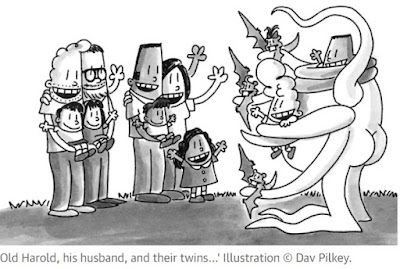
In the last book in the series, the boys travel forward in time to meet their future selves and their families: George has a wife, and Harold has a husband.  They both have kids. This is no big reveal -- "Wow, you mean Harold was gay all along?"  The partners are presented matter-of-factly, without surprise or commentary.

I suspect that author Dav Pilkey didn't plan on Harold being gay from the start;it was just what made sense as he was bringing the series to a close.  But to see if there are glimpses into Harold's sexual identity early on, I checked out Season 2, Episode 8 of the tv series (the only episode that mentions a girl).  


Scene 1:
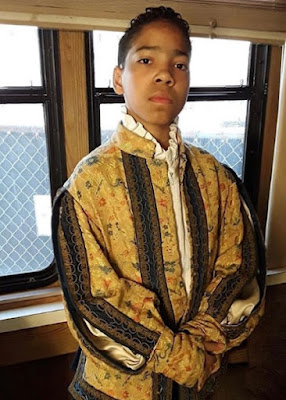
The narrator (Sean Astin) identifies the two boys: George (Ramone Hamilton, below) with a flat top, and Harold (Jay Gragnani) with wavy blond hair.  They're showing Erica their ideas for a new comic book character, Plungerina.  She disapproves, which makes them recoil in self-doubt: "I'm a hack!  I'm no good!  I should give up comics!"  Finally she likes one of the ideas.

Scene 2: We see the comic book. At a sports stadium, the toilets are all clogged.  A clog-monster climbs out of a toilet and attacks.  Captain Underpants (Nat Faxon, top photo) fights him, and is defeated.  Superhero Plungerina saves the day.

Scene 3:  At school, everyone is reading the new comic book.  Erica claims that Plungerina is even better than Captain Underpants, which causes the boys to screech to a halt.  "How can you say that?"  To prove that Captain Underpants is superior, they clog all the toilets at school (thankfully not with poop) so a real-life clog monster will emerge and Principal Krupp will morph into Captain Underpants and save them.

But Principal Krupp and Melvinborg (a future cyborg version of their enemy Melvin) are attending a principal's convention far away.  The school is helpless!

Scene 4: Teacher Mr. Rected (all teacher names are puns) uses the bathroom, flushes the toilet, and is inundated by water, transforming into Cloggernaut.  And Captain Underpants isn't around to save them.   Fortunately, a real-life Plungerina arrives to clobber Cloggernaut.  Erica was right -- Plungerina is superior!  If their comic book stories always come to life, could they conjure up some high grades, or pizzas, or cute boys/girls?

Scene 5: Who is Plungerina?  An adult, so not Erica.  The boys interrogate their  teachers: Miss Anthrope, Miss Heard, the Lunch Lady -- but find no suspects.

Mr. Rected returns to the bathroom.  The toilet is still clogged, so he morphs into Cloggernaut again!

I'll stop the scene-by-scene there.

Beefcake: No.  The characters are all stylized.

Heterosexism:  None.  No one expresses any romantic or erotic interest of any sort.  Erica is a big sister/antagonist, not an object of desire.

Gay Characters:  No one expresses any same sex interest. The only boys shown are antagonists as well.

What about Harold and George?  Usually inseparable best friends have a strong gay subtext, but here I didn't notice anything.  The boys are not differentiated in any way; they have no distinctive personality traits, no disagreements about strategy, nothing that would provide conflict.  Maybe a gay subtext requires conflict?


Gay Actors: 
No information on Nat Flaxon or Jay Gragnani.  Ramone Hamilton lives in West Hollywood, but since he's only 15 years old, it probably wasn't his idea.

Toilet Humor: Incessant.

My Suggestion:  Wait for the boys to grow up.

Dec 13, 2020

Rocket to the Moon: Adventure Boys in Love


Gay boys of earlier generations could find an escape from the incessant interrogation of "What girl do you like" in fiction -- the fast-paced adventure series starring teenage boys.

Unlike the Hardy Boys series, the British Boys' Annuals, or the books in the Green Library, the adventure boy series offered little cover beefcake, but they made up for it with lush verbal descriptions: the teenagersare extraordinarily handsome,  immensely muscular, strong, sturdy, erect, lithe, well-formed, and “well-knit.”

In Jack Winters’ Gridiron Chums (1919),  we read that “Big Bob stretched out his massive arms. . . as though to call the attention of his companion to his splendid physique.”

 In The Radio Boys at the Mexican Border (1922), the hero has “long legs, flat hips, trim waist, deep chest and broad shoulders and a flat back. . .altogether, he was a striking figure.”


Girls are entirely absent, but almost every Adventure Boy forms an intimate, passionate bond with a same-sex chum, and almost every Adventure Boy novel ends with the two planning to stay together forever, a homoromantic version of the fade-out kiss.


In Roy Rockwood’s Great Marvel series, teenagers Mark Sampson and Jack Darrow explore the North Pole, the South Pole, and various planets,  but when they return to ordinary time, they do not abandon each other in search of girlfriends. The books conclude with either a coyly described intimacy or an assurance that their bond is permanent.

For example, when they return from the Earth's Core laden with diamonds, they decide to invest their wealth in college educations. What will become of them after college, Mark wonders.  “We’ll take a trip!” Jack exclaims. The two clasp hands, and the narrator hastily retreats.

In the last book of the series, they are middle aged professors, and still living together.  They have taken an interest in two of their male students, who embark on the adventure, while the adults sit by the fire and reminisce.


In first Don Sturdy novel (1925), fifteen-year old Don is searching for his missing parents, when he encounters a boy, Teddy, being held captive by some brigands.  He mounts a daring rescue.  Since they are both missing one or more parents, it is only logical that they join forces.  But even after Teddy’s father is found, they stay together. Even after Don’s parents are found, they stay together.

They move to Hillville, New York, where they attend high school together and live with or near Don’s “bachelor uncles.”  Every so often they embark on a new adventure involving pirates in the Sargasso Sea, giants in Pantagonia, headhunters in Borneo, gorillas in Africa, or renegade Aztecs in Mexico, and afterwards they always return to lives of happy domesticity. They never discuss the possibility of one day parting.  Their homoromance is permanent.


In The Secret of Skeleton Island (1949), the teenage Ken Holt, son of a famous journalist escapes from kidnappers and stumbles into the office of a small-town newspaper, where he meets the editor’s son, the massively muscular Sandy.  The next day, they are both re-captured by the kidnappers.  Although he became involved in the adventure only by accident, Sandy does not scram the moment he gets his hands untied; he sticks by Ken through many close-calls and run-ins with the bad guys, rescuing him and being rescued by him, right through the final cliffhanger.  In the last chapter, Ken’s father arrives to explain the mystery and write it up for his newspaper.

Then, instead of saying goodbye with a promise to visit, Sandy asks that Ken come live with him forever.  Ken is so overcome with emotion that he can barely assent. Most novels end with the promise of a permanent relationship, but here it is two boys, not a boy and a girl, who will live happily ever after.


Jan 4, 2019

In Search of the Gay Bacchanal of "The Phantom Tollbooth"

Sometime around sixth grade, I was recommended The Phantom Tollbooth (1961) a "fantasy" about a boy exploring a mysterious land.

Sounds great, like Middle Earth, or Narnia, or maybe Oz.  A fantasy world with languages and cultures, histories, geographies! Maybe there would be a map!

I just had to leaf through the book to realize that it wasn't a fantasy at all.  There is no alternate world with well-thought out political systems, economies, and social structures.  It's a "world" full of incongruities, artifices, and horrible puns that ruin any sense of reality.

So Milo and his dog companion (who has a clock in his stomach because he's a "Watch Dog", get it?) are on a quest to save the daughters of King Azaz (from a to z, get it?) from the Mathemagician's attempt to eliminate language in favor of numbers.  The daughters, by the way, are named Rhyme and Reason (two characteristics of language)..

Idiotic!  There's no sense of wonder here!  This is not a land of dreams, it's a land of stupidity!

But apparently some other people, those who weren't conned into expecting another Tolkien, like the book.  It inspired a 1970 movie (starring Baby Boomer icon Butch Patrick), a stage play, a musical, an opera, and another upcoming movie directed by Matt Shakman (executive producer of It's Always Sunny in Philadelphia).

 While reading an article on the upcoming movie, I learned that the author of Phantom Tollbooth, Norton Juster, got the idea while on a holiday at Fire Island.

Fire Island?  The gay resort?  So the author of Phantom Tollboth was gay?

Time to do more research: Apparently Norton Juster was an architect  living in New York, who won a grant to write a children's book about cities.  But he was suffering from writer's block, so he went out to Fire Island to clear his head -- or get some head.

The characters of Milo and the Watch Dog came to him suddenly, and he started plotting the book. When he got home and told his housemates, Jules Feiffer (left) asked to illustrate

Housemates, huh?  Three gay men living in New York together in a pre-Stonewall Bohemian bacchanal.  Maybe they cruised at the Everard Baths, or Uncle Charlie's on Christopher Street.

More research: In the late 1950s, Juster was just out of the Navy and living in a small basement apartment in Brooklyn.  Jules Feiffer was his upstairs neighbor.  They met while taking out the garbage, and became boyfriends...um...gay bffs...and eventually got their own place.

I was unable to discover the identity of the third housemate. No doubt some trick who spent the night and never left.


So a gay man's trip to a gay resort resulted in a collaboration with another gay man on the horrible but popular Phantom Tollbooth.

Uh-oh.  More research, and my vision of a pre-Stonewall gay bacchanal began to fall apart.

Jules Feiffer published a lot of heterosexist stories and cartoons about courtship and marriage, like Boy Girl Boy Girl.  He wrote screenplays about heterosexuals, like Bernard and Huey, and he complained about "fags" in Playboy.  And he was married to women three times.

Ok, so a gay man and his straight housemate collaborated on The Phantom Tollbooth.

Nope. Norton Juster started writing while in the Navy, as a "way to pick up girls."  When he and Feiffer became friends, they "competed over girls." He married a woman named Jeanne in 1964, and they were together until her death in 2018.  They lived on a farm in rural Massachusetts, and volunteered for Amherst Family Services. Not the most common life trajectory for a gay man.

Ok, so a heterosexual man and his heterosexual house mate collaborated on one of the worst "fantasy" novels I've ever encountered.

Figures.

Apr 7, 2018

An Unfortunate Series of Unfortunate Events

There are a lot of things I like about season 2 of A Series of Unfortunate Events, the Netflix adaption of the book series about the unfortunate adventures of the orphaned Baudelaire children, Violet, Klaus, and Sunny.

1. In the books, the mystery was infuriatingly hard to unravel, and never fully resolved, but here it's straightforward: the children's parents belonged to a secret society dedicated to "putting out fires." A number of years ago, a group led by Count Olaf split off and dedicated themselves to "starting fires" instead.  The children are caught up in a war between the two factions. 

2. The settings and costumes are beautifully realized,  Depression-Era in The Austere Academy, Jazz Age art deco in The Ersatz Elevator, 1950s Cold War in The Hostile Hospital, with only a few of the books' anachronistic references to streaming videos and the internet.

3. There is a lot more humor in the series. In the books, it was unrelentingly depressing, with any humor coming from wordplay.

Of course, there are flaws:

1.  The children don't get to do much.  Their essential traits, Violet's inventions, Klaus's interest in books, and Sunny's biting, are minimized, while the adults get most of the action and all of the best lines.

2. The hetero-romance between the Baudelaires and the Quagmires is only hinted at in the books, but in the series, it takes center stage. Even when they're searching for their kidnapped friends, Violet yells "Duncan!" and Klaus yells "Isadora," as if the same-sex Quagmire doesn't even exist.   Have to emphasize that these kids are heterosexual!  Don't want any of those pesky gay subtexts!

3.  The action drags and drags and drags.  A very short book adapted into two 45-minute episodes means a lot of reaction shots, irrelevant comedy bits, and even songs.

4. No gay characters, except a couple of the villains, by implication.


5. The "Person of Indeterminate Gender" in the books is a man in drag.

6. No beefcake.  A lot of the actors are buffed -- even Louis Hynes (Klaus) somehow managed to develop a physique --but no one unbuttons a button not even Robbie Amell or Nathan Fillion.

7. This is kind of nitpicky, but, however evocative the name "Lemony Snicket" is, when you say it aloud, it sounds silly.


Nov 21, 2017

The Gay World of Dr. Seuss

When I was a kid, I hated fairy tales, but I liked Dr. Seuss.  No heterosexist boy-girl plotlines, no boy-girl romances of any sort, just pleas for tolerance of diversity, ambiguity, nonconformity.  Lots of alternative families.  Lots of gay subtexts.


Horton Hatches the Egg (1940): Gay man takes over for a neglectful mom, and proves to be a wonderful father.

Horton Hears a Who (1954): Nobody will believe that a community exists until they all shout "We are here!"  Sounds like the Gay Rights Movement.

The Cat in the Hat (1957):  An emissary of chaos, accompanied by the gay couple, Thing 1 and Thing 2.

How the Grinch Stole Christmas (1957): a gay outsider is accepted by the community.


Green Eggs and Ham (1960): People are into all sorts of different things.  Deal with it.

The Sneetches (1961): Insignificant personal characteristics, like whether you are attracted to men, women, or both, can create crazy prejudices.

But Seussical, the 2000 musical, is a disappointment.  It amalgamates a huge number of books, including some that I never heard of, into two confusing plots -- one for adults, one for kids.

Wait -- those books have no continuity.  They take place in different universes, some populated by humans, some by animals, some by other beings.


And there's a hetero-romantic primary plot, between Horton the Elephant and Gertrude McFuzz (a bird in Yertle the Turtle and Other Stories who thinks her tail isn't fancy enough).

The secondary plot is promising: Oddball outsider JoJo (here played by teen idol Aaron Carter) is ridiculed for "thinking thinks" and finally sent to military school.  He helps save the day without getting a girlfriend.

He buddy-bonds with Horton, but there's not much of a gay subtext between the little boy and the adult elephant.

Except in some local productions where the two actors are the same age, and Horton's elephantness is conveyed through pin-on ears, not an elephant costume.

Jan 15, 2017

The Netflix Unfortunate Events Series: Transphobic as Ever

In case you haven't read the originals Series of Unfortunate Events, the lachrymose Lemony Snicket narrates the adventures of the three newly-orphaned Baudelaire children, 14-year old Violet, 12-year old Klaus, and 1-year old Sunny (Malina Weissman, Louis Hynes, Presley Smith), as they encounter one horribly inappropriate guardian after another.


At first the Big Bad is thespian Count Olaf (Neil Patrick Harris), whose goal is purely mercenary -- getting his hands on their vast fortune -- but gradually, through a series of 13 books (1999-2006), a vast conspiracy is revealed, with battling secret societies, complex motivations, and strange back stories.

The new Netflix adaption is far superior to the 2004 film version, and in some ways better than the original books themselves.

1. The books keep annoying me with anachronisms. They feel like they are set in the 1930s, but suddenly there's a reference to "a computer store."  In the tv series, the costumes and sets are big, brash, glittering, and unquestionably 1930s.  There are still a few anachronistic references to "the internet" and "streaming media," but you can take them as jokes.

2. The books became tedious with so many horrible things happening to the children page after page after page, with no relief.  In the tv series, adults have a far greater role.  Even the parents are still alive (well, somebody's parents are still alive).

(Luke Camilleri, left, plays a secret society agent who is monitoring the children while trying not to interfere with the events).

This serves a practical purpose, of course -- child actors can't work many hours.  But it also dilutes the "unfortunate events," making them more palatable.

3. The books reveal the secret societies so gradually that it becomes tedious.  In the series, they're present from the start.


4. The tv series is wonderfully inclusive, with black and Indian actors playing pivotal roles.

5. Count Olaf's henchmen are humanized, not figures of pure evil, as in the books.  The Hook-Handed Man, played by comedian Usman Ally (right), seems actually rather nice.


6. The intensely annoying heterosexism of the books has been toned down.  Sure, heterosexual romances abound, and when someone mentions "relationship," it always means men and women together, but at least there  is sort of a gay couple, Sir and his "partner," plus a few characters around who aren't boy-girl romance-obsessed.  When Count Olaf is ruminating about marrying Violet to get his hands on her money, the Henchperson of Indeterminate Gender (real name: Orlando) complains that marriage is a patriarchal system that constrains personal liberty...

But that Orlando (Matty Cardarpole in bad drag): transphobia at its worst, or rather fear of androgyny, designed to make us queasy and uncomfortable.   Can't go around breaking gender norms!
Related Posts Plugin for WordPress, Blogger...