Jul 31, 2020

The Norsemen: Do You Want a Simpering, Backstabbing, Cowardly Sissy-Man as Your Chieftain?

The Norsemen )Vikingane)  is Monte Python light, finding humor in the incongruity of modern sensibility in Viking times:   "You can't go on the raid, we have a couple's night planned."

It's filmed in a replica of a Viking-Age farm in  Avaldsnes, Norway, usng authetic costumes and implements.  The actors  film every scene twice, first in Norwegian and then in English.  Their accents range from mild to nearly incomprehensible.  This makes the modern references evern more humorous ("Find your bliss!")

It's  quite plot-heavy; if you miss an episode, you're sunk.

1. The Vikings of Norheim pay tribute to the evil, powerful Jarl Varg.  When they discover a map to a new territory in the West (England), he schemes to get his hands on it.


2. When Chieftain Olav is murdered, his brother Orm (left) takes over, even though he's unqualified, having never been on a raid before because he's a weakling and a coward.  He's also gay.

Not open, andwhen he's accused, he denies it, but he has homoerotic drawings and dildos in his bedroom, he won't sleep with his wife, and when he is raped by one of Jarl Varg's men (while dressed as a woman for a play), he enjoys it.  He explains that according to Viking law, only the passive partner counts as "homosexual," so he tried to be as energetic as possible.

So a weak, cowardly, sneaky, underhanded, potential fratricide is gay but in denial?  I don't like that at all.  I don't care if Viking times were homophobic.  They could have made Orm a great warrior, not a sniveling pansy stereotype.  At least he doesn't lisp, and he was only shown sewing in the first scene.


2. Rufus (left), a captured Roman slave, regales Orm with stories of the pansexual  orgies he used to attend (but when he fantasizes about them himself, the players are all women).

None of the Vikings have ever heard of acting, so Rufus talks them into building a theater and letting him put on a play.  He wants to make Norheim the cultural capital of  the North.

Later, Rufus, Orm, and one of the women become outlaws.  I don't think they become lovers.


3. Arvid (left), a great warrior, wins a farm  by challenging its owner to combat, but he dislikes Liv, the wife he gets as part of the deal; she is into "feelings," and he'd rather be out pillaging.  He also apparently has affairs with Chieftain Olav's wife Hildur and Orm's wife  Frøya.

I had to check wikipedia. I can't tell the women apart.  Except Froya, who goes on raids, rapes men, and then cuts off their penis as a souvenir (she wears a chain of them arund her neck).

When Orm is disgraced and forced to flee the village, Arvid becomes chieftain.


There are many other named characters who have little snippets of plot:

1. Kark, a slave who earned his freedom but decided to stay on as a slave ("there's no greater joy than doing backbreaking work for no money)

2. Orn (top photo), who insists on sitting next to his best friend Ragnar during raids.

3.  Sturla Bonecrusher (left), hired as Rufus' assistant/bodyguard when he's working on the theater project. When Rufus tells him to "discipline" a recalcitrant worker, he knocks the guy's head off.  Literally.

Not much beefcake, on or off camera.  Rufus gets the only significant shirtless/bulge exposure.

And the blatant, blatant homophobia is a major turn-off.  I keep hoping for Orm to be redeemed, but throughout Season 1 he just keeps getting worse. Then I keep checking to see if Norway happens to be a homophobic country, but apparently not. So WTF?

Fall 1982: Dancer from the Dance: Gay Ghetto by Andrew Holleran

When I started grad school in Bloomington, Indiana in 1982, I had no trouble finding gay books.  There were no gay sections in the campus bookstore or the White Rabbit downtown, but you could just scan the shelves for titles that were dark and sinister, about secrets and lies and despair, like Yukio Mishima's Confessions of a Mask or Tennessee Williams' A Thirsty Evil.


But one day I stumbled upon one that didn't use code: Dancer from the Dance (1978), by Andrew Holleran, with a shirtless guy wrapped in a yuppie sweater on the cover (he looked like Perry King, bottom photo).  The blurb that yelled: "A haunting novel of romance and decadence in the fast lanes of gay society!"

Wow, no secrets, no lies, no despair!  Maybe even a gay man who experiences a moment or two of happiness, and doesn't die at the end.

No such luck.

The gay men in Dancer from the Dance are all young, beautiful, wealthy, and cursed. They trudge from gym to bar to after-hours club to bathhouse, dancing, taking drugs, having sex, seeing the same faces year after year, but knowing nothing about them except their penis size. They have dozens of lovers but no friends.  They are unable to find any meaning in life, or any happiness.

Every summer they are bussed from the Village to Fire Island, from one prison to another, and they peer out the windows at Sayville, with its husbands and wives sitting contented on porches while kids frolick in front yards, and they think "That's happiness!  But we can never experience it, because we're gay, and therefore doomed."

As one of the characters explains: "The world demands that gay life be ultimately sad, for everyone in this country believes. . .that to be happy you must have a two-story house in the suburbs and a FAMILY."  Andrew Holleran not excluded.

The main character, Malone, vanishes at the end of the novel.  Sex/dance partners are always vanishing.   Some escape, like the character who moves to the Deep South and finds infinite joy in helping a friend install a septic tank.  Others die.  The rest keep on dancing.

Very depressing take on the gay world.  Yet I wasn't depressed, because I knew something that Malone and his coterie didn't: the men they saw day after day, year after year were, in fact, a FAMILY, an adhesive brotherhood that could change the world.

See also: The Violet Quill

Jul 30, 2020

The Fate of "Gilligan's Island"

What Boomer kid doesn't get all wispy and nostalgic upon hearing "Just sit right back, and you'll hear a tale, a tale of a fateful trip..."

Gilligan's Island (1964-67) was an iconic Boomer tv series, part of the "lost far from home" genre, about seven people who set out from Hawaii on a "three hour tour" and ended up shipwrecked on a desert island.  We didn't care that their escape attempts were ludicrous, or that visitors managed to make it off the island with no trouble.  What counted was the adventure: they fought pirates, headhunters, mad scientists, Russian spies.  They found a Jungle Boy and a buffed surfer.

It was a "boys only" paradise, with no girls or grownups around to spoil the fun.

Ok, the Howells were grownups.  Sort of.

Ok, there were two girls, Ginger and Mary Anne, but no one acted all goofy around them.  They were like big sisters.

Although they paid lip service to the goal of getting off the island, it was obvious that no one really wanted to leave.  Back home they were failures, parodies of themselves.  Ginger was an actress relegated to horrid B-movies, but on the Island, she was a star.  The Professor was a polymath teaching high school science, but on the Island he was a genius.  On the Island they all could shine.

There was no ongoing plot arc, as is common in tv series today, nor was there a conclusion.  The last episode of the series leaves them still stranded on the island.

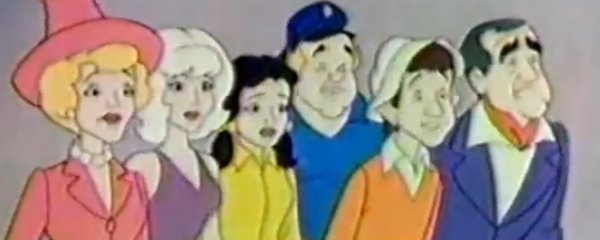
But iconic Boomer tv series don't stay dead for long.  There were endless reruns, and, 10 years later (1974-77), The New Adventures of Gilligan  appeared as a Saturday morning cartoon. Most episodes involved inter-group squabbles, with an 1970s "the more you know" moral, rather than escape attempts.


The characters look considerably younger than the actors they depict.  Gilligan and Mary Anne could be in their teens, and Skipper and the Howells look barely 30.  And why is Ginger platinum blonde instead of "ginger"?

.

In October 1978, I was a freshman in college,  and like every Boomer kid, I had no choice but to watch the tv movie Rescue from Gilligan's Island .  They finally made it back to civilization!  Except instead of having them shipwrecked for a reasonable amount of time, the premise is that they've been on the island for 14 years, since 1964.  They're obviously older, well into middle age or old age, which makes their stuntwork cringeworthy.

They arrive in Hawaii to a huge crowd of well-wishers and fans (except none of their family or friends).  The moment Gilligan leaves the coast guard ship, a soldier hands him an ice cream cone.

Giving a middle-aged man an ice cream cone rather than a hefty check from the insurance company? Bogus!

 They try to go back to their old lives: the Professor to his research university, the Howells to their snooty friends, Ginger to the movies, Mary Anne to her farm in Kansas.  But it's the midst of the sex-and-sleaze disco era, everything has changed, and they're miserable. Fortunately, they end up being shipwrecked on the same island again.  There's no place like home?

Every Boomer kid watched them being rescued again in The Castaways on Gilligan's Island (1979).  This time they return to convert the island into a resort, where they proceed to solve guests' soap opera problems.  Apparently this was the pilot to a proposed tv series, with different problems every week, sort of like Love Boat and Fantasy Island.

First up: a workaholic husband whose wife wants him to relax (played by Happy Days' Tom Bosley and The Bob Newhart Show's Marcia Wallace), and an unaccompanied minor (popular child star Ronnie Scribner) turns out to be a runaway.


Since this is a tropical island, there is some beefcake among the extras lounging at poolside.

Not many Boomer kids, now young adults, cared enough to tune in to The Harlem Globetrotters on Gilligan's Island (1981).  The island is still a resort, with the Harlem Globetrotters as guests, but the plot involves the villainous Martin Landau trying to get control of the valuable mineral "supremium."

Jim Backus, who played Thurston Howell III, was in poor health, so he appeared only in a cameo; his character was channelled by David Ruprecht (left) as his never-mentioned-before "son,"  Thurston Howell IV.

The last gasp of Gilligan's Island, except for in-character guest spots and retrospectives, came in 1982-83, with the Saturday morning Gilligan's Planet. The Professor can't built a boat, but he builds an interstellar spacecraft.  They end up spacecraft-wrecked on an uncharted planet.

Really?

I was in grad school at Indiana University at the time, too old for cartoons.  But even if I was 10 years old, the premise seems unbearably far-fetched.

Besides, I had already seen Lost in Space.

See also: Gilligan's Island

How Proust Can Bore You to Death

I have a confession to make: I have a B.A. in Modern Languages, a M.A. in English, and almost a doctorate in Comparative Literature, and I've never made it through more than a few pages of Proust's  Remembrance of Things Past.

I know I should.  It's an essential work of French literature, and an essential part of the gay literary heritage.  A gay writer, with gay characters, published during the 1920s.

I used to own the hefty Motcrieff translation, plus the first volume in French. Now I have it on an ebook.

Seven volumes, 4,200 pages, and you have to read each page several times because your mind keeps wandering.

The narrator as a young boy is in his bedroom, waiting for his mother to come upstairs and kiss him goodnight.  Then, as an adult, he eats a madeleine pastry, and memories come rushing back.  He used to live in a town named Combray...

 And I thrust the book aside.  Or, lately, I click it off my computer screen.

I've read books about it: How Proust Can Change Your Life, Proust's Library, Painting in Proust, Food in Proust.  

And I pick it up and start again.


2,000 characters, mostly divided into four camps:

The Swanns: An upper-class family.  Charles Swann marries the courtesan Odette.  The Narrator dates their daughter, Gilberte.

The Guermantes: Aristocrats that the Narrator envies. The flamboyant, decadent Baron de Charlus is the most important.

The Verdurins: mostly artists.

The Balbec Girls.  To my disappointment, Balbec does not refer to the ancient Middle Eastern city, but to yet another French provincial town, where the Narrator meets Albertine, the great love of his life.

Yawn.  Is there anything on tv?

I bought the graphic novel version, and still didn't make it past the first few pages.  So...so...sooooo...boring....


Can anyone claim to be knowledgeable about gay literature without having read Proust?

Probably.  There are thousands and thousands of pages of hetero-romance.  We don't get to the gay stuff until Volume 4, Sodom et Gomorrah, translated as The Cities of the Plain.when the Narrator discovers that Baron Charlus is gay and that some of the women he is attracted to are lesbians.  This upsets him, because it means that they are not sexually accessible.

Some critics think that the Narrator is gay, too, because he keeps falling in love with women who have masculine-sounding names: Albertine could be a closeted "Albert," and Gilberte could be "Gilbert."  But that sounds like grasping at straws.

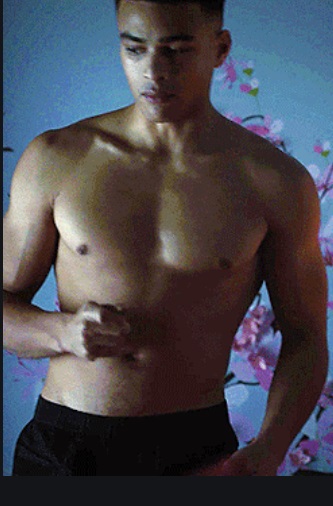
By the way, the top photo is a bodybuilder because when you search for "Remembrance of Things Past" on Google Images, he pops up.

Someone must have decided to post a bodybuilder on their Proust page, to alleviate the boredom.

Jul 29, 2020

My Crush on Bazooka Joe

Ok, I admit it.  When I was a kid in the 1960s, I had a little crush on Bazooka Joe.


Bazooka Gum consisted of an individually-wrapped, pillow-shaped square of Pepto-Bismol-colored bubble gum.  You could buy five of them for a nickel at Dewey's Candy Store, across the street from my grade school.  I wasn't a big fan of the gum, but I liked the wraparound comic, about 1.5 x 1", starring a blond boy named Bazooka Joe and his friends.

You can't do a lot of characterization or plotting in 3 or 4 tiny panels and less than 50 words, so the stories were minimal, usually setups for lame jokes or gags.  But none of the setups involved dating or romance; sometimes Joe was shown with a girl, but no doubt she was his sister.


You can't do a lot of detailed drawing in 3 tiny panels, but the artist somehow managed to make Joe a hunk, with a tight, spare frame.  Notice the second panel, where slightly curved lines suggest a rounded shoulder and bicep-bulge.  That took forethought.


His name, Bazooka: a big gun, powerful and dangerous.

His eye patch: he'd lost an eye, like Popeye or a secret agent.  No doubt in a fight with a villain.  No doubt he also had Popeye's superheroic strength.  Perfect for a gay-coded "my hero" rescue!

Muscle, power, danger, everything you want in a fantasy boyfriend, all in a 1-inch throwaway comic!

Turns out I got Bazooka Joe all wrong.  His artist, Wesley Morse, is mostly famous for drawing leggy dames in strips like Kitty of the Chorus and Frolicky Fables, not to mention a series of x-rated porn comics called "Tijuana Bibles."  He wasn't deliberately trying to draw Bazooka Joe as the object of an eight-year old's romantic fantasy.

Bazooka Joe hadn't really lost an eye: he wore the eye patch in a parody of a series of once-popular magazine ads about "The Man in the Hathaway Shirt."

And he did have a girlfriend; I just missed the strips involving heterosexual dating and romance.

The strips appeared in Bazooka Gum for over 50 years, making Bazooka Joe the most recognizable candy mascot in the world.  He has been referenced on Seinfeld, 30 Rock, and Mad Men,  and there is a professional wrestler who calls himself Bazooka Joe (top photo).

Jul 27, 2020

"Slasher: A Gay Couple, the Other Lesbian, and a Muslim Last Girl. What More do You Want?

There are lots of movies and tv shows called Slasher, so it was hard to find the one that Netflix thinks I have a 93% match with.  Apparently it's an anthology, started in 2016, with the same actors playing different roles, as in American Horror Story.  I started the third season, thinking it was the first.

It's a huge cast, and they aren't good at throwing names around whten a character is introduced, so I have the cast list on IMDB handy, and I'll fill them in as I can.


Prologue: A rave.  Lots of gyrating bodies, hands in the air, glitter, strobe lights, drugs, and sex.  Kit (Robert Cormier), with devil's horns and a nice chest, kisses a guy but selects a girl for nude plowing.

Suddenly Kit is on the deserted street, presumably heading home.  A person in a black robe and glowing mask rushes up and stabs him.  He runs inside an apartment building and starts banging on doors while being stabbed about 100 times.  "Help, I'm being stabbed!" "No, you're a jerk!" "Let me in, I'm being stabbed!"  "No, I hate you!"

Finally Kit gives up and rushes out into the street, still being stabbed.  He is hit by a car, and after a few last words, dies.  Finally! Suddenly the street is crowded with people looking at him.  Where did they all come from?

Scene 1: A year later.  It's morning (the first episode is entitled "6 to 9 am"), and a lot of people get up.  I can't keep track of them all, but there's a gay guy, a homophobe, and a well-dressed guy with a handlebar moustache.  We zoom in on Saadia (Baraka Rahmani), a Muslim girl whose parents caution her to be careful at the party tonight.  It's been exactly a year since...you know.

I don't know if Saadia's dad will be important, but actor Saad Sidiqui is in the top photo.

Saadia lives in the very same apartment complex that Kit the Dead Guy was getting stabbed in and knocking on doors.  On her way out, she runs into the homophobe, who is drunk and trying to get into the wrong apartment.

Scene 2: We switch to  a boy and a girl talking about her final exam today, and finally getting Amber to sleep.  Their baby?  I thought they were boyfriend and girlfriend because one is black and the other Hispanic, but according to IMDB, they are brother and sister, Connor (Gabriel Darku, left) and Jen (Mercedes Morris).

But who's Amber, who she finally got to sleep?  There's a guy sleepng on Jen's lap.  Could that be her?  A transman, or a masculine-presenting nonbinary person?

Scene 3:  I'm getting the idea that everyone lives in the apartment building where Kit kept knocking on doors and screaming for help.  So they're all guilty of "not my problem" selfishness.

Next up:  Frank  (Paulino Nunes) is being abusive to his wife, but not his daughter, who also has finals today.  Then he drives off.

He stops to yell at someone and use racial slurs. The robed figure rushes up  and tries to decapitate him.  It take several blows, and Frank is alive for almost all of them.

Wait -- is the figure stabbing people at random?  If they  wanted Frank, how did they know that he would be stopping at that exact spot?

Scene 4: Cassidy (Genevieve DeGraves) is in bed, mounting a guy with long hair and tattoos (maybe Garrett Hnatiuk?):"Don't you dare go soft on me!".

Aftter they finish, Long Hair asks Cassidy out to breakfast, but she is already on Tinder, looking for the next guy.  Rude!.

Scene 5:  Dan (Dean McDermott), who may be the homophobe from Scene 2,  is writing an anti-Muslim diatribe on his blog.  Suddenly the door opens, and  Long Hair and Cassidy come out!  She is Dan's daughter!  Long Hair didn't know that she was in high school.  Dan yells, Long Hair scrams, Dan continues to yell:

Dan: "You disgust me!  You'll open your legs for any cock!"
Cassidy: "No, only the big ones."

Scene 6: Saadia is at a coffee house, where the barista, Handlebar Moustache from Scene 1, is flirting with her.  She meets up with Jen (who finally got Amber to sleep in Scene 2).  They interrogate each other on history in preparation for their final exam., and discuss the summer solstice party tonight (do high schools get out in late June?).   Handlebar likes Saadia, but hates Jen.  Go figure.

Scene 7: The police have discovered Decapitated Frank from Scene 3.  Newbie Detective Hanson (Lisa Berry) clashes with Detective Singh (Ishan Davé) and yells at the bystanders furiously texting photos of Decapitated Frank to all their frineds.  She remembers interviewing him  last year.

The slasher is named the Druid, by the way.

Scene 8: At the coffee house, Cassidy (the homophobe's daughter) is complaining about her Dad.  Well, he is the worst.  She and her friends discuss whether Handlebar Moustache is creepy or hot ("He's at least 30! Ew!).  Suddenly everyone gets texted a photo of Decapitated Frank -- including his daughter, Erica (Romy Weltman), who freaks.

Scene 9: Saadia and Jen are at school.  Deserted hallway -- they must be early.  Suddenly Cassidy and her Bitch Friends appear and yell at Saadia about Decapitated Frank: "Your people did this!"

Size queen and a bigot? So no black, Hispanic, or Middle Eastern guys?  Poor thing!

Cassidy attacks, pulls off Saadia's hijab, shoves her to the ground.  The principal intervenes and tells them "Back to class!"  Um...class hasn't started yet, right?

Scene 10:  Detective Hanson interviews Decapitated Frank's wife and daughter. She flashes back to the night of the previous murder.  That night, Frank told her that he was sitting in his car, when he saw Kit running out of a building, chased by the Druid, who raised a bloody knife.  Frank raised a gun, and the Druid left.  But he tells the Detective that he didn't have anything to help with except his "tiny fists."

So Frank could have easily intervened, and now he's dead.  Got where this is going?

Scene 11:  The principal gets creepily white-guilt about Saadia having to go tthrough Islamophobic crap. Anyway, the says, you don't need to worry: Cassidy and her ilk will be gone soon.

Is that a threat, Principal Druid?

The final exam starts, but Saadia can't concentrate.  She flashes back to the night a year ago, when Kit the First Murder Victim knocked on her door, but her parents kept her from letting him in.

Scene 14: Aha! Amber was the "guy" asleep on Jen's lap.  She's the Other Lesbian, presenting as male, and now she's dragging around a container of gasoline. Joe (Ilan Muallem, left) and his wife Valerie  look down from a window.  Joe yells "Don't kill yourself!  I'm coming down!  I can help!".  But she douses herself with gasoline -- um, actually water -- while Valerie records his reaction for her vlog.

It was a joke at Joe's expense?  A guy tries to help, and he's made out to be a fool?  Valerie and the Other Lesbian are definitely slasher fodder.  

Scene 15: Joe goes to see another guy.  "I can't keep doing this!" he complains.  They kiss. and hug.


The only male cast member I couldn't identify is Angel (Salvatore Antonio), so that must be the boyfriend.  He doesn't look much like him.

Meanwhile, Violet starts her daily vlog.  It's  one year anniversary of the murder of "bisexual rent boy Kit Jennings."  And now, Decapitated Frank means that the Druid is back!

Scene 16: Saadia lost her cell phone during the fight with Cassidy, so she roams the deserted hallway of the school, looking for it.  She's being followed y a mysterious dark figure, but when she stops for a drink of water, it rushes past her.

On the way to kill Cassidy, Principal Druid?

Scene 17: Yep -- Cassidy isin the restroom, cybersexing with a hookup.  Suddenly the Druid rushes in and dunks her head in a toilet full of acid.  Very gross closeup of Cassidy with her face eaten off.  The Druid leaves.  The end.

Gay characters: Jen and Amber the Other Lesbian.  Joe and his boyfriend, gay but on the downlow.  Probably some others.

Ethnic Diversity:  Lots.  Black, Hispanic, Middle Eastern, South Asian, and a few white people.  It's nice to see a Muslim character doing things other than being Muslim.  Now, if only she turns itno a badass who saves the day.

Beefcake: A bare chest here and there.

Gore:  Lots.

Will I keep watching:  I already know who is druiding, and why.  Do I want to watch people getting sliced up in order of their culpability for Kit's death?

Wait --  Cassidy wasn't as culpable as the Homophobe, who is still around.  Could she be a red herring?  Maybe there are two Druids, working independently.

We can only hope?

Jul 26, 2020

Parker Stevenson and the Big One

In the fall of 1977, the question most gay boys were asking was: "Shaun or Parker?"

Most chose Shaun Cassidy, the fey, impestuous Joe on The Hardy Boys Mysteries (1977-79), the legendary gay-subtext tv adaption of the Hardy Boys books.

But many chose 25-year old Parker Stevenson (right), who played his older, cautious boyfriend. . .um, I mean brother, Frank.  He was just as dreamy, with brown wavy hair and piercing eyes, and he looked just as good in a Speedo.  Maybe better.

Besides, Parker had already played gay-vague characters twice: Gene, who falls in love with Finney in the boys boarding school drama A Separate Peace (1972); and Chris Randall, who is mentored by the older Rick (Sam Elliott) in Lifeguard (1976).

After Hardy Boys, Parker did the soap opera-softcore porn-thriller of the week thing (Not of This Earth, Are You Lonesome Tonight, Terror Peak, Trapped).  I haven't seen any of them.  His only movie with significant gay interest was Shooting Stars (1983), where he played an actor-turned-detective who buddy-bonds with the gruff Billy Dee Williams.


During the 1990s, he returned to the semi-nude beach shots as an aging lifeguard on Baywatch (1989-99).

In 1991, he came into the spotlight again when his then-wife Kirstie Allie won an Emmy for her work on Cheers.  She thanked Parker for giving her "the big one" for the last eight years.  All of his former fans immediately began scanning old teen idol pin-ups, and going through Baywatch in slow motion, looking for signs of "the big one."


I hadn't noticed anything noteworthy before, but now that she mentioned it....

Parker has been the subject of frequent gay rumors, but he hasn't made any public statements.

Jul 24, 2020

"Ugly Betty": The Gay, Transgender, and Racial Diversity Has Not Aged Well


I've been re-watching Ugly Betty (2006-2010), the soap opera/comedy adaption of the Colombian telenovela Betty la fea, about a Latinx girl of unconventional attractiveness (America Ferrara} who gpes to work in the svelte, "new now next" world of fashion magazine Mode.  The two worlds, working-class Queens and the upper East Side upper-crust, compete, collide, and merge in humorous or heartbreaking ways (this is a soap opera,after all).

Alhtough only 10 years has passed since the series ended, our  world is completely different, and Ugly Betty has not aged well.

1. The executive producer, some of the writers, and halfof the cast was Latinx.  The show won Alma awards for Hispanic representation.  But some of the depictions of Hispanic persons are cringeworthy today.  They're not all crass, gauche, loud, and flashy.

2. I find it a little annoying that Betty is supposed to be la fea, but she has to beat off the suitors.  In the first season, she has an on-off romance with a Queens boyfriend and Mode accountant Henry (Christopher Gorham, below), and gets several other suitors.

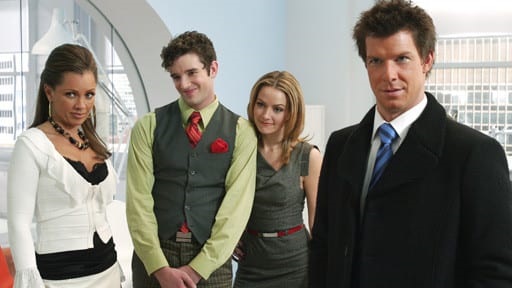
2. Women, especially women of color other than Betty, are scheming, manipulative, devious, underhanded, and treacherous. Mode creative director Wilhelmina wants to become editor-in-chief, a job for which she is exceptionally well qualified.  But magazine mogul Bradford installs his ne-er-do-well son Daniel (Eric Mabius, top photo), who knows nothing about fashion (except how to bed supermodels) and doesn't even want the job, except as a chance to prove to his father that he's not a screw-up. Wilhelmina is the villain, a veritable Wicked Witch of the West.

Other scheming women of color during Season 1 included: Sofia (Salma Hayak), who tricked Daniel into falling in love with her so she could write it up as the lead article in her magazine; and Constance (Octavia Spencer), the case worker of Betty's father Ignacio, who develops a wacky Fatal Attraction obsession with him.


3. Gay men are even worse.  In the first season, there were only two, both  flamboyant, flitting, fabulous fashion plates (plus a straight guy who pretended to be fabulous to get all of the wonderful benefits that gay people get, har har): Betty's nephew Justin, who doesn't actually come out until Season 4, in spite of his mother constantly saying how suppportive she is;and Wilhemina's "flying monkey" assistant Mark. She demeans, belittles, berates, and gay-bashes him every chance she gets, making it obvious that she ccnsiders him less than human.  She even "sells" him to a competing rich bitch.

4. The representation of transgender people is still worse.  Daniel's older brother Alex disappeared for two years and was assumed dead; then he returns as Alexis. It takes awhile,but eventually the other characters get used to she/her pronouns. But everyone, even Alexis, believes that she changed gender rather than confirming the gender identity she had all along: "I used to be a boy, but now I'm a girl." 

And "they cut it off," which is not at all what happens in sex confirmation surgery.

And back when he was a boy, Alex dated and had sex with girls, because, you know, everybody with a penis likes girls.  Now that she has "changed into girl," she dates boys. That's not how it works.  Your sexual orientation doesn't change along with your genitals. But heteronormativity and all that.

Did I mention that Alexis is even a bigger villain than Wilhelmina?

I still like the show, but it's amazing how much the world has changed in just 10 years.

See also: The Heterosexual Gay Kid of Ugly Betty

Jul 23, 2020

The Toast of London: Is Everybody in the Theater World Homophobic?

British humor is distinctly British; 90% of the time, we residents of that country across the pond don't get it.  Do you really sit through all of Monte Python, or do you fast forward to the Dead Parrot sketch?  For every Absolutely Fabulous, there are a dozen Drop the Dead Donkeys.

The Toast of London is a Drop the Dead Donkey

Matt Berry, who you may recall as the effeminate, pandsexual vampire on What We Do in the Shadows, plays a theaterical actor named Toast, who is having problems.  I'm not sure about all of them , but the main ones are:

1. Purchase (Harry Peacock, top photo)a failed actor who now works as a police artist, caught Toast in bed with his wife.  His attempts at revenge fuel most of the plot.  According to wikipedia, he is homophobic, but this doesn't come out in the first episode.

2. Due to financial problems, Toast is forced to stay with fellow actor Ed Howzer-Black (Robert Bathurst), who lives with an elderly agoraphobe, who may or may not be his lover.  When he convinces her to leave the house for the first time in two years, she is accosted by a flasher. Purchase frames Toast.

3.  Trying to find another place to live, Toast visits his estranged brother Blair (Adrien Lukis), a war veteran with an amputated hand, a bit of a looney, a lot of a homophobe.  He wants Toast to give up acting for the army, since there aren't any "homosexuals" to bollock things up.  Later, Purchase attacks Toast in the bathroom, and Blair thinks that they are having sex, and freaks out.

4. Toast gets a voiceover job which requires him to say one word: "Yes."  But the crew make him say it over and over until he loses his temper.

5. Toast must audition for Cliff Promise (Geoffrey McGivern), who is in prison for Holocaust denial.  I didn't know you could actually go to prison for that.  So Toast goes to the prison and reads a scene about an extra marital affair.

Promise tells him that the character is gay, so Toast camps it up.  The other prisoners think that they are a gay couple, and attack.

So, two scenes where people think that Toast is gay, and react with contempt or violence.  And we didn't even get around to Purchase's homophobia.  And I'm supposed to find this funny?

My grade:D


Jul 17, 2020

The Gay Enchanted Forest of Spooky the Tuff Little Ghost


When I was a kid in the 1960s, my favorite comics by far were the Harvey supernatural titles: ghosts, witches, and devils roaming an oddly-Medieval Enchanted Forest where same-sex desire was commonplace.

I preferred Casper, but in a pinch, I would read about Spooky the Tuff Little Ghost, a ghost boy with a Brooklyn accent, freckles, and a derby (or, as he pronounced it,  “doiby”).  (Not to be confused with Charlton's far inferior Timmy the Timid Ghost).

But while Casper was a 1960s nonconformist with a gay-coded softness and sensitivity, the hawkish Spooky had no aversion to booing.


 In Spooky’s wild region of the Enchanted Forest, ravenous bears, ogres, monsters, and evil wizards leapt out from behind every boulder, so booing was an essential form of self defense.  But for Spooky, it was an all-consuming passion.  He specialized in complex, artistic boos, creating statements similar to the happenings and guerilla theater of the 1960’s art scene: he might boo a horse and rider into trading places, so that the rider runs off with the horse on his back, or he might boo a lake out of its bed so precisely that the fish remain, swimming in mid-air.

In “Once upon a Scaresday," Spooky explains how he took up booing in the first place.  As a child, he was a coward and a sissy, always running away from danger.  One day he was walking in the hills beyond Spooktown with some friends, when cannibalistic monsters called Ghostcatchers attacked.  Spooky managed to run away, but his best friend Googy was captured and dragged off to be cooked and eaten.  Distraught with guilt and mourning his loss, Spooky asked his grandfather for advice, and the elderly ghost taught him how to defend himself by booing.  He proved to have a great gift for this ghostly martial art, and soon he was able to seek out the monsters and rescue his friend just as the cooking-fire was being lit.


A same-sex relationship originally motivated Spooky to boo, and a heterosexual relationship now compels him to stop.  Spooky and Poil (his pronunciation of Pearl) are quite an adult couple, dating, dining at each other’s homes, and even kissing on couches.  Pearl forbids him from booing.  She claims that it is immoral, but her real reason is class-based snobbery: she considers booing boorish and vulgar, a working-class pastime likely to offend her high-society ghost friends (but they usually turn out to be closet booing fans).


Spooky is constantly promising to refrain from booing, to keep Poil from brow-beating or even leaving him.  Many stories involved his frantic but quite clever schemes to continue booing after such a pledge, either for self defense or to assuage his addiction: he throws his voice, writes “boo” in the sand, spells it out with smoke signals.  But why would Spooky even agree to cease a useful, artistic, socially-praised, and strategically necessary activity, just because Poil disapproves?  Obviously she offers something more valuable than any of these things, more valuable than any love, but what?  I was mystified; I could imagine giving up a bad habit or even an innocuous hobby at the admonition of a friend, but a career, a passion, a veritable calling?

I knew it had something to do with the girls who jumped their ropes and played their singsong games in the shadow of the school.  At recess, we boys were herded far away to fields to play baseball and dodge ball, and if ever once we tried to play jump rope, or merely sit on the steps nearby to avoid the midday sun, a teacher would scream wildly at us to stay put.  What danger lurked there, against the cool bricks?  What threat did girls pose that could force Tommy Kirk to forsake his buddies at Midvale College, or Alec to forsake the wonders of the Earth’s Core, or Spooky to forsake his booing?

Jul 16, 2020

Manly P. Hall: Gay Psychic Murdered by His Lover

When I lived in Los Angeles, there was a University of Philosophical Research at 3910 Los Feliz, near the Silverlake gay neighborhood.  But it wasn't a university, and it didn't do any philosophical research, although it had a library of 50,000 volumes.  It was a mystical/occult organization founded by Manly P. Hall (1901-1990), who published The Secret Teachings of All Ages (1928).

I haven't read it.  It's a gigantic compendium of occult lore, thick, dense, and impenetrable, with chapters on "The Bembine Table of Isis," "The Hiramic Legend," "Hermetic Pharmacology," and "Fundamentals of Qabbalistic Cosmogony."  But it was immensely popular, on the shelf of everyone from H.P. Lovecraft to F. Scott Fitzgerald, and it has never gone out of print.


Hall became one of the biggest celebrities of the era.  In 1934 he founded the Philosophical Research Society, and stocked its library with thousands of rare occult volumes purchased for him by wealthy disciples, notably oil heiress Carolyn Lloyd.

He wrote many more books -- nearly 200 -- some with beefcake covers, like this rather buffed deity with a shining phallus creating the worlds.

He delivered over 7,000 lectures.

For all his erudition, Hall's philosophy was simple.  His Ten Basic Rules for Better Living include:
1. Stop worrying.
2. Don't try to dominate and control other people.
3. Learn to relax
4. Cultivate a sense of humor
5. Reign in your ambition.
6. Don't accumulate more than you need.
7. Believe in something bigger than yourself.
8. Never intentionally harm anyone.
9. Beware of anger.
10. Never blame others for your own mistakes.


Elvis Presley was a fan.  So was Ronald Reagan. He officiated at the wedding of horror movie great Bela Lugosi.

Disciples stood in line around the block on Los Feliz Avenue to hear his advice.  Astrologers, bodybuilders, magicians, actors, writers, philosophers.

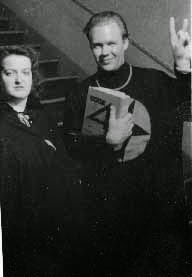
A few -- the best and brightest, the most eager, the most muscular (see top photo) -- stayed on, to become his assistants.  Like future paranormal researcher Arthur Louis Joquel.


Hall was gay or bisexual.  He was married twice, but neither marriage was ever consummated.  His wives and disciples turned a blind eye to his interest in attractive male proteges, and quickly put a stop to any hint of scandal. Except for the last one.

In 1988, when Hall had become morbidly obese, almost unable to walk, and showed signs of dementia, he fell in with a salesman-turned-psychic named Daniel Fritz, who claimed to be a reincarnation of a prince from ancient Atlantis, and his son David, who regularly took spirit-journeys to Jupiter.

No different than the hundreds of other psychics, astrologers, occultists, and reincarnated princes that Hall had entertained over the years.  But his disciples suspected that these two were con artists.  

In August 1990 Hall rewrote his will to give Daniel his entire estate, worth some $52,000,000.  Six days later, he was dead.  Daniel and David were alone with the body for several hours.  Disciples believed that the two had murdered him.

An inquest found no evidence of foul play.  But the will was contested, and the estate reverted to Hall's widow.  Daniel and David moved on to other clients.

Jul 14, 2020

"Spy Intervention": You Knew What You Were Signing On For

I  plugged in Spy Intervention, hoping for some beefcake, and maybe a best-buddy spy gay-subtext.

Scene 1:  A stereotyped caveman and woman (both blond white people). The voiceover: "At the dawn of time, men's and womens' roles were well defined."  Men hunted and gathered, and women stayed home "in the safety of the cave to cook."

That's idiotic.  No such strictly defined gender roles existed, and nobody actually lived in caves. 

"But over millions of years, something strange happened.  The lines blurred."

Ok, homo sapiens have only been around for about 300,000 years.  And the sexist fool is upset over women being able to work outside the home? 

Only 1 minute and 3 seconds in, and I'm already tearing my hair out.  I don't think I'm going to make it.

We go through history to the white-picket-fence 1950s, the couple kissing in each era.

Scene 2:  Spy (Drew Van Acker, top photo) and his associate Smuts (Blake Anderson, right) discuss where to take their girlfriends (Paris...Katmandu?).

Meanwhile Spy jumps out of a plane, kills an assassin, chases the bad guy through a shopping mall, and collides with the Girl.  They have a "are you as turned on as I am?" argument while the Bad Guy gets away.

Scene 3: Smuts and the two girls are in a hot tub in Katmandu, being stood up by Spy, who has taken the Girl ice-skating.

I fast forward through six minutes of them talking, kissing, talking, kissing, holding hands, having sex, holding hands, talking, and sitting on a couch in matching sweaters. Some long-shots of Spy's chest, but they are drowned out by the tight close ups of the Girl's face.  You can count the nostril hairs.

Scene 4: The Girl is at work in the mall, being hit on by a customer.  Sassy Friend tells her she's an idiot for not dating the rich guy, but the Girl is holding out for True Love.

Scene 5: Spy resigns (uh-oh, time for The Village).  He wants a normal life, with a job selling cardboard, a house with a picket fence, bowling on Tuesday nights, kids' soccer games, Satirdays at the hardware store.  Do men actually want the heteronormative trajectory of job, house, wife, kids, or is it just the power-elite trying to get us to buy things?

Scene 6: Spy and Girl move into a horrible house in the suburbs -- ranch, no picket fence.  They unpack boxes then kiss for 2.5 minutes of screen time..  This is every 1960s sitcom.  No, honey, I don't want any of your wealth/fame/witchcraft powers/genie powers.  I want to live a normal life, with you as my house slave...um, housewife.

Scene 7:  Spy is at his job selling cardboard from a cubicle, then joining the bowling team, then coming home to announce "Honey, I'm home," whereupon the Girl feeds him a sample of the Nepalese dinner she has prepared.  Nepalese?  Shouldn't she be making meatloaf? 

And what does any of this have to do with the first scene, the adulation of prehistoric times, where women knew their place," but then gender roles got all mixed up?  The Girl seems to know her place perfectly well.

Scene 8: Spy hates his job, and he's lousy at it; and he hates his bowling team for not being interested in winning.  Meanwhile, a lady dressed in a 1960s British raincoat photographs Spy (we never discover what that is about).

Scene 9:  Two minutes of Spy and Girl kissing. But then she refuses sex with him.  Uh-oh.

Scene 10:  Girl and Sassy Friend discuss how bored and miserable she is. Gee, too bad she didn't marry a spy, har-har.  

Meanwhile Spy and Smuts discuss how bored and miserable he is.

Scene 11:  Spy is captured and tied up -- by the other spies.  Smuts introduces him to his new partner, nicknamed Remora, the Sucker Fish (because he likes to give blow jobs?  Is this a gay reference?).

Remora is played by Akaash Yadav, who is attractive but has an Instagram full of pics of him hugging a woman, gazing into her eyes, dancing with her, and so on.

 They tell Spy that he is bored and miserable because he never finished his las assignment: to capture the Bad Guy he was chasing when he collided with the Girl 

Bad Guy recently got married, and is honeymooning right there in suburbia.  He's also planning to buy plans for a weapon that can destroy the world.  All Spy has to do is intercept the plans.

Spy refuses and walks out, but changes his mind later, while in bed in his...ugh...suburban home.

Scene 12:  Spy is paired with a Mrs. Spy (because marreid men seem more trustworthy to heteronormative heterosexist heterosexuals). But the agent assigned to be Mrs. Spy doesn't think that anyone would believe someone as babilicious as her would marry such a schlub so she gives him a hotness makeover.

There's some buddy-bonding homoeroticism between Spy and Smuts ("we've always worked together"), but it's drowned out by the incessant "we used to get lots of hot girls" talk.

Scene 13: Gone until late at night, hot makeover?  Spy is obviously having an affair.  The Girl commisserates with Sassy Friend.  Meanwhile, Smuts and Remora are filming Spy and Mrs. Spy in sexy positions, for some reason.

Scene 14: Spy attacks a guy at the hardware store, mistaking his princing gun for a real weapon.  He has problems at work and with the bowling team.  Then he rushes off to his spy assignment: dinner at the same restaurant Bad Guy (Max Silvestri) and Mrs. Bad Guy are eating at.  The Girl puts on a disguise to spy on Spy.

I skipped over the ensuing comedy of errors.

Scene 15: Spy at the bowling alley, complaining about the narrowly defined suburban life: "There's got to be more than this, right?"  His buds explain: no, there is no more.  "You get married, have a couple of kids, stop having sex, save for retirment, pick where you want your ashes scattered.  There is no grand adventure, just living."

This is certainly a critique of the heteronormative job-house-wife-kids trajectory.  But I don't think they mean to critique heteronormativity; they want to find the grand adventure in Her Eyes.

Scene 16: Spy goes home, takes off his shirt (finally, some beefcake!) and argues with The Girl over grand adventure vs. just living.

Scene 17: The Girl tails Spy to the hotel where he's staying with the fake Mrs. Spy.  They put on spy-swimsuits and head to the pool (beefcake and enormous bulge nearly hidden by tiny string bikinis).  They buddy up to Bad Guy and Mrs. Bad Guy.

Spy excuses himself and accosts the Pool Boy, who has the secret plans.

Then The Girl confronts Spy over his "cheating."  Mrs. Spy tries to salvage the con by saying that she is a delusional ex-fiancee, but Bad Guy and Mrs. Bad Guy are gone.

Scene 18:  Back home, Spy tries to reconcile with the Girl.  Suddenly the bowling team and their wives show up for the dinner party the Girl has apparently scheduled.  Then Sassy Friend.  Then the fake Mrs. Spy, trying to salvage things by explaining that she is the sexy dance instructor.  Then Bad Guy arrives to ask for his plans back, or he 'll shoot them all.

There's a tiny bit of lesbian-flirting between Sassy Friend and the fake Mrs. Spy, but it's over in a second.

Spy finally comes clean about the spy thing.  The Girl is angry with him for ruining the dinner party.

They subdue Bad Guy, and the bowling team subdues the henchmen (getting their grand adventure after all).

Scene 19: Divorced from Spy, the Girl quits her job and designs her own toiletry line called "Undercover: Discove who you really are."  Darn, I thought she was going to become a spy, like Scarecrow and Mrs. King.  How is selling shampoo adventurous?

Meanwhile, Spy, back in the spy biz, is climbing a mountain with Smuts, fake Mrs. Spy, and Remora..  Smuts asks Remora to go out for a beer later, but then reneges -- a tiny gay subtext?

Spy still misses The Girl, and....Tell me that True Love isn't going to win!  Please?

Scene 20:  Darn it!  "If we embrace our primal instincts, every day can be an adventure." In other words, invite Her along on the adventure, which is the exact opposite of the Scene 1 message that women should stay back in the cave, making meatloaf.

 Three -- three heterosexual couples and a fade-out kiss between Spy and The Girl.  True Love wins out, making the job, house, wife, kids trajectory wondrously fulfilling, with only the tiniest bit of "really stretching it" gay subtext.

But I knew what I was getting into from the start.  Should I be upset when it happens?
Related Posts Plugin for WordPress, Blogger...