Showing posts with label Weho. Show all posts

Aug 1, 2026

"You Spin Me Round": The Theme Song of 300 Sunday Afternoons in a Leather Bar

In West Hollywood, gay bars always had a theme song that you would hear over and over, at least once an hour, every time you visited.

 I went to Mugi, the Asian bar in Hollywood, almost every Saturday night, sometimes Wednesday or Friday, too.  That means that I heard "One Night in Bangkok" at least 300 times.

I went to the Faultline, the leather bar on Melrose, near Los Angeles City College, almost every Sunday afternoon for their Beer and Soda Bust.  The traditional schedule was Church 10:30 am, brunch at the French Quarter 12:00, Gym 2:00 pm, and the Faultline by 4:00 pm.  We hung out on the patio unless it was raining, and it never rains in Southern California.


Around 6:00 pm we left, and picked up tangerine chicken on the way home to eat while watching The Simpsons, Married...with Children, Parker Lewis Can't Lose, and Sliders (Jerry O'Connell, sigh).

Sometimes I went on Friday or Saturday nights, too.  So I must have heard their song over 1,000 times.


I never heard it anywhere else. I didn't know the title or the group, and I didn't bother asking.

It seemed to be a Gay Pride anthem:

Open up the closet door, watch out, here I come.

Although some of the lyrics seemed to involve a bar pickup:

You, I don't even know your name, baby.
You, I want to get you alone, baby.

With a chorus:
Round, round, round, round, something something baby, round round round round.

Years later, I heard the song again, at the gym of all places, and it brought me back to those many nights and Sunday afternoons surrounded by shirtless and leather-clad men.  When I got home, I did an internet search.


It's "You Spin Me Round (Like a Record)", by the British band Dead or Alive, released in December 1984, peaked at #4 on the dance charts in January 1985.

Boy, did I get the lyrics wrong!  The "gay pride anthem":

Not: Open up the closet door, watch out, here I come.
But:  Open up your lovin' arms, watch out here I come.

Not: You, I don't even know your name, baby/ You, I want to get you alone, baby
But: If I, I get to know your name, baby / Then I could trace your private number, baby

So you're planning to stalk him?


No specific gay content, although the lead singer of the bad was the fabulously feminine Peter Burns (bottom left), an androgyne in the mold of Boy George, who married a woman and then a man, but divorced him and declared in homophobic contempt that "gay marriage doesn't work.  It's better to marry a woman."

Other members were Mike Percy, Steve Coy, and Tim Lever.

I'm still trying to figure out why an androgynous dance number was the theme song in a leather bar with no androgyny and no dancing.


It doesn't really matter.  Even though I know the lyrics now, I still can hear in my head the gay pride anthem from 300 Sunday afternoons at the Faultline:

Open up the closet door, watch out, here I come.

See also: One Night in Bangkok


Jul 6, 2026

The 20 TV shows that we watched in West Hollywood: a gay brother, some "confused" guys, squabbling drag queens, Seinfeld, and Mario Lopez (sigh)


I lived in the heart of the Gay World, West Hollywood, San Francisco, and the East Village, from 1985 to 2001.  There wasn't much time for television, with our part time jobs, classes, AIDS volunteer activities, church activities, and endless nights of cruising, but a few shows were not to be missed.  They had strong gay subtexts, actual gay characters, or lots of muscular men.


1. The Golden Girls. Everybody watched the Girls before heading out to the bars on Saturday night, but you had to be careful.  Usually they were relatively gay-friendly, but suddenly, without warning, Blanche would reject her gay brother, or Rose would be horrified to discover that lesbians exist.

2. Mama's Family.   Another pre-bar show, with Vickie Lawrence as the elderly, crotchety Mama, Ken Berry as her dimwitted son, and Allan Kayser as her grandson, cast for obvious reasons.


3. Brothers.  We had to go to a friend's house to watch this Showtime sitcom about three grown-up brothers, two macho, grunting types, and one gay.

4. Dynasty.  Squabbling rich ladies with drag queen hair, some beefcake,  and a "confused" guy who veers between gay and straight.

5. Murder, She Wrote.   My friend Alan forced me to watch Jessica Fletcher solve murders every Sunday night.  One episode had a gay-light character: a fellow mystery writer whose whodunits are filled with "Greek boys mincing about."


6. Pee-Wee's Playhouse
Man-child Pee-Wee has hunky and drag queen friends, plus a genie who lives in a jewelry box. "Swish?  Did somebody say swish?"

7. Saved by the Bell.  Saturday morning teencom with Mario Lopez taking his shirt off.  'Nuff said.


8. Married...with Children.  A raunchy send-up of the heterosexual nuclear family, with occasional only-slightly-homophobic references.  Ed O'Neill would go on to play the patriarch of Modern Family, and David Faustino would bulk up and become a gay ally.

9. Eerie, Indiana.  I dig shows about quirky small towns, and Omri Katz, who would go on to star in gay films, had a gay-subtext buddy-bond with fellow paranormal investigator Justin Shenkarow.


10.  Mystery Science Theater 3000: Joel and the Bots riffed on cheesy movies every Saturday morning, and all day on Thanksgiving.


More after the break

May 1, 2026

Bob Paris: The World's First Out Gay Bodybuilder

 I started working for Joe Weider's Muscle and Fitness in  July 1985.   Bob Paris was on the cover.

We had a lot in common: he was one year older than me, grew up in Columbus, Indiana (near where my parents live today), attended Indiana University, and escaped to the gay haven of West Hollywood.  Originally he intended to become an actor, but he soon found his way into the world of competitive bodybuilding.

He won many competitions, including Mr. Southern California in 1981, and both Mr. America and Mr. Universe in 1983.


I met him sometime in 1986 -- we never dated, but I learned that he was gay.

He came out publicly in July 1989, in an interview in Iron Man, by mentioning his lover, fellow bodybuilder (and Playgirl model) Rod Jackson, whom he had just married in a Unitarian service.

No professional bodybuilder had ever come out before.  Actually, no professional athlete in any sport had ever come out during his career.

His friends advised him to stay closeted, but he was optimistic that, with all of the gay people working in bodybuilding and all of the gay fans, there would be no problem.

But there were lots of problems. His career didn't exactly end -- he continued to compete through 1991 -- but he lost a huge amount of business, including advertising tie-ins, and extensive homophobic harassment, including death threats.

But many fellow bodybuilders and fans applauded Bob's decision to come out.  Even the rather homophobic Joe Weider put him on the cover of Muscle and Fitness three times in 1990 -- the "Sexual Response" tag near Bob's crotch wasn't an accident.

In 1991 Bob and Rod retired from bodybuilding to concentrate on being the most famous gay couple in the world.  Eventually the stress of having to be perfect all the time put a strain on their relationship, and they broke up.

Rod has been busily acting, writing, and advocating for gay rights, especially gay marriage.   He has published several books on fitness, plus fiction, poetry, and two autobiographies: Straight from the Heart: A Love Story (with Rod) and Gorilla Suit: My Adventures in Bodybuilding.


He has appeared frequently in theatrical productions in Los Angeles and elsewhere, including the Broadway musical Jubilee.

Today Bob lives on an island near Vancouver, British Columbia, with his second spouse, Brian LeFurgey.


He continues to act, write, and inspire a new generation of bodybuilders.


Jan 1, 2026

The Golden Girls: Homophobic Gay Favorite?

When I was livingin West Hollywood,  Saturday night meant picking up tangerine chicken to eat on tv trays while watching Throb, Mama's Family and The Golden Girls, then heading out to the bars.

The Golden Girls' theme song "Thank You for Being a Friend" still brings back memories of those Saturday nights of lights and music, checking out the musclemen, searching for Mr. Right (or Mr. Right Now), and schmoozing with friends.

It featured four senior citizens who live together in a Miami:

1.Former Southern Belle Blanche (Rue McClanihan), the s*xually active one.

2. Dimwitted Rose (Betty White), who is from St. Olaf, Minnesota.

3. Sensible Dorothy (Bea Arthur).

4. Her mother, the sarcastic Sophia (Estelle Getty).

(Their kitchen table could only seat three, so Sophia had to find some excuse to hover around instead of sitting).


The real Miami has a population of 500,000, 2.8 million in the metro area, but on The Golden Girls, it was a small town where everybody knows everybody and you run into friends on the street.

The real Miami is 70% Hispanic, but on The Golden Girls it is exclusively white.

The real Miami was the site of Anita Bryant's homophobic Save the Children campaign in the 1970s, and in spite of the generally gay-friendly cast,  The Golden Girls could be quite homophobic:


1. In 1986, Dorothy's lesbian friend Jean visits after her partner Pat dies.  Everyone assumes that Pat was a guy.  Then Jean develops a crush on Rose, who is unaware that LGBT people exist.  When she is apprised, she is shocked and horrified. 

2. In 1988, as Sophia prepares to marry Max Weinstock (Jack Gilford), Blanche cannot restrain her disgust at a feminine caterer (Raye Birk, left, photo cropping his limp wrist)

"You're about to fly right out of here, aren't you?" she asks, alluding to the stereotype of gay men as "fairies."  

"Well, excuse me for living, Anita Bryant," he snaps back, before revealing that he has an ex wife, to gales of audience laughter.  Those wacky fairies!  

He returned in 1991 to cater Dorothy's wedding.

Raye Birk, a retired professor of theater at USC, is straight in real life.  He played played a mailman on Cheers, the assistant principal on Wonder Years,  a terrorist on Due South, one of Tim's grunting, sweating buddies on Home Improvement, and a fairy.

More after the break

Sep 18, 2025

Gay Comics of the 1980s

When I moved to West Hollywood in 1985, I was astonished.  There were no gay characters in any comic book or comic strip I had ever seen before, even in gay magazines, except for an occasional Donelan cartoon or Tom of Finland erotic drawing,  but here there were entire strips with all-gay casts (except for the occasional heterosexual villain). In Frontiers, the weekly news magazine. In the monthly anthology Gay Comix (1980-1988), by Kitchen Sink Press.  In the Meatmen anthology of trade paperbacks, edited by Winston Leyland (1989-1999).

During the late 1980s, they stopped being called "comix" (underground, radical) and became "comics" (mainstream).

Here are my favorite gay comic titles:

1. Murphy's Manor (Kurt Erichsen), about a regular guy who works as a librarian in Black Swamp, Ohio, and his various gay and lesbian friends.

The Sparkle Spinsters, led by the flamboyant Duchess (right), sometimes appeared in a separate feature.


2. Jayson, by Jeffrey A. Krell.  Jason Callohide is an underemployed liberal arts graduate sharing a single apartment in Philadelphia with his straight gal pal, Arena Stage. They are drawn in the clean, spare style of Archie Comics.

 Jeffrey A. Krell has published several trade paperbacks of Jayson's adventures, the most recent in 2012.  He also produced an off-Broadway musical, Jayson


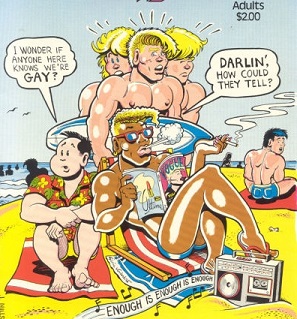
3. Poppers, by Jerry Mills, set right in the heart of West Hollywood, starring Yves, a regular guy who works in a bookstore, his hunky best friend Billy, and the flamboyant Andre. It features all of the glitz, glamour, sex, and drugs that you expect in the pre-AIDS era of sexual liberation (it's even named after a psychotropic drug, amyl nitrite)

But beneath all that it's about friends sticking together in a hostile world, about the search for a place where you belong.

Jerry Mills died of AIDS in 1993.

You can get gay comics now on Amazon -- they arrive in mail, hidden from view in a brown box -- but that can't match the immediacy of walking down to the Different Light Bookstore on Larrabee and Santa Monica and grabbing them right off the shelf.

See also: Donelan; Howard Cruse; and Tom of Finland.

Jun 25, 2025

Michael J. Fox/Alex P. Keaton


Michael J. Fox was the first celebrity I ever  met.  Shortly after I moved to Los Angeles in 1985, I met a guy who knew him from acting class, and the three of us had lunch at a place on Melrose Boulevard.  He was very nice, and completely gay-positive (and heterosexual, even though my insanely jealous boyfriend Ivo claimed to have dated him).

 Unfortunately his sitcom Family Ties (1982-89) wasn't.

It was one of the 1980s "family values" comedies, like Growing Pains, Life Goes On, and Home Improvementabout liberal ex-hippies (Meredith Baxter Birney, Michael Gross) with politically conservative kids (Scott Valentine was daughter Mallory's boyfriend). Michael played the teen Alex P. Keaton, a Young Republican whose money-grubbing provides most of the jokes.


Gay people did not exist in the world of Family Ties -- if they did, Alex's ultra-liberal parents would certainly have had gay friends.  However, sometimes Alex plays the "is he gay?"  game.  In order to impress a girl, he dons an apron to cook dinner. When Dad criticizes this gender transgression, he counters "I hope you don't mind -- I borrowed your apron.  I got quiche on mine."  The joke plays with the expression "Real men don't eat quiche."


In "Little Man on Campus," he fails his first test, and asks his sister Mallory why she fails so often:

Mallory: When I take a test...my mind starts wandering.
Alex: What do you think about?
Mallory: Boys.
Alex: (Waits for the howls of laughter to subside). Let's hope it's different for me.


Pretending to be gay as a joke only works if you don't have any significant same-sex friendships, so Alex carefully avoids sidekicks.  Wacky next door neighbor Skippy (Marc Price) hangs around because he has a crush on Mallory; they become friends anyway, but Alex carefully polices the relationship, even rejecting the standard sitcom stage business of sitting pressed together on a couch (so they can both be in a closeup).  In one episode, they somehow fall onto the bed together.  Skippy nonchalantly continues their conversation, but Alex recoils in horror and jumps away.  Since no gay people exist, this rejection has an even greater emotional impact than the homophobia of Teen Wolf, marking even nonsexual friendships as bad, wrong, and disquieting.


A few episodes suggest -- but immediately reject -- the possibility of romantic love between Alex and a male friend. In "Best Man," Alex's friend Doug (Timothy Busfield) gets engaged.  He treats Alex and his fiancee as emotional equivalents, hugging them and squealing "You're both so cute!", but still, Alex feels threatened by the new relationship and refuses to be his best man.  When he finally understands that he will still be an essential part of Doug's life, he hugs Doug so tightly at the altar that the minister, in "jest," asks which couple is going to be married.


In the two-part episode "A, My Name is Alex," Alex's friend Greg (Brian McNamara) is killed in an auto accident, and Alex is so distraught that he requires psychiatric help.  But after digging into his subconscious, the psychiatrist fails to find any homoromantic feelings, just guilt because Alex refused to accompany Greg on the errand that killed him, and the recognition of his own mortality.

How does someone who is so gay-friendly play someone so anti-gay on tv?

It was the 1980s?

Jun 8, 2025

Fred with Tires: The Iconic West Hollywood Photograph

This is one of the iconic photos of West Hollywood.  Nearly everyone I knew had a print in their living room or bedroom.  It was a fixture in our homes, like the family photos that heterosexuals keep on their mantles:

A buffed young man carrying tires through an auto shop, his male-model face and expensive hairstyle contrasting with his working-class surroundings, a sweaty, macho, implicitly heterosexual grease monkey emerging from his closet, transformed into an object of homoerotic desire.

He represented all of small-town joys that we left behind in the Straight World, and the much greater joys we found with our friends and lovers in our new home.

I didn't know where it came from until yesterday: it's "Fred with Tires" by fashion photographer Herb Ritts (1952-2002).


He grew up in a wealthy household in Los Angeles (his next door neighbor was Steve McQueen), and attended Bard College.  His photography career began in 1978, when he and buddy Richard Gere had car trouble on a road trip, and he began photographing the future star in front of their jalopy -- not shirtless but sultry, bulging, a canny evocation of working class machismo combined with pretty boy sensitivity.

The next year, a photo of John Voight made it to Newsweek.

Pleased with the critical reaction, Ritts began photographing other celebrities, such as Brooke Shields and Olivia Newton-John.  He specialized in female supermodels like Naomi Campbell and Cindy Crawford.  He published a number of books on fashion photography, and became a renowned expert in the field.

He was also a well-known commercial photographer, with work for Levis, Revlon, Brut, Chanel, Maybelline.


Although he was gay, out since college, in a committed relationship with partner Erik Hyman, his artistic emphasis was always on the feminine.  There are only a few male celebrities in his archive, and those few are rarely shirtless, displaying a sensuality but not overt eroticism.  This color photo of Justin Timberlake is an exception.


So how did we get "Fred, with Tires"?  In 1984, Herb hired a UCLA undergrad named Fred for a raincoat ad in the Italian magazine Per Lui.

 He hated the raincoats, so he had Fred pose in jeans instead.  The editor hated the photos -- too sultry, too erotic, too gay -- but ran them anyway.  And the last, taken when Fred was tired, sweaty, and little annoyed, anxious to finish up and go home -- perfectly captured the West Hollywood moment.

The original hangs in the Getty Museum, and prints became fixtures in our apartments, emblematic of home.

Mar 5, 2025

Russell Johnson: The Professor and His Gay Son

Everyone in West Hollywood knew Russell Johnson, who played the Professor on Gilligan's Island.  I met him once, and saw him a few times at events.  He was a gay ally, primarily due to his son David..


Everyone in West Hollywood knew David, too -- Alan (my ex-porn star roommate) dated him.  He was a fixture in the bars, at the French Quarter, and at the AIDS Project of Los Angeles.  Later he was named AIDS Coordinator of the City of Los Angeles (he died in 1994).

Russell's career began during the 1950s, with lots of roles in Westerns and sci-fi movies: look for him in the MST3K rendition of The Space Children (1958). 


In the late 1950s, he moved into tv, with guest spots on Twilight Zone, Thriller, Laramie, Rawhide, and such hip-detective series as Adventures in Paradise and Hawaiian Eye.  But Boomers will always remember him for Gilligan's Island, a "trapped far from home" sitcom about seven people who set sail from Honolulu for a "three hour tour" and end up trapped on a desert island.

The Professor was an egghead of the old school, an expert in every field of science from astronomy to zoology, who constantly amazed kids in the 1960s by concocting radios from coconuts.  His utter lack of interest in the two female castaways, Ginger and Mary Anne, gave me some of my first gay subtexts.

And some of my first beefcake, in his occasional shirtless scenes.

Although typecast as the Professor, Russell continued to work steadily during the 1970s and 1980s.  But he devoted most of his time to raising AIDS awareness and taking care of David.

His last screen role was in 1997, in Meego, about an alien boy hiding out on Earth. He played "The Professor."

Russell died in 2014.

Feb 10, 2025

Twin Peaks: The owls are not what they seem

In the spring of 1990, many tv viewers were persuaded to turn away from the Thursday night juggernaut of The Cosby Show -- A Different World -- Cheers -- and Wings to watch Twin Peaks, a tv series created by surrealist director David Lynch, to learn "Who killed Laura Palmer?"

No one knew that the answer would become so darn convoluted.

The premise: popular high schooler Laura Palmer of Twin Peaks, Washington, is found murdered.

FBI Agent Dale Cooper (Kyle MacLachlan, best known for Lynch's homophobic Blue Velvet) is called in to investigate, and works with local sheriff Harry S. Truman (Michael Ontkean, best known then as the gay guy from Making Love).


Gradually they discover that everyone in town has multiple dark secrets.  There are weird alliances and interconnections.  A middle-aged woman regresses to a teenager.  Laura's psychiatrist commits suicide.

Cooper has a dream of a backward-talking dwarf who is From Another Place, who makes cryptic utterances like "when you see me again, I won't be me" and "everybody is full of secrets."


Laura had several secrets of her own.  One wonders how she found time to hang out with her boyfriend  (played by Dana Ashbrook, left), when she was having affairs with several older men, as well as working as a prostitute to support her drug habit.  (In David Lynch's world, prostitution is the Ultimate Evil).

After seven episodes, the first season ended, with lots of clues but no answers.

During the summer of 1990, The Secret Diary of Laura Palmer was published, and became a must-read.  It offered no new clues.

You could also get Twin Peaks: An Access Guide to the Town, with tourist information about the town, including the cafe where Cooper got his "damn fine coffee!" and cherry pie.


In September 1990, the second season began, on Saturday nights.

A giant who may be an alien warns Cooper that "The owls are not what they seem."

Whatever that means.

Laura appears in a vision and says "Sometimes my arms bend back."

Whatever that means.

Cooper learns of Black Lodge, which can manipulate world events.

There was no way to unite all of the plot threads into a coherent whole, so in December they threw in a lame explanation -- Laura was murdered by her father, who was being possessed by a being named BOB, who was working for the Black Lodge, who...or something like that.  And everyone scratched their head and said WTF?  All this to murder a teenager?

This was the homophobic David Lynch, so of course there were no gay characters, other than some leering effeminate villains, and some unintentional gay subtexts in the interaction between Truman and Cooper.

No beefcake to speak of.

So why did Twin Peaks gain so many gay fans?

Maybe it's the sinister small towns.  In West Hollywood many of us came from small towns, and remembered them as prisons where everyone had lots of secrets.


Maybe it was wishful thinking.  We were waiting for one of the "secrets" to be about being gay.

Or maybe it was our own hidden knowledge.  Before the 1980s, and often after, kids grew up unaware that gay people exist.  There was a conspiracy of silence that could be overcome only through seeking out subtexts, euphemisms, things left out, clues hidden from view.  We knew more than anyone that "the owls are not what they seem."


Feb 2, 2025

One Night in Bangkok, Three Hundred Nights at Mugi

From 1985 to around 1993, I was in Mugi, the gay Asian bar in Hollywood, at least once a week, sometimes twice.  Probably 300 times in all.   And every single time I was there, they played "One Night in Bangkok."  It was ingrained into my brain; even today I often catch myself singing:

One night in Bangkok, and the world's your oyster.
The bars are temples, but the pearls ain't free.


Oddly enough, when I visited the real Bangkok in 1988 to "rescue" Alan, I never heard the song once.

I guess the owner was a little short on Asian-themed pop songs.  "One Night in Bangkok" was composed for the musical Chess (1984).


Yes, there was a musical about chess.  It was based on the match between chess superstars Bobby Fischer and Boris Spassky at the 1972 World Chess Championships,an American and a Russian, one of the epic battles of the Cold War.

I haven't seen it -- reviews complain that it is over-long, over-wrought, clunky, and exceedingly dull.  And it sounds rather homophobic. .

Chess champion Freddie Trumpeter (played by Murray Head in the British version and Philip Casnoff in the American) must face gay "accusations."  His father states that he's "probably queer," and his Soviet opponent, Anatoly (Tommy Korberg, David Carroll) calls him a "fruit" (a "nut" in the American version), and steals his girlfriend.

"One Night in Bangkok" appears on the night before an early match between Freddie and Anatoly.  Freddie wanders around town, trying to stay focused.


He dislikes Bangkok, "Oriental city," with its "muddy old river," its decadence, and its evil: "I can feel a devil walking next to me."

He disapproves of the drag queens: "the queens we use would not excite you."

And especially the feminine gay men: "you'll find a god in every golden cloister, and if you're lucky, then the god's a she."

Not the message you want to send to patrons of a gay Asian bar!

But at least gay people and transvestites are mentioned, a rarity in the 1980s.


See also: The Theme Song of 1000 Nights in a Leather Bar.

Jul 10, 2024

Throb: How We Watched TV in West Hollywood

The 1980s were extremely homophobic.  If you could manage it, you took refuge in a gay neighborhood, and rarely spoke to a heterosexual.  You absolutely never came out to any heterosexual. If anyone found out accidentally, you could expect, at best, a deer-in-the-headlights stare and a stumbling protest that "I'm...I'm...not gay."  More commonly they would rush off in horror, never to speak to you again.

And you absolutely stayed away from mainstream media.  Newspapers were full of shrieking editorials about how "They're sick!!!!  They're disgusting!  Put them in concentration camps!"

Movies couldn't go five minutes without a homophobic slur.

TV was a little better, generally presenting a world where gay people did not exist.  Still, most programs were incessantly heterosexist, so it was best to keep the tv off.

So in high school and college, I watched eight or nine hours prime-time network tv shows every week, but when I moved to West Hollywood, the number decreased to a non-heterosexist two or three:  

21 Jump Street: Buddy-bonding among undercover cops, including Johnny Depp (left).

Night Court: Buddy-bonding among the denizens of a night court.

Head of the Class: Buddy-bonding among high school overachievers.

 The Golden Girls: Four heterosexual women live together and form an alternative family.

Kate & Allie: Two heterosexual women live together and form an alternative family.

But you had to be careful: even the most "gay friendly" could turn on you at any moment, with a limp-wristed hairdresser swishing in or a visiting relative coming out to horrified gasps and "I just don't get it." 

I don't remember any limp-wristed hairdressers or visiting gay relatives on the workplace comedy Throb (1986-88).

It starred Diana Canova of Soap as Sandy (right), the decidedly unhip newly-divorced 30-something who finds herself a fish-out-of-water in the young, ultra-cool, hipster office of a New Wave record company.

She was heir of Mary Richards of The Mary Tyler Moore Show, and the precursor of the dozen or so women in workplace comedies of the 1990s, such as Caroline in the City and Just Shoot Me.  

Her coworkers included:

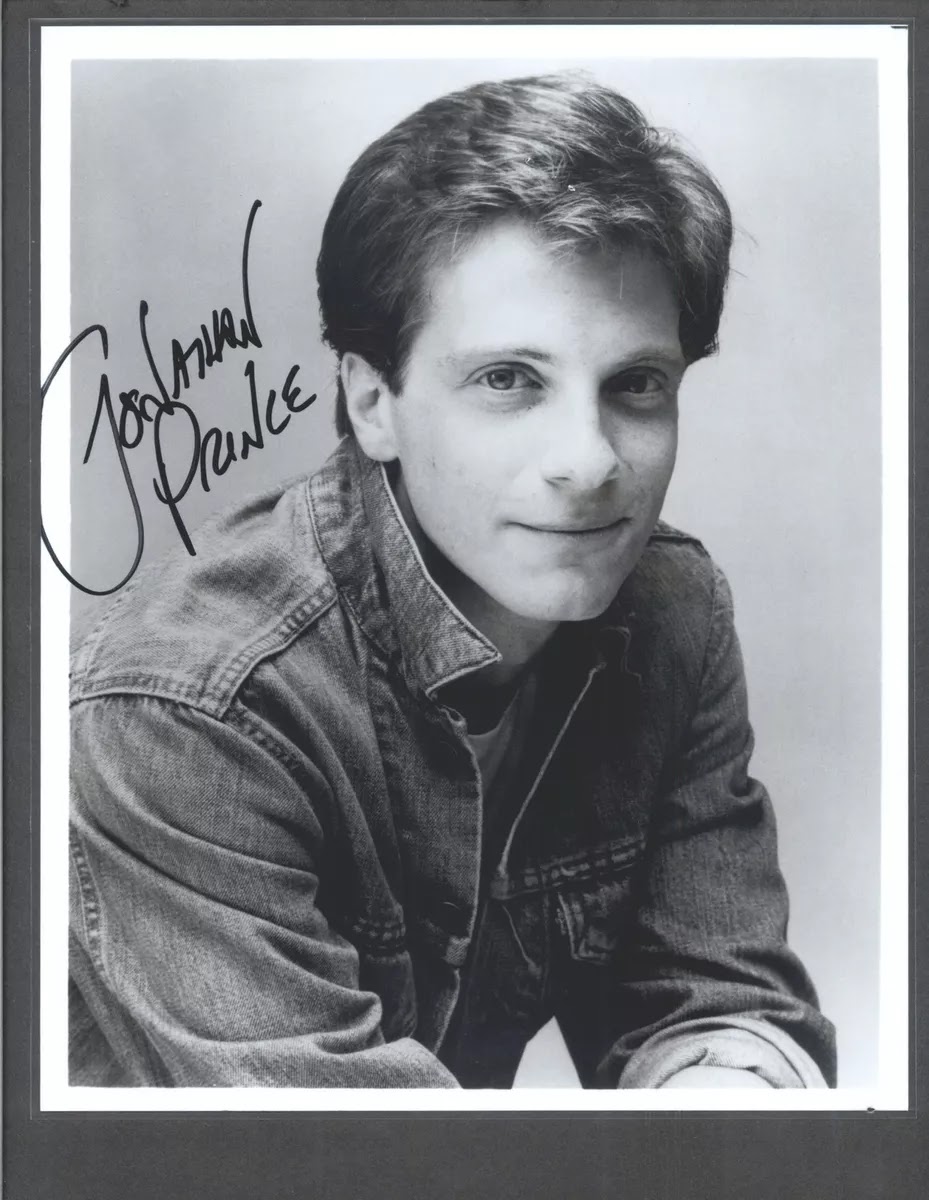
1. The boss,  diminuitive go-getter Zach (Jonathan Prince) channeling Michael J. Fox.  Today a writer and producer, Prince was at the height of a brief 1980s acting career: he played Johnny Depp's buddy in the sex comedy Private Resort and Clark Brandon's buddy on Mr. Merlin.


One of the cutest guys on the planet.  

2.  Hip business manager Phil (Richard Cummings, Jr., later to star in Northern Exposure).

3.  Spaced-out former singer Blue, probably based on the Andy Warhol superstar Ultra Violet (Jane Leeves, who would go on to play psychic therapist/housekeeper Daphne on Frasier).


4. Sandy had a 12-year old son at home, played in the first season by future screen hunk Paul Walker, and then by Paul Walker lookalike Sean de Veritch.

I actually don't remember any particular episodes, just the jazzy theme song, some buddy-bonding moments between Sandy and Blue, and the super-cute Jonathan Prince.

But I remember watching, and finding it a moment of freedom from the incessant homophobia of 1980s tv


May 8, 2024

Bronson Pinchot: A gay icon of my childhood turns out to be straight. Then it gets worse. But at least we see his dick


For many years, tv has disguised gay couples as heterosexuals with some other reason for being together -- they work in the same office, or share an apartment, or are brothers.  So censors, skittish network executives, and shrieking homophobic audiences remain clueless, but if you're "in the know," the gay subtext is obvious.


Bronson Pinchot broke into film as Tom Cruise's buddy in Risky Business (1983)..  After several years of playing swishy gay-vague characters, such as Dennis on Sara and Lloyd in After Hours, he was cast in the gay-vague buddy sitcom Perfect Strangers (1986-1993).  He played Balki Bartokomous, an exuberant free-spirit from the faux-Greek country of Mypos, who descends upon his stick-in-the mud distant cousin Larry (Mark Linn-Baker) in Chicago.  You can anticipate the the standard "let's do something wacky"/"but I have a dentist appointment" plotlines.

It's supposed to be a brief visit, but the two end up falling in love, their affection explained as fraternal love, and Balki stays on.

I watched during the first season when Perfect Strangers led into Head of the Class and Night Court on Wednesday nights.  A surprising number of plotlines could be read as negotiating a same sex romance.

Larry: "Balki is cute and all, but how can I build a future with someone who doesn't even know how to fill out an IRS Form 1088-B?" 

Balki: "Larry is good in bed, but he's so shy and reserved. How can I draw him out of his shell?" 


Apparently the network had a problem: the guys were too obviously a gay couple.  So during the second season plotlines increasingly involved dating girls, culminating in steady girlfriends Jennifer and Mary Anne (Melanie Wilson, Rebeca Arthur).

Obviously a screen.  Could they be sitting farther apart on that couch?

More after the break.  A lot more.
Related Posts Plugin for WordPress, Blogger...