Showing posts with label 1930s. Show all posts

Jul 1, 2026

Skeezix of Gasoline Alley: 1930s Gay Icon


When I was a kid, Dad would call me Skeezix when I misbehaved:
"Put down that comic book and clean your room, Skeezix!"

Particularly when my misbehaving had some connection to same-sex desire, like when Bill and I became a "mama and a papa", when I was disappointed at the lack of muscles at A Little Bit O'Heaven., or when I asked for a statue of a naked man for Christmas.

He never used that name on my brother or sister, just me.  I had no idea why.

One day I stumbled upon a book in my Aunt Nora's attic, starring a boy named Skeezix.  Turns out that he was from the long-running comic strip Gasoline Alley (1918-).  Originally about four buddies who hung around in an alley to talk about cars, it took a domestic turn on February 14, 1921, when Walt Wallet found a baby on his doorstep, and named him Skeezix.

The strips were now about a single dad raising a small child -- who aged in real time. Every day in the strip corresponded to a day in real life.

By the late 1930s, when my father was a kid, Skeezix was a teenager, and the undeniable star of the comic strip.  You could buy Skeezix toys, clothes, shoes, ice cream, coloring books, pin-backs, sheet music, and a full line of big little books.

He starred in three radio series and two movies (played by Jimmy Lyndon of Tom Brown's School Days fame, 

The strip was not known for beefcake -- Walt was rather pudgy -- but Skeezix got some shirtless and underwear shots, and displayed a nice physique.

And he had a buddy to bond with, Spud, who accompanied him on the adventures Skeezix in Africa (1934) and Skeezix at the Military Academy (1938).

So my father connected my homoerotic hijinks to the  shirtless, buddy-bonding, arguably gay Skeezix of his childhood.

The gay symbolism didn't last.  Skeezix got a girlfriend, Nina Clock (pronounced Nine-a).


He graduated from high school, served in World War II, and returned to run the gas station.  He married Nina, and had two kids: Chipper and Clovia.

Left: The bisexual Scotty Beckett played Skeezix's brother in Gasoline Alley (1951).


Chipper served in the Vietnam War, and became a physician's assistant as the job was just starting out.  He met his wife through a computer dating service.

Clovia grew up, managed the gas station after Skeezix retired, and married Slim Skinner.  They had two kids: Gretchen and Rover (born in 1978).


Rover grew up, graduated from high school, and married Hoogy Boogle.  They had a son, Boog, in 2004.  As of 2022, he is 18 years old, and has a girlfriend, Polly. 

The first and second generations don't appear much anymore, since Walt Wallet is over 120 years old, and Skeezix over 100, but none of the cartoonists want to mention iconic characters dying.


Six generations of Wallets, Skinners, Boggles, and Bumps, and you'd be hard pressed to find anyone in  who isn't involved in a hetero-romance.  There are no confirmed bachelor uncles or maiden aunts anywhere to provide queer subtexts (except for the outsider characters Rufus and Joel).  Gasoline Alley remains a holdout from the time when gay people were assumed not to exist.

Yet for kids growing up in the 1930s, there was Skeezix.


Jul 1, 2025

Out Our Way: Teenagers Before Girl-Craziness

When I was a kid in the 1960s, I was jealous of the comics they got across the river in Davenport, Iowa.  They got Peanuts, we got Winthrop.  They got The Wizard of Id, we got Apartment 3-G.  I sort of liked Alley Oop and Prince Valiant, but what was up with the single-panel strip, Out Our Way? 

 It was about an unnamed family -- mom, young adult daughter, teenage son, younger son -- drawn in grotesquely realistic detail.

They spoke in nearly incomprehensible slang and had bizarre customs. There was an "ice box" instead of a refrigerator, a gigantic radio instead of a tv.  They bathed in a tub in the kitchen.


The older son had a job, though he looked barely fifteen.

Confused, repelled, yet fascinated, I tried to decipher the strips day after day, week after week.  The world they portrayed was vastly different from the world I knew.


Boys in my world were always fully clothed, except in locker rooms, but in Out Our Way, they stripped down for baths and for bed and to swim.   They displayed a remarkable physicality, an awareness of the way their bodies looked and felt and moved.

Boys in my world did not touch each other, except during sports matches and fights. We were expected to find physical contact abhorrent.  But in Out Our Way, boys un-selfconsciously pressed against each other, draped their legs over each other's bodies, hugged, slept in the same bed


In my world, every trait, interest, and concern was gender-polarized.  Boys carried their books at their waist, girls across their chest.  Boys said "p.e." but "gym class," and girls "gym" but "p.e. class."  And the punishment for transgression was severe. But in Our Our Way, boys un-selfconsciously wore dresses.  The teenager performed "women's work," cooked (in an apron), cleaned, tended to his young brother.


Boys in my world were expected to groan with longing over the girls who walked in slow-motion across the schoolyard, their long hair blowing in the wind. They were expected to evaluate the hotness of actresses on tv, discuss breasts and bras, and claim innumerable sexual conquests.  But boys in Out Our Way never displayed the slightest heterosexual interest.  Instead, they consistently mocked the silliness of heterosexual romance.

What sort of world was this?

Many years later, I found that the comics I was reading were reprints from the 1930s, and even then, many had been nostalgic, evoking the author J.R. Williams' childhood at the turn of the century.

I was gazing into a time capsule, into a era when heterosexual desire was expected to appear at the end of adolescence, not at the beginning, so teenage boys were free from the "What girl do you like?" chant.

Feb 17, 2025

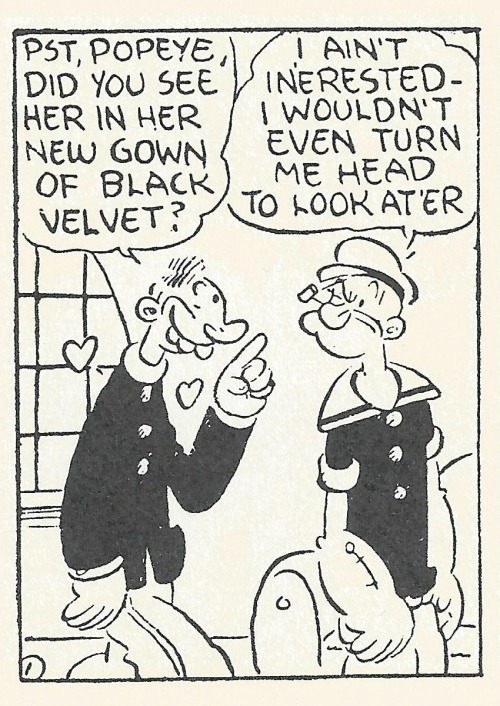
Popeye: The First Gay Superhero

When I was a kid, Captain Ernie's Cartoon Showboat often showed Popeye cartoons.  They were awful, nothing but heterosexist morality plays.  In every single one of them, the absurdly macho sailor Popeye and Bluto vied for affections of sexist stereotype Olive Oyl, they fought, and Bluto was pulverized (even though he had a far superior physique).

Then I stumbled upon a book called Popeye: His First Fifty Years, which talked about Castor Oyl, Ham Gravy, King Blozo, Tor, and Oscar.  Who were these people?

I discovered that the cartoons were the latest incarnations of  E.C. Segar's "Thimble Theater" comic strip, which began in 1919, starring get-rich-quick schemer Castor Oyl and his wise-cracking sister Olive.  In a 1929 continuity, Castor hired gruff one-eyed sailor Popeye for a sea voyage.  He became so popular that Segar added him to the cast, honed down his rough edges, and eventually made him the star of the strip.  It continues to run in some newspapers today.

There have been Popeye comic books almost continuously since 1948, published by Dell, Gold Key, Charlton, Harvey, and IDW.

There's a lot of gay content in the comic strip and comic book Popeye:


1.  He's sweet on Olive Oyl, but his main emotional bond is with Castor.  They run a detective agency together, rescue each other from danger, argue, break up, and reconcile.


2. Popeye has no interest in women other than Olive, but he develops several gay-subtext male friendships, notably with King Blozo.

Similarly, he becomes the object of desire of several men.  Reformed villain Tor keeps trying to kiss Popeye and saying that he loves him.

In fact, male friendships drive far more plots than quests for heterosexual romance.


3. The comic strips and comic books mostly occur in male homosocial spaces -- ships, boxing rings, detective agencies.  But Olive constantly disrupts those spaces.  The other characters keep telling her to "wait here" or "stay home where it's safe," but she is a full participant in every adventure.  And when there's trouble, she proves herself a competent fighter, as good or better than Popeye himself.

4. Popeye has no qualms about gender transgressions. He frequently dresses in women's clothing to accomplish some plot point.  When he becomes the ward of the infant Swee'Pea, he joins a women-only parenting class.

All that changed in the heterosexist "every man's fantasy" world of the cartoons.

Jul 13, 2024

Bug Hall: A lot of movies that no one has seen, some homophobic rants, and an enormous penis


Link to the enormous penis

 I'm always conflicted about posting nude pictures of homophobic actors. There's a little frisson of guilt that comes from looking at the penis of someone who hates you, as if you are somehow encouraging him. On the other hand, imagine how upset he would be to find himself the object of homoerotic desire.

And, to be fair, it is huge.

In this case, I'm talking about Bug Hall, who hit the big screen in 1994. at the age of eight.  He played Alfalfa in The Little Rascals, a modernized version of the Our Gang comedy shorts of the 1930s.  Having already seen some of the shorts -- no, not in the 1930s -- I didn't watch, but I heard that Alfalfa falls in love with a girl.  At age eight.


The original Alfalfa, Carl Switzer, had a hard life after Our Gang, and was killed in a bar fight in 1959, at age 31. 


Bug Hall had a hard life after The Little Rascals, too. Far less successful kid movies followed: The Big Green, The Stupids, and The Munsters' Scary Little Christmas. I don't think anybody saw them.

He sprang into a heteronormative adolescence with Skipped Parts, 2000, about having sex with a girl.  I didn't see it, but there's a clip floating around the internet where the 14-year old is getting undressed in preparation for the sex, and becomes aroused.  I can't tell if it was scripted, or an accident.  Either way, you don't want to see it. 


More heteronormativity with Get a Clue, 2002, about two high school journalists who solve a mystery and fall in love.  I didn't see it, but I like the theme song, "Get a Clue," performed by Simon and Milo, an animated gay-subtext couple.

Get a clue, there's nothing you can't do.
Nothing's ever quite what it seems
Just look a little closer at me
Wake up, who knew, it's me, it's you, get a clue.

More sex in Footsteps and Arizona Summer, which I didn't see, and then a fizzing out into guest spots on tv dramas: Strong Medicine, Charmed, Cold Case, The O.C.

Bug runs away naked in The Day the Earth Stopped, 2008: "Hundreds of massive intergalactic robots appear in all of the world's major capitals with an ultimatum: Prove the value of human civilization or be destroyed."  Holy cow, that sounds awful.

It features a man and a woman falling in love -- heterosexual romance is the value of human civilization, get it? 


At this point, you're probably wondering if I've actually seen Bug Hall in anything. I'm wondering about that, too. 

American Pie Presents the Book of Love. No.

Camoflauge: "A troubled teen-aged boy is sent to a boot camp in a secluded forest where he must survive the horrifying disciplinary tactics of a demented camp counselor."  No, and the blurb writer forgot the first rule of writing: minimal use of stupid, superfluous adjectives.

More Bug after the break

Apr 25, 2024

Junior Durkin and Henry Willson: Hollywood's First Gay Romance

When 15-year old New York boy Trent Durkin was contracted by Paramount Pictures, his name was changed to "Junior" to make him seem more wholesome and All-American. 

The ploy worked: Tom Sawyer (1930) was the #1 box office hit of 1930, in part because of the palpable buddy-bond between Tom (16-year old Jackie Coogan) and rascallion Huck Finn (15-year old Junior Durkin).  

Huckleberry Finn followed (1931).


Then Hell's House (1932),  in which a boy (Junior) is framed for bootlegging and sent to juvenile hall, where he falls in love with the younger Shorty (Junior Coughlan).  

And Man Hunt (1933), in which a junior detective (Junior) and his boyfriend (Arthur Vinton) solve a murder.


Before World War II, boys were expected to become interested in girls at the end of adolescence, not at the beginning, leaving adolescent actors free to star in amazingly overt "two boys in love" or "boy in love with older man" movies.

But Junior wasn't just acting.  In 1933, the 18-year old met 22-year old Henry Willson at a gay bar on Sunset Strip.  Willson had just arrived from Pennsylvania, and was writing for movie magazines.  The two became lovers, and when Willson became a talent agent for the Joyce and Pollimer Agency, he hired Junior.

Or maybe he hired Junior before they became lovers.  Accounts vary.

Willson got Junior to leave Paramount for some meatier roles, such as Ready for Love (1934) and Little Men (1934), and suggested that he go back to Trent: a tough, masculine, single-syllable name.  He appeared in Chasing Yesterday (1935) as Trent.

On May 4, 1935, Junior was killed in an automobile accident near a ranch owned by his friend Jackie Coogan's family in San Diego.  He was 19 years old.  Jackie's father and three other people died in the accident as well.  Jackie survived to become a major box office draw, and near the end of his career, Uncle Fester on The Addams Family.

Henry Willson went on to become an important talent agent, creating the beefcake fad of the 1950s by signing on innumerable hunks and changing their names to something tough, masculine, and single-syllable: Rock, Doug, Chad, Nick, Van.  Most were gay or gay-friendly, and many knew their way around a casting couch.


Feb 23, 2024

Reefer Madness: marijuana hysteria, demonic bulges, a dinner date with Satan, and Christian Campbell's cock

I've shown many classes the 1936 film Reefer Madness.  It was originally released as Tell Your Children, a cautionary tale about the dangers of marijuana. 

Link to Christian Campbell's cock


There's a strong gay subtext: drug dealer Ralph (Dave O'Brien) sees high schooler Jimmy (Warren McCollum), murmurs "Nice!", and practically licks his lips in anticipation.  Wrangling an introduction, he says "Nice to meet youuuuuu!" with a lascivious leer, then invites Jimmy to the soda shop, where he will try to get him hooked on the psychosis-inducing weed in a parallel to how gay men were accused of recruiting boys.

After Jimmy is tricked into taking a puff of the "evil weed," he is plagued by instant addiction, psychotic rambling, uncontrollable sexual desire (the most horrifying to audiences of the day ), drunk driving, and finally murder.  It seems laughably sensationalistic today, but in fact Harry J. Anslinger, the commissioner of the Federal Bureau of Narcotics from 1930 to 1963, devoted his entire career to feeding the flames of the panic.  As late as the 1950s, marijuana was considered more dangerous than heroin. 


The movie was placed on the exploitation circuit, officially meant to educate viewers about the "dangers" of the  practice, but drawing crowds interested in gawking at the degradation. In the 1970s it was discovered by the hippie art-house crowd, who would watch while high for an ironic twist.  


In 1998, Reefer Madness: The Musical appeared off-Broadway, eliminating the redundant characters and upping the camp.  Christian Campbell (left) played Jimmy, lured from his "wholesome" heterosexual chastity by drug dealer Jack (Robert Torti, top photo) and cohort Ralph (John Kassir).  

In addition to the gay subtext, there was a lot of beefcake, with the super-muscular Jimmy stripped down to his underwear and a chorus of semi-nude male and female devils.

More music and bulges after the break

Aug 28, 2023

Krazy Kat: The First Gay Comic Character


From 1913 to 1944, newspaper readers could read a sparely drawn comic strip, an anomaly in the era of lush art deco masterpieces like Little Nemo, in which a small, squiggly cat named Krazy professes undying romantic love for the mouse Ignatz, who responds by lobbing a brick at Krazy's head.  But the cat is not dissuaded, accepting even violence as a signifier of desire. And, in fact, Ignatz often gives in and grudgingly accepts Krazy's affection.

 Meanwhile Officer Pup hangs around to throw Ignatz in jail or pontificate on the evil of brick-throwing.

The general public wasn't impressed, but the elites loved it, exuding comparisons to Charlie Chaplin and German expressionism. Gilbert Seldes’ The Seven Lively Arts (1924) devoted a chapter to the strip, and today most histories of the comic strip include warmly appreciative paragraphs.  Literary figures as diverse as Jack Kerouac and Umberto Eco have praised it.  It has influenced every comic strip from Peanuts to Pearls Before Swine. 

But heterosexuals try desperately to avoid admitting that Krazy Kat is gay.

The evidence is incontrovertible.  Cartoonist George Herriman always refers to Krazy Kat and Ignatz Mouse with the pronouns "he," "him," and "his," not to mention "Mr. Kat" and "Mr. Mouse."  I haven't read all 1500 strips, but I've read several hundred, and never once is Krazy Kat referred to with any feminine pronouns.  Krazy Kat is most definitely a male, experiencing same-sex desire.  He's gay.

Yet Gilbert Selden ("The Seven Lively Arts") and Robert Harvey ("The Art of the Comic Book") insist that Krazy's gender is indeterminate or ambiguous.

Gene Deitch ("The Comics Journal") calls Krazy a "he/she."

Martin Burgess ("The Comics Journal") says that Krazy is "always changing genders."

Miles Orville suggests that there is some ambiguity, but adds “for the sake of consistency, I am going to refer to Krazy as ‘she.’”

Poet E.E. Cummings, cartoonist Bill Watterson, and encyclopedist Ron Goulart have no qualms it: Krazy is a girl. Period.

A classic example of refusing to recognize same-sex desire even when it is hitting you in the head like a well-thrown brick.

When cornered, even cartoonist George Herriman backed off.  He was questioned about Krazy's gender, but not with homophobic disgust -- with honest confusion, in those days before the general public knew that gay people existed.  Wow could a male possibly desire another male?  It made no sense.

He responded that "The Kat can't be a he or a she.  The Kat's a spirit -- a pixie -- free to butt into anything.  Don't you think so?"

No.

No evidence that Herriman was gay, but he was hiding, of mixed race in the all-white world of newspaper cartooning.  He explained his dusky looks by claiming to be half Greek, and always wore a hat to hide his kinky hair.  He knew all about masks.

See also: Pogo, the Gay Possum of Okefenokee Swamp


Aug 2, 2023

Barbarian Heroes: Conan, Brak, Kull


Depression-Era pulps often invoked the unimaginably ancient and unimaginably decadent civilizations based vaguely on the Orient: the cities all warrened with harems, opium dens, dungeons,  lairs, and oubliettes; the rulers all fat, bejeweled, and lecherous; the people childlike; the laws brutal; the religions by turns esoteric and superstitious: the distant past worlds of Hyperborea and Atlantis, the distant future world of Xiccarph, or the aging jungle-cities of Mars.

Placing Adventure Boys in realms of Oriental myth allowed for a lushly sensual homoromance.  In H.P. Lovecraft's "Quest of Iranon”(1921), a young man wanders a stern, unfriendly world in search of the city of Aira, where there are “men to whom songs and dreams. . .bring pleasure.”  He meets “a young boy with sad eyes” who also dreams of escape, to a city where  “men understand our longings and welcome us as brothers, nor even laugh or frown at what we say.”    They travel together, happy in a way yet always longing.  They grow old together and finally die, never finding their true home.
  
Often the outskirts of these unimaginably ancient cities were teaming with mighty-thewed, sword-wielding barbarians -- Henry Kuttner’s Elak, Clark Ashton Smith’s Tiglari, Robert E. Howard’s Conan, Brak, and Kull (played by Kevin Sorbo in the film version).  Their plots usually involved a masculine/feminine colonizer/colonized myth, with the muscle man rescuing a naked woman from some effeminate, ruby-ringed satrap.


Fellow muscle men appeared only as bullies, cads, or at best, untrustworthy companions who ended up betraying the hero -- except when the barbarians are teenagers rather than men. Then they rescue no naked women, and their same-sex bonds are true.

Robert E. Howard’s Conan the Barbarian spends his seventeen stories in Weird Tales rescuing the requisite naked woman and being betrayed by men, except in the only story set in his adolescence, “The Tower of the Elephant” (1933).   About sixteen years old, a “tall, strongly made youth” with “broad, heavy shoulders, massive chest” and so on, Conan sneaks into the Tower of the Elephant with the hope of stealing a fabulous jewel hidden there.  At this point, plot conventions decree that he find a naked woman.  Instead, he finds a naked man.


An alien named Yag-kosha, elephant-headed but otherwise human, has been blinded, crippled, and imprisoned in the tower by an evil sorcerer.  They become friendly, and Yag-kosha asks Conan to rescue him through the strange-sounding expedient of cutting out his heart.  Conan never hesitates about killing monsters and enemies, but he will not kill a friend, and complies only when Yag-kosha assures him that he will not die.  In fact, he uses the magic of the heart to take revenge on the evil sorcerer, and then, restored to his original strength and beauty, he jubilantly flies away to join his companions on his home planet.

This story is fascinating because it precisely mirrors the adventures of the adult Conan, only transformed from hetero-erotic to graphically homoerotic.  In the shimmering tower, the adult Conan would find a female object of desire (naked, beautiful, benevolent) contrasted with a male threat (clothed, hideous, evil).  However, the teenage Conan finds a male, both object of desire (naked, benevolent) and threat (blind, crippled, aged, with a hideous face “of nightmare and madness”).  Then ritualized death and resurrection removes the threat, leaving only desire: Conan perceives the new Yag-kosha as beautiful.

Even the hints of heterosexual intimacy that the adult Conan often enjoys with the naked ladies he rescues  are mirrored when the naked Yag-kosha gets to “know” Conan by caressing his chest and shoulders with his soft phallic trunk: “its touch was as light as a girl’s hand,” Howard tells us, suggesting a tender, gentle sexual congress.  Conan’s desire here is for the male, a yearning for masculine intimacy that must be sublimated beyond all recognition among the adults in Cimmeria but can be expressed freely, with only a veneer of euphemism, during the paradox of youth.

Mar 21, 2022

Cary Grant: Hints and Closets in the 1930s

On November 29, 1986, Cary Grant died in Davenport, Iowa, right across the river from my home town of Rock Island.  I was living in West Hollywood at the time, but still, it felt weird to know that a film legend had died right next door.

Cary Grant had a brilliant career, usually playing suave, sophisticated types driven mad by a free spirit or a series of catastrophes.  Must-sees include Topper (1936), Suspicion (1941) directed by Alfred Hitchcock, The Bachelor and the Bobby-Soxer (1947), To Catch a Thief (1955), North by Northwest (1959) by Hitchcock again,and  That Touch of Mink (1962) with Doris Day.  Many of his movies have gay subtexts.

In Bringing Up Baby (1938), his character answers the door in a frilly women's nightgown (because a woman stole his clothes), and declares "I just went gay all of a sudden."  He continues: "I am sitting in the middle of Time Square, waiting for a bus."  This is one of the first uses of "gay" in its modern sense, augmented by the reference to cruising.  It's an ad-lib, not in the shooting script. How would he know it?

The perennial question is, was he gay?

The facts of the matter are:

1. He met Randolph Scott in 1932, and the two lived together, on and off, for the next ten years ("to save on expenses," heterosexist biographers claim) and remained close friends for the rest of their lives.

2. But neither have been associated with any gay stars, or with the gay subcultures of Hollywood in the 1950s, 1960s, or 1970s.

3. Friends and acquaintances noted that he was often seen in the company of young men.


4. He was married five times. His first two wives "accused" him of being gay, his last three denied the rumors, stating that they had sex a lot.

5. He sued Chevy Chase for suggesting that he was gay.

6. His daughter stated that he liked the rumors, because they motivated women to "cure him" through sex.

7. His last movie, Walk, Don't Run (1966), is obviously about a gay romance.

8. He never acknowledged his gay fans.

9. My friend Randall claims that he had a three-way with Cary Grant and Groucho Marx in 1958.  The story is on Tales of West Hollywood.

Answer: there's a ton of evidence for both gay and heterosexual identity.  Most likely he was bisexual and highly closeted.

Feb 12, 2022

Bobbseys, Boxcars, and Beefcake

I was never much of a fan of the mystery genre, but many gay kids liked the gentle, pre-Hardy Boys exploits of The Famous Five or their American counterparts, the Bobbsey Twins and the Boxcar Children.

Laura Lee Hope’s Bobbsey Twins series lasted through 72 installments from 1904 to 1979.  Originally the two sets of twin siblings aged normally, but when the series was revised and extensively rewritten during the 1960s, Bert and Nan remained twelve, and Freddie and Flossie remained six.  They all seemed to behave somewhat older than their "real" ages, or maybe that is just a reflection of the extra freedom kids had in earlier generations. 

 In the 1960s they also began to have more dramatic adventures in realistic locales, though the titles were still aimed at a youngish market: The Secret of Candy Castle, The Doodlebug Mystery, The Flying Clown.


Gay boys found most resonance in Bert, who was in his last days of childhood, still happy to play with his sister and younger siblings but obviously longing for emotional connections outside the group.  In fact, an ongoing theme of the books is the conflict between the comfort and safety of family and the need to “leave the nest” and find one’s own way in the world.  But girls play no part in any of the stories; instead, in nearly every book, in the midst of piecing out clues and solving mysteries, Bert goes off on his own with a boy.

The Boxcar Children were another group of siblings, Henry (14), Jessie (13), Violet (10), and Benny (6), orphans who moved into an abandoned boxcar in the 1924 novel by Gertrude Chandle Warner.  Then, in the late 1940s, Warner realized that the four would make ideal child-sleuths.  She had them adopted by their wealthy grandfather, Mr. Alden, who traveled around the country to keep track of his various business investments, thus providing lots of exotic locales for sleuthing.  Eighteen new installments appeared between 1949 and 1976, sending the kids to haunted houses, bedeveled ranches, mountain cabins, and seaside resorts.   The children age through the adventures, and by #19, Benny Uncovers a Mystery, Henry is in college.


Like Bert, Henry is trying to establish his independence while still remaining part of the family, but, unlike adolescent boys in children's media today, he is never portrayed as girl-crazy.  Instead, when his life outside the family appears in the novels, he is usually seen in the company of a boy (the girl on this cover is his sister).

Jan 12, 2022

Doc Savage: The First Gay Superhero

When I was a kid, I never cared much for Marvel comics, other than the gay-subtext heavy Werewolf by Night, but in the summer of 1972, my eyes were drawn to the gleaming hard-muscle physique on the cover of Doc Savage #1, "the first superhero of them all!"

How was that possible?  We already had Superman, Batman, Spiderman....


Turns out that Doc Savage got his start as a pulp hero, first created by Lester Dent in 1933 (5 years before Superman). His adventures have been reprinted in paperback form from the 1960s through the 1990s.  There have been comic books, two radio series, and a 1975 movie starring Ron Ely of Tarzan fame.

Like Batman, Doc has no superpowers; he relies on his superb physique, scientific gadgets, and medical training to fight evil (when he catches villains, he gives them brain operations to cure them of their criminal tendencies).

Unlike Batman and every other superhero, he doesn't wear a spandex costume; he appears shirtless and bronze and gleaming.


He lives and works on the 86th floor of the Empire State Building in New York City, accompanied by his team, "The Fabulous Five."
1.-2. Chemist Monk (who has the build of a gorilla) and attorney Ham, who feud with each other.
3. Renny, an engineer with a massive physique of his own.
4. Long Tom, a long, thin engineer.
5. The egghead archaeologist Johnny.

The only regular female character was Doc's cousin Pat, who tagged along on adventures in spite of being told to "wait here where it's safe."

Here are some of the plotlines:

Johnny finds a prehistoric egg that may have hatched into a dinosaur.
Monk runs afoul of the mind-controlling Lucky Napoleon.
Ham witnesses "the rustling death" that drops men out of airplanes.
A naked man is fished out of the Atlantic and hailed as a prophet.

Quite a lot of captures and nick-of-time rescues going on, and not a lot of hetero-romance.

Other members of the team occasionally get girlfriends, but as Monk explains, "There won't be any women in Doc's life."  He has a female companion in the 1975 movie, but doesn't kiss her.  Many rescued damsels-in-distress have tried to snare him, but he tactfully rebuffs their advances.  He has, you see, "no time for women."


Yeah, right, no time.

Philip Jose Farmer's A Feast Unknown (1969) gives Doc Savage and Tarzan an abusive sexual relationship.

Heterosexual fans have faced the "accusation" of Doc's gayness for many years, usually with shrieks of "No way is Doc gay!"  But a surprising number of gay kids found a role model in the Doc

.

May 19, 2021

What Kind of Flower are You: Queer Boys of the 1920s

Before World War II, teenage boys were not expected to like girls.  At Everett High School in Washington, most of the boys in the graduating class in 1925 are memorialized in their yearbook with manly "woman-hating mottos": "Tall, dashing, quick and fair, spurns all girls with vigilant care!"

In movies and literature, the teenage boy who liked girls was labeled gay, an effeminate contrast to the real, red-blooded, masculine boy who “spurned all girls with vigilant care.”   He was jeered, blackmailed, and ostracized. He was asked “What kind of flower are you?” and “Can I borrow your lipstick, dearie?”  His peers called him “honey-boy,” “panty-waist,” “mollycoddle,” and “Percy,” and the adults, “sensitive,” “gentle,” “artistic,” and “sweet.”


Sinclair Lewis’s Babbitt (1922), though hetero-horny himself, worries when his son Ted, “a decorative boy of seventeen,” offers to give two girls from his high school rides to a chorus rehearsal.  “I hope they're decent girls,” he muses. “I wouldn't want him to, uh, get mixed up and everything.”  (Ted was played by Raymond McKee in 1924 and Glen Boles in the 1934 movie version.)

His wife suggests that he take Ted aside and give him a little talk about “Things,” but he rejects the proposal: “no sense suggesting a lot of Things to a boy’s mind.”  He assumes that no seventeen-year old boy could possibly experience heterosexual desire unless he is manipulated from outside.

The next summer, Babbit discovers Ted kissing a girl, but he blames her for "enticing him," refusing to believe that any eighteen-year old could want to kiss girls of his own accord.


Richard, a boy just short of his seventeenth birthday, falls for a girl in Eugene O’Neill’s Ah, Wilderness! (1933), but he is coded as gay.  There is “something of extreme sensitiveness. . .a restless, apprehensive, defiant, shy, dreamy, self-conscious intelligence about him.”  He reads too much poetry, especially sexual anarchist Swinburne and gay icon Oscar Wilde, whose trial and incarceration for “the love that dare not speak its name” was still freshly scandalous in 1904 (the date of the plot).

“He’s a queer boy,” his mother muses. “Sometimes I can’t make head or tail of him.”

Richard has been played in movies by Eric Linden (1935), Simon Lack (1938), and Lee Kinsolving (1959), and in the theater by many actors, including Luke Halpin (of Flipper), left and T.R. Knight (of Grey's Anatomy), top photo.

In the first movies of his series (1937-1939), Andy Hardy (played by Mickey Rooney, left) had an effeminate girl-craziness and was  psychoanalyzed as "queer," suffering from a “unconscious fixation on youth.”

Henry Aldrich, gay girl-crazy star of his own movie series (1939-1944) (played by Jimmy Lydon of Tom Brown's School Days) was subject to pummeling by bullies and tense heart-to-hearts with his parents.  His buddy Dizzy usually tolerated his eccentricity,  but sometimes even he couldn’t take it anymore, and yelled “What the heck’s the matter with you, anyway?”


Related Posts Plugin for WordPress, Blogger...