Feb 27, 2023

"The Consultant": Tawdry, Tasteless Homophobia at a Modern Gaming Company


 Amazon Prime has been pushing The Consultant, an adaption of a novel about a consultant who turns out to be the Devil.  I knew that bosses are all evil, but not that evil.... So I watched the first episode.

Scene 1: Six kids from Glendale Middle School are taking a tour of one of those gaming companies where employees sit on stools and play foosball.  Guide Elaine stops to flirt with Craig (Nat Wolff, left), one of the coders,  then gives them the back story: Sang (Brian Yoon, below) coded his first game at age 13, and now has over 100, including all of the super-popular favorites.  He's worth uncountrable billions of dollars.  She ushers them into his office, then stops by to flirt with the coder again.  They discuss how much they hate Sang. 

Suddenly gunshots ring out!  The employees, looking bored, duck under their desks -- this is America, there are .  Guide Elaine and Coder Craig der rush into Sang's office.  One of the kids, Tokyo (Henry Rhoades) shot him!  "I want my Mommy," he says. 


Scene 2
: Late at night, Coder Craig lies awake next to his sleeping girlfriend or wife, horrified by the tragedy.  He tries playing a video game about killing people, but that doesn't help, so he reads a news story about the murder: "The Devil made him do it," then goes for a run. Through Los Angeles at 2:00 am?  Is he crazy?  

Scene 3: He jogs through the deserted streets to the office to get some weed (he keeps marijuana at the office, but not at home?).  It's deserted except for Elaine, who is removing video cameras from the smoke detectors.  She explains that Sang was paranoid, and had them installed everywhere. They discuss the jobs they are going to get, now that Sang's company has closed.

Plot dump: Craig's girlfriend/wife is a fundamentalist, and thinks he should repent of his sins.  He wonders: If the Devil really did make the kid kill the boss, are the company employees evil, too?  Wait -- the Devil would want a good person killed, so his employees would be the good guys, right?  

Elaine shuts him down: millions of people play video games, and don't shoot anyone. There's no evidence that pretend violence causes real-life violence.

They hear a noise, and rush to the foyer: Regus (Christoph Waltz), a white haired man in an overcoat, carrying a briefcase, is just standing there, staring into space like a ghost.  He's here to see Sang.  At 2:00 am?  Then he corrects himself: "Oh, right, he's dead.  He killed those kids, then turned the gun on himself."  

They explain what really happened.  "Oh, right, that was the version I told myself." Creepy, dude. 

Apparently before he died, Sang hired Regus as a consultant "on all matters of business."   He also ordered this beautiful engraved Bible for you.

Unusual trait: Regus can walk ok, but he can't climb stairs.

He barges into Sang's office, shows them his contract, and calls a staff meeting for 9:00 am.  They protest, but the contract checks out.

Scene 4: Coder Craig in bed (muscle shirt), being sniffed by his fundamentalist wife.  She criticizes him for smoking weed. After a kiss, he rushes off to the office to join the grumbling employees.  I guess the kid killing Sang plotline has been dropped. 


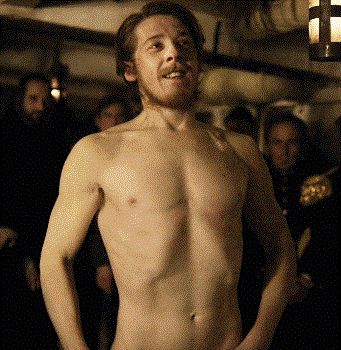
Regus starts making crazy CEO demands, like no more working from home.  He sniffs everyone, and forces Iain (Michael Charles Vaccaro), the guy that he thinks smells bad,  to strip and wash right in his office (chest and butt shots).   He knows nothing about video games (except that they brainwash kids into becoming murderers, which Elaine disagrees with).  He is usuing an assumed name: Patoff comes from "Patent office." 

They check the security cam footage of Regus's appointment with Sang. No sound, but after 14 minutes, Sang signs the contract. Then he kneels and gives Regus a blow job.  "Was Sang...." Craig asks, another annoying example of "Don't say 'gay'"   No, he was asexual.  The end.

Beefcake: Naked chubby guy while he's being humiliated.  There's a full-sized, nude, well-hung statue of Sang later on.

Heterosexism: Craig and his fundamentalist wife, but they don't do much.

Gay Characters: Probably not, but gay sex signifies humiliation, degradation, and evil, which, combined with the refusal to use the G-word, becomes was homophobic.  Not to mention "cocksucker."

Violent Video Games Cause Violence:  Disproven over and over. There's no evidence that violent mass media consumption impacts real-life violence.

My Grade: F.

Feb 21, 2023

Sad Sack

When I was a kid, I loved Harvey comics' supernatural titles, Casper, Spooky, and Hot Stuff having science-fiction and espionage adventures in the Enchanted Forest.  In a pinch, I didn't mind the kids-with-crazy-obsession titles, Little Dot, Little Lotta, and Richie Rich.  But I never even picked up Sad Sack.  

Military humor -- gross!  It was the middle of the Vietnam War.  Our fathers and older brothers were dying in Vietnam, or burning their draft cards and going into exile in Canada.  Who wanted to be reminded of all that?

But recently I came across an old book, The Sad Sack.  Apparently the character existed before Harvey Comics, in a pantomime strip published by Sergeant George Baker in the military magazine Yank during World War II.  The Sad Sack (short for "Sad Sack of Sh*) was a classic schmiel, beset-upon by bad luck, but tough, masculine, and sexually active (although here he's paying a woman to iron his pants).


Two hardcover compilations of Sad Sack strips appeared in 1944 and 1946.  There was a radio series (1946) starring Herb Vigran and a movie adaption (1957) starring Jerry Lewis.

Harvey took over the franchise in 1949, giving Sad Sack a voice, a nebbish personality, and surprisingly, a lot of shirtless and semi-nude shots (although he didn't have much of a physique).

 He was now a permanent private at Camp Calamity, so he would never go to war (like Beetle Bailey and Gomer Pyle), and he had a coterie of friends and superior officers, notably Sarge.


Sad Sack and Sarge have a "antagonistic best friend" relationship similar to that of Beetle Bailey and Sgt. Snorkel, with the same homoerotic subtext.


There were many spin-off titles, including Sad Sack's Funny Friends, Sad Sack's Gobs n Gals, Sad Sack and the Sarge, and Sad Sack Laugh Special.  Sounds like Archie spin-offs like Pals n Gals, and Laugh.

I never knew whether Sadie Sack was Sad in drag or just his girlfriend, but she turns out to be his female identical-twin cousin.  Rather a gender bender.


The Sad Sack title continued to be published for over thirty years, ending only when Harvey Comics folded in 1982.   so somebody was interested in Sad's chubby physique and buddy-bonding with the Sarge.

Just not me.


Feb 16, 2023

Can Netflix redeem itself with "Red Rose," About an Evil App Harassing Gay and Straight Teens?


After my last three or four grim reviews, I have to conclude that Netflix, the streaming service that brought us Crazy Ex-Girlfriend, The Good Place, Bojack Horseman, and Kim's Convenience, has been reduced to dredge.    But maybe Red Rose, a British tv series about a murderous app, will break the heteronormative trend.  I'll watch Episode #1, "It's Grim Up North."

Scene 1: Manchester, Christmastime.  Snow, trees, ecstatic crowds. Teenage Alyssa says goodbye to her friends and stares in horror at carolers. Come on, they're singing "The Carol of the Bells,' not "Have Yourself a..."    Mom calls to back out of picking her up, so Alyssa walks home.  She rushes into the elegant noveau-modern mansion and turns the smart thermostat up to 27 (80 degrees Fahrenheit).  But it turns down to 0!  And the big screen tv is mirroring her!   Lights and vacuum cleaners go off and on at random.  Alyssa yells for the home app Electra to turn everything off, but it doesn't obey  She runs through the house terrified.  Mum finally gets home, but it's too late: Alyssa jumps off the roof!  WTF?  What was she afraid of?  A cranky home app?  Mum?


Scene 2:
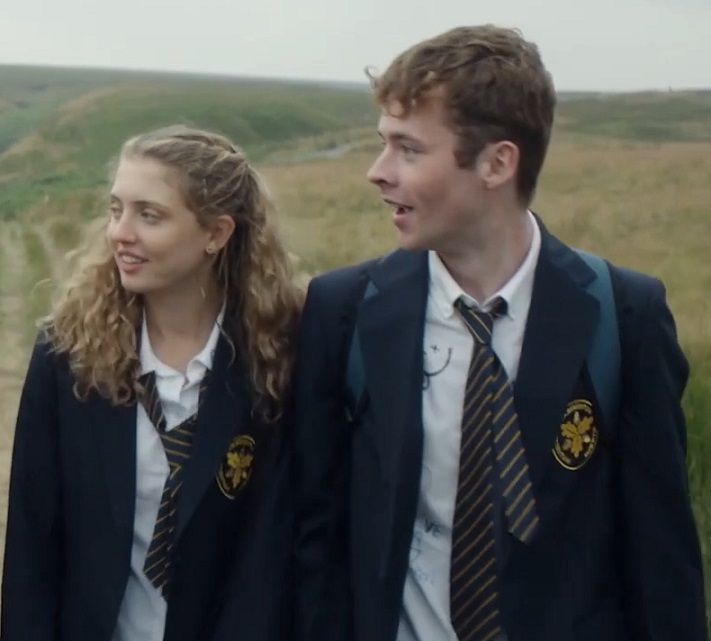
Bolton, a quaint, very English town near Manchester, six months later.  Two teenage girls, Wren (blonde) and Roche (brunette), are sitting on a rustic road, discussing the end of exams and summer plans. They sign each other's shirts, frolick, and almost kiss, but they are interrupted by a third girl.  Any boys in this show?   Finally  -- two boys, Noah  and Antony (Ellis Howard, below), catch up to joke and tease the girls. 


Cut to teens in school uniforms dancing on hilltops.  Noah and Antony dance with each other, but pair off with girls to smoke and drink and play patty-cake (teenagers?  Is that a British thing?). 

A Middle Eastern guy,  Taz (Ali Khan), joins them, which upsets one of the girls but delights the others.  They invite him to join their friend group, the Dickheads.  Are organized friend groups a thing?  

All of the Dickheads except for Roche, who is poor, have been invited to Rich Snob Becky's party.  They approach and ask if she can come, too. Becky tries to exclude Roche by making up a 10 quid ($12) door charge, but the friends offer to pay it for her.  "Sigh...ok, but it's 'dress to impress'"


Scene 3:
While the others are dancing, Wren and Noah (Harry Redding) find a deserted phone booth and make out. What is a phone booth doing in the hills, with no buildings or roads around?  Poor girl Roche sees them and is upset.  She wanders off by herself, and gets a text inviting her to download an app, Red Rose: "Welcome to the new you." 

Scene 4: Morning. Roche awakens and goes downstairs to a shabby, mismatched house, two whiney preteen sisters, a dead Mum, and a Dad who is folding laundry (Samuel Anderson, top photo).  She prepares breakfast, but there's not enough cereal to go around.  She complains that she has to look after the twins all summer, so she won't be able to hang out with her friends.  'Why don't you invite them to our shabby hovel?" Dad suggests.  "Um...no, I'm ashamed that we're poor."  

Scene 5: The five Dickheads are leaving a pasty shop in downtown Bolton, when they run into Jaya (a girl).  She quotes from The Goonies (they're fans of a 40-year old movie?).  She's not going to the Rich Snob Party because, um...she's hanging out with her old mates. Realizing that she actually can't afford the cover charge, Roche makes fun of her.  But you're poor, too.  Covering? 

Next, some bully girls accuse Wren of being a slut; Roche defends her.  Then she breaks away from the group to play with her Red Rose app, which asks: "Do you need help?" "No!"


Scene 6:
Wren working in a tea shop.  Her coworkers ask about the mysterious boy she is dating.  Cut to a cemetery, where Wren meets with an older, bearded guy (Adam Nagaitis?).  He asks if they can be more open about their relationship, but she refuses and stomps off: "Don't push me!" 

Scene 7: Night. Roche (the poor one) is entertaining her sibs with hand puppets. Suddenly the lights go out: the electro-card reader is out of money.  

The app asks again "Do you need help?"  "Yes!" 

 "Write three wishes on a mirror, and chant these disturbing words."  Roche goes to her room and writes: "Wealth. Power. Respect."  The lights come back on -- 100 pounds was added to the account!  In the morning, there's a sparkly princess dress and new shoes waiting for her.  So, what about the power and respect?

Scene 8:  The Friend Group is playing a board game.  Does anyone under 60 still do that?   Roche bursts in to show off her new shoes.  Bestie Wren wants to know if Roche is upset about her dating Noah.  Of course she is. 

Scene 9: Roche is taking her younger sisters on a wilderness hike.  The app instructs her to build a fire, so she does.  Then it reveals a ghostly image of her Mum.  Horrified, Roche takes the girls to the store where a girl named Ash works.  She doesn't see anything on the phone.  Roche gets a flapjack (what Americans call a brownie).  

Next, Roche and Wren discuss their relationship and upset each other by referring to their parents: Dead Mum, and...um, something wrong with Dad.   Roche rushes off to a mansion, where a middle-aged woman has been minding the kids, and blurts out: "Wren has been seeing Rick!"  Soap opera, innit?  Then she goes home and looks at videos of her Dead Mum.

Scene 9: The middle-aged woman confronts Wren about dating Rick. Wait, the older, bearded guy from the cemetery is not a boyfriend, he's Wren's Dad, who is not allowed to see her.   He must have done something truly horrifying to not even get structured visitation.  "He's better now," Wren argues.  "He doesn't get better! What he did..."   Keep it a mystery, why don't you?

Scene 10: Roche brings the kids to a food bank, where they also have free breakfasts. She didn't get much wealth, did she?  The priest wants to know why she's upset.   More stuff about the fight with Wren.  

Scene 11; We finally get to the Rich Snob Party advertised in Scene 2.  The app instructs Roche to "kiss Noah" (Wren's boyfriend).  She refuses, so it displays a video of her at the food bank.  To humiliate her for being poor?  It repeats: "Kiss Noah, or everyone will know the real you."  So she does -- and that's displayed on the big tv, too!  Wren is upset.

Scene 12: On the way home, the app shows Roche a picture of the kids -- with Dead Mum behind them!  The end.

Beefcake: None.  The three teenage boys don't even have any shirtless pics online.

Other Sights: Lots of Bolton.

Heterosexism: Wren is dating Noah, but the plot is actually about her relationship with Roche.

Gay Characters:  Wren and Roche have a gay subtext romance.  Antony, the member of the Dickheads with just two lines in this episode, comes out as gay later on, but I don't know how much character development he gets.

Paranormal: The app hasn't done anything yet that couldn't be done with computer hacking, but we'll see...

My Grade: B

Update: In Episode 3,  the evil app lures Antony to a public restroom by pretending to be a hot guy on a Grinder-like app. So there are no gay organizations, and everyone is deeply closeted.  Sounds rather retro.

Feb 13, 2023

H. R. Pufnstuf: The Dragon and the Witch Compete over Jimmy's Flute


 I can’t watch H. R. Pufnstuf anymore. The lightning-quick takes, psychedelic colors, lame wise-cracks, and aggressive laugh-track are annoying. But in 1969, when I was 8 years old, I looked forward to it all week.

In the opening segment, a cute, androgynous sixteen-year old named Jimmy (Jack Wild, fomerly of Oliver), with a Beatles moptop and a cowboy hat, is prancing through a bucolic mountain countryside, playing with his golden flute (it is not really gold in color but dark bronze, thicker and blockier than real flutes, and extremely phallic later, as it peeps out of Jimmy’s pocket).

 A “kooky old witch” named Witchiepoo (Billie Hayes), passing by on her supersonic Vroom-Broom, spies Jimmy and decides that her drafty old castle could use his youthful vitality – and his ten inches of flute. She instructs a sentient boat to lure Jimmy aboard with the promise of a pleasant journey to Living Island. But when the trip commences, the boat develops arms and claws to hold Jimmy securely in place, while the witch laughs maniacally, and:

The sky grew dark
The sea grew rough
And the boat sailed on and on and on and on


In a scene that is still frightening today, Jimmy manages to free himself from the grasping claws, and dives into the dark, choppy sea. He crawls onto a distant, desolate beach and collapses, half-drowned and exhausted. Then – somewhat too late – help arrives. A tall green-and-yellow dragon named H. R. Pufnstuf resuscitates Jimmy, moves him into his cave, and dresses him in a garish Fab Four outfit (one wonders where the dragon got human clothes. Have there been other Jimmies, lost boys washing up on the beach over and over forever?). Then Pufnstuf introduces Jimmy to the citizens of Living Island, various animals, plants, and inanimate objects, all sentient and wise-cracking, almost all male.

Since Jimmy is well protected, Witchiepoo turns her attention to the flute, now sentient and named Freddy. Most episodes involve Witchiepoo’s grandiose, impractical schemes to steal Freddy, or, when she succeeds, Jimmy and company’s equally grandiose, impractical schemes to retrieve him. Jimmy also mounts a few half-hearted escape attempts, but it is obvious that he has no real desire to leave Living Island. Witchiepoo is more cranky than evil, promising excitement more than threat, and Jimmy is having the time of his life, dancing, singing, putting on plays with a group of caring, attentive friends who tolerate all of his many gender transgressions.

The feature film Pufnstuf appeared in July 1970. In a new back story, Jimmy has recently moved from England to a resort town (Big Bear Lake, California), where he plays the flute in the school band (rather a fairy choice of instrument, I thought). During a practice session on the front lawn of a gaudy, baroque junior high school, the other boys insult him, mock his accent, and finally trip him, and he knocks over some music stands. True to junior high form, the teacher concludes that Jimmy is the troublemaker, and kicks him out of the band. Jimmy runs away, through a town of small brown cabins and autumn-orange trees that, for all its beauty, promises nothing but brutality and viciousness. Eventually he stops by the lake to rest. Suddenly his flute grows longer and thicker, changes from gold to brown, and starts to move of its own accord – an awkward moment for Jimmy to enter puberty!

Witchiepoo happens to be flying overhead, and the plot proceeds as in the series. But now she has a homosocial motive for her designs. She believes that Freddy the Flute will be a perfect trinket to impress the other witches, especially Witch Hazel (Mama Cass Eliot of The Mamas and the Papas), with whom she has a sort of Auntie Mame/Vera Charles rivalry.

All of the many witches we meet in the film are female, and all are aggressively heterosexual. Witchiepoo tries to sneak into Pufnstuf’s cave by flirting with him as vampish dance instructor Benita Bugaloo, and when she telephones Witch Hazel, their conversation consists mostly of gossip about which female witch is dating which man. The film makes Living Island, conversely, a veritable Fire Island, inhabited by ten men (or male beings) and only two women, Pufnstuf’s sister and Judy the Frog (a parody of gay icon Judy Garland).

 None of them is married or involved with the other sex, nor do any of the male residents “boing” with lust over Witchiepoo in her bodacious disguise. It was not unusual for children’s films a generation ago to omit heterosexual content, but quite unusual to place it squarely in the laps of evil witches while infusing the hero and his friends with a blatantly gay sensibility.


Certainly Jimmy’s cherubic cuteness and sexy Cockney accent made the show a must-see for me in 1969, but there is more. The crux of the action is a competition between the female Witchiepoo and the male Pufnstuf over control of Jimmy’s phallus ( Freddy the Flute), and it ends unequivocally in the male camp. Witchiepoo lives in a dark, sinister castle dug-through with dungeons and pits, and Pufnstuf in a gaudy psychedelic Arcadia, with living trees and flowers. Witchiepoo barks out orders to cowering servants, Pufnstuf offers advice to dear friends. Who would disagree that the Dragon is far superior to the Witch?

There's a gay hookup story about Jack Wild on Tales of West Hollywood.
Related Posts Plugin for WordPress, Blogger...