Showing posts with label Bill. Show all posts

Feb 10, 2026

My Boyfriend and I Play "Fighting Prince of Donegal"

This is the Scholastic Book Club edition of Fighting Prince of Donegal, by Robert T. Reilly.

It may not look like much now, but when I was in fourth grade at Denkmann Elementary School, it appeared among the selections offered by the Scholastic Book Club.  I was entranced.

This was no wimpy fairy-tale prince in love with a princess.  He was a Fighting Prince, strong and powerful.  I had never heard of Donegal, but it was obviously a mystical, distant country with castles on high mountains, outlined against an orange moon.

My boyfriend Bill and I both ordered copies.  They wouldn't arrive for four to six weeks.

We talked about the book every day.  Would the Prince have muscles?  Would he have a best man?  Would he rescue his best man, who would then sigh "My hero?" and melt into his arms?


We made swords out of cardboard and played "Fighting Prince of Donegal."  My brother got to be the villain, who would lock Bill in the dungeon (the lilac bushes outside my house) so I could rescue him.

We often talked about what the Prince looked like.  If you read the ad very carefully, you could see that the book was originally published in 1958 and called Red Hugh, Prince of Donegal.  That meant a red-head.  He must look something like this.


Or, from an adult point of view:

We looked up Donegal in the Golden Book Encyclopedia.  It was a county in Ireland, on the northeast coast.

There was a book in the Denkmann Library called Donegal Stories, but it was all fairy tales, which we  hated.

Would those books ever arrive?


Bill's big brother Tom told us that a couple of years ago, Disney made a movie version of The Fighting Prince of Donegal, starring Peter McEnery.

"Did he rescue a boy or a girl?" I asked expectantly.

More after the break

Oct 5, 2020

Summer 1971: Donald Duck's Double Life


When I was a kid in the 1960s, my favorite comics were the Harveys (CasperRichie Rich), followed by Gold Key jungle heroes (Tarzan, Korak, Brothers of the Spear), and then Archie, and maybe some Marvel and DC if I could get them.  Disney's Donald Duck was not as low on the list as Bugs Bunny, but it was down near the bottom.
The problem was that Donald led a double life.  I liked the stories where he was an adventurer, brave, resourceful and intelligent, setting out with his rich Uncle Scrooge to explore lost Atlantis, the Yucatan, Tibet, Antarctica, or the Seven Cities of Cibola, in plotlines as macho as Treasure Island, as passionate as Time Tunnel.  It was a man-only world, with no damsels in distress to be rescued and no girls waiting back home at the story’s end.

In fact, no one expressed any heterosexual interest at all, though the nephews sometimes swooned over male crooners and teen idols.  (During the 1990s, Don Rosa retconned the characters to give Uncle Scrooge a long-ago romance with dance-hall girl Glittering Goldie).

But in other stories, Donald transmutated like a zombie into a single father living in the town of Duckburg, where he was saddled with a series of dismal jobs: janitor, gas station attendant, door-to-door salesman, delivery boy. And  he had a girlfriend, Daisy Duck, who was constantly natting her disapproval of  every single one of his interests, hobbies, goals, and dreams (precisely like Poil's disapproval of Spooky's passion for scaring).

The two could not be more different. Donald exuded toughness and aggression, Daisy was dainty to the point of idiocy. Donald bellowed at baseball games, Daisy drank tea at the Tuesday Afternoon Ladies’ League. Donald puttered around in junkyards, Daisy puttered about in her petunia bed.


It was disgusting! Donald had not only abandoned his life of swashbuckling adventure, he could not even enjoy the simple pleasures of boxing matches and working on cars. Instead, he sat bored on a frilly white chair at the Bon Ton, while Daisy tried on hats. Why would he do it? If they shared no common interests whatsoever, why would he even want to hang out with her?

In "The Double Date," Daisy and Donald go on a double date with Clara Cluck and Rockhead Rooster.  Donald and Rockhead exhibit an instant, eye-bulging attraction to each other, and become so engrossed in discussions of cars and sports that they ignore the girls.  They even dance together at a party.  Daisy and Clara agree that "They shouldn't see each other again."

One rainy afternoon in the summer of 1971, when we were sitting on the floor in Bill's family room, reading comic books, I brought up my concerns.  "I don't get it.  Donald Duck has a lot more fun on his adventures with Uncle Scrooge, and he doesn't anything that Daisy likes.  Why does he hang out with her?  What's the big deal?”

Bill's older brother Mike happened to be passing through on his way out, wearing a raincoat and tossing his keychain in the air. He pulled the comic from my hands and leafed through it, murmuring “Hmm…very eenterest-ing,” like the Nazi spy on Laugh-In. Then he returned it with a grin. “Een mine professional opinion, Uncle Scrooge ees a boy, und Daisy Duck ees a girl.”


“So what?” I asked.

Mike  laughed, and reached down to tousle my hair. “So what!” he exclaimed in his normal voice. “Just wait ‘til you discover girls. Then you won’t ask ‘so what’? You’ll say ‘gimme her number!’”  And he was gone. I heard him repeat “so what!”, chortling to himself, as he clomped through the kitchen and out the back door.

Suddenly chilled, I scooted over to sit next to Bill, our backs against the couch.  He smiled, and we sat together, quietly.

Abandon the Seven Cities of Cibola to drink tea from fragile cups and discuss poetry! The idea was absurd!

See also: Heterosexualizing my Childhood Hero

Jun 22, 2018

Don Grady/Robbie Douglas


When I was a kid in the 1960s, a trio of teenage legs signified my bedtime on Thursday nights.  Mom and Dad refused all pleas to stay up longer and investigate, though later, in our basement room, my brother and I heard teenage voices and sitcom laughter.  In November 1966, I was finally old enough.

I found My Three Sons (1960-72), a sitcom about two men who were married: Steve Douglas (Fred MacMurray), who read the newspaper on a reclining chair, and Uncle Charlie (William Demarest), who puttered around with sack lunches and vacuum cleaners.

Their three sons: college boy Robbie (Don Grady), sleepy teenager Chip (Stanley Livingston), and little kid Ernie (Barrie Livingston).  I later discovered that another son, Mike (Disney regular Tim Considine) had been written out.


All of the boys were cute, but I liked Robbie best.

He was not a jock yet trim and energetic, innocent and even naïve yet self-assured; his dark-eyed dreamy expression, shy half-smile, and endless supply of cool varsity sweaters made him seem distant but attainable, a perfect fantasy boyfriend.

And most importantly, he liked boys, not girls!  I watched week after week, as Robbie fell for a cute bullfighter, an Italian exchange student, a hunky college boy named Kerwin, even a gay pal (played by Sal Mineo).  Sometimes he pretended to like girls, too; but it was all an act, to get something he wanted (like a passing grade in chemistry).  When he grew up, he would certainly marry a boy, like his Dad.


One day in 3rd grade, my boyfriend Bill and I were sorting through his older sister's record collection, and we were amazed to find two Canterbury singles by Robbie Douglas, Don Grady.  "Impressions with Syvonne" had Robbie shirtless, displaying warm tanned arms and shoulders, smiling his shy yet knowing smile, but it was too scratched to play.

"Children of St. Monica" was hard to hear, but one line stood out: two children, no doubt boys,  hiding in a church, holding hands among the candles.

An evocation of same-sex romance!


Bill's older brother obligingly took us to the Record Barn every couple of weeks, but we found no more Robbie Douglas records until one day I saw The Yellow Balloon (1969), the cover displaying a hard-muscled young man sullen on a beach.

To my surprise, one of the performers, “Luke R. Yoo,” turned out to be Don Grady in a wig and dark glasses, Robbie Douglas leading a secret life!

Most of the lyrics were heterosexist, but “A Good Man to Have Around the House,” hinted at hidden knowledge.  Robbie argues that he should move in with someone -- I assumed a boy -- because he could help out with the chores: take out the trash, and so on. Then he adds with a lascivious laugh, “I know how to do some things your father just can’t do.”

What things could a boyfriend do that a father couldn't?  In a couple of years, I would know what he meant, but I didn't then.  It had something to do with the boys holding hands among the candles.

The gay-vague Robbie didn't last.  He fell in love with a girl, Katie (Tina Cole),  and married her, and became a nuclear family dad before vanishing from the show. But the image of Robbie Douglas remained with me, the promise of hidden knowledge, of boys holding hands, of men married to each other.

I saw Don Grady many years later, during the late 1980s, in the crowd at a gay sports event in Los Angeles, shirtless, toned and handsome. He saw me looking and smiled shyly. You see heterosexual celebrities at gay events all the time, but still, I was afraid to go over and talk to him.

It was enough to know that he had been a friend all along.

Don Grady died on June 28, 2012.

Jun 2, 2018

Bill and I Fall Asleep Reading Uncle Scrooge


When I was a kid in the 1960s, it was hard to find comic books.  I didn't get a regular allowance until junior high, and when I did manage to earn a quarter or a dime, Schneider's Drug Store would be out of my favorite titles. I depended mostly on gifts from my uncles, or hand-me-downs from my cousin or the big kid down the street.

So one of my fondest childhood memories is of the summer of 1971 -- a few weeks before my Aunt Mavis took us to see The Time Machine.  My boyfriend Bill, my brother, and I went to the Denkmann Elementary School Carnival, and  I won a whole box of Disney comics that somebody donated-- Donald Duck, Walt Disney's Comics and Stories, Uncle Scrooge --  over 20 in all.


In those days new comics cost 15 cents, so that was quite a score!

I could do without the Donald Ducks, with Donald being forced to sit on a chair at the Bon Ton while Daisy tried on hats, and the Walt Disney's Comics and Stories were uneven, but each of the Uncle Scrooges was a gem.

In each issue Uncle Scrooge traveled to a far-flung corner of the world with Donald and his grand-nephews (Huey, Dewey, and Louie) to manage his various business enterprises or acquire more wealth.

They are captured by the Harpies while searching for the Golden Fleece.
They rocket to a solid gold moon created by a Venusian explorer.
They find the Mines of King Solomon.
They visit the kingdom of Tralla-La in Tibet.


History, astronomy, mythology, chest-pounding adventure, either before or at the same moment that I was discovering Treasure Island, King Solomon's Mines, Coral Island, Journey to the Center of the Earth, and the books in the Green Library!

It was a male-only world, with no damsels in distress to be rescued and no girls waiting back home at the adventure's end.  Uncle Scrooge is elderly, his life nearly over, and he has never expressed the slightest interest in a woman.

But my memory has another layer:

I did not read the comics alone.

Bill invited me to stay over at his house so he could "help me" read, squeezed into his small bed in the room down the hall from his big brother Mike.


I read long into the night, long after Bill loosened his grip on a comic, his eyelids fluttered shut, and he began to snore. Once he shifted position until we were pressed together, his soft chest rising and falling, his lips parted slightly, his face illuminated in the golden light of his cowboy lamp.

When I was ready to sleep, I lay against his chest, and he put his arm around me.

I had slept over with Bill many times before, and I would sleep over again, but that was the only time we slept in each other's arms.

Feb 9, 2016

Charlton Comics: More Gay Subtexts than Casper


When I was a kid in the 1960s, my staple was Harvey comics: gay-vague pacifist Casper the Friendly Ghost saving the world from science-fiction threats.  I liked the Gold Key jungle comics, Little Lulu, Archie, and occasionally a Marvel or DC title, but I hated the bottom-of-the-barrel Charlton comics: cheaply printed on bad paper, amateurish illustrations, horrible dialogue, stupid stories.

Until one day my boyfriend Bill suggested that I take another look: "They're all full of best men."

That was our word for gay romantic partners.


I wasn't convinced.  "No way.  Harveys are lots better."  I picked up the first on the pile.  "Abbot and Costello?  My Grandma talked about them -- they were on tv like a thousand years ago."

"The big guy has to rescue the little guy all the time."

A same-sex rescue was our main test of whether two guys were friends or "best men."


"What about Timmy the Timid Ghost? It's stupid!"

It was a blatant knock-off of Harvey's Casper the Friendly Ghost.  There was even a tough derby-wearing ghost, Manny, a blatant knock-off of Harvey's Spooky the Tuff Little Ghost

"Do Casper and Spooky live together?" Bill asked pointedly.

No.  Casper lived with his uncles, and Spooky lived alone.  Their paths rarely crossed in the vast Enchanted Forest.

Domesticity -- male characters living together -- was our second test of best men!


The only original characters made no sense, like Surf n' Wheels: good surfers vs. evil motorcyclists in one issue, then crime fighting surfer-motorcyclists in the next.

But Bill pointed out that they had their shirts off for about half of every issue, more than you ever got with Harveys.

Beefcake -- guys taking their shirts off, or even better, wearing only underwear or swimsuits -- was our third test!

Bill pointed out that some Charlton titles, like Hercules, Jungle Jim, and Robin Hood, were even more beefcake-heavy than the Gold Keys.

Beefcake, same-sex rescues, and domesticity.  What else could you ask for in a comic book?

Competent stories, interesting artwork, and dialogue that made sense.  I still didn't like Charlton.

Mar 31, 2014

The Three Stooges: Gay Symbolism on "Cartoon Showboat"

When I was a kid in the 1960s, every day after school I rushed home or to my boyfriend Bill's house to watch Captain Ernie's Cartoon Showboat.  Captain Ernie (later weatherman Ernie Mims) showed old Bugs Bunny and Popeye cartoons, and with the proviso "Don't try this at home," The Three Stooges.

I didn't realize that the comedy shorts were originally shown in theaters 30 or more years before, or that the three "stooges" belonged to a long tradition of comedy teams.  I found them bizarre, somewhat disgusting,  and fascinating.

What was this world of boarding houses, boxing rings, hobos riding the rails, jitterbug music, and machine-gun toting gangsters?

Why did Moe, Larry, and Curly/Shemp have different jobs and living situations in every episode?


Why was their theme song Three Blind Mice?

Why was third member of the trio so changeable, sometimes Curly, sometimes Shemp?

The role of the Third Stooge was sometimes filled by two flamboyantly gay-coded actors, Joe Besser in the shorts and Joe DeRita in the movies (seen here with Samson Burke in The Three Stooges Meet Hercules).  But they never appeared on Cartoon Showboat.


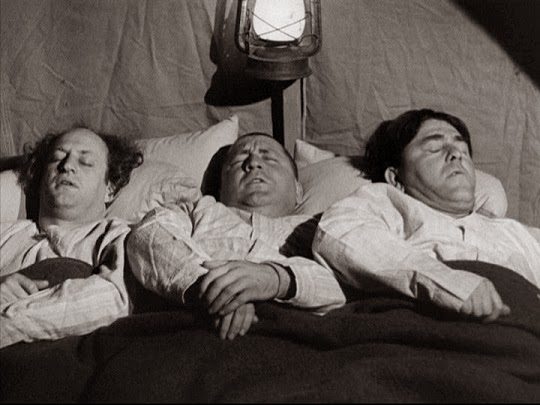
And the most important question: why did the men live together (and sleep together)?  Where were their wives?

All of the adult men I knew, or had seen on tv, or had ever heard of, had wives.  My parents and other relatives constantly talked about the far-off day when I would be "grown up" and "married," as if the two states were identical.

Yet these three men were obviously grown up, and obviously not married.  Men building a life together, not needing or wanting wives (I missed or ignored the scenes where they flirt with women).

I didn't think there was any  romance between them, not even friendship -- Moe was painfully abusive to the others, and they treated him with open contempt.

But, as with the Hanna Barbara cartoons of my earliest childhood (Yogi Bear, The Flintstones), the domesticity itself was evocative.

There was a recast, The Three Stooges, in 2012, with Chris Diamantoupoulos  (top photo) as a rather muscular Moe.  Again, they don't get girlfriends or wives; the hetero-romantic plot is given to a new character.

See also: Samson Burke.

Aug 3, 2013

Runner for the King: A Dream of Hispanic Freedom


When I was little, I loved Runner for the King (Rowena Bennett 1944), about a boy named Roca who is part of a relay of runners in the Inca Empire of South America.  They deliver messages to and from the king in the form of knotted cords, or quipu.

But as Roca tries to deliver the latest message, things go wrong.  A relay station is abandoned, a rope bridge is cut; he must go through the jungle, where he is attacked by a jaguar.  He rescues his friend Cachi from the savages who are planning an attack, and they run together to deliver the message personally to the Inca.  

Cachi and Roca's perilous run entered my dreams.  My friend Bill and I were racing across a vast sandy desert beneath a midnight sky. In the distance I saw a city of sharp jagged towers, brightly lit with green lights. We ran for countless hours, for all our lives, never tiring, never stopping to rest.  The landscape never changed, the sun never rose, the city grew no closer. Yet we were content.


Sometimes as we ran, I glanced over, caught Bill's eye, and he smiled. It was the same smile that Chekhov and Sulu shared in their room on the Enterprise, and Rich and Sean at the inn in rural Ireland. It was the most important sight in the world


Later I read Temple of the Sun (Evelyn Sibley Lampman, 1964), about a 12-year old boy named Chimal, whose quiet life with his best friend in the ancient Aztec capital of Tenochtitlan is disrupted by the arrival of Cortez and his conquistadores.


And I saw Royal Hunt of the Sun (1969), with the Conquistador Pizarro (Robert Shaw) capturing the extraordinarily muscular, semi-nude Atahualpa of the Incas (Christopher Plummer) and holding him for ransom.  But the plan becomes complicated as he develops feelings of respect, affection, and finally love for the god-king.


All I knew about Latin America at the time was Pre-Conquest, about vast empires rising from the jungles, Aztecs, Incas, and Mayas, who wore loincloths and built step-pyramids and worshipped the Feathered Serpent and validated same-sex love.

In the fifth grade, we had a choice of Spanish or French.  I took Spanish, and soon learned about Maximilian, Bolivar, Juarez, Santa Ana, and Zapata.  I soon read Los de Abajo, Don Segundo Sombra, the Ficciones of Jorge Luis Borges. I watched Santo, El Blue Demonio, La Gran Aventura, Papa soltero.  I dated Hispanic men. Eventually I learned about gay Latin American writers, like Arenas and Puig.

And I ran. Track in high school, cross-country in college, 5-Ks, 10-Ks, fun runs.  I've been running ever since.


Related Posts Plugin for WordPress, Blogger...