Showing posts with label Bewitched. Show all posts

Sep 22, 2024

Wandavision: More Sitcom than Science Fiction


 For months, Netflix has been a wasteland, mostly a lot of  "dead girl in a small town" cop shows and "poor boy and rich girl fall in love" Korean melodramas.  So we have pulled the plug and switched to Disney Plus, which allows us to finally see what all the fuss is about with Wandavision.

The series has been showing up on my Twitter and Facebook feeds a lot: "The staggering surprise of the last episode!": "Wasn't the last episode the best thing you ever saw?"; "Fifteen top theories about the new Disney Plus hit!"  But what was it?  I figured the video blog of Wanda from Corner Gas.

I started watching with only minimal research, enough to determine that Wanda Maximoff (Elizabeth Olson) and Vision (Paul Bettany) are superheroes in the Marvel Universe who are dating or married to each other.  So, if she was dating The Incredible Hulk, would the show be called Wandahulk?

In the first two episodes, they seem to be the stars of an archetypal early 1960s black-and-white sitcom with a "my secret identity" premise: Vision is a robot, and Wanda has magical powers.  Plotlines are about what you'd expect from old sitcoms, although you'll have to grow up with them to get all the references.

Episode #1: The living room is from The Dick Van Dyke Show, and the kitchen from I Love Lucy.  Vision has a job at an amorphous company that doesn't produce or sell anything, like sitcom dads of the era.  There's a wacky next door neighbor.  The plot: Wanda thinks that the "special night" is their anniversary, but it's actually dinner with the boss and his wife.

Episode #2: The living-dining room, front yard, and opening credits are from Bewitched.  The plot: Wanda and Vision are set to perform at a talent show to benefit the local elementary school, but Vision is incapacitated by eating chewing gum (apparently he can't eat, although, as Isaac Asimov pointed out in I, Robot, food is a part of so many social occasions that any robot designed to interact with humans should have the capability).


Of course, Wandavision is not a complete clone of these shows.  The friends and neighbors are racially diverse without comment; for instance, Vision's coworker Norm is played by Asif Ali (below), and future episodes will feature Special Agent Jimmy Woo (Randall Park, left).  There were no black or Asian characters on early 1960s sitcoms, except for a very few episodes about them.  

There also seem to be more jokes about sex than appeared in the uptight sixties.    

And there  are occasional hints that something is wrong.  

1. Wanda and Vision don't want to say where they came from, how long they've lived in Westview, or how long they've been married.  I wasn't sure if they were trying to avoid being outed as superheroes, or they really didn't know.  Maybe they can't remember anything before the "series" began, like the residents of Storybrook in Once Upon a Time.

2. At dinner, the boss starts choking on a piece of food, and his wife laughs and tells him to "Stop it" over and over.  An inappropriate affect.

3. People keep announcing that the talent show is a benefit "for the children," and everyone repeats "for the children" in a robotic drone.

4. In the second episode, red objects occasionally appear in the black-and-white world, and then suddenly everything switches to color.

5. Wanda asks a new acquaintance her name, and she doesn't know.


I would prefer more hints.  Most of each episode's dialogue, characterization, and plot so closely matches early 1960s sitcoms that I wanted to turn it off and watch a real episode of I Love Lucy or Bewitched.  I want more evidence this is not actually a 1960s sitcom, it's a science fiction series about superheroes trapped in a sitcom world.

Beefcake: No.

Heterosexism: Wanda and Vision are a standard loving heterosexual couple.

Gay Characters: None specified yet, although I understand that the characters are all superheroes, and one of them is gay in other media.

Will I Keep Watching:  Sure.  I want to see their take on The Brady Bunch in the 1970s and the hip sitcoms of the 1980s.

Oct 24, 2019

The ABC Saturday Superstar Movie

When I was in junior high in the 1970s, the anthology series The ABC Saturday Superstar Movie grabbed kids and teens (and sometimes adults) from live-action sitcoms and put them into badly-animated adventures:

The kids from The Brady Bunch are trapped on a desert island.

The Nanny and the Professor kids tackle spies.

Gidget (who actually hadn't been on tv for a decade) tackles smugglers.

Ann Marie from That Girl goes to Wonderland.


I watched sometimes -- it was pleasant to see some of my mega-crushes, like Greg Brady and David Doremus (from Nanny and the Professor), even in animated form.


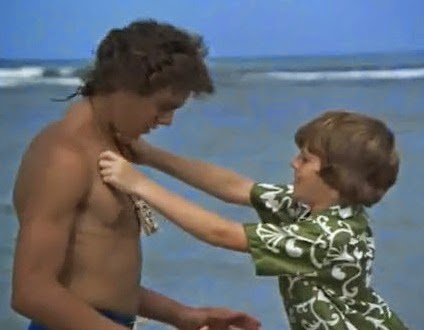
And there was plenty of animated beefcake, like this hunk, a cousin of Tabitha and Adam from Bewitched who plays in a pop group in a circus, or something.

Besides, the only other option was Scooby-Doo.

But the stories varied in the quality of their animation, and their level of ridiculousness.

Yogi Bear flies around with Hanna-Barbera characters in a giant ark, ridding the world of bigotry, greed, sloppiness, and lack of niceness (all caused by mad scientists with ray guns).

Warner Brothers stars Porky and Daffy clash with The Groovy Ghoulies from Sabrina the Teenage Witch.


The absolute worst was Popeye and the Man Who Hated Laughter, which aired on October 7th, 1972.

I would love to hear the conversation in the board room at ABC:

"Let's do a cartoon special about newspaper comics!  Kids love reading the newspaper, right?"

Um...no, we didn't.

"Great idea!  We can include all of their favorite comic strip characters -- Jiggs and Maggie, Tim Tyler, Mandrake the Magician, The Little King, the Katzenjammer Kids, the Phantom..."

Right, comic strips that were last popular 40 years before we were born!  

They added Popeye, another character from ancient days who was having something of a renaissance on Saturday morning cartoons.

And a plot was created about a mad scientist who hates laughter, so he kidnaps the source of most of the world's laughter -- characters from doddering, long-forgotten comic strips.  The only way they can escape is to convince him that laughter is not so bad after all.  So they put on an idiotic talent show.

The only song I remember is: "Hi, my name is Iodine, and I'm feeling so fine, doing the comic strip rag."

"Rag" was a dance craze from before World War I.

Well, at least you could see The Phantom and Bluto together.

See also: 1970s Saturday Morning Beefcake; Gay Subtexts in "Bringing Up Father."

Jul 13, 2019

Dick York: Bewitching Beefcake

I imagine that most gay male and heterosexual female Baby  Boomers have been desperate to see Dick York with his shirt off ever since their diaper days, when they saw him eye-bulge as Darren Stephens, mortal married to the witch Samantha (Elizabeth Montgomery) on the gay-symbolism-heavy "my secret" sitcom Bewitched (1964-69)  

Good luck.  As a stick-in-the-mud advertising executive in the Mad Men sixties, Darren usually wore a business suit, slept in pajamas, and was never shown in the shower or at the beach.  Dick was suffering from a debilitating back injury that prohibited most stunts and action scenes; finally the writers had to find reasons to keep Darren in bed for entire episodes.

Prior to Bewitched, Dick starred in various Westerns, thrillers, and dramas.  I haven't seen any of them except for Inherit the Wind (1960), but they probably didn't include significant beefcake.

But you can find everything on youtube.  A  compilation clip called Dick York: the Sexiest Man Alive seems to be displaying clips from Dick's very early work, playing high schoolers in "educational films" such as "How Popular Are You?" (1951).  They were used in classrooms for promoting conformity and compulsory heterosexuality.


In Bewitched, Darren was the "straight" man, in more ways than  one.  Not only the eye-bulging, slow-burning spectator to the mayhem, but aggressively heterosexual, faithful to Samantha but tempted by slithery witches, wood nymphs, sirens, and human women every five seconds.

But the compiler finds some gay-subtext images.  Dick and another boy check out each other's equipment in the shower (top photo), and he demonstrates that he is popular by walking off arm in arm with the school hunk.


There are also a few pics, very small, of an older Dick York at poolside, courtesy of Democratic Underground.  Not a bad physique.  Too bad Darren didn't get zapped out of his clothes from time to time.

Mar 29, 2016

The Patty Duke Show

I was saddened to hear of the death of Patty Duke today, at age 69.

The actress was a long-time friend of the gay community, supporting gay rights and AIDS research, and appearing in a number of gay-friendly productions, such as By Design (1982), in which she played a lesbian fashion designer, and Hail to the Chief (1985), about the first woman president of the U.S., with a gay Head of the Secret Service ("The deadliest fairy you'll every meet").

Two of her sons, Sean Astin (born 1971) and Mackenzie Astin (1973), are actors.  They have also appeared in gay-positive productions.  Mackenzie is bisexual.

Of all her memorable performances on tv and in the movies, Baby Boomers remember her most fondly for The Patty Duke Show (1963-66).  It was before my time, but I've seen episodes on youtube.

Patty Duke plays Cathy Lane, a sophisticated, urbane Scottish teenager "who's lived most everywhere, from Zanzibar to Barclay Square," but comes to America to live with her uncle.  She has a cousin, Patty Lane, a typical American teenager who "loves to rock and roll, a hot dog makes her lose control."

Guess what: Patty Duke plays both girls!  They're identical cousins!

Ok, there's no such thing.  They must be sisters -- there's more going on in that family tree than meets the eye.  Better not to ask.

We also shouldn't ask about what happened to Cathy's parents.  Better leave it open, like Mike and Carol's exes on The Brady Bunch.

Cathy sets in to become Americanized, and the standard sitcom complications ensue:
Patty gets a crush on her French teacher.
Cathy tutors a basketball star.
Patty becomes the editor of the school paper.
Cathy gets a date with Sal Mineo.

Looking through the episode synopses on Wikipedia, I find few instances of the girls masquerading as each other.  I guess the novelty of seeing Patty Duke playing two characters at once was enough to fuel the plots.

The family was rounded out with a mother and a father (William Schallert, Jean Byron), a kid brother (Paul O'Keefe), and a series of boyfriends and crushes, notably Eddie Applegate (Richard, who appeared in 88 episodes), but also just about every young adult in Hollywood: Ronnie Schell, Steve Franken, James Brolin, Frank Sinatra Jr., Bobby Vinton, Richard Gautier, and Daniel J. Travanti.

Celebrities like Frankie Avalon, Sammy Davis, Jr. Troy Donahue, and Robert Goulet played themselves.  Chad and Jeremy and the Shindogs performed.

No gay specific characters, obviously, but the show was memorable for not trying to push people into a heteronormative box.  Patty and Cathy's classmates included science nerds, movie buffs, artistic types, athletic types, boys who weren't interested in girls, girls who weren't interested in boys.

William Asher, who co-created the program and wrote most episodes, went on to the gay-subtext filled Bewitched.


In 1999, 33 years after the series ended, many of the cast reprised their roles in The Patty Duke Show: Still Rockin' in Brooklyn Heights.  The family reconvenes to prevent the destruction of the old high school.

Patty is a drama teacher, divorced from Richard, with a grown son (Alain Goulem) and a granddaughter, and Cathy is a widow with a teenage son (Kent Riley. left).

Neither of them is immersed in the heterosexual nuclear family box.

See also: Mackenzie Astin; Sean Astin


Related Posts Plugin for WordPress, Blogger...