When I was in junior high in the 1970s, the anthology series The ABC Saturday Superstar Movie grabbed kids and teens (and sometimes adults) from live-action sitcoms and put them into badly-animated adventures:
The kids from The Brady Bunch are trapped on a desert island.
The Nanny and the Professor kids tackle spies.
Gidget (who actually hadn't been on tv for a decade) tackles smugglers.
Ann Marie from That Girl goes to Wonderland.
I watched sometimes -- it was pleasant to see some of my mega-crushes, like Greg Brady and David Doremus (from Nanny and the Professor), even in animated form.
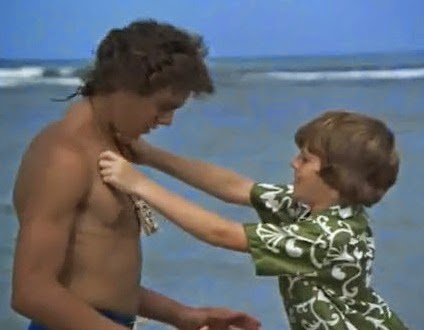
And there was plenty of animated beefcake, like this hunk, a cousin of Tabitha and Adam from Bewitched who plays in a pop group in a circus, or something.
Besides, the only other option was Scooby-Doo.
But the stories varied in the quality of their animation, and their level of ridiculousness.
Yogi Bear flies around with Hanna-Barbera characters in a giant ark, ridding the world of bigotry, greed, sloppiness, and lack of niceness (all caused by mad scientists with ray guns).
Warner Brothers stars Porky and Daffy clash with The Groovy Ghoulies from Sabrina the Teenage Witch.
The absolute worst was Popeye and the Man Who Hated Laughter, which aired on October 7th, 1972.
I would love to hear the conversation in the board room at ABC:
"Let's do a cartoon special about newspaper comics! Kids love reading the newspaper, right?"
Um...no, we didn't.
"Great idea! We can include all of their favorite comic strip characters -- Jiggs and Maggie, Tim Tyler, Mandrake the Magician, The Little King, the Katzenjammer Kids, the Phantom..."
Right, comic strips that were last popular 40 years before we were born!
They added Popeye, another character from ancient days who was having something of a renaissance on Saturday morning cartoons.
And a plot was created about a mad scientist who hates laughter, so he kidnaps the source of most of the world's laughter -- characters from doddering, long-forgotten comic strips. The only way they can escape is to convince him that laughter is not so bad after all. So they put on an idiotic talent show.
The only song I remember is: "Hi, my name is Iodine, and I'm feeling so fine, doing the comic strip rag."
"Rag" was a dance craze from before World War I.
Well, at least you could see The Phantom and Bluto together.
See also: 1970s Saturday Morning Beefcake; Gay Subtexts in "Bringing Up Father."
Showing posts with label Popeye. Show all posts
Oct 24, 2019
Jul 3, 2018
Popeye: Finding a Non-Traditional Family
Critics panned the 1980 movie musical Popeye, starring Robin Williams and Shelley Duvall, but I loved it.
I loved the world of Sweethaven, a tiny, cramped, desolate seaport, cut off from the rest of the world, where everyone is trapped, like the castaways in Lost or Gilligan's Island:
Sweet Sweethaven
God must love us
Why else would He have stranded us here.
It's the heart of the Depression. People have no jobs; they must wear second-hand clothes and live in decrepit houses. They spend their days drinking bootleg liquor, boxing, "horse racing" (without horses), and philosophizing on the futility of life: one day you're alive, full of hope for the future, and the next, you're food.
Everything is food, food, food
To make matters worse, the town is ruled by a Big Man (literally), Bluto (Paul L. Smith, top photo, bear-hugging Bruce Lee). He levies arbitrary taxes, forecloses on houses, and beats up people at random.
He is engaged to Olive Oyl (Shelley Duval), whose parents run the local boarding house, but she really had no choice in the matter. She tries in vain to think of a reason to like him:
He's tall...goodlooking...and large....so large...so large.
"Large" would actually be a plus for me. Extra-large, even moreso.
Into this lost, shipwrecked world comes the one-eyed sailor Popeye (Robin Williams), not the sophomoric star of 1960s cartoons, but the ultimate individualist from the E.C. Seegar comics of the 1930s, whose mantra was remixed by Gloria Gaynor and became a gay anthem:
What am I?
I am what I am!
At first reluctant to get emotionally involved, Popeye befriends Olive Oyl and her family and decides to help out.
He wins a boxing tournament to forestall foreclosure, and trounces both Bluto and a giant octopus. On the way he adopts a founding child and re-unites with his long-lost father.
And there's a gay connection: there's no indication, anywhere in the movie, that Popeye and Olive Oyl have fallen in love. Olive Oyl is ecstatic to finally find someone who "needs me," but Popeye, similarly, sings "Everybody needs somebodys," to his son Swee'Pea.
They work together to raise a child that neither has had a biological role in producing. They are a non-traditional family.
The movie is about finding a family, finding a home, not necessarily in a heterosexual embrace, but among people who care about you.
I loved the world of Sweethaven, a tiny, cramped, desolate seaport, cut off from the rest of the world, where everyone is trapped, like the castaways in Lost or Gilligan's Island:
Sweet Sweethaven
God must love us
Why else would He have stranded us here.
It's the heart of the Depression. People have no jobs; they must wear second-hand clothes and live in decrepit houses. They spend their days drinking bootleg liquor, boxing, "horse racing" (without horses), and philosophizing on the futility of life: one day you're alive, full of hope for the future, and the next, you're food.
Everything is food, food, food
To make matters worse, the town is ruled by a Big Man (literally), Bluto (Paul L. Smith, top photo, bear-hugging Bruce Lee). He levies arbitrary taxes, forecloses on houses, and beats up people at random.
He is engaged to Olive Oyl (Shelley Duval), whose parents run the local boarding house, but she really had no choice in the matter. She tries in vain to think of a reason to like him:
He's tall...goodlooking...and large....so large...so large.
"Large" would actually be a plus for me. Extra-large, even moreso.
Into this lost, shipwrecked world comes the one-eyed sailor Popeye (Robin Williams), not the sophomoric star of 1960s cartoons, but the ultimate individualist from the E.C. Seegar comics of the 1930s, whose mantra was remixed by Gloria Gaynor and became a gay anthem:
What am I?
I am what I am!
At first reluctant to get emotionally involved, Popeye befriends Olive Oyl and her family and decides to help out.
He wins a boxing tournament to forestall foreclosure, and trounces both Bluto and a giant octopus. On the way he adopts a founding child and re-unites with his long-lost father.
And there's a gay connection: there's no indication, anywhere in the movie, that Popeye and Olive Oyl have fallen in love. Olive Oyl is ecstatic to finally find someone who "needs me," but Popeye, similarly, sings "Everybody needs somebodys," to his son Swee'Pea.
They work together to raise a child that neither has had a biological role in producing. They are a non-traditional family.
The movie is about finding a family, finding a home, not necessarily in a heterosexual embrace, but among people who care about you.
Apr 23, 2017
Bobby London's Homoerotic, Homophobic Popeye
You may not know this, but E. C. Segar's Thimble Theater comic strip, which first appeared in 1919, has never gone out of publication (and it's still called Thimble Theater, even though Popeye has been the undisputed star since 1929).
After Segar's death in 1938, Tom Sims took over the strip, then Bill Stein, and most notably Bud Sagendorf, who introduced Popeye and his costars to the fads and foibles of the 1960s, 1970s, and 1980s (here Popeye battles a beatnik).
In 1986, Sagendorf decided to retire, and the syndicate hired 38-year old Bobby London to draw Thimble Theater.
Perhaps an odd choice: London was an underground comic artist whose work appeared in such disrespectable publications as National Lampoon and Playboy. His most famous character, Dirty Duck, was foul-mouthed, sleazy, and amoral.
When London took over the strip, he resurrected characters who hadn't been seen since the days of Segar, such as Olive Oyl's parents, her brother Castor, her ex-boyfriend Ham Gravy, the prehistoric man Toar, and Alice the Goon. He also introduced the conceit that the characters had actually been alive since the early 1900s (although they hadn't aged), and were confused and befuddled by the craziness of the 1980s.
The fun was in the juxtaposition of the 1930s characters with 1980s life: Olive taking aerobic classes, Poopdeck Pappy on a skateboard, the Sea Hag opening a disco, Castor Oyl trying to use a fax machine.
The gay-subtext friendship between Popeye and Castor Oyl was still intact, although muted by making them both rather aggressively hetero-horny.

In spite of his radical past, London was quite conservative, and his fear and distrust of this brave new world came out often.
And, occasionally, a dose of pure homophobia.
Of course, London was homophobic in his underground comic days, but one can forgive his depiction of a gay man as a bearded drag queen named Tiger Lily who gets into a multi-sexual orgy. It was, after all, 1972 only a few years after Stonewall.
But not in 1988, when Castor Oyl says that tv wrestling is "real rough stuff," but Popeye begs to differ.
Take a closer look at the limp-wristed, eyelashed hair stylist. Not much has changed in 16 years.
In June 1992, London began a continuity in which Olive Oyl receives a Baby Bluto doll, and decides to get rid of it. Passerbys think that she intends to get an abortion.
Worried over even the implication of the a-word, the syndicate fired London and refused to run the continuity. They've been running repeats of Sagendorf strips ever since.
See also: Popeye, the First Gay Superhero.
After Segar's death in 1938, Tom Sims took over the strip, then Bill Stein, and most notably Bud Sagendorf, who introduced Popeye and his costars to the fads and foibles of the 1960s, 1970s, and 1980s (here Popeye battles a beatnik).
In 1986, Sagendorf decided to retire, and the syndicate hired 38-year old Bobby London to draw Thimble Theater.
Perhaps an odd choice: London was an underground comic artist whose work appeared in such disrespectable publications as National Lampoon and Playboy. His most famous character, Dirty Duck, was foul-mouthed, sleazy, and amoral.
When London took over the strip, he resurrected characters who hadn't been seen since the days of Segar, such as Olive Oyl's parents, her brother Castor, her ex-boyfriend Ham Gravy, the prehistoric man Toar, and Alice the Goon. He also introduced the conceit that the characters had actually been alive since the early 1900s (although they hadn't aged), and were confused and befuddled by the craziness of the 1980s.
The fun was in the juxtaposition of the 1930s characters with 1980s life: Olive taking aerobic classes, Poopdeck Pappy on a skateboard, the Sea Hag opening a disco, Castor Oyl trying to use a fax machine.
The gay-subtext friendship between Popeye and Castor Oyl was still intact, although muted by making them both rather aggressively hetero-horny.
In spite of his radical past, London was quite conservative, and his fear and distrust of this brave new world came out often.
And, occasionally, a dose of pure homophobia.
Of course, London was homophobic in his underground comic days, but one can forgive his depiction of a gay man as a bearded drag queen named Tiger Lily who gets into a multi-sexual orgy. It was, after all, 1972 only a few years after Stonewall.
But not in 1988, when Castor Oyl says that tv wrestling is "real rough stuff," but Popeye begs to differ.
Take a closer look at the limp-wristed, eyelashed hair stylist. Not much has changed in 16 years.
In June 1992, London began a continuity in which Olive Oyl receives a Baby Bluto doll, and decides to get rid of it. Passerbys think that she intends to get an abortion.
Worried over even the implication of the a-word, the syndicate fired London and refused to run the continuity. They've been running repeats of Sagendorf strips ever since.
See also: Popeye, the First Gay Superhero.
Jul 20, 2015
Popeye: The First Gay Superhero
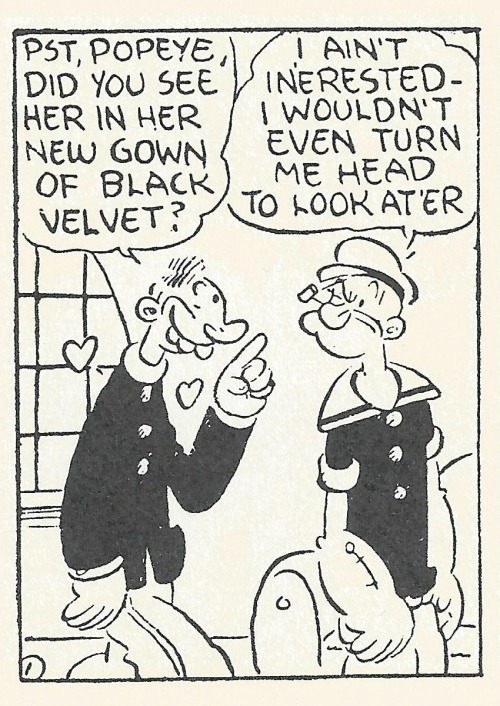
Then in 1979, I stumbled upon a book called Popeye: His First Fifty Years, which talked about Castor Oyl, Ham Gravy, King Blozo, Tor, and Oscar. Who were these people?
I discovered that the cartoons were the latest incarnations of E.C. Segar's "Thimble Theater" comic strip, which began in 1919, starring get-rich-quick schemer Castor Oyl and his wise-cracking sister Olive. In a 1929 continuity, Castor hired gruff one-eyed sailor Popeye for a sea voyage. He became so popular that Segar added him to the cast, honed down his rough edges, and eventually made him the star of the strip. It continues to run in some newspapers today.
There have been Popeye comic books almost continuously since 1948, published by Dell, Gold Key, Charlton, Harvey, and IDW.
1. He's sweet on Olive Oyl, but his main emotional bond is with Castor. They run a detective agency together, rescue each other from danger, argue, break up, and reconcile.
2. Popeye has no interest in women other than Olive, but he develops several gay-subtext male friendships, notably with King Blozo.
Similarly, he becomes the object of desire of several men. Reformed villain Tor keeps trying to kiss Popeye and saying that he loves him.
In fact, male friendships drive far more plots than quests for heterosexual romance.
3. The comic strips and comic books mostly occur in male homosocial spaces -- ships, boxing rings, detective agencies. But Olive constantly disrupts those spaces. The other characters keep telling her to "wait here" or "stay home where it's safe," but she is a full participant in every adventure. And when there's trouble, she proves herself a competent fighter, as good or better than Popeye himself.
4. Popeye has no qualms about gender transgressions. He frequently dresses in women's clothing to accomplish some plot point. When he becomes the ward of the infant Swee'Pea, he joins a women-only parenting class.
All that changed in the heterosexist "every man's fantasy" world of the cartoons.
See also: My review of the 1980 Popeye movie.
Subscribe to:
Posts (Atom)