Showing posts with label Sean Astin. Show all posts

Dec 5, 2018

White Water Summer/Stand By Me

Although panned by the critics and ignored by most heterosexuals, White Water Summer (1987) became a hit among gay kids and teenagers, maybe for the same reasons that they ignored the critically acclaimed Stand by Me the year before (1986).

 The plot of Stand: four boys (Will Wheaton, River Phoenix, Jerry O'Connell, Corey Feldman) brave a suburban wilderness on a weird quest to see a dead body.  En route they confront their anxieties and bond with each other.

The plot of Summer: four boys (Sean Astin, Jonathan Ward, Matt Adler, K.C. Martel) brave a wilderness on a white water rafting expedition, led by the brutal, abusive Vic (Kevin Bacon).  En route the confront their anxieties and bond with each other.


The differences:

In Stand, the conflicts involve parentage, family, bullying, and heterosexual destiny.  In Summer, the conflicts involve the boys' relationships with each other and their dismay at the brutality of the adult world.


In Stand, the male body is a site of anxiety and despair; a boy is too fat, or has poor eyesight; leeches attack their crotches.  In Summer, the male body is a thing of beauty. The characters compliment each other, gaze at each other, lie prone against each other.


The boys of Stand are aggressively homophobic, throwing around the term "faggot" and challenging each others' "masculinity."  They are also aggressively heterosexual, discussing boobs, girls, having sex with girls, not having sex with girls.  The boys of Summer mention neither "faggots" nor girls.

Stand ends with the boys parting, and the adult narrator telling us what happened to them -- mostly involvng marriage and family, the "inevitable" loss of boyhood bonds.

Summer ends with the boys together, still friends, the same-sex bond intact.


Jan 3, 2018

Toy Soldiers: Muscle on Parade

Every once in a while, a movie producer hires all of the teen hunks he can find, puts them in an all-male environment, and orders a script that involves fighting a common adversary with their shirts off, thus ensuring the avid interest of every gay boy in the world: Tom Brown's School Days, Bless the Beasts and Children, Lord of the Flies, White Water SummerWhite Squall.  In 1991, the movie was Toy Soldiers.


The plot: terrorists take over an elite prep school for the sons of the wealthy and powerful, and take the boys and their headmaster hostage.  The boys use their troublemaking skills to gather intel on the terrorists, and wise-cracking operator Billy Tepper (20-year old Sean Astin, left) sneaks out to brief the adults.

When they turn out to be ineffectual, Billy and his friends, including comic relief Snuffy (21-year old Keith Coogan, middle) and surly bodybuilder Ricky (19-year old George Perez, right), go on the offensive, incapacitating several terrorists, disabling their bomb, and leading the  younger kids to safety, just in time to be "rescued."


Other boys include the rich "jerk" Joey (19-year old Wil Wheaton, well known for playing Wesley Crusher on Star Trek: the Next Generation).


And T. E. Russell as the pragmatic Hank.


Sean Astin (Billy) was a major teen idol of the period, with roles in The Goonies, The War of the Roses, White Water Summer, and Rudy).  

Keith Coogan (Snuffy) was a former child star with credits in Adventures in Babysitting and The Book of Love.  


There's some buddy-bonding between Billy and Snuffy, but with a large ensemble cast, it's not well developed.

However, heterosexual interest is absent, except for a scene in which Billy confiscates a Playboy from one of the younger kids.  There are references to getting laid and masturbation, but no one mentions a girlfriend or a desire for girls.

Absence of expressed heterosexual desire is almost unheard-off in a teen movie of the 1990s, giving viewers permission to read one or more of the boys -- or all of them -- as gay.


And the parade of underwear-clad, towel-clad, and shirtless teenage muscle (or rather young adult muscle, since all of the actors were over 18) didn't hurt.

There's a Keith Coogan story on Gay Celebrity Dating Stories


Oct 17, 2017

Jonathan Ke Quan: The Goonies Grow Up

Indiana Jones and the Temple of Doom (1984) gives the whip-wielding archaeologist-adventurer Indiana Jones (Harrison Ford) a modern-day English-mangling Sabu, the equivalent of the teenage-sidekick in the 1930’s serials.  But instead of a young adult playing a teenager, the gay subtext is minimized by making Indy's sidekick the prepubescent waif Short Round (Jonathan Ke Quan, nearly 14 years old but looking around 10).

 Indy and Short Round display a great deal of affection, but always of the parent-child variety: Indy sleeps with the boy in his arms, and holds his hand while they are walking, but he is continually presented as a small boy, lest anyone think that when he says “Indy, I love you” anyone think he means something besides substitute father.  There is no rejection of the homoerotic other, except in a passage in the novelization about the “disreputable careers” that might befall a 13-year old boy on the streets of Shanghai; that is, if it were not for Indy’s intervention, Short Round might have become a boy prostitute.


Jonathan Ke Quan went on to star in The Goonies (1985) as the Asian nerd Data, who buddy-bonds in a rather aggressively physical way with fellow Goonie Mikey (Sean Astin).


And on two tv series: Together We Stand (1986-87), as a Vietnamese orphan adopted by an American family (his brother was played by the gay-friendly Scott Grimes); and the last season of Head of the Class (1990-1991), as Asian nerd Jasper Kwong.


Are you starting to see a pattern here?  Asians stereotyped as mathematical, nerdish, and asexual, so no romantic leads, no beefcake -- but, on the bright side, ample room for gay subtexts.

After playing adolescents with no heterosexual interest and intense buddy-bonding in the martial arts drama Breathing Fire (1991) and the comedy Encino Man (1992) with Sean Astin, Jonathan studied martial arts and went to USC Film School.

Since graduating, his only acting role has been in the Hong Kong movie Second Time Around (2002), which involves Las Vegas, time traveling, romance, and apparently gay characters.

He has also worked behind the scenes, as a stunt coordinator, fight choreographer, and cinematographer. No idea if he's gay in real life or not.


Sep 23, 2017

Elijah Wood: Fear of the Buddy-Bond

Unlike his Lord of the Rings costar Sean Astin, Elijah Wood never got much play as a teen hunk, and he didn't do a lot of buddy-bonding roles; the only one that springs to mind is Radio Flier (1992) with Joseph Mazzello, and Oliver Twist (1997).

In fact, a lot of his roles drew on 1990s anxiety concerning same-sex bonds; masculine smiles hide danger, destruction, and malice:

The Good Son (1993): Mark (Elijah) discovers that his irrepressible cousin (Macaulay Culkin) is a psychotic murderer.

The War (1994): Stu (Elijah) and his friends are at war.  Oh, and he gets a girlfriend.

The Ice Storm (1997): Mikey (Elijah) has a violent brother, has sex with a girl, wanders out into an ice storm, and dies.


Or sometimes irrelevant:

The Adventures of Huckleberry Finn (1993), a version that ignores the Huck-Jim subtext.

Flipper (1994): a remake of the classic tv series with Elijah playing Luke Halpin's character. He kisses a girl.

The Faculty (1998): Casey (Elijah) discovers that the faculty are aliens, with the help of a girl who has a boorish boyfriend.


The lack of heterosexual interest and homoromantic subtext of The Lord of the Rings might exonerate him, except that during the last ten years, he hasn't done much of gay interest: a gay-vague psychopath with supernatural powers who eats women in Sin City (2005), and a gay "best friend" in Celeste and Jesse Forever (2012).

There's an Elijah Wood dating story on Tales of West Hollywood.


Mar 29, 2016

The Patty Duke Show

I was saddened to hear of the death of Patty Duke today, at age 69.

The actress was a long-time friend of the gay community, supporting gay rights and AIDS research, and appearing in a number of gay-friendly productions, such as By Design (1982), in which she played a lesbian fashion designer, and Hail to the Chief (1985), about the first woman president of the U.S., with a gay Head of the Secret Service ("The deadliest fairy you'll every meet").

Two of her sons, Sean Astin (born 1971) and Mackenzie Astin (1973), are actors.  They have also appeared in gay-positive productions.  Mackenzie is bisexual.

Of all her memorable performances on tv and in the movies, Baby Boomers remember her most fondly for The Patty Duke Show (1963-66).  It was before my time, but I've seen episodes on youtube.

Patty Duke plays Cathy Lane, a sophisticated, urbane Scottish teenager "who's lived most everywhere, from Zanzibar to Barclay Square," but comes to America to live with her uncle.  She has a cousin, Patty Lane, a typical American teenager who "loves to rock and roll, a hot dog makes her lose control."

Guess what: Patty Duke plays both girls!  They're identical cousins!

Ok, there's no such thing.  They must be sisters -- there's more going on in that family tree than meets the eye.  Better not to ask.

We also shouldn't ask about what happened to Cathy's parents.  Better leave it open, like Mike and Carol's exes on The Brady Bunch.

Cathy sets in to become Americanized, and the standard sitcom complications ensue:
Patty gets a crush on her French teacher.
Cathy tutors a basketball star.
Patty becomes the editor of the school paper.
Cathy gets a date with Sal Mineo.

Looking through the episode synopses on Wikipedia, I find few instances of the girls masquerading as each other.  I guess the novelty of seeing Patty Duke playing two characters at once was enough to fuel the plots.

The family was rounded out with a mother and a father (William Schallert, Jean Byron), a kid brother (Paul O'Keefe), and a series of boyfriends and crushes, notably Eddie Applegate (Richard, who appeared in 88 episodes), but also just about every young adult in Hollywood: Ronnie Schell, Steve Franken, James Brolin, Frank Sinatra Jr., Bobby Vinton, Richard Gautier, and Daniel J. Travanti.

Celebrities like Frankie Avalon, Sammy Davis, Jr. Troy Donahue, and Robert Goulet played themselves.  Chad and Jeremy and the Shindogs performed.

No gay specific characters, obviously, but the show was memorable for not trying to push people into a heteronormative box.  Patty and Cathy's classmates included science nerds, movie buffs, artistic types, athletic types, boys who weren't interested in girls, girls who weren't interested in boys.

William Asher, who co-created the program and wrote most episodes, went on to the gay-subtext filled Bewitched.


In 1999, 33 years after the series ended, many of the cast reprised their roles in The Patty Duke Show: Still Rockin' in Brooklyn Heights.  The family reconvenes to prevent the destruction of the old high school.

Patty is a drama teacher, divorced from Richard, with a grown son (Alain Goulem) and a granddaughter, and Cathy is a widow with a teenage son (Kent Riley. left).

Neither of them is immersed in the heterosexual nuclear family box.

See also: Mackenzie Astin; Sean Astin


Jan 10, 2016

Sean Astin

Speaking of John Astin, his adopted son Sean, born in 1971, was a reliable teen idol through the 1980s, with iconic roles in The Goonies (1985), White Water Summer (1987), and The War of the Roses (1989). (Meanwhile his brother Mackenzie was starring in The Facts of Life).


But Sean's gay subtexts began in earnest with starring roles in Memphis Belle (1990), a "boys alone" movie about a World War II airforce squadron (with Matthew Modine, Tate Donovan, and D. B. Sweeney).

 In the beefcake-heavy Toy Soldiers (1991), about boys alone in a private school.

In Where the Day Takes You (1992), as homeless drug addict Greg, who is partnered with Little J (Balthazar Getty).


And in Encino Man (1992), about college student Dave (Sean) and his slacker buddy Stony (Paulie Shore) unfreezing a cave man (Brendan Frasier) trapped in the ice.

In the late 1990s, Sean was mostly involved in boy-meets-girl-comedies and heterosexist actioners, but he returned to gay subtexts in a big way in The Lord of the Rings trilogy (2001-2003): his Sam Gamgee was achingly in love with Frodo Baggins (Elijah Wood), in spite of the marrying-a-girl conclusion.


Today he is a little beefy, but he can still fill out a Speedo.

Although he is a supporter of gay marriage, Sean's only gay character, in  Stay Cool (2009), was a homophobic stereotype, a swishy hairdresser named Big Girl.

Jan 3, 2016

Charles in Charge: The First Teencom

Fresh from his tenure on Happy Days, Scott Baio made a dent in the "servant saves dysfunctional family" genre with Charles in Charge (1984-85), about a college student who works as a male nanny, a surprisingly gender-bending role for 1984.

Willie Aames, who had starred with Scott in the teen sex comedy Zapped! (1982), would play his girl-crazy best friend Buddy.


Charles' rather disturbed charges would include painfully shy teenager Lila (15-year old April Lerman), tween mad scientist Douglas (14-year old Jonathan Ward), and preteen juvenile delinquent Jason (Michael Pearlman).


Charles himself would be rather nerdy, fond of suspenders, ties, and shirts buttoned all the way up.  To preclude any gay suspicions, he would have a steady girlfriend, Gwendolyn (Jennifer Runyon), and Buddy would be indefatigably girl-crazy.

Charles in Charge premiered on October 3, 1984 in a block with John Stamos' teen-oriented sitcom Dreams. There were a few things to like about it, like Jason's blatant crush on Charles.  But the teens who were expecting a hot teen idol stayed away, and the adults were busy watching The Fall Guy and Highway to Heaven, so the show tanked after 22 episodes.


A retooled Charles in Charge appeared in first-run syndication on January 3rd, 1987.   Lots of retooling:

1. The theme song was revamped to sound sexy and risque ("I want...ooh...I want Charles in charge of me!").

2. Charles was now a collegiate hunk, with an updated wardrobe, when he wasn't wandering around the house in a towel (or a hot dog suit).  A Charles-of-all-trades, he supplemented his nanny income by working as a teaching assistant at the college, and at the local pizza parlor hangout.

3. Buddy's girl-craziness likewise faded away; he became a dimwit instead.

4. There were strong adult characters, grumpy Walter Powell (James T. Callahan) and Charles' mother Lilian (Ellen Travolta).

5. And Charles' new charges, the Pembrokes, were not at all dysfunctional: glamorous future model Jamie (14-year old Nicole Eggert), bookish future writer Sarah (13-year old Josie Davis), and preteen athlete Adam (12-year old Alexander Polinsky).  Justin Whalen played Cousin Anthony.

This time teen viewers took notice, and Charles quickly becoming the #1 syndicated program on the air (Mama's Family was a close second).  It lasted until 1990, and inspired a whole genre of beefcake-heavy 1990s teencoms.

Of the three kids in the first incarnation of Charles, only Jonathan Ward had a significant acting career as a teenagerHe starred in the "boys alone" drama White Water Summer with Sean Astin (1987) and in the E.T. ripoff Mac and Me (1988), plus his own "my secret" teencom, The New Adventures of Beans Baxter (1987).  In 1994, he wrote and starred in a Discovery Channel documentary, Understanding Sex. 

Of the three kids in the second incarnation, both Nicole Eggert and Josie Davis went on to successful acting careers.  Alexander Polinsky does voice-over work and is involved behind-the-scenes in model construction.

See also: The Sound of Music

Aug 10, 2015

Mackenzie Astin: Bisexual-Inclusive

In 2011, Mackenzie Astin starred in Caught at the Zephyr Theater in Los Angeles.  He played a gay man blissfully planning a wedding with his partner (Will Beinbrink), when suddenly his Bible-thumping sister arrives for some screeching.


I hadn't heard much about Mackenzie, son of John Astin and Patty Duke, younger brother of Sean Astin, since the 1980s.  His biggest claim to fame then was a starring role on The Facts of Life (1985-88), about four girls in a private boarding school.

By the time he hit the series, the girls had graduated and were working in a boutique, Over Our Heads.  He played Andy Moffett, an orphan adopted by end-of-series lead Beverly (Cloris Leachman).

Teen magazines gave Mackenzie some attention, but not a lot.  Maybe because he wasn't very muscular.  He was soft, pretty, and feminine, a tween version of Kurt from Glee.

During the 1990s, he grew hard, hairy, and rather gaunt, as he tried to distance himself from his gay-coded teen years with macho hetero-roles: Iron Will (1994), about a dogsled competition; the Western Wyatt Earp (1994); Ernest Hemingway's wartime buddy in In Love and War (1996).


But Mackenzie played a lot of gay characters, too. In Stranger Than Fiction (2000), he plays a gay man named Jared who kills someone and asks his straight friends to help him hide the body.  In the short-lived tv series First Years (2001), he played a gay lawyer living in San Francisco.

Out as bisexual, Mackenzie is married to a woman, and a gay ally.

See also: The Patty Duke Show.

Oct 4, 2013

Kurt Vonnegut: Homophobia on Trafalmador

When I was in college in the 1980s, all of the hip, cool guys read Kurt Vonnegut.  All of them.  He was even printed in Playboy

Oh, he's great!  They would exclaim.  There's this science fiction writer, see, but it turns out that the things he's writing are real....and, and, the crazy Trafalamadorians are behind Stonehenge....and, and Vonnegut and his sister turn into ducks...and, and Billy Pilgrim gets unstuck in time...and, and.


Sounded sort of like Monte Python and Hitchhiker's Guide to the Galaxy.  Besides, The Sirens of Titan had a hot guy on the cover.  So I checked some of Vonnegut's books out of the library.

The homophobia was equal to or surpasses that of anything on the syllabus of my Modern American Literature class.

In The Sirens of Titan (1959), Salo, a robot, is in love with a man.  "There was nothing offensive in this love.  That is, it wasn't homosexual."  Well, that's a relief!  Can't have any of that offensive "homosexual" love!

In God Bless You, Mr. Rosewater (1965), we read the personals column of a newspaper.  Some of the ads are nice, and others are sick: "St. Louis hairdresser, male, would like to hear from other males in the Show-me State."  Am I supposed to find this disgusting?


In Breakfast of Champions (1973): Dwayne's son had "grown up to be a notorious homosexual" named Bunny.  It was filmed in 1999, with Bruce Willis as Dwayne and Lucas Haas (left) as Bunny.

The short story "Harrison Bergeron" (1961), an impassioned plea against equal rights, posits a future dystopia where everyone is equal -- literally.  Attractive people have to wear masks, smart people hear loud noises to break their concentration, and graceful dancers are hobbled, all due to the draconian political correctness fomented by lesbian feminazi Diana Moon Glampers.

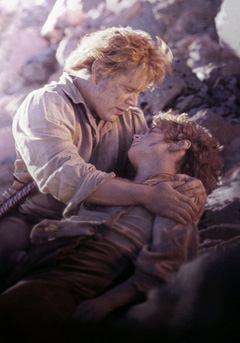
 It's been filmed three times, with  Avind Harum, Sean Astin (top photo), and Richard Kindler as the heroic heterosexual Harrison.

Lest you think that Vonnegut's homophobia mellowed with age, try his memoir, Man without a Country (2005):

“If you want to really hurt you parents, and you don't have the nerve to be gay, the least you can do is go into the arts."

Ok, how could being gay possibly hurt your parents?
And who in 2005 thought that you could decide to be gay in order to hurt them?

Apr 9, 2013

I'm Dickens...He's Fenster: Early 1960s Bonding

When I was a kid,  I knew John Astin as the mustached, googly-eyed Gomez Addams on The Addams Family (1964-66), as the Riddler on Batman (a replacement for Frank Gorshin), and as various kooky characters thereafter, such as Professor Gangreen in Return of the Killer Tomatoes (1988).  Funny, but not really swoon-worthy -- I was more interested in his teen idol sons, Sean and Mackenzie.

And Marty Ingels as a voice on Cattanooga Cats and Grape Ape on Saturday morning tv, married to Shirley Jones and the stepfather of David, Shaun, and Patrick Cassidy.  Again, not really swoon-worthy.

Then a Boomer of the older generation suggested the sitcom I'm Dickens -- He's Fenster (1962-63), which appeared after The Flintstones on Friday nights.   I looked up some episodes on youtube.

John Astin (age 32) and Marty Ingels (age 26) play bumbling carpenters Harry Dickens and Arch Fenster.  Dickens is married, and trying to be stable and respectable.

Arch is a swinger (with a Little Black Book full of women's phone numbers), and keeps trying to drag his partner into crazy adventures.


But in spite of the blatant girl-leering, there's a blatant homoromantic subtext.  The two behave as if they were romantic partners, in that unself-conscious way that performers had before they were aware that gay readings were possible: an amazing physicality, a devotion to each other, and even a domesticity, as Fenster practically lives with Dickens.


And they are swoonworthy.  No nudity, but 32-year old John Astin displays a respectable chest and nicely-toned biceps in a tight black  t-shirt, and 26-year old Marty Ingels has a beefy, promising physique.

Producer Leonard Stern was also responsible for the beefcake-heavy Run, Buddy, Run and the buddy comedy The Good Guys.


Nov 2, 2012

The Lord of the Rings


I had a friend in high school who claimed to have read J.R.R. Tolkien's  Lord of the Rings trilogy straight through 38 times (for a fast reader, that would take 2 hours per day, every day, for 5 years). I barely made it through once, with lots of skimming, , but I returned to certain passages over and over again.  They were "good beyond hope."

A company of men.  Working together, fighting, rescuing each other, hugging, saving the world.

Heterosexual desire almost absent: Tom Bombadil is devoted to Goldberry, the Ents pine away for the Entwives, Aragorn pines for Arwen (though not as much as in the movie series), and a few poems and songs say things like "Little Princess Mee -- Lovely was she," but nobody read them anyway.

And lots of same-sex romance.


1.  Everyone today sees a romance between Frodo and Sam, especially as portrayed by Elijah Wood and Sean Astin in the movie series.  But I didn't see it.  Tolkien was highly class conscious, and Frodo and Sam are master and devoted servant.  At the end of the story, Frodo goes to the Undying Lands by himself, and Sam goes home to his wife.
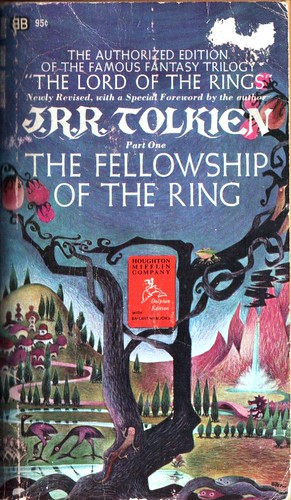
But I did notice that Frodo is gay.  He surrounds himself with men and never once mentions a woman.  (He reveres Galadriel, but as a goddess to be worshipped, not as an object of desire). 


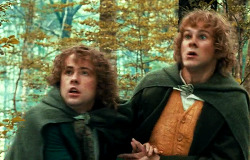
2. Merry and Pippin (played by Dominic Monaghan and Billy Boyd in the movie) are devoted to each other.  They go through deadly danger for each other, and when they are split up, each pines for the other.  After the War of the Ring, they go to work for Aragorn, so they can stay together forever.


3. The Elf Legolas and the Dwarf Gimli (played by Orlando Bloom and John Rhys-Davies in the movie) are sworn enemies, working together only to fight a greater evil.  But as the novels progress, they develop a grudging admiration, then a friendship, then a romance.  Neither seeks out a wife.

After the War of the Rings, when Legolas goes to the Undying Lands, Gimli comes with him. Tolkien comments:

It is strange that a Dwarf should be willing to leave Middle Earth for any love, or that the Eldar (Elvish Gods) should receive him, or that the Lords of the West should permit it. . .More cannot be said about this matter.

This is a curious way to end the discussion, suggesting not that Tolkien has no more information on the subject (of course he does, he wrote the books and he could invent any information he wanted), but that he is forbidden from saying more.  What is forbidding him?  It seems that, in attempting to understand Legolas and Gimli, their love for each other, and their motive for forsaking Middle Earth together, Tolkien is drawing dangerously close to acknowledging a love that he dare not acknowledge, and he abruptly forbids himself from considering the matter further.

 Tolkien was no doubt quite as homophobic as others of his generation, or moreso, a conservative Roman Catholic who eschewed the modern era.  But his subject matter  -- Medieval epics like Beowulf and The Nibelungenlied -- traditionally minimize heterosexual exploits to concentrate on the manly love of comrades.  Tolkien couldn't help but acknowledge it, on some level, whether he wanted to or not.
Related Posts Plugin for WordPress, Blogger...