Showing posts with label cruising. Show all posts

Jan 14, 2024

The Top Gay Hunks of "American Horror Story: New York City"


American Horror Story, Season 11, is a refreshing change of pace in the long-runnning series.  First, they've covered all of the paranormal bogies, from ghosts to vampires to aliens, so in this season they're sticking close to Earth with an ordinary murder mystery.  It's about a serial killer stalking New York's gay community in the early 1980s: think Cruising, but less homophobic. Second, although  Leather/BDSM is still portrayed as decadent, wild, and violent, sex outside a committed relationship is even more likely to "draw the darkness."   Third, after several seasons with no gay characters, or gay-femme villains, or "gay" guys who only have sex with women, most of the main cast is gay and into men.  Introduced in the first two episodes:

Spoiler alert: I give away some surprises.

1. Patrick (Russell Tovey), a newly-out, divorced, closeted cop who doesn't want to investigate the serial killer for fear of outing himself.  Or he may be the serial killer: he has a secret closet full of leather gear and handkerchiefs of every color, from light blue (oral) to yellow (golden showers).


2. Gino (Joe Mantello, only with a ridiculous tan), his boyfriend,a reporter for a gay newspaper trying to research the story in spite of Patrick's reticence.  He is captured by a serial killer who acts like he's in The Silence of the Lambs. No doubt a red herring.


3. Adam (Charlie Carver), who lost his roommate to the serial killer, and caught a glimpse of a suspect: a muscular guy in a leather outfit (like everyone at the Eagle on a Saturday night?).  He launches his own investigation, and discovers that Theo (#4 below), has photographed him.


4. Theo
(Isaac Powell), a photographer who specializes in disturbing scenes , like men in leather (think Mapplethorpe).  By the second episode, he's on the way to pursuing a "normal" relationship with Adam (that is, one modeled after traditional heterosexual courtship, where the first date ends with a kiss rather than a blow job, and you don't see him naked until you have celebrated at least three major holidays together). .     

5. Sam (Zachary Quinto), Theo's  manipulative, cocaine-snorting boyfriend, who may also be the serial killer: he invites random strangers home for BDSM scenes without asking what they're into or giving them a safe word.  Plus the mysterious muscular leatherman that Adam saw is his bodyguard/doorman.

6. Henry (Dennis O'Hare), an elderly, fey Quinton Crisp type who knows something about the serial killer: he 's somehow connected to anal sex, which also "draws the darkness."  Wow, no anal, no BDSM, no sex at all on the first date. My Sunday School teacher was less uptight. 


7. Big Daddy (Matthew William Bishop), the guy Adam saw, Theo photographed, and Sam keeps around for his aesthetic appreciation.   This is Matthew's first screen role; previously he worked in public relations, and was an amateur bodybuilder.  On the show, everyone who sees him is terrified; personally, I would be asking for his phone number.  

Jan 19, 2022

Walt Whitman, The Good Gay Poet

When I was in high school and college it was customary to closet gay writers.  The professor might have known, but it was assumed unseemly (at best) to tell a class full of "impressionable youth" that gay people exist  So Oscar Wilde was arrested on "scandalous charges," and Shakespeare's rhapsodies over the "fair youth" of the Sonnets was a "poetic convention of the day."

And Walt Whitman (1819-1892), whose Leaves of Grass includes exceptionally open lines like "we boys together clinging, one the other never leaving"?

"Oh...um...he's talking about his brother."

In my junior year, my American Renaissance professor, Dr. Ames, brought Whitman a little farther out of the closet: "He loved women -- he scattered illegitimate children up and down the Eastern Seaboard -- but he also had a bit of the fruit in him."


Thirty years later, Walt Whitman the "good gay poet," and his magnum opus, Leaves of Grass, are still usually closeted by English professors.  I often give my students this list of famous writers, and ask them to guess which ones were gay or bisexual:

1. Herman Melville (Moby Dick)
2. Charles Dickens (Tale of Two Cities)
3. Walt Whitman (Leaves of Grass)
4. William Shakespeare (Romeo and Juliet)
5. Emily Dickinson (Final Harvest)
6. Lewis Carroll (Alice in Wonderland)
7. Oscar Wilde (The Importance of Being Earnest)
8. F. Scott Fitzgerald (The Great Gatsby)
9. Edgar Allen Poe (The Raven)
10. Kenneth Grahame (The Wind in the Willows)

Answers: #1, #3, #4, #5, #7, #10.
They're always the most surprised to find out that Whitman was gay, and Dickens was not.

So let's make things clear:  Walt Whitman, the greatest poet in American history, was definitely, undeniably gay.

There is no evidence that he had any erotic interest in women: the illegitimate children story was a screen, made up during the 1920s to "save" the poet's image.

Before there was a vocabulary for same-sex desire, Whitman was all about inventing one:
"the manly love of comrades" and "adhesive friendships."

Near the end of his life, when the word "homosexual" was coined, and same-sex desire defined as a symptom of a dangerous psychosis, he backtracked a bit, claiming that he meant only spiritual comrades, nothing physical.

But he had many "physical" comrades through his life, and his journals describes cruising in detail.  He picked up men on streetcars, at the docks, in the park.

Jerry Taylor, slept with me last night, heavenly.

Traverce Hedgeman, young, slight, fair, feminine, conductor.

Howard Atkinson, tall, sandy, country-fied.

Thin, smooth, and slightly feminine were his favorite traits. In West Hollywood, we called them Cute Young Things.

His long-term lover, Peter Doyle, went against type.

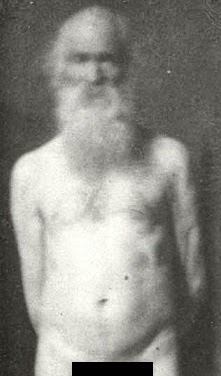
He also spent time with early gay rights pioneer Edward Carpenter (1844-1929), and, perhaps, artist Thomas Eakins (1844-1916), who painted a famous portrait of him, and may have photographed him nude.


Labeled only "Old Man, Seven Photographs," they are today housed in the Getty Museum.

But not on exhibit; you have to ask for them.

Even today, Walt Whitman is closeted.

See also: Gay American Renaissance

Apr 7, 2018

The Violet Quill: Sex, Drugs, Alienation, and Elitism in 1980s New York

Did you ever wonder about the origin of the stereotype of gay men as wealthy, over-educated, over-sophisticated, and indolent, doing nothing all day but lounging on the beach, so they can spend their nights disco dancing, taking drugs, and having meaningless sex with strangers?

I blame the Violet Quill.

During the early 1980s, there was very little gay fiction available, even at gay themed bookstores like Wilde and Stein in Houston and A Different Light in West Hollywood.  You could get a few classics, like Remembrance of Things Past, The Immoralist, The City and the Pillar, and Berlin Stories, but contemporary gay literature was dominated by novels published by the Violet Quill.


They were a group of young, sophisticated, wealthy gay men who lived in the Village (the gay neighborhood of New York City) and wrote about young, sophisticated, wealthy gay men who lived in the Village.

Their seven novels constituted Gay Literature:

1. Dancer from the Dance (Andrew Holleran, 1978).  Sophisticated, indolent young hedonists divide their time between the Village and the gay resort of Fire Island, having lots of meaningless sex with strangers, and eventually die.

2. Nocturnes for the King of Naples (Edmund White, 1978): A stream-of-consciousness tale of lost love while having lots of meaningless sex with strangers. Don't be fooled: it's set in the Village, not Naples.

3. The Confessions of Danny Slocum (George Whitmore, 1980).  His confessions involve lots of meaningless sex with strangers while searching for love in the Village.

4. Late in the Season (Felice Picano, 1981). More sophisticated, indolent young hedonists divide their time between the Village and Fire Island, while having lots of meaningless sex with strangers and competing over lovers.  It's "late" because Fire Island empties out in September, not because of AIDS.

5. A Boy's Own Story (Edmund White, 1982): the sophisticated, indolent young hedonist lives in the Village, but goes back home to come out to his wealthy relatives, who are shocked.

6. Nights in Aruba (Andrew Holleran, 1983).  Don't be fooled: the sophisticated, indolent young hedonist lives in the Village, but goes back home to come out to his wealthy relatives, who are shocked. 

7. The Family of Max Desir (Robert Ferro, 1983).  Max is a wealthy, sophisticated, indolent young hedonist who lives in the Village, but goes back home to try to reconcile with his wealthy relatives, who disowned him when he came out.


Noticing a pattern here?  Sex, alienation, wealthy relatives, lost loves, and death.  Not a lot of Gay Pride here: it's a picture of gay life about as sordid and depressing as any of the homophobic novels of the 1930s.

And very, very insular.  No one working class or poor (even middle class is rare), few racial minorities except as fetishes ("I'm in the mood for an Oriental tonight!"),  and no one who doesn't live in the Village or on Fire Island.

Gay people simply do not exist elsewhere.

Later in the 1980s, Gay Literature became dominated by novels about gay men dying of AIDS.  Strangely, they were no more depressing than the endless sex-drugs-and-alienation of the Violet Quill.

See also: Dancer from the Dance; Frank O'Hara


Sep 14, 2017

Hi, Guy!: Cruising in a 1970s TV Commercial

Between 1969 and 1972, and then again in 1978, Right Guard deodorant aired a series of commercials in which an unsuspecting apartment dweller (Bill Fiore) opens his medicine chest, only to discover he's sharing it with the apartment next door.

The other occupant (Chuck McCann) opens his side of medicine chest.  He's big, brash, leering, apparently high.  I remember them both being shirtless, but I guess they weren't.

"Hi, guy!" McCann says, obviously cruising the uncomfortable Fiore, before extolling the wonders of Right Guard (which seems unnecessary, since Fiore already uses it).


By the way, the medicine chests contain nothing but two cans sticks of Right Guard deodorant, facing with the labels out regardless of which side they're on.

"Hi, guy!" became a catchphrase.  Everyone at Denkmann Elementary School tried to match Chuck McCann's intonation and leer, without realizing that we were imitating a gay pick-up line.


Bill Fiore was a cute, unassuming comedian of the 1970s.  He appeared on The Corner Bar, which had the first ongoing gay character on tv, Love, American Style, Mary Tyler Moore, Laverne and Shirley, Three's Company, and Alice.  

As this photo suggests, he had quite a nice physique.


Former children's show host Chuck McCann was also a comedy staple of the 1970s.  One of his more interesting roles was W.C. Fields in the 1982 biopic Mae West. He's played Santa Claus several times, notably in an ongoing role on the soap Santa Barbara (1987-88).

No indication that he was gay, or intended a gay reading to his leering "Hi, guy!"

But it's impossible to say without an innuendo.  Try it.

See also: The Eastwood Insurance Cowboy
Related Posts Plugin for WordPress, Blogger...