Dec 30, 2024

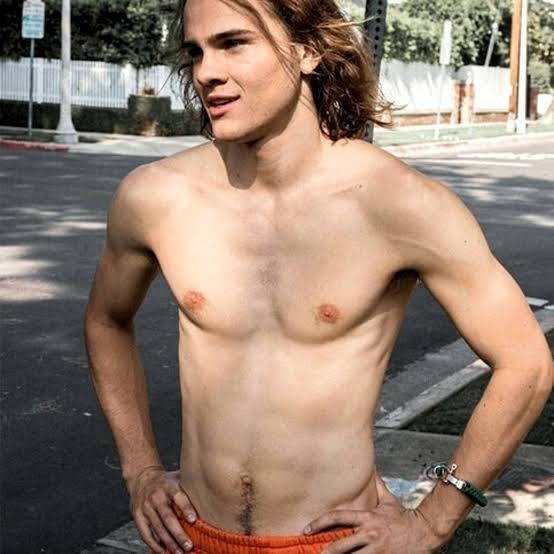
Nick Rutherford: A straight guy who likes to pretend he likes guys. Or is he pretending?


Nicholas Rutherford, Beck Bennett, and Kyle Mooney formed the sketch comedy group Commedus Interruptus in 2003, while they were still undergrads at the University of Southern California.  In 2007, they formed the comedy group Good Neighbors, and produced short films like "Is My Roommate Gay?". Later they joined the cast of Saturday Night Live.  


You have also seen Nick on Adam Devine's House Party


They are all married to women, but they all, and especially Nick, spend a lot of time suggesting that they like men's physiques and body parts.  


Of course, Tony Cavalero does the same thing, but Nick goes even farther, actively suggesting that he is in love with one or both of his comedy team partners.  Such as Kyle Mooney.

More after the break

Dec 28, 2024

David Cassidy

The oldest of a show biz family (his brothers are Shaun, Patrick, and Ryan), David Cassidy got his start on The Partridge Family (1970-74), about a family of pop singers who tour the country in a psychedelic bus (Danny Bonaduce played his younger brother). It aired on Friday nights in a block of gay teen "Must See TV," including The Brady Bunch, Room 222, and The Odd Couple.

His character, Keith Partridge, was interested in girls, but never portrayed as a absurdly girl-crazy, like most teenagers on prime-time in the 1970s. And, although pop superstars were presumably dream dates for every girl on earth, Keith frequently encountered girls who disliked pop music, who had never heard of his group, or who simply did not find him attractive. This self-deferential parody, a teen idol who can’t get a date, destabilized the myth of universal heterosexual desire; if some girls are not attracted to Keith, perhaps some boys are.

In “Days of Acne and Roses” (November 1971), Keith teaches a shy delivery boy named Wendell (Jay Ripley) how to date girls. He demonstrates the “yawn, stretch, and arm around” maneuver on Wendell, and then pretends to be a girl so that Wendell can practice his pick-up lines. Keith is remarkably unself-conscious about the physical contact and the mock flirtation, and he is not the least worried about someone overhearing and thinking that he is gay. When most of his fellow television teens recoiled in heart-pounding terror at a buddy’s touch, Keith’s nonchalance seems aggressively gay-friendly.

The teen magazines went wild with shirtless, swimsuit, and towel-shots, revealing David's slim, androgynous body, but in this case they were justified in praising his talent: his music was good.

And gay-friendly.  Songs credited to The Partridge Family (studio musicians except for David and his mother, Shirley Jones) almost entirely eliminated the incessant “girl!” that deadened most bubblegum pop lyrics in the 1970s. In the emblematic “I Think I Love You,” David awakens to the disturbing realization that he is in love:

I just decided to myself, I'd hide it from myself
And never talk about it, and [so I] didn't go and shout it
When you walked in to the room.

Why does he “never talk about it”? Heterosexual teenagers in love do nothing but talk about it. In 1971 I concluded that there must be something more to “a love there is no cure for,” perhaps a love that dares not speak its name.

David’s solo numbers also eliminate almost all gender-specific pronoun or refrainsof “girl!”  For instance in“Where is the Morning,” he laments a failed hookup that could be with either a boy or a girl:

I can’t sleep tonight. I found someone.
You smiled at me and said you were free. And I was alone.
Would you meet me again? 

My friend Derek claimed to have dated him, but David doesn't mention any same-sex relationships in his memoirs, C’mon, Get Happy (1994).

He does graciously acknowledges his appeal to gay boys: “I had a pretty strong gay following. I kind of liked it. Gay publications ran pictures of me; I was named gay pinup of the year by one. I’d get fan letters from gay guys saying things like ‘I can tell by the look in your eyes that you’re one of us.’”

And in a sense, he was “one of us,” an ally, demonstrating that same-sex desire was not only possible, but valid and worthwhile.

David spent most of his later career in Las Vegas, where he wrote songs and performed for audiences of both men and women.  He died in 2017

See also: Derek and the Pop Star.

"It Ends with Us": Not a post-Apocalyptic thriller, a drama about a lady with clunk rings and a hunk named Atlas


Link to the n*de photos

It Ends With Us showed up in my Netflix recommendations.  Obviously a post-Apocalyptic movie about the last generation of humanity struggling for survival. The icon shows an elegantly dressed woman talking through her fingers at an elegantly-dressed man, but that must be before society falls apart.

Scene 1: The woman who talks through her fingers in the icon is driving through an autumnal road to a quaint New England town with a sign saying Plethora, Maine.  Maybe the  human race goes extinct due to a vampire outbreak. 

 She stops in front of one of those gigantic "middle class" homes, and hugs and cries with the woman inside.  Geez, she's wearing like a gold ring the size of a baseball on each finger. How will she stake vampires that way?

Wait -- according to IMDB, this isn't about vampires.  It's a drama about domestic abuse!  Why such a misleading title, almost identical to The Last of Us, about survivors of a zombie Apocalypse?

I'm still watching.  I never see dramas, so this will be an adventure in snarky comments. And it will be fun to watch a movie produced by, for, and about straight people, like going undercover in a foreign country.

The lady in the house tells the Finger-Talking Woman -- who has the ridiculous name Lily Bloom  -- that this is her father's funeral (thanks for letting her know!), then criticizes her for taking a job out of town, so she couldn't be by his side every second.  Oh, and she informs Lily that she is her mother. She acts so oddly that I thought she was the housekeeper.  Why would the wife of the dead guy say "your father's funeral" instead of using his name?  


Scene 2:
 Lily Bloom goes up to her room -- huge, cluttered with girly stuff like pictures of fairies and a ballerina music box.  She brought nothing with her when she moved out?

Mom follows her upstairs to say "He really loved you." Yeah, that's what all abusers say.  "At the funeral, you're going to have to say five things that you loved about him."  Um...er...he was...um...

Left: Dad Kevin McKidd, in 1996. 

Time for the funeral, at city hall, super-crowded -- Dad was the mayor, also a husband and a father.  Give him a medal!  Time for Lily's eulogy, but she can't think of anything, so she steps down from the podium.  Murmur, murmur.  

Scene 3: Back in Boston, Lily sits on the roof of a high-rise apartment building, no doubt planning to jump, but The Man of Her Dreams, Ryle (Justin Baldoni, top photo) bursts in, angry, kicking over chairs.  He joins her on the ledge to discuss how much he hates maraschino cherries.  She wants to know if he is upset over "a woman...or a man."  Acknowledging that gay people exist!  But I'll bet that's all the representation we'll see.  

They exchange job information, which I understand is common for straight people in their first meeting:  Florist, neurosurgeon.  Guess which Lily is. 

Their falling-in-love conversation takes up the next seven minutes of screen time, but they don't make a date for later. Are you sure there won't be any vampires?

Scene 4: Adolescent Lily in her bed,putting flowers into a scrap book. Gratuitous leg shot as she gets up, brushes her teeth, writes in her diary, and puts on her starter set of huge, clunky rings -- well, she couldn't write in her diary with them on, could she?  

Looking out the window, she sees a young man sneaking out of the abandoned house next door and sorting through the garbage for food.  

He gets on her bus!  She gazes in Boy-of-Her-Dreams longing.  Lily's going to have two abusive boyfriends? 

It takes about five minutes of screen time for her to arrange a meeting and get his story: "My Mom kicked me out...because..."  You're gay?  Nope: because she doesn't like him interfering with her boyfriends "beating the shit out of her."  They beat him up, too, but he can't mention it because he's macho.

Lily invites him home to shower and change clothes, and watch Ellen.  A lesbian exists in their world.  He stares at her clunker rings; she criticizes the outfit that she gave him.  So, for straight people, is criticism like flirting?


Scene 5: 
The adult Lily heads toward the store she's leasing for her new flower shop, while Mom tries to discourage her on the phone: she saw on the internet that "45% of all flowers die."  Just 45% ?

As Lily is cleaning out the old stuff, a woman named Alyssa comes in to ask about the "help wanted" sign.  It's leftover from the previous owner, but Lily might need some help soon: "I'm opening a flower shop." 

"Ugh!  Never mind, I hate flower shops.  They're depressing, full of dying things." 

"You're hired!"  So you get a job by criticizing the job.

Montage of the two bonding over cleaning out stuff, painting, and so on.  

Alyssa's husband Marshall (Hasan Minaj) calls  -- darn, I thought she was a lesbian.  He's across the street with her brother, watching the Big Game, but she drafts him into helping out. 

Ulp: Alyssa's brother is -- Ryle the neurosurgeon!  

They gaze at each other for about three minutes of screen time.  Don't straight people, like, talk?  Finally Alyssa and Marshall get tired of it and suggest a double date.  

Cut to a karaoke bar, with Ryle and Lily trying to ignore their mutual attraction -- they're single adults, what's the problem? --  and Alyssa and Marshall aggressively pushing them together -- they've known Lily for like three hours, why do they care?  After about ten minute of screen time, they kiss.


Scene 6: 
Adolescent Lily on a picnic with the Abused Guy, whose name is Atlas (Alex Neustaedter).  The Greek god who is holding up the world, not the book of maps. 

Left: Atlas

They discuss Lily's Dad beating up her mom.  In other news, Atlas will be joining the Marines, so they can't continue their relationship. 

Scene 7: BFF Alyssa's birthday party, at her gigantic palace, with a living room bigger than a hotel atrium.  Around a thousand people there, all heterosexual couples.  Why does she want to work in a flower shop, again?

Lily runs into Ryle the Neurosurgeon again, and tells him, "Stop flirting with me."  Then they go up to his room. Mixed signals, lady.

Scene 8: In the morning, Lily walks the six miles down to a kitchen big enough to prepare meals for the population of a medium-sized city.  Apprised that she has spent the night, Alyssa cautions that Ryle the Neurosurgeon goes through women like candy mints.  He's ok for a hookup, but if you're looking for a serious relationship, forget it.  Then why were you so aggressively pushing them together?

More after the break

Dec 27, 2024

Jeff East: Tom Sawyer's boyfriend, Disney teen, young Superman, n*de fratboy, Pumpkinhead prey


If you were  a kid in the 1970s, Sunday night meant either church or The Wonderful World of Disney, countless movies set in the wilderness chopped up into 40-minute segments.  It was dreadful, but at least you got to see a cadre of teenagers personally selected by Walt or Roy Disney to represent "youthful masculinity":  Tommy Kirk, Kurt Russell, Tim Considine, James MacArthur.  
And if you could tell your fundamentalist, "movies are sinful" parents that you were going to the library downtown and sneak into a matinee, you could see Jeff East and Johnny Whitaker playng boyfriends.

Born in 1957 in Kansas City, Jeff had virtually no acting experience when he was chosen from among 1,000 hopefuls in open auditions to play Huck Finn in Tom Sawyer (1973), with Johnny Whitaker as Tom.

They appeared together again in Huckleberry Finn (1974), with a romance that would be impossibly overt today.

Plus they both showed bare chests and backsides, which would never be permitted today.  


Jeff went on three Wonderful World of Disney movies about big animals.  Disney loved animal stars.

Return of the Big Cat (1974): he has to save his sister from a cougar.

The Flight of the Grey Wolf (1975): he tries to re-introduce a wolf into the wild.  Nobody flies.

The Ghost of Cypress Swamp (1977): he has to save his dog from a panther, and runs afoul of a crazy guy.

This was the era of the big name teen idols like Shawn Cassidy, and a guy who fought panthers couldn't compete.  Jeff got very little attention in the teen magazines.


Jeff moved on to his first "adult" role as a college student who participates in a deadly hazing in The Hazing (1977),  also released as The Case of the Campus Corpse to make it seem like a comedy.  

Again he takes everything off -- he spends about half the movie in nothing but a jockstrap.


And he has a painfully intense, gay-subtext romance with his costar, fellow college student Charles Martin Smith.

Charles Martin Smith went on to display his goods in Never Cry Wolf (1983), about a government researcher living with wolves.  

What's with these guys and their wildlife?

More after the break
Related Posts Plugin for WordPress, Blogger...