I was around in 1987, but almost nothing in Pose (2018-) is familiar. In retrospect, I was enjoying a lot of privilege: white, middle-class, conventionally masculine, HIV negative, able to escape from the homophobia of the mainstream Reagan-Jerry Falwell society. I visited my parents twice a year.
Meanwhile, many LGBT people were racial minorities, drag queens or transwomen, sick, poor, eking out a living through sex work and petty theft, rejected by their birth families, rejected even by other LGBT people. They had nothing but each other.
So they lived together in "houses" under the care of a "mother," and when the lights went down, they vogued.
Look around, everywhere you turn is heartache
It's everywhere that you go
You try everything you can to escape
The pain of life that you know
I know a place where you can get away
It's called a dance floor, and here's what it's for, so
Come on, vogue
They compete in gigantic drag contests with judges and scores, their acts involving not lip-synching but "posing," often not in dresses but in the Park Avenue drag of the rich and powerful, critiquing the culture of excess and exclusion that would eventually lead to the Orange Goblin being elected president.
Real house members act as series consultants and take small roles, so the series has an air of authenticity. The nostalgic 1980s soundtrack helps: "Heartbeat," "In My House," "On the Radio," "I Wanna Dance with Somebody," "It's Raining Men," all of those old songs that we heard constantly at the bars but have since forgotten.
Feuds between houses occupy a substantial part of the plot, but there are also stories about conflicts with the outside world.
1. Damon Richards of the House of Evangelista (Ryan Jamal Swain) is neither drag queen or transwoman, just a rather feminine gay man who aspires to become a dancer. He begins dating fellow Evangelista Ricky (Dyllón Burnside),
2. Angel Evangelista (Indya Moore) begins dating Stan (Evan Peters): white, married, middle-class, employed by the Trump organization (which was sleazy even back in 1987)
The cast consists mosly of transgender actresses, so one doesn't expect a lot of beefcake. But there are a few conventionally masculine physiques:
1.Dyllón Burnside
2.Evan Peters
3. Angel Bismarck Curiel as drug-dealing house member Lil Papi.
4. Johnny Sibilly, Costas, the lover of ball m.c. Pray Tell (Billy Porter), who is dying of AIDS.
5. James Van Der Beek as Matt Bromley, Stan's completely odious boss.
6. Matthew Carter as "Walkman Wally).
But aren't muscles themselves a type of drag, a costume we wear to hide who we really are?
My grade: A+.
Showing posts with label dance. Show all posts
May 15, 2019
Dec 2, 2018
10 Gay Things You Didn't Know about "White Christmas"
1. White Christmas is not about Christmas. It's a backstage musical that just happens to end at Christmastime. Backstage movies were well-known for gay subtexts.
2. The songs are by Irving Berlin, who looked good in a swimsuit.

3. It's about two showbiz partners, Bob and Phil (Bing Crosby, Danny Kaye), who find their relationship threatened by women.
4. The women, Judy and Betty (Vera-Ellen, Rosemary Clooney), are sisters. At least, they perform as sisters, although their numbers would work well in a drag act.
God help the mister, who comes between me and my sister
And God help the sister who comes between me and my man!
5. Bob and Phil perform as "sisters," too.
6. Rosemary Clooney was a gay icon and reputedly bisexual.
7. Early in his career, Bing Crosby was the roommate of gay jazz musician Bix Beiderbecke.
8. Danny Kaye was bisexual. He had a long term romance with Sir Laurence Olivier.
9. He played gay fairy-tale writer Hans Christian Anderson, whose psychiatrist coined the word "homosexual."
10. John Brascia was in the cast as a "special dancer." You can see his physique, and his bulge, in several numbers. As far as I can determine, he didn't have any gay rumors.
2. The songs are by Irving Berlin, who looked good in a swimsuit.

3. It's about two showbiz partners, Bob and Phil (Bing Crosby, Danny Kaye), who find their relationship threatened by women.
4. The women, Judy and Betty (Vera-Ellen, Rosemary Clooney), are sisters. At least, they perform as sisters, although their numbers would work well in a drag act.
God help the mister, who comes between me and my sister
And God help the sister who comes between me and my man!
5. Bob and Phil perform as "sisters," too.
6. Rosemary Clooney was a gay icon and reputedly bisexual.
7. Early in his career, Bing Crosby was the roommate of gay jazz musician Bix Beiderbecke.
8. Danny Kaye was bisexual. He had a long term romance with Sir Laurence Olivier.
9. He played gay fairy-tale writer Hans Christian Anderson, whose psychiatrist coined the word "homosexual."
10. John Brascia was in the cast as a "special dancer." You can see his physique, and his bulge, in several numbers. As far as I can determine, he didn't have any gay rumors.
May 19, 2018
Haka: The Maori Dance of Posturing and Muscle
Haka means "dance" in the Maori language, and kapa haka a line dance, performed at all types of public events.
We are most familiar with the war haka, the traditional dance performed before a battle, in which you try to intimidate your enemy by posturing, yelling, stamping your feet, gesturing, making wild faces.
Today it is performed across New Zealand, by people of all racial groups, typically before a sports contest. This group is from Hamilton Boys' High School.
Rotorua Boys' High School.
.St. Brigid's School in Dunedin has boy and girls performing.
The New Zealand National Rugby Team, the All-Blacks (a reference to the color of the uniforms, not the race of the players), perform a haka before each game, using a routine borrowed from the Ngati-Toa tribe.
The publicity has made haka popular beyond New Zealand. Here it is at the Churchill School in Zimbabwe.
And at Eastern Oregon University.
But be careful: you can't do the All-Blacks' routine without permission from the Ngati-Toa Tribe. The University of Hawaii's legal department made the football team come up with original haka moves.
We are most familiar with the war haka, the traditional dance performed before a battle, in which you try to intimidate your enemy by posturing, yelling, stamping your feet, gesturing, making wild faces.
Today it is performed across New Zealand, by people of all racial groups, typically before a sports contest. This group is from Hamilton Boys' High School.
Rotorua Boys' High School.
.St. Brigid's School in Dunedin has boy and girls performing.
The New Zealand National Rugby Team, the All-Blacks (a reference to the color of the uniforms, not the race of the players), perform a haka before each game, using a routine borrowed from the Ngati-Toa tribe.The publicity has made haka popular beyond New Zealand. Here it is at the Churchill School in Zimbabwe.
And at Eastern Oregon University.
But be careful: you can't do the All-Blacks' routine without permission from the Ngati-Toa Tribe. The University of Hawaii's legal department made the football team come up with original haka moves.
May 9, 2018
American Werewolf in London
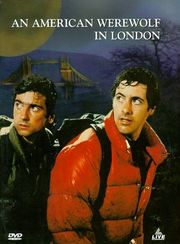
There have been many gay-coded werewolves on tv and in comics, but not a lot in movies. David Kessler (David Naughton) in An American Werewolf in London (1981) is the most famous, and the most evocative.

Born in 1951, David Naughton became famous in the late 1970s for dancing, singing, and bulging in a series of energetic, well-choreographed tv commercials for the soft drink Dr. Pepper. In the spring of 1979, he starred in Makin' It, an adaption of the hit Saturday Night Fever (1977). Although the sitcom aired for only 8 weeks, David's rendition of the theme song became a Top 40 hit, and resulted in a teen idol
album.
In American Werewolf, American college students David and Jack (Griffin Dunne, son of Hollywood novelist Dominic Dunne) are hiking through the moors of Britain, when they're attacked by a wolf. Jack is killed, and David turns into a werewolf, destined to kill innocent people at every full moon. Furthermore, Jack -- along with every werewolf victim -- is trapped in a limbo state, unable to go on to the afterlife until the last werewolf, David dies. "Kill yourself, David!" Jack pleads.
David is hesitant -- he has fallen in love with a girl, Alex (Jenny Agutter), so according to the myth of the "fade out kiss," his life now has meaning. Besides, he reasons, maybe her love can tame the beast with in. But after a killing spree, he is cornered by the police, shot, and killed. He dies as Alex murmurs "I love you."
Sounds enormously heterosexist so far. The same-sex bond represents death, and the heterosexual bond, life. David himself is homophobic: trying to get arrested, he stands in Trafalgar Square and yells insults, like "Prince Charles is a faggot!"
So why was it so evocative for gay teenagers in 1981?
1. An enormous amount of beefcake. Everyone in the movie is obsessed with David's body. He's fully nude for an extended sequence, with both frontal and rear shots.
There's a graphic werewolf transformation scene, with David rolling around nude.
He's naked in a hospital bed, where the nurses all gawk at him, and one states "He's Jewish -- I've had a look."
The last scene zeros in on David's body, tastefully posed like a Medieval martyr, with the bullet wounds carefully placed to not detract from his beauty.
2. Jack is rather obviously in love with David. He is jealous of "the girl"; he wants David to kill himself so that they can "be together." In one scene, he berates David: "We had a good thing going, and you ruined it." David wasn't responsible for his death, so Jack must be referring to something else, like David abandoning their same-sex bond to go chasing after some girl.
After American Werewolf, David Naughton found himself famous for appearing fully nude on film. He worked primarily in horror (Amityville: A New Generation, Body Bags, The Ice Cream Man). Griffin Dunne went on to star in After Hours (1985).
There was a sequel, American Werewolf in Paris, 16 years later.

Born in 1951, David Naughton became famous in the late 1970s for dancing, singing, and bulging in a series of energetic, well-choreographed tv commercials for the soft drink Dr. Pepper. In the spring of 1979, he starred in Makin' It, an adaption of the hit Saturday Night Fever (1977). Although the sitcom aired for only 8 weeks, David's rendition of the theme song became a Top 40 hit, and resulted in a teen idol
album.
In American Werewolf, American college students David and Jack (Griffin Dunne, son of Hollywood novelist Dominic Dunne) are hiking through the moors of Britain, when they're attacked by a wolf. Jack is killed, and David turns into a werewolf, destined to kill innocent people at every full moon. Furthermore, Jack -- along with every werewolf victim -- is trapped in a limbo state, unable to go on to the afterlife until the last werewolf, David dies. "Kill yourself, David!" Jack pleads.David is hesitant -- he has fallen in love with a girl, Alex (Jenny Agutter), so according to the myth of the "fade out kiss," his life now has meaning. Besides, he reasons, maybe her love can tame the beast with in. But after a killing spree, he is cornered by the police, shot, and killed. He dies as Alex murmurs "I love you."
Sounds enormously heterosexist so far. The same-sex bond represents death, and the heterosexual bond, life. David himself is homophobic: trying to get arrested, he stands in Trafalgar Square and yells insults, like "Prince Charles is a faggot!"
So why was it so evocative for gay teenagers in 1981?
1. An enormous amount of beefcake. Everyone in the movie is obsessed with David's body. He's fully nude for an extended sequence, with both frontal and rear shots.
There's a graphic werewolf transformation scene, with David rolling around nude.
He's naked in a hospital bed, where the nurses all gawk at him, and one states "He's Jewish -- I've had a look."
The last scene zeros in on David's body, tastefully posed like a Medieval martyr, with the bullet wounds carefully placed to not detract from his beauty.
After American Werewolf, David Naughton found himself famous for appearing fully nude on film. He worked primarily in horror (Amityville: A New Generation, Body Bags, The Ice Cream Man). Griffin Dunne went on to star in After Hours (1985).
There was a sequel, American Werewolf in Paris, 16 years later.
Dec 21, 2017
Nutcracker Beefcake
Heterosexist plotline aside, every year The Nutcracker gives us the opportunity to see traditional, family-friendly, school-sanctioned, Christmastime ballet written by a gay man.
And loaded to the brim with hot guys in tights.
Not only the Nutcracker-turned-Prince who woos Clara, but the Mouse King, the Cavalier, party guests, soldiers, sentinels, Arabian dancers, Russian dancers -- the list goes on.


And on.

Not a lot of shirtless dancers -- it's set in a Russian winter, after all. But wander backstage before or after the performance, and you can get a glimpse of Christmas perfection.
More after the break.
And loaded to the brim with hot guys in tights.
Not only the Nutcracker-turned-Prince who woos Clara, but the Mouse King, the Cavalier, party guests, soldiers, sentinels, Arabian dancers, Russian dancers -- the list goes on.


And on.

Not a lot of shirtless dancers -- it's set in a Russian winter, after all. But wander backstage before or after the performance, and you can get a glimpse of Christmas perfection.
More after the break.
Aug 20, 2017
How I Found Nico Greetham
The problem with popular culture is, they keep making more of it. Not only am I expected to know all about my childhood favorites, like The Brady Bunch, Lost in Space, Mission: Impossible, I Dream of Jeannie, Batman, and Get Smart. I have to know about the childhood favorites of people born in 1970, 1980, 1990, and 2000, like Saved by the Bell, Gimme a Break, We Got it Made, Space: 1999, Battlestar Galactica, Cheers, Seinfeld, Friends, The Mary Tyler Moore Show, Married: With Children, Lost, Twin Peaks, Pete and Pete, The Suite Life of Zack and Cody, and Modern Family.
Sometimes it all blurs together in my mind.
For example, I heard that One Direction's Harry Styles had been linked romantically with Radio 1's Nick Grimshaw, who is gay. The name Nick Grimshaw sounded vaguely familiar.
So I looked in my folder of beefcake photos waiting for future posts, and sure enough, there were some shirtless shots of a Nick Greetham that I found while researching someone else. Must be the same person. And Radio 1 must be a singing competition like The X-Factor.
But the only Nick Greetham I could find on the internet was the manager of a print shop in South Africa. His facebook photo showed him kissing a girl. Not gay, not a singer. I must have gotten the name wrong.
So I looked up everyone who has appeared recently on The X-Factor. Nothing. But there was a Nico Greetham who performs on So You Think You Can Dance. He's an 18-year old recent high school graduate from Woodbridge, Virginia.
Not dating Harry Styles.
Well, is he gay? Or does his work have any gay subtexts?
The IMDB revealed only two credits, the heterosexist So You Think You Can Dance and the movie From Within (2008), where he played "Boy on Bicycle."
The Broadway Database revealed nothing.
A google search on "Nico Greetham" and "gay" revealed a tumblr that says "Age: 19 Male. Gay," but that might just be a fan.
His tweets are noncommittal, but one of his images showed him hugging a guy, Paul Kamiryan. Could that be his boyfriend?
Now I had to find Paul Kamiryan. More research.
Sometimes it all blurs together in my mind.
For example, I heard that One Direction's Harry Styles had been linked romantically with Radio 1's Nick Grimshaw, who is gay. The name Nick Grimshaw sounded vaguely familiar.
So I looked in my folder of beefcake photos waiting for future posts, and sure enough, there were some shirtless shots of a Nick Greetham that I found while researching someone else. Must be the same person. And Radio 1 must be a singing competition like The X-Factor.
But the only Nick Greetham I could find on the internet was the manager of a print shop in South Africa. His facebook photo showed him kissing a girl. Not gay, not a singer. I must have gotten the name wrong.
So I looked up everyone who has appeared recently on The X-Factor. Nothing. But there was a Nico Greetham who performs on So You Think You Can Dance. He's an 18-year old recent high school graduate from Woodbridge, Virginia.
Not dating Harry Styles.
Well, is he gay? Or does his work have any gay subtexts?
The IMDB revealed only two credits, the heterosexist So You Think You Can Dance and the movie From Within (2008), where he played "Boy on Bicycle."
The Broadway Database revealed nothing.
A google search on "Nico Greetham" and "gay" revealed a tumblr that says "Age: 19 Male. Gay," but that might just be a fan.
His tweets are noncommittal, but one of his images showed him hugging a guy, Paul Kamiryan. Could that be his boyfriend?
Now I had to find Paul Kamiryan. More research.
May 19, 2017
The Beefcake Bonanza of Hula Boy Memorabilia
The hula is a traditional Hawaiian interpretive dance accompanied by music. Although practiced for hundreds of years, it did not become widely known outside Hawaii until the Tiki Craze of the mid-20th century brought various aspects of Polynesian culture to restaurants, bars, and game rooms across the U.S.
Men and women both performed, and not in grass skirts -- women wore pa'us, and men malo loincloths.
You can find a lot of hula boy memorabilia in antique shops and on ebay. You may have to buy boy and girl figurines and throw out the girl, or endure the sappy heterosexist "He's looking for a hula girl," but you can get some nice retro Hawaiian beefcake.

A very muscular figure in a beige grass skirt.
Car bobbler with the same face as the above figure, but different hair. A skirt of real fibers and a ukelele.
A rare ceramic figure from the 1950s. Not exactly hula, but he has a ukelele and a flower lei.

This hot cartoonish Hawaiian guy is decked out like Father Christmas. He's actually on wall paper; his "hula girl" is on the next panel.
More after the break.
Men and women both performed, and not in grass skirts -- women wore pa'us, and men malo loincloths.
You can find a lot of hula boy memorabilia in antique shops and on ebay. You may have to buy boy and girl figurines and throw out the girl, or endure the sappy heterosexist "He's looking for a hula girl," but you can get some nice retro Hawaiian beefcake.

A very muscular figure in a beige grass skirt.
Car bobbler with the same face as the above figure, but different hair. A skirt of real fibers and a ukelele.
A rare ceramic figure from the 1950s. Not exactly hula, but he has a ukelele and a flower lei.

This hot cartoonish Hawaiian guy is decked out like Father Christmas. He's actually on wall paper; his "hula girl" is on the next panel.
More after the break.
Feb 18, 2017
Death in Venice
My sophomore year in college revealed the world of Winnetou and Bravo magazine, but my junior year was oppressively heterosexist: gay-free Modern British Novel and Modern American Literature, and in German Literature, Dr. Weber assigned us the Thomas Mann novel Der Tod in Venedig (Death in Venice, 1912), and then spent a lot of time on a blazing hot spring day pointing out that Aschenbach was not Wearing a Sign.
What I read was obviously about a stymied same-sex courtship. The middle-aged writer visits Venice on holiday, and becomes obsessed with the beautiful 15-year old Tadzio. He watches the boy and follows him around Venice, but does not approach.
Aschenbach notices that there is a cholera epidemic in Venice, being covered up by the authorities, but he doesn't warn Tadzio, for fear that he will leave, and beauty will be lost to the earth. Nor does he leave town himself; he sits, watches Tadzio, and smiles. Finally he succumbs to cholera and dies. I couldn't help noticing the parallel with Herman Melville's Billy Budd, which we were reading in my American Renaissance class at the same time.
Why didn't Aschenbach just strike up a conversation with the boy? I wondered. Same-sex act were legal in Italy, and the age of consent was 14. Maybe he thought the match inappropriate due the age difference? Maybe he was just shy, or maybe same-sex desire was so alien to his self-image that he was paralyzed? When Tadzio smiles at him, inviting a "hello," Aschenbach runs away in terror and whispers "I love you" to an empty garden.

But Dr. Weber said: "Aschenbach's obsession for Tadzio is the desire of age for youth, for the new that will supercede the old, even of civilization for savagery. It is a quest for ideal beauty that always kills. When Icarus flies too close to the sun, he dies. There is no hint of homosexuality in the novel."

As "proof" that Aschenbach and Tadzio, like all fictional characters, were straight, Dr. Weber showed us the 1971 film version, Morte a Venezia (this was the same class that showed us a beefcake version of Das Nibelungenlied). Tadzio was played by 15-year old Swedish actor Bjorn Andresen (left).
But in the movie, Tadzio is obviously gay, engaging in homoerotic horseplay with his friends. He even appears to have a boyfriend. And Aschenbach, played by gay actor Dirk Bogarde, is obviously gay, too. They are separated not by sexual orientation, but by their different worlds.
I've seen the Benjamin Britten opera three times, twice on tv (in 1981 with Robert Garde and an unnamed, non-singing performer, and in 1990 with Robert Tear and Paul Zeplichal). It gives Aschenbach a girlfriend. But the ballet doesn't; and it transforms Tadzio from an androgynous waif to a muscular, gay-and-proud twenty-something.
So the obsession becomes that of an old-style gay man who believed that his same-sex desire was "too personal" to reveal, who pretended to be heterosexual, who married a woman, and who now longs for the freedom of modern gay youth, cavorting openly on the beach.
See also: Male Nudity in German Class; and The Gay Werewolf of Steppenwolf.
What I read was obviously about a stymied same-sex courtship. The middle-aged writer visits Venice on holiday, and becomes obsessed with the beautiful 15-year old Tadzio. He watches the boy and follows him around Venice, but does not approach.
Aschenbach notices that there is a cholera epidemic in Venice, being covered up by the authorities, but he doesn't warn Tadzio, for fear that he will leave, and beauty will be lost to the earth. Nor does he leave town himself; he sits, watches Tadzio, and smiles. Finally he succumbs to cholera and dies. I couldn't help noticing the parallel with Herman Melville's Billy Budd, which we were reading in my American Renaissance class at the same time.
Why didn't Aschenbach just strike up a conversation with the boy? I wondered. Same-sex act were legal in Italy, and the age of consent was 14. Maybe he thought the match inappropriate due the age difference? Maybe he was just shy, or maybe same-sex desire was so alien to his self-image that he was paralyzed? When Tadzio smiles at him, inviting a "hello," Aschenbach runs away in terror and whispers "I love you" to an empty garden.

But Dr. Weber said: "Aschenbach's obsession for Tadzio is the desire of age for youth, for the new that will supercede the old, even of civilization for savagery. It is a quest for ideal beauty that always kills. When Icarus flies too close to the sun, he dies. There is no hint of homosexuality in the novel."

As "proof" that Aschenbach and Tadzio, like all fictional characters, were straight, Dr. Weber showed us the 1971 film version, Morte a Venezia (this was the same class that showed us a beefcake version of Das Nibelungenlied). Tadzio was played by 15-year old Swedish actor Bjorn Andresen (left).
But in the movie, Tadzio is obviously gay, engaging in homoerotic horseplay with his friends. He even appears to have a boyfriend. And Aschenbach, played by gay actor Dirk Bogarde, is obviously gay, too. They are separated not by sexual orientation, but by their different worlds.
So the obsession becomes that of an old-style gay man who believed that his same-sex desire was "too personal" to reveal, who pretended to be heterosexual, who married a woman, and who now longs for the freedom of modern gay youth, cavorting openly on the beach.
See also: Male Nudity in German Class; and The Gay Werewolf of Steppenwolf.
Dec 6, 2016
The Nutcracker: Men in Tights
When I was a kid, our church forbade movies, theater, carnivals, circuses -- basically anything that had a plot. And my working-class parents disapproved of anything "long hair." So ballet and opera were completely alien.
Except at Christmastime, when we would go to see "The Nutcracker" at Centennial Hall on the Augustana College campus, or at Rock Island High School, or both. One year the Youth Symphony participated, so I got to be in the orchestra pit for eight full performances.
The plot is heterosexist -- Elsa receives a nutcracker shaped like a toy soldier for Christmas. He comes to life, fights an army of mice, and reveals that he is actually a prince. They return to his kingdom, the Land of Sweets, where he makes Elsa his queen.
But who pays attention to the plot? No matter what people tell you, they go to ballets for one reason, and one reason only: to celebrate male or female beauty. Dances in form-fitting tights, swaying and twisting, making every curve and muscle visible.
No other art, not even bodybuilding, displays the male physique so openly and extensively. You don't just get a glimpse or a hint -- everything is out there, through the entire performance.
No wonder every gay kid in town, even those who were otherwise obsessed with sports, couldn't wait for Christmas.
The only ballet dancer I knew by name was Rudolf Nureyev (1938-1993), who danced in a tv version of The Nutcracker in 1968. I also saw him on The Muppet Show in 1977, and in Romeo and Juliet in 1982 (which also has a heterosexist plot, but who cares?)
I didn't know at the time that he was gay in real life, and dated a number of celebrities, including Raymundo de Larrain and Tab Hunter (left), plus his long-time lover Erik Bruhn. I responded to his passion, his obvious joy at being an object of desire, and his superlative physique.
He was even able to invest The Nutcracker with gay symbolism, transforming the Prince into an outcast, a wooden soldier who longs to be a "real boy."
I discovered Mikhail Baryshnikov (1948-) in a 1977 tv version of The Nutcracker, and later in Carmen (1980) and Don Quixote (1984). He was more muscular than Nureyev, and an accomplished actor, but his aggressively heterosexual stance bothered me, as if he wanted to "redeem" ballet from its gay reputation.
Good luck. Vaslav Nijinsky (1890-1950), the first ballet superstar, was gay, and caused a scandal with his erotic movements (the audience rioted at the premiere of The Rites of Spring).
So was Tchaikovsky, who scored The Nutcracker and Swan Lake.
See also: Erik Bruhn, Closeted Ballet Great.; Ten Nutcracker Beefcake Boys
Except at Christmastime, when we would go to see "The Nutcracker" at Centennial Hall on the Augustana College campus, or at Rock Island High School, or both. One year the Youth Symphony participated, so I got to be in the orchestra pit for eight full performances.
The plot is heterosexist -- Elsa receives a nutcracker shaped like a toy soldier for Christmas. He comes to life, fights an army of mice, and reveals that he is actually a prince. They return to his kingdom, the Land of Sweets, where he makes Elsa his queen.
But who pays attention to the plot? No matter what people tell you, they go to ballets for one reason, and one reason only: to celebrate male or female beauty. Dances in form-fitting tights, swaying and twisting, making every curve and muscle visible.
No other art, not even bodybuilding, displays the male physique so openly and extensively. You don't just get a glimpse or a hint -- everything is out there, through the entire performance.
No wonder every gay kid in town, even those who were otherwise obsessed with sports, couldn't wait for Christmas.
The only ballet dancer I knew by name was Rudolf Nureyev (1938-1993), who danced in a tv version of The Nutcracker in 1968. I also saw him on The Muppet Show in 1977, and in Romeo and Juliet in 1982 (which also has a heterosexist plot, but who cares?)
I didn't know at the time that he was gay in real life, and dated a number of celebrities, including Raymundo de Larrain and Tab Hunter (left), plus his long-time lover Erik Bruhn. I responded to his passion, his obvious joy at being an object of desire, and his superlative physique.
He was even able to invest The Nutcracker with gay symbolism, transforming the Prince into an outcast, a wooden soldier who longs to be a "real boy."
I discovered Mikhail Baryshnikov (1948-) in a 1977 tv version of The Nutcracker, and later in Carmen (1980) and Don Quixote (1984). He was more muscular than Nureyev, and an accomplished actor, but his aggressively heterosexual stance bothered me, as if he wanted to "redeem" ballet from its gay reputation.
Good luck. Vaslav Nijinsky (1890-1950), the first ballet superstar, was gay, and caused a scandal with his erotic movements (the audience rioted at the premiere of The Rites of Spring).
So was Tchaikovsky, who scored The Nutcracker and Swan Lake.
See also: Erik Bruhn, Closeted Ballet Great.; Ten Nutcracker Beefcake Boys
Jul 14, 2016
What's Gay about "The Afternoon of a Faun"
My friend Mickey the Russian Major, who I met at the Iowa Gay Pride March in 1981, told me about the Ballet Ruses, founded by Sergei Diaghilev to showcase the muscular bodies of male dancers, and his protege and lover Vaslev Nijinsky, who scandalized audiences with his homoerotic interpretation of L'apres-midi d'un faun (The Afternoon of a Faun). My professor in Russian Culture and Civilization also told me that they were gay, symptoms of the "decadence" of fin de siecle Russia.
But how could you do a homoerotic interpretation of The Afternoon of a Faun?
The original poem by Stephane Mallarme (1875), is a masterpiece of symbolist literature, but with no gay content. A male faun of Greek mythology chases and has sex with several female nymphs, while saying things like "Ces nymphes, je les veux perpétuer" (These nymphs, I would perpetuate them).
It inspired Claude Debussy to write Prélude à l'après-midi d'un faune (1894), an orchestral piece that imagines the Faun pursuing nymphs all afternoon, and then tiring and falling asleep. Again, no gay content.
In 1912, Vaslev Nijinsky choreographed and performed a ballet version, pursuing nymphs in a frenzy of heterosexual desire before finally taking one of their veils as an autoerotic fetish object. He made it homoerotic by:
1. Training all eyes on his body, his masculine virility, not on the nymphs.
2. Training his eye on his lover, Diaghilev, so his autoerotic fantasy is about men.
It received mixed reviews and some downright hostility, so was only performed a few more times.
It was choreographed again in 1953 by Jerome Robbins, with Francisco Moncion (top photo) as the Faun, and in 2006 by Tim Rushton, with Johan Kobberg as the Faun. They skip the homoerotic veil to make it heterosexist again.
In the 1980 movie Nijinsky, Nijinksy was played by George de la Pena, and Diaghilev by the gay actor Alan Bates.
See also modern dancers Ted Shawn and Erick Hawkins.
But how could you do a homoerotic interpretation of The Afternoon of a Faun?
The original poem by Stephane Mallarme (1875), is a masterpiece of symbolist literature, but with no gay content. A male faun of Greek mythology chases and has sex with several female nymphs, while saying things like "Ces nymphes, je les veux perpétuer" (These nymphs, I would perpetuate them).
It inspired Claude Debussy to write Prélude à l'après-midi d'un faune (1894), an orchestral piece that imagines the Faun pursuing nymphs all afternoon, and then tiring and falling asleep. Again, no gay content.
In 1912, Vaslev Nijinsky choreographed and performed a ballet version, pursuing nymphs in a frenzy of heterosexual desire before finally taking one of their veils as an autoerotic fetish object. He made it homoerotic by:
1. Training all eyes on his body, his masculine virility, not on the nymphs.
2. Training his eye on his lover, Diaghilev, so his autoerotic fantasy is about men.
It received mixed reviews and some downright hostility, so was only performed a few more times.
It was choreographed again in 1953 by Jerome Robbins, with Francisco Moncion (top photo) as the Faun, and in 2006 by Tim Rushton, with Johan Kobberg as the Faun. They skip the homoerotic veil to make it heterosexist again.
In the 1980 movie Nijinsky, Nijinksy was played by George de la Pena, and Diaghilev by the gay actor Alan Bates.
See also modern dancers Ted Shawn and Erick Hawkins.
Subscribe to:
Posts (Atom)