Showing posts with label werewolves. Show all posts

Jul 28, 2025

David Naughton: The cutest guy of the Disco Era tells us to "Be a Pepper" and shows his d*ck


Is this not the cutest guy you've ever seen?  Other than Wes Stern (sigh) and Adam Devine, of course.

Link to David's d*ck

Between 1977 and 1981, the recent University of Pennsylvania graduate David Naughton could be seen in dozens of tv commercials, prancing about in a white shirt, black vest, and bulging jeans, selling Dr. Pepper.

"I'm a Pepper -- wouldn't you like to be a Pepper, too?"

I don't like the soft drink, but the spokesman was one of my first crushes.


David's fame from the commercials led to an invitation to star in Makin' It (1979), a rip-off of Saturday Night Fever with David and Greg Antonacci as disco-dancing brothers.  He also recorded the theme song:

Makin' it, oo makin' it, I'm solid gold.

I've got the goods

They stand when I walk through the neighborhoods

I'm makin' it

"Hit tv series" was a little premature: Makin' It was canned after nine episodes.


Next came Midnight Madness (1980), with teams of college students on an all-night scavenger hunt.  David's team, the good guys, includes his younger brother (Michael J. Fox before Family Ties).  There are also teams of jocks, spoiled rich kids, and girls.  I didn't notice any gay subtexts.

But American Werewolf in London (1981) has one.


College students David and Griffin Dunne are hiking through the Scottish highlands, when they are attacked by a werewolf.  Griffin is killed, and David turns, in scenes that emphasize his physique -- and p*nis.


He falls in love with a girl and uses a homophobic slur, and  his dead buddy Griffin keeps encouraging him to commit suicide. And -- spoiler alert -- there is no happy ending.

But the buddy-bonding subtext, the disco physique, and the d*ck (almost unheard of in mainstream movies at the time) were enough to make American Werewolf a must-see for gay men.

More after the break

Nov 25, 2024

True Blood: Vampires come out of the closet amid a Southern Gothic soap opera, with some n*de vampires


Link to the n*de photos

Last night we latched onto True Blood, which ran from 2008 to 2014 on HBO.

This is the stereotypic South of Eudora Welty and Mama's Family, where people named Hoyt Fortenberry shop at the Piggly-Wiggly and drink sweet tea on the veranda, where everyone is related to everybody else's great-grand daddy once removed, and where the War means the Civil War...um, I mean the War of Yankee Aggression.   

It starts in media res, two years after vampires have "come out of the coffin," har har -- yep, the connection with LGBT people is just that heavy-handed -- due to the invention of artificial blood, brand name True Blood, which some humans have developed a taste for.  Snooty fratboy Brett (Josh Kelly, top photo), looking for a store that sells it, learns too late that every long-haired, multi-ringed Goth isn't a vampire; and sometimes chubby rednecks are.


We switch to the problems of Tara, who gets fired from or quits every job because she doesn't abide idiots and her best friend Sookie, who can read minds.  Sookie and soon Tara work at Merlotte's Bar, where the owner, Sam Merlotte (Sam Trammell), is in love with her.  He won't come out with it, but of course Sookie can read his mind.


The only gay character so far is the bar's swishy cook, Lafayette (Nelsan Ellis), a stereotyped flamboyant, promiscuous queen who  claims he's done most of the men in town, and likes to flirt with racist, homophobic rednecks to get them all scared. He doesn't get a boyfriend until late in the series.


That same evening, the bar's other waitress, Maudette, hooks up with Sookie's brother, Jason (Ryan Kwanten).  She's a fangbanger, a human who likes sex with vampires, because they get rough.  She offers to show him the video, which turns him on so much that he wants to do rough sex, including strangling her...a little too enthusiastically.  And she's taping the encounter!

Ryan Kwanten shows his stuff on  RG Beefcake and Boyfriends

More after the break

Nov 24, 2024

The top 15 hunks of the "Twilight Saga," with some n*de vampires and werewolves


Twilight, a series of four young adult paranormal fantasy novels by Stephanie Meyer, was published between between 2005 and 2008, with sequels in 2015 and 2020. They have been translated into 49 languages, with worldwide sales of 140 million.  The movie series, which appeared between 2008 and 2012, grossed $3.36 billion worldwide.

The premise: teenager Bella moves to Forks, Washington with her parents, and falls in love with the vampire Edward.  When he leaves town, she falls in love with the werewolf Jacob.  Eventually she has to choose between them: she chooses Edward, and they get married and have a daughter. 

There were lots of sexy, tortured bad-boy vampires before, on Dark Shadows and Buffy the Vampire Slayer, in the novels of Anne Rice, but never whole tribes of them.  And uber-muscular, macho vampires, not sophisticates and androgynes.  Perfect for erasing the gay symbolism from the vampire mythos and producing a totally gay-free world.

And it is.  There are dozens of vampire, werewolf, and human characters, but not a single gay one, in the books or any of the movies.

Are you really surprised?  The series is aimed at an audience of teens, who are never allowed to know that gay people exist.  It's fantasy, and gay people appear almost exclusively in comedies set in the real world.   Kristen Stewart, the actress who played Bella, claimed that the series had a "gay inclination...it's all about oppression."  

Big deal.  This was in 2012, not 1965.

But that doesn't mean that gay teen boys must be content to watch actors looking sullen with their shirts off.  There are always subtexts, either intentional or accidental, especially among the gay or gay-friendly members of the cast: 

The Vampires:

1. Robert Pattinson, left, as head vampire Edward.


2. Peter Facinelli as Carlisle, his Dad.

3. Kellan Lutz, left, as Emmett, his brother.


4. Jackson Rathbone as Jasper, his younger brother.

5-6. Christopher Heyerdale and Cameron Bright as Marcus, leader of the Volturi vampires, who have lived in Italy since Etruscan times.


7. Xavier Samuel as Riley, companion of the evil vampire Victoria, who is trying to kill Bella.

More after the break

Oct 30, 2024

Bobby Boris Pickett and the Gay Monster Mash

Born in 1938, Robert Pickett was a minor tv star, with roles in Dr. Kildare, The Beverly Hillbillies, Bonanza, and Petticoat Junction.  He displayed a respectable physique opposite gay teen icon Tommy Kirk in the beach movie It's a Bikini World (1967).  


(Left:  more respectable physique from Bikini World).

He recorded many songs, mostly  horror parodies: "The Werewolf Watusi," "Monster Man Jam," "Monsters on the Prairie."  But his biggest claim to fame was the novelty-horror song "The Monster Mash" by "Boris" Bobby Pickett and the Crypt-Kickers, which sprang to the top of the charts in 1962, 1970, and 1973.

 It has been covered by everyone from Boris Karloff to Alvin and the Chipmunks, heard on every tv series from Cheers to The Office.  


There isn't a lot of specifically gay or heterosexist content. Dr. Frankenstein is "working in the lab, late one night," when his Monster rises from the slab and wants to dance. Other Universal monsters appear and join in. The only conflict comes when Dracula prefers "The Transylvania Twist."  Nobody expresses any heterosexual interest, though Dracula has a son.

There's a video on youtube starring more explicitly gay versions of the monsters: they hug, hold hands, and collapse into each other's arms.


The 1995 Monster Mash: The Movie channels The Rocky Horror Picture Show, with two teenagers dressed as Romeo and Juliet (including Ian Bohan, left, later photo) trapped in a castle with the monsters, who want to use them for various nefarious purposes. Gay actor Adam Shankman plays a gay Wolfie, who wants to eat them.  It's not on DVD, but there are VHS tapes out there, and there's a trailer on youtube.

Bobby Pickett died in 2007.

See also: Jozin z Bazin, the Czech Swamp Monster.


May 1, 2024

American Werewolf in London

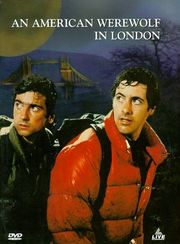
There have been many gay-coded werewolves  on tv and in comics, but not a lot in movies.  David Kessler (David Naughton) in An American Werewolf in London  (1981) is the most famous, and the most evocative.


Born in 1951, David Naughton became famous in the late 1970s for dancing, singing, and bulging in a series of energetic, well-choreographed tv commercials for the soft drink Dr. Pepper.  In the spring of 1979, he starred in Makin' It, an adaption of the hit Saturday Night Fever (1977).  Although the sitcom aired for only 8 weeks, David's rendition of the theme song became a Top 40 hit, and resulted in a teen idol album.


In American Werewolf,  American college students David and Jack (Griffin Dunne, son of Hollywood novelist Dominic Dunne) are hiking through the moors of Britain, when they're attacked by a wolf. Jack is killed, and David turns into a werewolf, destined to kill innocent people at every full moon.  Furthermore, Jack -- along with every werewolf victim --  is trapped in a limbo state, unable to go on to the afterlife until the last werewolf, David dies.  "Kill yourself, David!"  Jack pleads.

David is hesitant -- he has fallen in love with a girl, Alex (Jenny Agutter), so according to the myth of the "fade out kiss," his life now has meaning.  Besides, he reasons, maybe her love can tame the beast with in.  But after a killing spree, he is cornered by the police, shot, and killed.  He dies as Alex murmurs "I love you."

Sounds enormously heterosexist so far.  The same-sex bond represents death, and the heterosexual bond, life.  David himself is homophobic: trying to get arrested, he stands in Trafalgar Square and yells insults, like "Prince Charles is a faggot!"

So why was it so evocative for gay teenagers in 1981?

1. An enormous amount of beefcake.  Everyone in the movie is obsessed with David's body.  He's fully nude for an extended sequence, with both frontal and rear shots.

There's a graphic werewolf transformation scene, with David rolling around nude.

He's naked in a hospital bed, where the nurses all gawk at him, and one states "He's Jewish -- I've had a look."


The last scene zeros in on David's body, tastefully posed like a Medieval martyr, with the bullet wounds carefully placed to not detract from his beauty.


2. Jack is rather obviously in love with David.  He is jealous of "the girl"; he wants David to kill himself so that they can "be together."  In one scene, he berates David: "We had a good thing going, and you ruined it." David wasn't responsible for his death, so Jack must be referring to something else, like David abandoning their same-sex bond to go chasing after some girl.

After American Werewolf, David Naughton found himself famous for appearing fully nude on film.  He worked primarily in horror (Amityville: A New Generation, Body Bags, The Ice Cream Man).  Griffin Dunne went on to star in After Hours (1985).

Sep 24, 2023

Manga: Gay Japanese Comics

When I visited Japan, I saw manga everywhere: thick, heavy books of sequential art, similar to Western comic books but with a different history, a distinctive style, and a much larger audience.  Everybody was reading manga, not just fanboys, and they came in many different genres, from comedy to drama to the hardest of hard-core porn.

In the absence of Western hysteria concerning gay people, same-sex desire and relationships are commonly portrayed as unremarkable facts of life, even in manga aimed at juveniles.

Yaoi are manga involving romances between teenage boys, both drawn as ultra-feminine and girlish, aimed at an audience of teenage girls.  They seem to be the Japanese equivalent of Western teen idols, who are commonly presented as androgynous.

(Yuri are the female equivalent, involving romances between teenage girls.)


If you prefer more masculine men, try bara, manga involving hirsute man-mountains in love.

Here are some of the more popular (but non-pornographic) gay-themed manga available in English translation.  Many have also been turned into anime (Japanese cartoons).

But be careful...they are convoluted, multi-volume, so once you start, you'll have to read a dozen or more to get the whole story.

1. Close the Last Door! Nagai is a salaryman who is secretly in love with his coworker, Saito, who is about to marry a woman.....

2.Silver Diamond. High school student Sawa teams up with the intergalactic outlaw Chigusa, to try to save Chigusa's planet from evil plant creatures.


3. Punch Up. Sophisticated young architect Motoharu has lost his pet cat.  Rough, husky factory worker Kouta has found it.  The two mistrust each other at first, but....

4. Three Wolves Mountain. Kaya runs a cafe in a small, isolated town.  One night he meets two werewolf brothers (fox spirits in the original Japanese).  He falls in love with the younger brother, but the full moon is coming....

5. Antique Bakery. Famous baker Ono is accustomed to getting any guy he wants, using both his superlative physique and his baking skills.  But his boss, Tachibana, seems oblivious.  Until....


6. One Thousand and One Nights.  The sultan keeps marrying women and killing them, and Sehara's sister Shahrazad is next in line!  He is willing to do anything to save her, including....

7. Loveless. Ritsuka is a "catboy," who will lose his cat-like qualities when he loses his virginity.  He and an older man named Soubi team up to find his brother's killer, and encounter a mysterious organization called The Seventh Moon....

8. Hetalia Axis Powers. World War II is recreated by characters named after the countries involved: Italy, Germany, Japan, America, England, France.  Except now they can form hidden alliances and fall in love...


9. Crimson Spell. Prince Vaid suffers under a curse: he turns into a demon every night!  He seeks out the assistance of the powerful sorcerer Halvi, who is afraid to tell him about the one act that can break the curse....

10. G-Defend. Ishikawa is an instructor for the Japanese Security and Anti-Terrorist Squad. His assistant, Iwase, has a secret crush on him....


May 9, 2022

"Werewolf Castle": Mostly Gay Actors, Mostly Shirtless Scenes, and a Dead Wife


Werewolf Castle (2021) has popped up among my Vudu recommendations.  The trailer shows a werewolf eating a girl while Medieval villager Thorfinn (Peter Lofsgard) looks on in horror, but after that it's all beefcake and bonding -- seven shots of the shirtless Thorfinn, plus a scene where another guy grabs his arm.  Besides, who knows who the girl is?  She could be his sister, his mother, or a random villager. 

I'm still worried that I'll fork over $3.95 for a rental and spend two hours watching Thorfinn fight werewolves with his shirt off, only to see him fall in love with a girl.  Time for more research.

1. Getting pictures of his shirtless scenes proved impossible.  There are none on Google Images, and screen captures didn't work with Chrome or Firefox.


2. If "Peter G. Lofsgard" is the same as "Peter Lofsgard," he has a boyfriend.


3. Six of the top-listed stars on IMDB are men.  I am particularly interested in the buddy-bonding potential of Percy, played by Jake Watkins. 

Jake Watkins is also gay.


4. Or Osmond Blakewood (Derek Nelson).

Derek Nelson has lots of pictures of women on his Instagram, so he's probably straight, but he has a bedroom-cuddling shot with Peter Lofgard in Vampire Virus 

5. A second trailer on IMDB shows the girl getting werewolf-ized three times.  Once she's in bed with Thorfinn.  So the dead wife or girlfriend drives the plot!  Boo!  


6. A review on Dread Central complains about having a "flamboyant" gay-coded villain, Wolfstan (Reece Connolly, who is gay and flamboyant in real life).  Maybe it's not a stereotyped gay villain so much as the luck of the draw: when you hire mostly gay actors, some of them are bound to be swishy.

7. Who is hiring all of these gay actors?   Writer/director Charlie Steeds has produced 15 movies, including A Werewolf in England, Vampire Virus, Death Ranch, An English Haunting,  and Escape from Cannibal Farm.  They usually have a heterosexual-romance primary plot, with gay characters or gay subtexts in the background.

I've now spend more time on research than it would take to watch the actual movie.  But sometimes research is a lot more fun.

May 31, 2021

Jack Russell's Boyfriend: Werewolf by Night

Speaking of werewolves, the only Marvel/DC comic I read regularly in the 1970s was Werewolf by Night, which appeared from 1972 to 1977.

I bought the first issue because I figured it would the first time the character appeared in print, as opposed to other Marvel characters who moved in and out of each other's books at random.  Wrong -- Jack Russell had been around for a couple of years.

Why name a werewolf after a breed of dog?  

At least the first issue had an origin story. 

Jack Russell turns 18 and inherits the family curse; during the three nights of the full moon, he turns into a ravaging werewolf. Afterwards, of course, his clothes are gone, revealing an amazing physique.  In the second issue, he tries to explain his dilemma to the man he lives with -- "more than a friend" -- a middle-aged writer named Buck Cowan.


Buck also has an amazing physique and is allergic to shirts.


There is a "damsel in distress" being threatened on most covers, but surprise!  It's not some girl, it's his sister.  Jack doesn't have a girlfriend, girl admirer, or female crush, at least not in the issues I read.  

In 2013, he appeared in a guest spot on The Ultimate Spider-Man, voiced by Disney hunk Ross Lynch.

See also: Jim Steranko

Oct 26, 2020

Elvira, Mistress of the Dark

When I moved to West Hollywood in 1985, everyone was watching Movie Macabre (1981-86), starring Elvira, Mistress of the Dark (Cassandra Peterson).  A throwback to the horror movie hosts of the 1950s and 1960s, Elvira was vampire-like being with a Valley Girl accent ("As if!") and a revealing Morticia Addams outfit.
She showed bad movies like The Fall of the House of Usher (with peplum star Mark Damon not taking his clothes off), Horror Hospital (with Robin Askwith threatened by gay psycho surgeons), and Werewolf of Washington (with Dean Stockwell, werewolves, hippies, and hippie werewolves).


In a tradition that would extend to Mystery Science Theater 3000, Elvira made snarky comments about the movies.  And in the tradition of drag queen performers, she made lots of self-referential jokes about her sexual escapades and cleavage ("I'm glad to see you're back...and you're glad to see my front!").  

Gay fans loved her, and she returned the affection, appearing at AIDS benefits and Gay Pride parades through the 1980s.


And not only gay fans.  She was everywhere, branding her image to sell everything from beer to Halloween costumes.

The feature film Elvira, Mistress of the Dark (1988) sends Elvira to the small town of Falwell (named after Jerry Falwell, the poster boy for 1980s homophobia), where she befriends all of the town's outcasts, butts heads with local bigots and romances an uptight theater manager (professional hunk Danny Greene).

Since Elvira is immortal, she continues to perform, cleavage and all.  She continually hosts new versionfs of Elvira's Movie Macabre., on cable in the 2000s and now on Amazon Prime.

Oct 14, 2020

Dark Shadows: Barnabas and Willie


In the spring of 1969, my friends and I began running home from school as fast as we could (my house was the closest) to catch the last ten or fifteen minutes of Dark Shadows (1966-71), a soap opera about the brooding, guilt-wracked vampire Barnabas Collins (Jonathan Frid) and his immensely wealthy, occult-obsessed family.

He enters the story when the slim, stuttering ne’er-do-well Willie Loomis (John Karlen, left), prowling around the Collins estate on the stormy coast of Maine, discovers a secret room in the old mausoleum, and inside it a chained coffin.  At this point, most people would flag down the next bus to Boston, but the none-too-bright Willie decides to open the coffin.  A bejeweled hand shoots up and grabs him by the neck.


The next day Barnabas Collins presents himself as a long-lost “cousin from England” and talks his way into possession of the ancient, decrepit Old House.

Willie inexplicably moves in with him, telling his friends that he has taken a job as Barnabas’ servant; yet he is obviously more than a servant.  The two spend an inordinate amount of time together, and are on an altogether chummy first-name basis, a liberty taken by no other servant on the estate.

The truth, of course, is that Barnabas bit him, and now they are co-conspirators if not secret lovers.  What is a vampire’s bite, after all, but a form of sexual congress?

Gossip about the early years of the series reveals that the producers were so skittish about potential homoerotic readings of the relationship that they gave Willie a heterosexual crush, and mandated that same-sex neck-biting must always occur off-camera.

But the heterosexual crush backfires, as the writers have Willie confiding in Maggie Evans about his problems with Barnabas.
Maggie: Where's Barnabas?
Willie: I don't know where he is.  He left without saying anything to me.
Maggie: You seem very angry with him.
Willie: I don't care about Barnabas.
Maggie: You don't really believe that, do you?

Eventually the strain of living with a vampire is too much for Willie; he has a nervous breakdown, and is confined to Windcliff Sanitarium. Later, Barnabas misses Willie, and asks him to return.  Willie eagerly agrees.  Later that evening, their friend Julia Hoffman (Grayson Hall) is sitting alone in the drawing room of the Old House, evidently keeping guard, when someone comes to the door.  “Barnabas isn’t here  – he’s with Willie,” she says with a diffident glance upstairs – to the bedrooms. Exactly what is Barnabas doing up there to welcome Willie home?  

When Barnabas announces his plans to cure his vampirism by transferring his spiritual essence into a different body, Willie worries that the new Barnabas will not be attracted to him (or, perhaps, that he will not be attracted to the new Barnabas):
Willie: Suppose he don’t like me?
Barnabas:         He will be exactly toward you as I am.
Willie: You don’t know that!  You might come out of this all different. . .It won’t be the same.

Although Barnabas barely acknowledges his affection, Willie obviously cares deeply for him, with an unstated and perhaps unconscious homoerotic desire.

As Barnabas zapped back and forth between time periods and parallel worlds, he encountered different characters played by the same cast members, and John Karlen managed to infuse all of his characters with a sometimes frivolous, sometimes dark and passionate attraction to the vampire hero.

When Barnabas visits Collinwood in the year 1897, he meets Karlen as Carl Collins, a fop only slightly toned down from Oscar Wilde’s green carnation crowd.  Carl grabs his shoulder,  touches his hand, takes his arm, and whispers softly in his ear “You look so nice!  We’re going to be close friends, aren’t we?  We’re going to be buddies!”  And thereafter, whenever he has a problem (usually involving ghosts or werewolves), he throws himself into Barnabas’s arms, overtly presenting himself as a lover.

Many of the cast members were gay, including Joel Crothers, left (who played Maggie Evans' boyfriend and remained her best friend in real life) and Louis Edmonds (patriarch Roger Collins).

When Don Briscoe (werewolf Chris Jennings) took time off to appear in the gay-themed Boys in the Band (1969), he brought Chris Bernau and Keith Prentice back with him.

Most of the others were gay friendly, including Grayson Hall (who was nominated for an Oscar for her role as a repressed lesbian in Night of the Iguana), Katherine Leigh Scott (Maggie Evans), Roger Davis (who went on to star in Alias Smith and Jones),  and the vampire himself, Jonathan Frid.


Most soap operas, like One Life to Live, were unremittingly heterosexist, requiring us to seek out subtexts, but Dark Shadows had ample male characters who were immune to the charms of eyelash-fluttering governesses and sought out each other: David Collins, heir to the family fortune; the fey Noah Gifford (Craig Slocum), who has an unspecified and “sinister” relationship with the golddigging Lieutenant Forbes (Joel Crothers); Aristede (Michael Stroka), a brooding, androgynous “manservant”; the nerdish mad scientist Cyrus Longworthy (Christopher Pennock); and the darkly sensuous Gerald Stiles (Jim Storm) who was not shy about expressing his devotion to werewolf/man-about-town Quentin Collins (David Selby).


No wonder we ran home from school as fast as we could to watch.


Aug 7, 2018

Chuck Connors


Chuck Connors may be forever remembered as the taciturn, loving, and endlessly shirtless Lucas McCain,  Johnny Crawford's dad on The Rifleman, but he had a long career before and after as a screen hunk.  Born in 1920, he started out as a pro ball player -- both baseball and basketball -- before a talent scout spotted him and cast him in Pat and Mike (1952).  Dozens of Westerns, spy movies, and war movies followed, with an occasional comedy thrown in, like the tv series Hey Jeannie (1958) and Love That Jill (1958).


The Rifleman brought him fame, of course, both for his shirtless shots and for the frequency with which he kills bad guys -- two or three per episode.  Fortunately, the kids who grew up on a diet of nonstop violence turned out fine -- the 10 year olds of 1958 grew into the 20-year old anti-war protesters of the Summer of Love.


Immediately after The Rifleman, Chuck moved back to the 20th century to play Porter Ricks in the movie version of the boy-and-pet-dolphin movie Flipper (1963), with Luke Halpin as Sandy; it later became a popular, beefcake heavy tv series.

In the Doris Day comedy Move Over, Darling (1963), Ellen (Doris) is lost at sea and presumed dead, so after five years her husband Nick (James Garner) moves on.  But Ellen resurfaces during his honeymoon.  Hijinks ensue. Chuck plays Steven Burkett, the handsome, athletic, leopard-skin swimsuit-clad man she shared a desert island with for five years.  Nothing happened, however.

Some dramas and Westerns followed, including Synanon (1965), with Alex CordBranded (1966-67), about a man unjustly drummed out of the army for cowardice ("what do you do when you're branded, and you know you're a ma-aa-n?"; and Cowboy in Africa (1967-68), which I never saw, but appeared to be about a same-sex couple (Chuck Connors, Tom Nardini) who run a ranch in Kenya and adopt a native boy.  It was based on the movie Africa: Texas Style, starring Hugh O'Brian.


I didn't seem much of Chuck during the 1970s; he appeared mostly in Westerns, which I didn't care for.  But he appeared again in Werewolf (1987-88), which starred hunky Eric (John J. York), a college student bitten by a werewolf; Chuck played evil head werewolf Janos Skorzeny, the object of Eric's quest to free himself from his curse.


Chuck Connors died in 1992.  He was married three times and had four children.  Recently there was a rumor circulating that he did some gay porn during his pro-ball days.  I doubt it; he wasn't part of the Physique Pictorial or Henry Willson crowd, and the footage doesn't really look like him.

But here's a censored full-frontal.  It looks a lot like him.

The uncensored photo is on Tales of West Hollywood.

Feb 16, 2017

The Wizards of Waverly Place


Even Stevens, Hannah Montanaand The Suite Life of Zack and Cody are not unique. American tv programs aimed at a juvenile audience are strictly forbidden from mentioning gay people or ever suggesting that heterosexual desire, practice, and identity are not universal human experience.  So the Disney Channel has become very good at hints.


For example, take Wizards of Waverly Place (2007-2012), an "I've Got a Secret" sitcom about a family of wizards living in contemporary Manhattan.  Jerry (David DeLuise, far right) and Theresa (Maria Canales Barrera) and their kids:

16-year old Justin (David Henrie, second from left), 14-year old Alex (Selena Gomez), and 12-year old Max (Jake T. Austin, far left). (The others are supporting characters.)


All of the characters have opposite-sex dates and relationships. Not one is Wearing a Sign.  Therefore they are all heterosexual, and gay people do not exist. Are you listening, network censors?  Ok, then:

1. Alex is gay.  She and Justin are constantly fighting over girls that they both want.  She's constantly telling Justin, "I like this girl. You can't have her."  During the third season, she falls in love with a butch lesbian stereotype named Stevie (Hayley Kiyoko), but drops her upon discovering that she is a leftist revolutionary. Her main squeeze is Harper (Jennifer Stone); the two eventually move into an apartment together.  No one even tries to pretend that they are platonic friends.

2. Justin is a heterosexual ally.  In one episode, Alex spreads a rumor that he is engaged to a boy, Hugh Normous (Josh Sussman).  Justin is angry, not because of the accusation, but because now he won't be able to attract the girl he likes.  Besides, he could do a lot better than Hugh Normous.

3. Hugh Normous is gay.  Alex is hit on by lots of guys at school, so she befriends Hugh, knowing that he won't have any romantic interest.  In the last season, she invites Hugh to a party at her apartment, where he hooks up with a guy.


4.  Uncle Kelso  (Jeff Garland) is gay. He is masquerading as pop star Shakira.  Alex asks if it bothers him that millions of teenage boys have his picture on their bedroom walls.  He shrugs.

5. Max is probably gay.


His crush on Alex's boyfriend, Mason (Gregg Sulkin, left, with costar Dan Benson), is so intense that when they break up, Max falls into a deep depression, and when Mason re-appears to request a reconciliation, Max thinks that Mason wants a reconciliation with him.  


At age sixteen, Max turns into a girl, and hates it because now he has to hang out with other girls; he likes to hang out with guys.


6. Just about everyone else in the cast could be gay or bisexual.  In “Saving WizTech” (2008), the evil Ronald Longcape (Chad Duell) flirts with Alex in order to steal her powers.  He admits that he wasn’t actually interested in Alex, any of the Russo wizards would do, but she seemed more gullible.  Therefore he would have been perfectly willing to flirt with Justin or Max.

And that's not even counting the constant gender-shifting and transvestism.

As stated earlier, every character expresses heterosexual interest, and not one is Wearing a Sign. Therefore they are all heterosexual.  Therefore gay people do not exist.  Is that clearly understood?

The story of my date with one of the stars is on Tales of West Hollywood.
Related Posts Plugin for WordPress, Blogger...