There were many variations of the Tarzan mythos during the middle years of the 20th century, but one of the most fondly remembered by the first generation of Baby Boomers was Wild Boy, Prince of the Jungle.
He had a short run, appearing in 8 issues of a Ziff-Davis series (1950-1952), which oddly starts with 10. Then St. John took over the title, renamed it Wild Boy of the Congo, and published 6 issues (#9-#15), in 1953. That's it.
But what he lacked in longevity, Wild Boy made up for in gay potential.
His origin story: the young American boy David Clyde goes to the Congo with his uncle, who hires evil native to kill him. He escape and grows up in the jungle, but speaks a stilted "me, Tarzan" patois.
He has two animal companions, a panther (Daro) and a monkey (Kimba), and a native boyfriend, Keeto (who speaks the same patois.)
Artists vary in their interpretation of Wild Boy: should he be a little kid or nearly an adult? And just how feminine should his wavy hair, lipstick, and eye liner get?
But he's definitely a gay icon. He displays no interest in women, but he rescues and hugs Keeto every five minutes.
The comics are hilarious today for their stereotypes of the white Western colonial master and the "childlike" natives.
Hint: the good ones wear Western-style clothes, and the bad ones wear loincloths.
Here he uses the old chestnut "I will make the sun disappear!" to avoid execution by an evil tribe. How corny can you get?
But at least he's holding hands with Keeto.
Showing posts with label jungle. Show all posts
Jul 21, 2019
Jul 19, 2019
Is Dora the Explorer's City of Gold Worth Exploring?
Dora the Explorer (2000-2015) was a Nickelodeon cartoon series aimed at preschoolers, starring an 8-year old girl who had adventures in a Latin American jungle. I never watched -- preschool-oriented, and besides, the rhyme irks me: "explorer" is pronounced "explorer," not "explorah."
But I understand that it has become quite a media empire, broadcast in 35 languages (including Irish and Maori, even though all of the speakers are bilingual in English), spun off into toys, books, games, videos, and a series starring Dora's cousin Diego (2005-2011). And now a live-action movie, Dora the Explorer and the City of Gold, with Dora as a teenager (played by 18-year old Isabel Moner, far right).
Wait -- a teenager? What audience are they trying to reach with fart jokes and hetero-horniness? Preschoolers who are still watching the show? Young adults who grew up with Dora? Teen idol fans?
Let's see if there are any teen idols or beefcake actors in the cast.
The top photo suggests that Dora goes explorah-ing with three guy friends and an adult guide. From the right, they are:
1. Jeffrey Wahlberg as Cousin Diego. Even though he's the son of former underwear model Mark Wahlberg, I can't find any shirtless shots.
2. Nicholas Coombe, "va new face in the entertainment industry," as Randy. According to his instagram, Nicholas is a "part-time actor, full time iced mocha connoisseur," and he has a girlfriend.
This is as close as I could find to a shirtless shot, Nicholas made up to be killed in the Australian zombie movie Infected Paradise.
3. Madeleine Madden as Sammy. Madeleine seems to identify as a woman, but Sammy is a boy's name and the character looks like a boy. Maybe they're nonbinary.
4. No other potential teen idols except, down near the end of the cast list, Joey Vieira as Nico. His favorite acting job so far has been an episode of The Simpsons. When I search for shirtless or nude pics, all that comes up is his namesake, the Joey Vieira who played the sidekick on Lassie in the 1960s, and a female bodybuilder.
That's it, unless you look way down in the cast list for the Australian actors cast in "blink and you miss it" scenes:
Jace Fleming as Mean Kid
Lachlan Winters as High School Kid
Cameron Jackson as High School Student #23.
Well, maybe there are some adult beefcake actors?

5. The adult guide, Alejandro, is played by Eugeno Derbez. He's known for a lot of Mexican tv, Aztec Warrior (which is not about an Aztec), Geostorm, Overboard, and How to Be a Latin Lover. Nice hairy chest, stupid expression.
6. Michael Peña with a beard play Dora's Dad. You can also see him or hear him in Narcos, My Little Pony, Family Guy, and CHIPS (the remake; he plays Ponch, but never takes off his shirt).
7. Kiwi actor Temuera Morrison, as Powell, who I'm guessing is a baddie. He's been in Star Wars, Aquaman, and other superhero movies, as well as Tatau (2015), a supernatural murder miniseries set in the Cook Islands.
We'll have to wait to see if there are any gay subtexts, but so far it looks like Dora the Explorah is a dud.
But I understand that it has become quite a media empire, broadcast in 35 languages (including Irish and Maori, even though all of the speakers are bilingual in English), spun off into toys, books, games, videos, and a series starring Dora's cousin Diego (2005-2011). And now a live-action movie, Dora the Explorer and the City of Gold, with Dora as a teenager (played by 18-year old Isabel Moner, far right).
Wait -- a teenager? What audience are they trying to reach with fart jokes and hetero-horniness? Preschoolers who are still watching the show? Young adults who grew up with Dora? Teen idol fans?
Let's see if there are any teen idols or beefcake actors in the cast.The top photo suggests that Dora goes explorah-ing with three guy friends and an adult guide. From the right, they are:
1. Jeffrey Wahlberg as Cousin Diego. Even though he's the son of former underwear model Mark Wahlberg, I can't find any shirtless shots.
2. Nicholas Coombe, "va new face in the entertainment industry," as Randy. According to his instagram, Nicholas is a "part-time actor, full time iced mocha connoisseur," and he has a girlfriend.
This is as close as I could find to a shirtless shot, Nicholas made up to be killed in the Australian zombie movie Infected Paradise.
3. Madeleine Madden as Sammy. Madeleine seems to identify as a woman, but Sammy is a boy's name and the character looks like a boy. Maybe they're nonbinary.
4. No other potential teen idols except, down near the end of the cast list, Joey Vieira as Nico. His favorite acting job so far has been an episode of The Simpsons. When I search for shirtless or nude pics, all that comes up is his namesake, the Joey Vieira who played the sidekick on Lassie in the 1960s, and a female bodybuilder.
That's it, unless you look way down in the cast list for the Australian actors cast in "blink and you miss it" scenes:
Jace Fleming as Mean Kid
Lachlan Winters as High School Kid
Cameron Jackson as High School Student #23.
Well, maybe there are some adult beefcake actors?

5. The adult guide, Alejandro, is played by Eugeno Derbez. He's known for a lot of Mexican tv, Aztec Warrior (which is not about an Aztec), Geostorm, Overboard, and How to Be a Latin Lover. Nice hairy chest, stupid expression.
6. Michael Peña with a beard play Dora's Dad. You can also see him or hear him in Narcos, My Little Pony, Family Guy, and CHIPS (the remake; he plays Ponch, but never takes off his shirt).
7. Kiwi actor Temuera Morrison, as Powell, who I'm guessing is a baddie. He's been in Star Wars, Aquaman, and other superhero movies, as well as Tatau (2015), a supernatural murder miniseries set in the Cook Islands.
We'll have to wait to see if there are any gay subtexts, but so far it looks like Dora the Explorah is a dud.
Oct 24, 2018
Tarzan Also-Rans
Most people prefer Johnny Weissmuller's Tarzan. In 12 films (1932-1948), the former Olympic swimmer embued Edgar Rice Burroughs' creation with a savage innocence borrowed directly from Rousseau.
Others prefer Mike Henry's suave 1960s James Bond-style Tarzan, Denny Miller's beach boy, Ron Ely's lanky environmentalist, or Miles O'Keeffe's New Sensitive Tarzan of the 1980s. But there have been many others. Twenty men have played Tarzan since Elmo Lincoln in 1918. All provided ample beefcake, but some were better than others at evoking homoromantic subtexts:
1. Buster Crabbe, better known as Flash Gordon, played an exceptionally buffed Ape Man in a 1933 movie serial. He invented the Tarzan yell, and fell in love with a girl named Mary.
2. Herman Brix, who changed his name to Bruce Bennett so he wouldn't sound German, competed with Weissmuller in two movies, The New Adventures of Tarzan (1935) and Tarzan and the Green Goddess (1938). His Tarzan was cultured, sophisticated, and spoke proper English. He rescued girls, but never fell in love with them.
3. Lex Barker took the mantle from the aging Weissmuller and played the Lord of the Jungle five times (1949-1953). He had Jane at his side just as often as his predecessor.
4. Gordon Scott, who had an amazingly v-shaped torso, played Tarzan six times (1955-1960), with a "Me Tarzan" patois that sounded very odd coming from an immaculately coiffed 1950s head. He was uninterested in heterosexual romance most of the time, but never met a man who wasn't planning to stab him in the back.
5. Jock Mahoney, at age 44, became the oldest Tarzan in Tarzan Goes to India (1962) and Tarzan's Three Challenges (1963). He doesn't have a girlfriend, but in Three Challenges he gets a sidekick, the young Thai prince Kashi (Ricky Der).
6. Greystoke: the Legend of Tarzan, Lord of the Apes (1984) was an attempt to provide a realistic view of the Ape Man mythos. Though this was the era of the man-mountains, Christopher Lambert was not particularly massive, because the Ape Man's diet would not have been good enough for bulking up. He had romantic relationships with both Jane (Andie McDowell) and Philippe (Ian Holm)
7. Joe Lara starred in Tarzan in Manhattan (1989), with Jane as a cab driver, and Tarzan: The Epic Adventures (1996-97), with no Jane.
8. Wolf Larson (left) became the second TV Tarzan in the French-Canadian production (1991-94), and the only one to have a teen sidekick (played by Sean Roberge). Jane (Lydie Denier) became a French environmental scientist.
9. The last live-action Tarzan on the big screen was played by Casper Van Dien in 1998. He's engaged to Jane Porter.
10. In 2003-4, a WB series transformed Jane Porter into a NYPD detective, and Tarzan (Travis Fimmel) into her industrialist boyfriend. Sounds awful.
Others prefer Mike Henry's suave 1960s James Bond-style Tarzan, Denny Miller's beach boy, Ron Ely's lanky environmentalist, or Miles O'Keeffe's New Sensitive Tarzan of the 1980s. But there have been many others. Twenty men have played Tarzan since Elmo Lincoln in 1918. All provided ample beefcake, but some were better than others at evoking homoromantic subtexts:
1. Buster Crabbe, better known as Flash Gordon, played an exceptionally buffed Ape Man in a 1933 movie serial. He invented the Tarzan yell, and fell in love with a girl named Mary.
2. Herman Brix, who changed his name to Bruce Bennett so he wouldn't sound German, competed with Weissmuller in two movies, The New Adventures of Tarzan (1935) and Tarzan and the Green Goddess (1938). His Tarzan was cultured, sophisticated, and spoke proper English. He rescued girls, but never fell in love with them.
3. Lex Barker took the mantle from the aging Weissmuller and played the Lord of the Jungle five times (1949-1953). He had Jane at his side just as often as his predecessor.4. Gordon Scott, who had an amazingly v-shaped torso, played Tarzan six times (1955-1960), with a "Me Tarzan" patois that sounded very odd coming from an immaculately coiffed 1950s head. He was uninterested in heterosexual romance most of the time, but never met a man who wasn't planning to stab him in the back.
5. Jock Mahoney, at age 44, became the oldest Tarzan in Tarzan Goes to India (1962) and Tarzan's Three Challenges (1963). He doesn't have a girlfriend, but in Three Challenges he gets a sidekick, the young Thai prince Kashi (Ricky Der).
6. Greystoke: the Legend of Tarzan, Lord of the Apes (1984) was an attempt to provide a realistic view of the Ape Man mythos. Though this was the era of the man-mountains, Christopher Lambert was not particularly massive, because the Ape Man's diet would not have been good enough for bulking up. He had romantic relationships with both Jane (Andie McDowell) and Philippe (Ian Holm)
7. Joe Lara starred in Tarzan in Manhattan (1989), with Jane as a cab driver, and Tarzan: The Epic Adventures (1996-97), with no Jane.
8. Wolf Larson (left) became the second TV Tarzan in the French-Canadian production (1991-94), and the only one to have a teen sidekick (played by Sean Roberge). Jane (Lydie Denier) became a French environmental scientist.
9. The last live-action Tarzan on the big screen was played by Casper Van Dien in 1998. He's engaged to Jane Porter.
10. In 2003-4, a WB series transformed Jane Porter into a NYPD detective, and Tarzan (Travis Fimmel) into her industrialist boyfriend. Sounds awful.
Oct 9, 2018
Two Boys and an Elephant: Jay North on Maya
In the movie Maya (1966), Terry (15-year old Jay North, formerly Dennis the Menace) travels to India with his father, runs away after an argument, and meets Raji (14-year old Sajid Khan) and his elephant, Maya. Not for the first time. The white European or American paired with the Indian jungle boy is commonplace in post-War movies and tv, probably deriving from the work of Sabu in the 1940s.
After many adventures, nude shots, and buddy-bonding moments, including a scene in which the two literally hold hands, Terry and Raji are reunited with Terry's father and go back to America together.
When the beefcake-heavy Flipper ended in 1966, its Saturday night timeslot was filled by a tv version of Maya (1967-68). It was retconned a little: now Terry goes to India in search of his missing father, and though he never displays a bare backside, he apparently forgot to pack any shirts. He meets the androgynous, gay-coded Raji, who also owns no shirts, and they spend the next 18 episodes caring for each other, rescuing each other from danger, and gazing deeply into each other's eyes.
Gay kids were ecstatic -- it was like Jonny Quest and Hadji come to life, or Andy's Gang in color! But producers must have found the homoerotic romance a little too overt. In the next season, the time slot was taken over by the macho cops of Adam-12.
Sajid Khan looked like my friend Bobby in Rock Island: brown and firm-bodied, with soulful black eyes and full lips. There hadn't been a South Asian in teen culture since Gunga Ram of Andy's Gang (and even he was played by a Caucasian), so Sajid got some play in the teen magazines.
After Maya, he tried his hand at singing, performing on It's Happening in 1968 and releasing a teen idol album in 1969.
He returned to India during the 1970s, starred in a few films there, and then retired from show business.
India is not known for being gay friendly, so Sajid was surprised to discover that there were rumors that he was gay. In an 2011 interview with The Times of India, he acknowledged the rumors and said "I have not gone out and tried to change people's perceptions. I have never done things to try to win brownie points in my life."
Jay North, tall, thin, and blond, didn't get much attention from the teen magazines -- they already had Dean Paul Martin, Davy Jones, and the Cowsills. But gay boys still liked him.
After Maya, he moved into voice work, live theater, and The Teacher (1974), in which he seduces his older teacher (and if you look closely, you can see him getting into the scene).
Today he works with Paul Petersen on A Minor Consideration. He has been married to women twice, but remains a gay ally.
There's a Jay North hookup story on Tales of West Hollywood.
Sep 19, 2018
Buster Crabbe and Johnny Weissmuller: Duelling Tarzans
In 1931, MGM was auditioning musclemen with exceptional swimming ability for a new movie about Tarzan, the Edgar Rice Burroughs pulp hero. It would be a big deal, the first Tarzan talkie, with real location shots.
Two Olympic gold medalists auditioned: 23-year old Buster Crabbe and 27 year old Johnny Weissmuller. Weissmuller won, and starred in Tarzan the Ape Man (1932), one of the top box office draws of the year.
Apparently being muscular and bulgeworthy was not a consideration.
Undaunted, Buster was cast as the Tarzan clone Kaspa the Lion Man in King of the Jungle (1933).
And Tarzan the Fearless (1933), which sank like a stone and was quickly forgotten.
Johnny continued his juggernaut in Tarzan and his Mate (1934), Tarzan Escapes (1936), and Tarzan Finds a Son! (1939), 12 movies in all, becoming the iconic Tarzan for generations of moviegoers, finally retiring to become Jungle Jim in 1948. Watch his Cannibal Attack (1954) for some major gay subtexts.
He doesn't have a lot of gay rumors, though some people suggested that when his movie son, Johnny Sheffield, grew up, they became an item.
Buster had a much more versatile career, playing many action heroes, including Flash Gordon and Buck Rogers, and many Western heroes, including Billy the Kid and Captain Gallant of the Foreign Legion (1955-57). He even played another Tarzan clone at the age of 44, Thunda, in the movie serial King of the Congo (1952).
He has more gay rumors than Johnny. In Full Service, the tell-all memoir of a Hollywood hustler, he's listed as one of Scotty Bowers' clients.
Close friends in real life, Buster and Johnny competed for a girl in the non-jungle drama Swamp Fire (1946), set in the Louisiana bayou.
Two Olympic gold medalists auditioned: 23-year old Buster Crabbe and 27 year old Johnny Weissmuller. Weissmuller won, and starred in Tarzan the Ape Man (1932), one of the top box office draws of the year.
Apparently being muscular and bulgeworthy was not a consideration.
Undaunted, Buster was cast as the Tarzan clone Kaspa the Lion Man in King of the Jungle (1933).
And Tarzan the Fearless (1933), which sank like a stone and was quickly forgotten.
Johnny continued his juggernaut in Tarzan and his Mate (1934), Tarzan Escapes (1936), and Tarzan Finds a Son! (1939), 12 movies in all, becoming the iconic Tarzan for generations of moviegoers, finally retiring to become Jungle Jim in 1948. Watch his Cannibal Attack (1954) for some major gay subtexts.
He doesn't have a lot of gay rumors, though some people suggested that when his movie son, Johnny Sheffield, grew up, they became an item.
Buster had a much more versatile career, playing many action heroes, including Flash Gordon and Buck Rogers, and many Western heroes, including Billy the Kid and Captain Gallant of the Foreign Legion (1955-57). He even played another Tarzan clone at the age of 44, Thunda, in the movie serial King of the Congo (1952).
He has more gay rumors than Johnny. In Full Service, the tell-all memoir of a Hollywood hustler, he's listed as one of Scotty Bowers' clients.
Close friends in real life, Buster and Johnny competed for a girl in the non-jungle drama Swamp Fire (1946), set in the Louisiana bayou.
Aug 28, 2018
A New Sensitive Tarzan
Miles O'Keeffe graduated from the University of the South with a degree in psychology, and worked for a year as a prison counselor, before heading for Hollywood, hoping to make it big as an actor.
He did. The biggest.
Tarzan, the Ape Man (1981), the first Tarzan movie in over a decade, was an attempt to revitalize the Tarzan myth for the 1980s generation. It starred the breasts of Bo Derek, a heterosexual sex symbol from 10 (1979).
The plot was about Jane (Bo Derek) and her breasts traveling to Africa on a scientific expedition, where they meet, civilize, and have sex with the Ape Man (Miles O'Keeffe). Though superbly muscular, Miles' Tarzan was not a man-mountain; he was a romance novel hero, a New Sensitive Man, desirable more for his tenderness than his muscles.
I don't remember him speaking, not even a "Me Tarzan" grunt.
There was no gay subtext.
Bo won the Golden Raspberry for the Worst Actress of the year, but Tarzan was a box office success, making more money than, Excalibur, The Great Muppet Caper, or An American Werewolf in London.
Miles disliked his Tarzan character, and spent the next decade trying to live him down. I haven't seen any of his later movies, but apparently he played sword-and-sorcery heroes Ator (1982, 1984, 1987), and the Lone Runner (1986), the Medieval hero Sir Gawain (1984), and some man-mountains rescuing buddies from Southeast Asian warlords (1987, 1988, 1990).
No gay characters, but between 1999 and 2001, he appeared six times on So Graham Norton, a late-night talk show hosted by the gay British comedian.
See also: The Tarzan Who Might Have Been.
He did. The biggest.
Tarzan, the Ape Man (1981), the first Tarzan movie in over a decade, was an attempt to revitalize the Tarzan myth for the 1980s generation. It starred the breasts of Bo Derek, a heterosexual sex symbol from 10 (1979).
The plot was about Jane (Bo Derek) and her breasts traveling to Africa on a scientific expedition, where they meet, civilize, and have sex with the Ape Man (Miles O'Keeffe). Though superbly muscular, Miles' Tarzan was not a man-mountain; he was a romance novel hero, a New Sensitive Man, desirable more for his tenderness than his muscles.
I don't remember him speaking, not even a "Me Tarzan" grunt.
There was no gay subtext.
Bo won the Golden Raspberry for the Worst Actress of the year, but Tarzan was a box office success, making more money than, Excalibur, The Great Muppet Caper, or An American Werewolf in London.
Miles disliked his Tarzan character, and spent the next decade trying to live him down. I haven't seen any of his later movies, but apparently he played sword-and-sorcery heroes Ator (1982, 1984, 1987), and the Lone Runner (1986), the Medieval hero Sir Gawain (1984), and some man-mountains rescuing buddies from Southeast Asian warlords (1987, 1988, 1990).
No gay characters, but between 1999 and 2001, he appeared six times on So Graham Norton, a late-night talk show hosted by the gay British comedian.
See also: The Tarzan Who Might Have Been.
May 11, 2018
Bomba the Jungle Boy
Johnny Sheffield began playing Boy, adopted son to Johnny Weissmuller's iconic Tarzan, in 1939, when he eight years old, and finished in 1947, when he had grown bigger, taller, and far more muscular than his movie Dad and could hardly be called a "Boy" anymore.A couple of years later, he started on a series of 12 Bomba the Jungle Boy movies (1949-55), ostensibly based on the series of boys' adventure novels, but really about a teenage Tarzan -- Bomba borrowed Weissmuller's trademark loincloth and "Me Tarzan" patois, and the short-lived comic book spin-off was subtitled "TV's Teenage Jungle Star."
The Bomba movies, which I saw on tv during the rare Saturday afternoons in the 1960s that didn't have a game or a repeat of The Magic Sword, seemed to have the same plot, with minor variations.
Bomba is summoned by a scientist or colonial administrator, who tells him about the bad guys and introduces his attractive teenage niece, visiting from America. Bomba and niece flirt. Bomba is captured by the bad guys, but escapes. The niece is captured, but Bomba rescues her and defeats the bad guys. The niece goes back to America. Bomba goes back to the jungle.The 30 or so minutes of action was turned into a feature-length movie through some stock footage of African wildlife and 20-30 minutes of close-ups of Johnny Sheffield's body.
When Bomba takes a nap, we don't get an establishing shot and then a switch to the next scene: the camera slowly travels down the length of his body for a good five minutes.
When he is tied up by the bad guys, he struggles with his bonds for the amount of time it takes the cameraman to go down to the commisary for a sandwich.
When he goes back into the jungle, he climbs a tree, and the camera obligingly zooms in on his semi-nude butt.
This wasn't an accident of direction or editing. It was obvious that the African adventure and the heterosexist boy-meets-girl romance were just window dressing; the entire point of the movie was to put Johnny Sheffield on display as often as possible, for as long as possible.
Not that the audience, comprised primarily of preteen gay boys and straight girls, was complaining. They could think of lots worse ways to spend a dull Saturday afternoon than gazing at Johnny Sheffield.
He influenced a generation of muscular, semi-nude jungle boys, such as Gunga on Andy's Gang and Terry on Maya
After Bomba, Johnny filmed a tv pilot called Bantu the Zebra Boy, which is available on youtube. He then went to UCLA, got a degree in business, and had a successfully fully-clothed career in real estate. But was always happy to chat with his fans, gay or straight -- Johnny was refreshingly gay-friendly for someone of his generation.
There's a gay celebrity story about him on Tales of West Hollywood, but it might be apocryphal.
He died in 2010.
See also: Why is Bomba the Jungle Boy always tied up?
Oct 12, 2017
Tarzan's Boy: Johnny Sheffield
When MGM executives wanted to expand the audience of their extremely successful Tarzan series by giving the Ape Man and his Mate (Johnny Weissmuller, Maureen O’Sullivan) a child, they faced a quandary: since the couple was not married, Jane could hardly give birth to Korak. Instead, Tarzan Finds a Son! (1939) envisions an airplane crash in the jungle with a sole survivor, a cooing infant whom Tarzan names Boy.
It is an odd name, and evidently a last-minute change – the trailers call him Tarzan Jr. One wonders why Jane did not insist on Tarzan Jr. or John Clayton Jr., particularly if she expected the child to one day survive hazing at Eton. But if Tarzan and Jane are the primal Man and Woman of a sexless heterosexual Eden, then their Boy must be the primal Boy, the archetype of all Boys everywhere.
The primal Boy was cast with seven year old Johnny Sheffield, hand-picked by Johnny Weissmuller from the hundreds of hopefuls. Perhaps Weissmuller was shopping for a surrogate son of his own: he taught Johnny to swim and wrestle, and often took him places off-camera. They were a common sight at premieres and Hollywood hotspots.
Johnny was no ordinary Boy. In Tarzan and the Amazons (1944), Johnny at 13 could easily pass for a high school athlete. In Tarzan and the Leopard Woman (1945), he is 15, but he already sports the thick, heavy chest, flat belly, and deepened voice of young adulthood. In Tarzan and the Huntress ( 1946), he is nearly 16 years old and six feet tall, with a chiseled torso that makes 42-year old Weissmuller look flabby and out of shape, a middle-aged businessman ludicrously enacting a Tarzan fantasy. The Boy has surpassed the Man, and Johnny Sheffield must retire from the series.
Although the teenage Boy is handsome enough to compel most of his classmates at Randini High School to write his name amid hearts in their notebooks or scramble to ask him to the Spring Fling, he has few opportunities for jitterbugging. The women he encounters are always older, and usually evil; indeed, a half-hour walk in any direction seems to lead to lost civilizations led by evil women.
Any cute boy he meets is likely to be evil, too. In Tarzan and the Leopard Woman, a boy named Kimba (Tommy Cook) appears one day at the Escarpment, claiming that he got lost in the jungle. The Tarzan family takes him in, but Boy is suspicious. It turns out that Kimba belongs to an evil leopard cult, and plans to prove his manhood by murdering them all. Many jungle-story scripts would have Boy befriend and ultimately rehabilitate the troubled teen, but not here: the two Boys never express any sentiment but seething contempt, and the unrepentant Kimba is shot to death.
More often, Boy’s homoromantic interests are stymied by Daddy Tarzan himself. In Tarzan and the Amazons, a scientific expedition visits, and Boy can barely contain his excitement; he wiggles up to one, then another, flirting his way into hands-on-shoulders, cool gifts, and an invitation to “come around anytime.” Tarzan passively-aggressively suggests that Boy shouldn't pester the strangers. “They’re not strangers!” Boy cries, over-reacting with teen angst. “They’re Jane’s friends, and mine. . .I don’t want to go hunting with you! I won’t go hunting with you ever again!”
Tarzan is equally passive-aggressive about denying Boy peer companions. In Tarzan and the Huntress, the Tarzan family visits the kingdom of Teronga, where Boy befriends the teenage Prince Suli (Maurice Tauzin). But when Boy asks to stay longer, Tarzan says no. Later they find Prince Suli in the jungle, left to die by his evil usurper-uncle. Surely the long and dangerous trek back to Teronga would provide many opportunities for buddy-bonding, but Tarzan has other ideas: “Boy, go home, tell Jane!” he barks. “We go to Teronga!” Boy protests, but Tarzan stubbornly leads the Prince away.
What is the significance of these denials? Of course the movies are about Tarzan, so he must wrestle all of the crocodiles, rescue all the princesses, and supervise all of the shifts from absolutism to democracy in lost-civilization governments, but surely allowing Boy some friends would not threaten his status as Busybody of the Jungle.
The three pre-Boy movies all end with Tarzan swooping down to rescue Jane. Afterwards, she is captured along with Boy twice, and in four movies, Boy is captured alone, tied to something, muscles straining, until Tarzan swoops down to the rescue. (And in one, Cheetah comes to the rescue.)
During Boy’s adolescence, he and Tarzan are constant companions, leaving little time for Jane, who confesses without complaint “They’re used to doing everything together. Why, they often leave me alone for days!” They leap into the lagoon together, enacting the quintessential moment of jungle romance. They are even shown sleeping together, curled up on the same mat, Boy’s head pillowed by Tarzan’s bicep (Jane’s sleeping arrangements are left unseen).
If the homoromantic Arcadia is a displaced fantasy of adulthood, then the viewer must desire the sight of the primal Man and Boy diving into the lagoon together as eternally as the primal Man and Woman. Tarzan must contain his Paradise against threats to Boy as well as to Jane, and he must guard as jealously against any other love.
Johnny Sheffield continued wearing a loincloth through the 1950s as Bomba the Jungle Boy, to the delight of gay kids everywhere. Johnny Weissmuller put a shirt and pants on to buddy-bond as Jungle Jim.
There's a Johnny Sheffield hookup story on Tales of West Hollywood.
See also: Why is Bomba the Jungle Boy always tied up?; On Your Knees, Boy
May 12, 2017
Akim and Jim: Tarzan and Boy of European comics
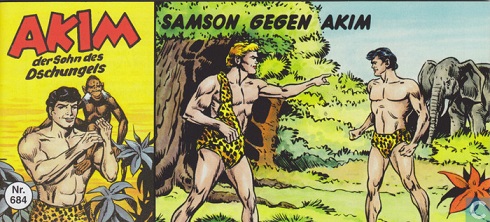
One of the more popular Tarzan clones was Akim, Son of the Jungle, created by Italian cartoonist Roberto Renzi and artist Augusto Pedrazza. In Italy Tarzan clones are called Tarzanidi.
During his run in Italy (1950-1967), he was exported to France for 700+ issues, Germany for 500+ issues, the Netherlands, Scandinavia, and Greece (where he was renamed Tarzan). Hundreds of issues appeared through the 1960s and 1970s, with ironic "new adventures" in the 1990s.
Amazon.fr has them for sale for between 5 and 10 euros.
Some of the rarest appeared in this single-strip per page format. Here Akim fights the Biblical muscleman Samson.
Akim's back story is nearly identical to that of Tarzan:
Count Frederick Rank, the British ambassador to Calcutta, is shipwrecked on the wild coast of Africa along with his wife and infant son, Jim. The parents soon die, leaving the toddler to be raised by gorillas.
Grown up, he becomes Akim, Son of the Jungle, with various animals at his command. He marries the British heiress Rita, and they adopt a son, Jim, who turns into buffed blond man-mountain.
In most adventures, they leave Rita back at the tree house and venture out as a pair, leaving all of the gay subtexts of the 1940s Tarzan movies starring Johnny Weissmuller and Johnny Sheffield.
Sometimes Jim goes out adventuring on his own, requiring Akim to rescue him from the usual jungle poachers, cannibals, and lost civilizations, as well as aliens, mad scientists, and dinosaurs.
Whether they're speaking French, German, Italian, or Dutch, the buddy-bonding is easy to spot.
During his run in Italy (1950-1967), he was exported to France for 700+ issues, Germany for 500+ issues, the Netherlands, Scandinavia, and Greece (where he was renamed Tarzan). Hundreds of issues appeared through the 1960s and 1970s, with ironic "new adventures" in the 1990s.
Amazon.fr has them for sale for between 5 and 10 euros.
Some of the rarest appeared in this single-strip per page format. Here Akim fights the Biblical muscleman Samson.
Akim's back story is nearly identical to that of Tarzan:
Count Frederick Rank, the British ambassador to Calcutta, is shipwrecked on the wild coast of Africa along with his wife and infant son, Jim. The parents soon die, leaving the toddler to be raised by gorillas.
Grown up, he becomes Akim, Son of the Jungle, with various animals at his command. He marries the British heiress Rita, and they adopt a son, Jim, who turns into buffed blond man-mountain.
In most adventures, they leave Rita back at the tree house and venture out as a pair, leaving all of the gay subtexts of the 1940s Tarzan movies starring Johnny Weissmuller and Johnny Sheffield.
Sometimes Jim goes out adventuring on his own, requiring Akim to rescue him from the usual jungle poachers, cannibals, and lost civilizations, as well as aliens, mad scientists, and dinosaurs.
Whether they're speaking French, German, Italian, or Dutch, the buddy-bonding is easy to spot.
Apr 28, 2017
Searching for Beefcake in "The Jungle Book Musical"
The Jungle Book Musical has a slightly different plot from the 1967 Disney movie: feral child Mowgli and his panther friend Bagheera flee from the tyrannical despot Shere Khan. They meet allies and enemies: Baloo the Bear, the seductive snake Kaa, and the gibbering Monkey King. Amassing their forces, they defeat Shere Khan, and restore freedom to the jungle. Then Mowgli follows a Little Girl to the Man-Village, his heterosexual desire pushing him into becoming a man.
Depressingly heterosexist.
And Mowgli is no Tarzan: he's a scrawny ten-year old boy.
But he's not always played by a scrawny ten-year old boy..
Here the grown-up and buffed Tom Boss plays Mowgli at the community theater in the gay resort town of Orono, Maine.
At the King Street Theater in Sidney, Australia, a hunkoid with the amazing name Badaidilaga Maftuh-flynn plays the jungle waif.
At the Rose Theater in Omaha, we find 25 year old thespian Aaron Ellis. One only wishes that the scanty loincloth would ride up a bit.

This production is at the Oak Grove Theater in Edinburgh. I don't know who this Mowgli is. I think that's Bagheera behind him.
Another unknown Mowgli from a production in Amsterdam. At least he looks South Asian.
Buffed monkeys from the production at the Goodman Theater in Chicago.
At the famous Metta Theater in Britain, Mowgli becomes a girl, and the jungle is re-envisioned as a hip-hop urban wasteland. Bagheera is a graffiti artist, Baloo a beat-box bohemian, and Shere Khan (Dean Stewart) a crime boss who struts his stuff shirtless.
See also: The Jonas Brothers
Depressingly heterosexist.
And Mowgli is no Tarzan: he's a scrawny ten-year old boy.
But he's not always played by a scrawny ten-year old boy..
Here the grown-up and buffed Tom Boss plays Mowgli at the community theater in the gay resort town of Orono, Maine.
At the King Street Theater in Sidney, Australia, a hunkoid with the amazing name Badaidilaga Maftuh-flynn plays the jungle waif.
At the Rose Theater in Omaha, we find 25 year old thespian Aaron Ellis. One only wishes that the scanty loincloth would ride up a bit.

This production is at the Oak Grove Theater in Edinburgh. I don't know who this Mowgli is. I think that's Bagheera behind him.
Another unknown Mowgli from a production in Amsterdam. At least he looks South Asian.
Buffed monkeys from the production at the Goodman Theater in Chicago.
At the famous Metta Theater in Britain, Mowgli becomes a girl, and the jungle is re-envisioned as a hip-hop urban wasteland. Bagheera is a graffiti artist, Baloo a beat-box bohemian, and Shere Khan (Dean Stewart) a crime boss who struts his stuff shirtless.
See also: The Jonas Brothers
Jul 7, 2016
The Phantom and Son
When I was a kid in the 1960s and 1970s, all of the good comic strips appeared in the Times-Democrat, across the river in Davenport, Iowa. Our Rock Island Argus featured a few lousy bargain-basement knockoffs -- Freckles instead of Archie, Winthrop instead of Peanuts -- and a lot of weird, incomprehensible dinosaur comics that were last popular when Mom and Dad were kids -- Prince Valiant, Out Our Way, Alley Oop.
The weirdest, most incomprehensible of the lot was The Phantom, a muscular Tarzan who roams the jungle in a purple jumpsuit. wearing a ring, and has a wife and kids at home.
I found this ridiculous.
1. Hetero domesticity kills adventure. That's why superheros are typically not interested. Edgar Rice Burroughs had Tarzan marry Jane Porter because he didn't plan on any further adventures for the Lord of the Jungle; as a long-running series began, he had to think of more and more reasons to get Jane out of the picture.
2. A purple jumpsuit. Lords of the Jungle always wear loincloths! The only reason to put them in the jungle, where it's hot and humid, is so you can draw hard muscles for your readers to ogle.
3. Did I mention the effeminate ring? Was the Phantom a drag queen?
The Phantom was created by Lee Falk in 1936, two years before Superman. and continues to run today. At its peak it appeared in over 500 newspapers worldwide.
Today's Phantom is Kit Walker, is the 21st in a line that extends back to Christopher Walker, a British soldier who was shipwrecked in the jungles of Bengal, India, in 1536. He became a masked vigilante, complete with jumpsuit and ring, and when he was ready to retire, bequeathed them to his son, the new Phantom, and so on, and so on. The superstitious natives thought he was the same person, an immortal god, and dubbed him "The Ghost Who Walks."
The Phantom lives with his wife (Helen), kids (Kit and Heloise), and various sidekicks in a skull-shaped cave, where he sits on a skull-shaped throne. He fights poachers, pirates, insurgents, smugglers, evil witch doctors, cannibals, and various baddies in what is no longer Bengal, but Bengalla Island, off the coast of sub-Saharan Africa.

He also appeared in comic book form, under various imprints: Ace, Harvey, Charleton, and finally Gold Key, where his title ran for 72 issues.
I occasionally leafed through them at Schneider's Drug Store, but quickly go bored. No same-sex rescues, no beefcake. Geez, at least show us a bicep now and then!

He appeared in a serial in 1943, when the studios were running out of properties, starring Western star Tom Tyler (left), but otherwise his screen appearances have been few.
A big screen version in 1996 starring Billy Zane (top photo) had the superhero fighting big business in modern-day America. tanked, along with the sci-fi cartoon, Phantom 2040, with Scott Valentine. Not like...um, well Tarzan, for instance.
I'm holding out for the modern strips, written by Tony DePaul and drawn by Paul Ryan and Terry Beatty. They often send in the Phantom's kids to do the adventuring.
Lee Falk imagined him as a cherubic preteen, but the modern Kit is drawn as a muscular blond teenager who has no qualms about appearing in a loincloth.
And none of the comics I've checked show him expressing heterosexual interest (the girl he's wrestling with is his sister).

Maybe we'll finally get some gay subtexts.
See also: Alley Oop; Prince Valiant.
The weirdest, most incomprehensible of the lot was The Phantom, a muscular Tarzan who roams the jungle in a purple jumpsuit. wearing a ring, and has a wife and kids at home.
I found this ridiculous.
1. Hetero domesticity kills adventure. That's why superheros are typically not interested. Edgar Rice Burroughs had Tarzan marry Jane Porter because he didn't plan on any further adventures for the Lord of the Jungle; as a long-running series began, he had to think of more and more reasons to get Jane out of the picture.
2. A purple jumpsuit. Lords of the Jungle always wear loincloths! The only reason to put them in the jungle, where it's hot and humid, is so you can draw hard muscles for your readers to ogle.
3. Did I mention the effeminate ring? Was the Phantom a drag queen?The Phantom was created by Lee Falk in 1936, two years before Superman. and continues to run today. At its peak it appeared in over 500 newspapers worldwide.
Today's Phantom is Kit Walker, is the 21st in a line that extends back to Christopher Walker, a British soldier who was shipwrecked in the jungles of Bengal, India, in 1536. He became a masked vigilante, complete with jumpsuit and ring, and when he was ready to retire, bequeathed them to his son, the new Phantom, and so on, and so on. The superstitious natives thought he was the same person, an immortal god, and dubbed him "The Ghost Who Walks."
The Phantom lives with his wife (Helen), kids (Kit and Heloise), and various sidekicks in a skull-shaped cave, where he sits on a skull-shaped throne. He fights poachers, pirates, insurgents, smugglers, evil witch doctors, cannibals, and various baddies in what is no longer Bengal, but Bengalla Island, off the coast of sub-Saharan Africa.

He also appeared in comic book form, under various imprints: Ace, Harvey, Charleton, and finally Gold Key, where his title ran for 72 issues.
I occasionally leafed through them at Schneider's Drug Store, but quickly go bored. No same-sex rescues, no beefcake. Geez, at least show us a bicep now and then!

He appeared in a serial in 1943, when the studios were running out of properties, starring Western star Tom Tyler (left), but otherwise his screen appearances have been few.
A big screen version in 1996 starring Billy Zane (top photo) had the superhero fighting big business in modern-day America. tanked, along with the sci-fi cartoon, Phantom 2040, with Scott Valentine. Not like...um, well Tarzan, for instance.
I'm holding out for the modern strips, written by Tony DePaul and drawn by Paul Ryan and Terry Beatty. They often send in the Phantom's kids to do the adventuring.
Lee Falk imagined him as a cherubic preteen, but the modern Kit is drawn as a muscular blond teenager who has no qualms about appearing in a loincloth.
And none of the comics I've checked show him expressing heterosexual interest (the girl he's wrestling with is his sister).

Maybe we'll finally get some gay subtexts.
See also: Alley Oop; Prince Valiant.
Subscribe to:
Posts (Atom)