Showing posts with label Johnny Sheffield. Show all posts

Jun 27, 2018

Johnny Weissmuller: A Second Rate Tarzan

I have a confession to make: I never liked Johnny Weissmuller as Tarzan.  I prefer Buster Crabbe, Herman Brix, or Mike Henry.

I know, I know, he invented the Tarzan mythos.  There were Tarzans on screen before, not to mention comic strips, a radio program, and the original novels by Edgar Rice Burroughs, but nothing matched the popularity of the MGM Tarzan series:

1. Tarzan the Ape Man (1932)
2. Tarzan and His Mate (1934)
3. Tarzan Escapes (1936)
4. Tarzan Finds a Son! (1938)
5. Tarzan's Secret Treasure (1941)
6. Tarzan's New York Adventure (1942)

And the RCA series:
1. Tarzan Triumphs (1943)
2. Tarzan's Desert Mystery (1943)
3. Tarzan and the Amazons (1945)
4. Tarzan and the Leopard Woman (1946)
5. Tarzan and the Huntress (1947)
6. Tarzan and the Mermaids (1948)

 The yell, the vine-swinging, the "me Tarzan" patois -- all invented by or for Weissmuller.

The problem is, they were entirely heterosexist, all about Tarzan and Jane's primal jungle romance.   They were Adam and Eve in a pristine heterosexual paradise, threatened only by the savages and unscrupulous Europeans who carried Jane off, kicking and screaming, in every single episode -- that girl was totally unable to take care of herself.  When Jane wasn't around, Tarzan found a nubile female substitute.

There were no gay subtexts, except maybe between Tarzan and his adopted son, Boy (Johnny Sheffield). Tarzan had no male friends, and whenever Boy tried to make a male friend, Tarzan roughly jerked him

 And, come on -- look at him!  In the 1960s, the go-to guy for Tarzan on film was the spectacularly muscular Mike Henry.
Or you could see Gordon Scott, whose impossibly super-sized chest cast its own shadow.


After that, it was quite a shock to turn on Tarzan Theater  and see this rather paunchy specimen, with ridiculous hair and yet another woman tied up by his side.


May 11, 2018

Bomba the Jungle Boy


Johnny Sheffield began playing Boy, adopted son to Johnny Weissmuller's iconic Tarzan, in 1939, when he eight years old, and finished in 1947, when he had grown bigger, taller, and far more muscular than his movie Dad and could hardly be called a "Boy" anymore.

A couple of years later, he started on a series of 12 Bomba the Jungle Boy movies (1949-55), ostensibly based on the series of boys' adventure novels, but really about a teenage Tarzan -- Bomba borrowed Weissmuller's trademark loincloth and "Me Tarzan" patois, and the short-lived comic book spin-off was subtitled "TV's Teenage Jungle Star."


The Bomba movies, which I saw on tv during the rare Saturday afternoons in the 1960s that didn't have a game or a repeat of The Magic Sword, seemed to have the same plot, with minor variations.


Bomba is summoned by a scientist or colonial administrator, who tells him about the bad guys and introduces his attractive teenage niece, visiting from America. Bomba and niece flirt.  Bomba is captured by the bad guys, but escapes.  The niece is captured, but Bomba rescues her and defeats the bad guys.  The niece goes back to America. Bomba goes back to the jungle.

The 30 or so minutes of action was turned into a feature-length movie through some stock footage of African wildlife and 20-30 minutes of close-ups of Johnny Sheffield's body.

When Bomba takes a nap, we don't get an establishing shot and then a switch to the next scene: the camera slowly travels down the length of his body for a good five minutes.

When he is tied up by the bad guys, he struggles with his bonds for the amount of time it takes the cameraman to go down to the commisary for a sandwich.

When he goes back into the jungle, he climbs a tree, and the camera obligingly zooms in on his semi-nude butt.

This wasn't an accident of direction or editing.  It was obvious that the African adventure and the heterosexist boy-meets-girl romance were just window dressing; the entire point of the movie was to put Johnny Sheffield on display as often as possible, for as long as possible.

Not that the audience, comprised primarily of preteen gay boys and straight girls, was complaining.  They could think of lots worse ways to spend a dull Saturday afternoon than gazing at Johnny Sheffield.

He influenced a generation of muscular, semi-nude jungle boys, such as Gunga on Andy's Gang and Terry on Maya


After Bomba, Johnny filmed a tv pilot called Bantu the Zebra Boy, which is available on youtube.  He then went to UCLA, got a degree in business, and had a successfully fully-clothed career in real estate.  But was always happy to chat with his fans, gay or straight -- Johnny was refreshingly gay-friendly for someone of  his generation.

There's a gay celebrity story about him on Tales of West Hollywood, but it might be apocryphal.

He died in 2010.

See also: Why is Bomba the Jungle Boy always tied up?

Oct 15, 2017

Matt's Date with Johnny Sheffield's Son

San Diego, July 1989

My ex-boyfriend Fred's boyfriend Matt was loud and proud, out to everybody and everything.  "Hi, I'm gay, and I'd like to order a large pizza."  "Hi, I'm gay.  What time will the flight from Kansas City be arriving?"

Fred didn't care for gay pride events, but Matt dragged him to Christopher Street West in L.A. every year, and sometimes to the parades in San Francisco and San Diego too.  "Mon chevalier blanc, it will be fabulous!" he promised.  "And, as any queen knows, they come with nonstop cruising.  Finding a Cute Young Thing to share my butt and our bed will make it all glorioski, n'est pas?"

In 1989 they went to the San Diego gay pride parade, and afterwards they went to a "hair cutting" exposition at the Eagle.  One of the guys in the chair was a Cute Young Thing named Stewie (this was before Family Guy co-opted the name): early 20s, tall, slim, very tanned, with brown curly hair, a round open face, pinprick nipples, and an average-sized penis.  Plus he came from a wealthy family and attended a private school, just like Matt.  They immediately hit it off, and were so busy talking that they almost forgot to cruise.

The full story, with nude photos and explicit sexual situations, is on Tales of West Hollywood.

Oct 12, 2017

Tarzan's Boy: Johnny Sheffield


When MGM executives wanted to expand the audience of their extremely successful Tarzan series by giving the Ape Man and his Mate (Johnny Weissmuller, Maureen O’Sullivan) a child, they faced a quandary: since the couple was not married, Jane could hardly give birth to Korak.   Instead, Tarzan Finds a Son! (1939) envisions an airplane crash in the jungle with a sole survivor, a cooing infant whom Tarzan names Boy.

 It is an odd name, and evidently a last-minute change –  the trailers call him Tarzan Jr.  One wonders why Jane did not insist on Tarzan Jr. or John Clayton Jr., particularly if she expected the child to one day survive hazing at Eton.  But if Tarzan and Jane are the primal Man and Woman of a sexless heterosexual Eden, then their Boy must be the primal Boy, the archetype of all Boys everywhere.

The primal Boy was cast with seven year old Johnny Sheffield, hand-picked by Johnny Weissmuller from the hundreds of hopefuls.  Perhaps Weissmuller was shopping for a surrogate son of his own: he taught Johnny to swim and wrestle, and often took him places off-camera.  They were a common sight at premieres and Hollywood hotspots.  

Johnny was no ordinary Boy. In Tarzan and the Amazons (1944), Johnny at 13 could easily pass for a high school athlete.  In Tarzan and the Leopard Woman (1945), he is 15, but he already sports the thick, heavy chest, flat belly, and deepened voice of young adulthood.  In Tarzan and the Huntress ( 1946), he is nearly 16 years old and six feet tall, with a chiseled torso that makes 42-year old Weissmuller look flabby and out of shape, a middle-aged businessman ludicrously enacting a Tarzan fantasy.  The Boy has surpassed the Man, and Johnny Sheffield must retire from the series.

Although the teenage Boy is handsome enough to compel most of his classmates at Randini High School to write his name amid hearts in their notebooks or scramble to ask him to the Spring Fling, he has few opportunities for jitterbugging.  The women he encounters are always older, and usually evil; indeed, a half-hour walk in any direction seems to lead to lost civilizations led by evil women.

Any cute boy he meets is likely to be evil, too.  In Tarzan and the Leopard Woman, a boy named Kimba (Tommy Cook) appears one day at the Escarpment, claiming that he got lost in the jungle.  The Tarzan family takes him in, but Boy is suspicious.  It turns out that Kimba belongs to an evil leopard cult, and plans to prove his manhood by murdering them all. Many jungle-story scripts would have Boy befriend and ultimately rehabilitate the troubled teen, but not here: the two Boys never express any sentiment but seething contempt, and the unrepentant Kimba is shot to death.

More often, Boy’s homoromantic interests are stymied by Daddy Tarzan himself.  In Tarzan and the Amazons, a scientific expedition visits, and Boy can barely contain his excitement; he wiggles up to one, then another, flirting his way into hands-on-shoulders, cool gifts, and an invitation to “come around anytime.”  Tarzan passively-aggressively suggests that Boy shouldn't pester the strangers.  “They’re not strangers!” Boy cries, over-reacting with teen angst. “They’re Jane’s friends, and mine. . .I don’t want to go hunting with you!  I won’t go hunting with you ever again!”

Tarzan is equally passive-aggressive about denying Boy peer companions.  In Tarzan and the Huntress, the Tarzan family visits the kingdom of Teronga, where Boy befriends the teenage Prince Suli (Maurice Tauzin).  But when Boy asks to stay longer, Tarzan says no.  Later they find Prince Suli in the jungle, left to die by his evil usurper-uncle. Surely the long and dangerous trek back to Teronga would provide many opportunities for buddy-bonding, but Tarzan has other ideas: “Boy, go home, tell Jane!” he barks. “We go to Teronga!”  Boy protests, but Tarzan stubbornly leads the Prince away.

What is the significance of these denials?  Of course the movies are about Tarzan, so he must wrestle all of the crocodiles, rescue all the princesses, and supervise all of the shifts from absolutism to democracy in lost-civilization governments, but surely allowing Boy some friends would not threaten his status as Busybody of the Jungle.

Yet perhaps Tarzan is threatened after all.  As Boy hardens into adolescence, his role becomes paradoxically soft and passive – his muscles become purely decorative, to be displayed for their beauty just as Jane’s curves, and as useless for fending off crocodiles.  Indeed, Boy usually takes Jane’s place as the objective of Tarzan’s chest-pounding heroics.

The three pre-Boy movies all end with Tarzan swooping down to rescue Jane.  Afterwards, she is captured along with Boy twice, and in four movies, Boy is captured alone, tied to something, muscles straining, until Tarzan swoops down to the rescue.  (And in one, Cheetah comes to the rescue.)

During Boy’s adolescence, he and Tarzan are constant companions, leaving little time for Jane, who confesses without complaint “They’re used to doing everything together. Why, they often leave me alone for days!”  They leap into the lagoon together, enacting the quintessential moment of jungle romance.  They are even shown sleeping together, curled up on the same mat, Boy’s head pillowed by Tarzan’s bicep (Jane’s sleeping arrangements are left unseen).


If the homoromantic Arcadia is a displaced fantasy of adulthood, then the viewer must desire the sight of the primal Man and Boy diving into the lagoon together as eternally as the primal Man and Woman. Tarzan must contain his Paradise against threats to Boy as well as to Jane, and he must guard as jealously against any other love.

Johnny Sheffield continued wearing a loincloth through the 1950s as Bomba the Jungle Boy, to the delight of gay kids everywhere.  Johnny Weissmuller put a shirt and pants on to buddy-bond as Jungle Jim.

There's a Johnny Sheffield hookup story on Tales of West Hollywood.

See also: Why is Bomba the Jungle Boy always tied up?; On Your Knees, Boy

May 12, 2017

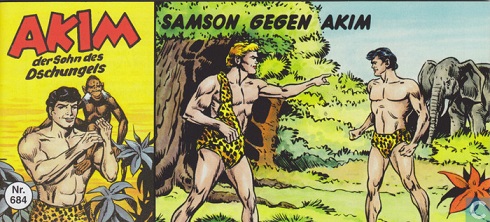
Akim and Jim: Tarzan and Boy of European comics

One of the more popular Tarzan clones was Akim, Son of the Jungle, created by Italian cartoonist Roberto Renzi and artist Augusto Pedrazza.  In Italy Tarzan clones are called Tarzanidi.

During his run in Italy (1950-1967), he was exported to France for 700+ issues, Germany for 500+ issues, the Netherlands, Scandinavia, and Greece (where he was renamed Tarzan).  Hundreds of issues appeared through the 1960s and 1970s, with ironic "new adventures" in the 1990s.

Amazon.fr has them for sale for between 5 and 10 euros.


Some of the rarest appeared in this single-strip per page format.  Here Akim fights the Biblical muscleman Samson.


Akim's back story is nearly identical to that of Tarzan:

Count Frederick Rank, the British ambassador to Calcutta, is shipwrecked on the wild coast of Africa along with his wife and infant son, Jim.  The parents soon die, leaving the toddler to be raised by gorillas.


Grown up, he becomes Akim, Son of the Jungle, with various animals at his command.  He marries the British heiress Rita, and they adopt a son, Jim, who turns into buffed blond man-mountain.

In most adventures, they leave Rita back at the tree house and venture out as a pair, leaving all of the gay subtexts of the 1940s Tarzan movies starring Johnny Weissmuller and Johnny Sheffield.


Sometimes Jim goes out adventuring on his own, requiring Akim to rescue him from the usual jungle poachers, cannibals, and lost civilizations, as well as aliens, mad scientists, and dinosaurs.


Whether they're speaking French, German, Italian, or Dutch, the buddy-bonding is easy to spot.

Jan 7, 2016

Why Is Bomba the Jungle Boy Always Tied Up?

Johnny Sheffield (1931-2010) spent the first 24 years of his life being filmed in a loincloth cut to the thigh, first as "Boy," son of Tarzan Johnny Weissmuller in 8 movies (1939-1947), and then as the teenage Bomba the Jungle Boy in 12 movies (1949-1955).  After all that, it proved impossible to find a fully-clothed role, so Johnny went to UCLA, got his degree in business, and had a successful second career in real estate.

The movies were on tv constantly during my childhood, and now they're all available on DVD. 


I noticed something interesting: in all of the Tarzan movies featuring the adolescent Boy, and in all but one of the Bomba movies, Johnny gets tied up. 

Did the directors have a bondage fetish?

Or is it a matter of maximizing beefcake?

Johnny begins to get an impressive physique in the last 3 Tarzan movies, which are terrible.  Maureen O'Sullivan refused to do them, so Jane was recast with Brenda Joyce.  

The Bomba movies are even worse: endlessly recycled stock footage of African animals, and an endlessly recycled plot about Bomba falling in love with a visiting colonial administrator's daughter while fighting poachers or insurrectionists.  

How can you get audiences to fork over money to see such stuff?

Easy: show some pecs and biceps, and maybe a loincloth-bulge now and then.

So you add a few scenes of Johnny asleep, or else unconscious after falling out of a tree.  The camera zooms in for a close up of his face, shoulders, chest, stomach, and loincloth.  Then it starts over again.  Before we're done, we've been staring at Johnny's body for five minutes.  

But sleeping/unconscious shots show the muscles at rest.  Audiences want big, bulging, flexing muscles.  Fight scenes with bad guys or wild animals cause bulges, and sometimes the loincloth rides up to reveal the underwear beneath, but there's too much moving around for a serious gawk at Johnny's body.

Idea: why not have Boy/Bomba tied up, threatened by poachers or about to be sacrificed by an evil cult or something? That way he can strain against the bonds, flexing his muscles, but he's not moving.  The camera can zoom in, and audiences can stare as he struggles for five minutes.


I'd pay money to see that.


Mar 23, 2013

Visiting Africa

With all of the teenage African and American boys pairing off, in A Visit to a Chief's Son (1974), African Journey (1989), and The Great Elephant Escape (1995), you'd think that sub-Saharan Africa would easily make my list of "good places," like India or the Pacific, but it didn't.  When I was a kid in the 1960s and 1970s, I heard about Africa mostly from Tarzan movies: steaming jungles occupied by hoards of gibbering natives who were semi-nude but not very muscular, and spent all of their time trying to kill white people.  Here they plan to burn Tarzan's Boy (Johnny Sheffield) at the stake.  He was also almost drowned, forced to drink poison, attacked by a giant spider, and tied up for no particular reason.
School wasn't much better.  Our few lessons about Africa mentioned the steaming jungles and naked natives living in grass huts, fighting crocodiles and waiting for Stanley and Livingston to discover them.  Although occasionally the pictures showed some muscles (and some of the nudity), and suggested the potential for homoromantic liaisons.


Jungle comic books occasionally showed natives who were "civilized," though still in loincloths, but they were always in the background.  The focus was on the white European or American leads.  Here the white Dan-El is in the foreground, and the black Natongo in the background.


There were also two tv series about Americans in a more modern Africa: Daktari (1966-69), starring Yale Summers (left) and Hari Rhodes (right), and Cowboy in Africa (1967-68), starring Chuck Connors.  I never saw them.

I heard about the real Africa some time later, but it didn't help much.  Sub-Saharan Africa today has some of the most repressively homophobic regimes on the planet.
Related Posts Plugin for WordPress, Blogger...