Showing posts with label older-younger. Show all posts

Jan 17, 2026

Mark Lester: Jack Wild's boyfriend moves on to sleazy hetero cringe, buddy-bonds with Michael Jackson, shows his backside on the grass


It seems that every kid is forced to see Oliver! (1968)   Their parents think that the musical is somehow educational because it's roughly based on Oliver Twist.

I saw it on DVD a few years ago, after two doses of the live musical, in high school and in L.A.  Not my favorite: all about child abuse, domestic violence, and other fun stuff, with a heterosexist "true love" plot.  


But I liked the gay-subtext buddy-bonding between the streetwise Artful Dodger (15-year old Jack Wild) and the cherubic innocent Oliver (10-year old Mark Lester).


I knew Jack Wild from H. R. Pufnstuf, but I heard nothing more about Mark Lester for many years. During the early 2000s, I was writing an article on demonic children in the movies, and I found that the cherubic Mark Lester spent his pubescence playing violent or creepy, or both.  His characters seemed uncomfortable with their bodies, ravaged by uncontrollable desires, and obsessively heterosexual.

In Eyewitness (1970), also released as Sudden Terror, 12-year old Ziggy (Mark) witnesses a murder on the Mediterranean island of Malta,  and is pursued by the killer.  He goes on the lam, along with his girlfriend.


In Melody (1971), 10-year old Daniel (Mark) falls in love with a girl and decides to marry her. The adults disapprove of a 10-year old getting married, but it's the heart of the counterculture, and "true love" is always right.

Jack Wild plays his gay-subtext budd.


In What the Peeper Saw (1972), also released as Night Hair Child and Diabolica malicia, 14-year old Marcus (Mark) isattracted to his father's new wife (Britt Eklund).  She shares his interest, and they start a relationship. They conspire to kill Dad so they can be together. But is she really conspiring to kill Marcus? 

In Who Slew Auntie Roo (1972), 14-year old Christopher (Mark)  tries to rescue his sister from the demented Mrs. Forrest (Shelley Winters), who is holding her prisoner in the attic. 

More after the break

Jan 11, 2026

Scott Garrison: Swamp Thing's teen sidekick takes off his shirt, and the whole world watches. Or at least West Hollywood


In 1990, the newly founded USA Network was looking for series ideas, and they latched onto the DC comic book character Swamp Thing, a human-looking mass of vegetation who wreaks vengeance on people who try to invade his swamp home.  Seeing environmental relevance, they softened Swamp Thing (Dave Durock in a latex costume), gave him a new back story -- he was an environmental scientist disfigured by the evil Dr. Arcane (Mark Lindsay Chapman) -- and gave him a human chum, 11-year old Jim (Jesse Zieglar).  

A monster and a kid didn't bring in the viewers, so after 13 episodes Jim's 17-year old half-brother Will (Scott Garrison) showed up.   Will spends a lot of time being captured by Dr. Arcane, evil cultists, monsters, and sundry baddies, forcing the Swamp Thing to enact a daring rescue.  He also helps a series of stray kids, both boys and girls, but doesn't develop much romantic interest in anyone.  

So a heterosexual villain, and a hero who is not interested in women.  And did I mention the beefcake?  The extremely buffed Garrison is shirtless or nearly nude in nearly every scene (this is a humid swamp, after all).  


I couldn't find many biographical details of Scott Garrison, just that he was born in San Antonio, Texas, in 1964, studied music at North Texas State University, and formed a band.  When they broke up, he moved to Los Angeles to study acting.  His on-screen career began with two episodes of TV 101 (1989-90), a drama about a high school class in tv production. Sam Robarts (left) played their teacher.  It aired opposite Who's the Boss (Tony Danza, sigh), so the ratings were abysmal, and it was yanked after 12 episodes.


Next came a 1989 episode of the Fox hit  Married...with Children.  Scott plays Bill, the sleazy, leather jacket-wearing boyfriend of teenage Kelly Bundy.  Here her father Al is showing him the door. 

More after the break

Dec 16, 2025

Gangster's Boy: Jackie Cooper Falls in Love

Born September 15th, 1922, the blond, pug-faced Jackie Cooper (left, with Freddie Bartholomew and Mickey Rooney) was the Ricky Schroder of his generation.  He got his start in Skippy, an adaptation of the comic strip about kids and dogs and the lunacy of adult society.  Jackie’s ability to shed realistic tears on cue (augmented by authoritarian directing: Taurog threatened to shoot his dog if he failed to deliver) won him a Best Actor Oscar nomination and catapulted him into the ranks of Hollywood royalty.  Sooky, The Champ, When a Fellow Needs a Friend, and Treasure Island followed, all box-office toppers.  By 1934 Jackie had his own fan magazine, half a dozen Big-Little book titles, and enough advertising tie-ins to shame Little Orphan Annie.

When Jackie hit pubescence, his box office draws declined, he re-invented himself la hard, masculine boys’ book hero.  He spent hundreds of hours at the gym, becoming an expert boxer, wrestler, and swimmer.  Movie magazines published photos of him in boxing trunks or skimpy swimsuits, displaying a hard-packed muscularity that made adult beefcake star John Garfield look downright scrawny.  Boys and men rarely appeared shirtless on camera in the 1930s, so instead Jackie wore tight dark-colored t-shirts that accentuated his v-shaped torso and mountainous biceps.


But even with a stunning boys’ book physique, he had become so thoroughly promoted as vulnerable, sensitive, and clingy that audiences simply wouldn’t accept him as tough, not even tough as a façade to hide a sensitive soul, so he was still asked to make with the waterworks in every picture.  And his pictures always featured gay subtexts, sometimes with heterosexual competition.

In Gangster’s Boy (1938),  Jackie plays Larry Kelly, a whiz-kid valedictorian, a letterman in every sport, yet also a fun-loving regular fella: he drives a jalopy covered with graffiti, plays the drums in a swing band, and litters his speech with goofy  expressions like “Who do you think you are?  Anyhow?”


He is stunningly attractive, so thoroughly desired by the guys, gals, teachers, and townsfolk that they always look like they want to rip his clothes off, but he is devoted to his long-term “particular friend,” Bill Davis (future Broadway star Tommy Wonder).  “We’ll always be together,” Larry exclaims in a tender moment, and indeed after their high school graduation they plan to enroll at West Point together.

When Larry stars dating a girl, Bill seems to resent the competition: every time Larry swoops in for a kiss, he finds some excuse to interrupt them. He claims that pictures of girls are not allowed in cadets’ lockers at West Point: “You’re not supposed to waste time thinking about girls. . .you’ve got important things to think about!”  This may or not be true, but Larry does not challenge him.

The somewhat strained romance is further interrupted when Larry’s father, Knuckles, returns from an extended “business trip” up the river and confesses that he is actually a reformed gangster, just released from prison (perhaps the name “Knuckles” should have provided a clue).

When the townsfolk discover the terrible secret, they turn into slathering bigots.  No gangster’s son has the right to sully their town: they kick Larry out of the nightclub where he’s performing, refuse to applaud after his valedictory speech, and forbid their children from seeing him.  On the night of the Big Dance, Bill and his sister both sneak out of the house to see Larry, positioning themselves both as “dates,” as competitors for his affection.  But then the sister is forgotten, and the rest of the movie maintains the gay romance.

Driving home from the Big Dance, they accidentally hit and injure a small child.  Bill was at the wheel, but Larry claims responsibility, recognizing that an arrest for reckless driving will ruin either of their chances of being admitted to West Point.  But Bill is unwilling to let Larry sacrifice his career.


They posture and argue about who will take the blame until the judge uncovers the truth and exonerates them both, intoning that they have “learned a lot about friendship.”  But really it is the adults who have learned a lot. Larry and Bill already knew that they were ready to fight and die for each other, that their bond far transcended any momentary flirtation with girls.  Instead of a heteronormative clinch, the movie ends with the boys gazing at each other with eye-shimmering affection.

Within the Hollywood community, there was considerable speculation that the teenage Jackie’s sensitivity and his many friendships with girls signified that he was gay.  Whispered “anecdotes” had Jackie and former costar Wallace Beery caught with their pants down, and once at a nightclub, brash blue comedian Milton Berle spotlighted him as a “fag”, to gales of humiliating laughter.  These jokes and rumors apparently had a profound effect on Jackie.  In his later years, in spite of his otherwise liberal politics, he has made some mildly homophobic statements,  and he has never formed a close friendship with a man, perhaps out of a fear of what masculine intimacy might signify.


Sep 24, 2025

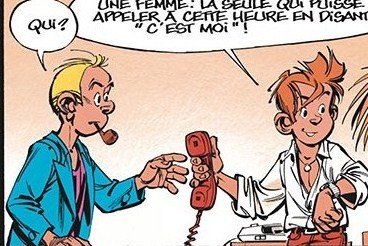
Spirou and Fantasio: The Bellhop and his Boyfriend

The young hunk and his blond, balding but still youthful boyfriend recline cozily on the couch, watching tv, their legs pressed together.  The young hunk places his foot atop his boyfriend's in a gesture of intimacy.


Suddenly the telephone rings.  "It's a woman," the young hunk announces.  "One who has the chutzpah to call us at this hour and say It's me."

His shirt is open, revealing a smooth, buffed chest.  His boyfriend is wearing a lavender t-shirt and a sky-blue jacket, a style that an older gay man might wear.


As his boyfriend takes the call, the young hunk cuddles their pet squirrel, adopting a nurturing, feminine pose. He's wearing extremely  tight pants.  The boyfriend glances over at him, apparently thinking "I'm lucky to have landed such a hot guy."


It's their coworker, Seccotine, asking for a ride to the airport.  "Sorry, tomorrow I'm going to a conference in Bali," the boyfriend says.  Ignoring the young hunk's frantic gestures, he continues: "...But don't worry, my partner will be glad to give you a ride."

A gay comic?  A parody?  A slash fantasy?  No, this is an actual excerpt from Spirou et Fantasio, a Belgian comic strip for children (and college students learning French).


The young hunk Spirou began his career in 1938 as a bellhop engaged in humorous antics.  In 1944, he met intrepid journalist Fantasio, and soon the two were pairing up for investigations, traveling through time and space, confronting gangsters, spies, dictators, mad scientists, and alien invaders, rescuing each other again and again.


 Like Tintin and Captain Haddock, Corentin and Kim,  and Alix and Enak, Spirou and Fantasio became domestic partners, and rather obviously lovers,  Occasionally Fantasio liked a woman (unlike Captain Haddock), but in the end he always returned to his true love.

During the 1990s, the couple was redrawn, becoming more naturalistic, with pleasantly muscular physiques -- and the gay subtext was revved up (it's hard to read them as anything but a modern-day gay couple).

Over fifty albums have been released to date.  Three have been translated into English.

Jul 1, 2025

Male Nudity in English Class: The Canterbury Tales


During my junior year in college, I heard The Word in my college class for the first time.  My Culture and Civilization of Modern Germany class was devoted to proving that no German ever wrote about homosexualitat, but the professor in my Chaucer class, a big, hoarse-voiced woman named Dr. Dorothy, thought that The Canterbury Tales was all about how terrible "homosexuality" was.

Ok, but the Pasolini adaption of The Canterbury Tales had the most impressive male nudity I had ever seen at that point.  I can't show a picture here, but those guys were huge.


The Pardoner, one of the pilgrims who tell stories on the road to Canterbury, was thin and willowy, beardless, with long yellow hair and a high pitched voice.

"An effeminate homosexual!" Dr. Dorothy cried, obviously delighted to say a forbidden word.  "How grotesque!"

Ok, but look at the Squire: a powerfully built young man of about twenty.  But instead of jousting and fighting dragons, he spends his time dancing, singing, and embroidering, quite feminine pursuits. He is a "lover and a lusty bachelor," so busy having sex that he doesn't sleep much at night.  Yet who does he have sex with?  Chaucer leaves this vague, but traditionally squires were devoted to the knights they served.


In The Miller's Tale, a parish clerk named Absolon is infatuated with the Miller's wife, and asks her for a kiss through a peep-hole.  Instead, the Miller shoves his bare butt through and farts in Absolon's face.  But Absolon gets revenge by shoving a red-hot poker into the Miller's butt.

"Symbolic homosexuality!" Dr. Dorothy cried, enjoying the shocked expressions on the students' faces. "How humiliating for the Miller!"

Ok, but look at The Knight's Tale, about two bosom buddies, Arcite and Palamon, who are both in love with Emily.  A classic triangulation, with the quarrel over the girl an impediment to their love, which is described in lushly romantic terms:

Sworn as we are, and each unto the other,
That never, though for death in any pain,
Never, indeed, till death shall part us twain.


Medieval literature was filled with men in love, like Roland and Oliver.  Shakespeare and John Fletcher used the same story as the basis for The Two Noble Kinsmen (1634), here performed by Tyler Neale and Tim Elliott.


A Knight's Tale (2001), starring Heath Ledger, tells a different story, but it does feature a nude Geoffrey Chaucer (Paul Bettany), plus a gay couple, the Knight's humorous sidekicks, Roland and Wat (Mark Addy, Alan Tudyk).

As I discovered in my classes in Modern British and American Literature, you can't always believe what you hear from a college professor.

See also: Pasolini's Canterbury Tales: More gay characters and cocks than Chaucer imagined

Feb 15, 2025

The Boys and Men of Oz

I know, all gay men are supposed to get all starry-eyed over The Wizard of Oz, the 1939 movie starring Judy Garland, but I don't care for it.  As a child I was terrified of the flying monkeys, the man-eating pigs, and the homicidal Wicked Witch. As a teenager, I ridiculed the saccarine songs and the corny "It was all a dream" bit.  And why would anybody want to go back to Kansas?

I had no idea that the movie was based on a novel, one of a series, until I read something about Ruggero the Nome King in Lin Carter's Imaginary Worlds..  A check of the children's room at the Rock Island Public Library revealed 14 books written by L. Frank Baum and 20 by others, extending from 1900 through the 1940s.  I checked out the first five.  And then the next, and the next.  I had found a "good place."

There was little beefcake: the protagonists, boys or girls, were drawn in the same style, as delicate and pretty as cherubs yet tough and hardy, able to endure long wilderness treks and fight monsters.

There was little buddy bonding. The protagonist traveled with a melange of talking animals, magical objects, and adult companions. I found only two significant homoromances:

 In Ojo in Oz, between Ojo and the bandit Realbad, but in the end Realbad turns out to be the boy's father, ruining it.

And in Rinkitink in Oz (1916), the jovial king Rinkitink discovers that his talking goat companion is really an enchanted prince named Bobo.  The two walk into the sunset together.


There were many disturbing, horrible elements.

1. No one ages in Oz, so babies stay babies and kids stay kids forever.

2. No one can die, so if you cut someone into pieces, each piece remains alive and conscious.

3. Inanimate objects can easily be brought to life, and they stay alive and conscious forever.

4. There is casual racism, sexism, and class-based bigotry.  Rude comments and unpleasant mannerisms are presented as endearing. Kids are often threatened by sinister adults.


So why was Oz a good place?

1. The delicate, pretty boys in their flamboyant costumes are all gay-coded. Every boy in Oz is gay.

2. Adult men and women follow a strict division of labor, with women who hoped for equality ridiculed.  But the boys and girls have precisely the same interests and activities.  A boy named Tip is transformed into Princess Ozma.

3. The boys and girls never express any heterosexual interest.  Occasionally an adult does, but only minor characters in side-plots irrelevant to the main story.

4. There are few if any nuclear families.  The main family structure in Oz is single parent and child.

5.The outsiders who find their way to Oz are the odd, the unusual, the outcast, the "queer."  And they always find a home.

See also: The Wizard of Oz


Aug 21, 2023

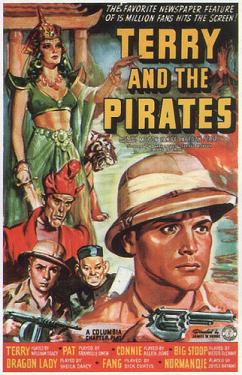
Terry and the Pirates


Terry and the Pirates (1934-1973) presented the most overt adult-teen homoromance in the comic strips.  When fourteen-year old Terry Lane first set out to search for his missing grandfather, accompanied by soldier of fortune Pat Ryan, he was a wide-eyed innocent who seemed to belong in a humor strip, quite out of place among the jungles, copra plantations, and seedy port cities of the South China Sea, where everybody had an angle, a price, and a lot of secrets.  He was even drawn differently from the other characters, with a round face and soft, curvy lines amid Milt Caniff’s trademark square-jawed, angular men and women.  Caniff often used humorously drawn outsider characters, like the pug-cute Dickie Dare and the eyeglassed, golly-gee-spurting Wash Tubbs, to link the preternatural world of adventure with the comfortable, familiar world back home.  But Terry was neither boy, like Dickie Dare, nor man, like Wash Tubbs.  He was a teenager, and he was growing up.


Most comic strip characters either do not age, or they jump from child to adult instantly, but Terry aged normally, celebrating his fifteenth birthday in 1935, his sixteenth in 1936, and so on.  As he approached manhood, his relationship with Pat Ryan became considerably more intimate than those of the other pairs, the homoromantic slipping inexorably into the homoerotic.  Terry and Pat were sometimes shown sharing a single bed, or showering together, or naked together.  In a 1936 strip, the sixteen-year old Terry has just bathed, and he is toweling off.  The towel shields his backside from readers, but his frontsize is fully exposed to Pat, who is gazing with obvious appreciation.


Buck Rogers, Flash Gordon, and Don Winslow spent half of their time brawling with men and the other half kissing women, but as long as Terry is not yet a man, Pat Ryan actively avoids the tall, slinky femmes fatale who keep wrapping their arms around him.  . When jewelry fence–kept girl Burma throws herself at Pat for three weeks’ worth of strips, he consistently rejects her, consenting to a kiss only after she calls him “Yellow!”, denigrating his masculinity, eight times in three panels.  Then, after the kiss, he refuses to accept her purring “darlings.”

Pat’s masculinity is, indeed, open to question, in spite of his square-jawed stoicism and expertise at fisticuffs.  He is denigrated by worse terms than “yellow,” including “sissy” and “pansy,” but only by women, so he won’t have to fight back.  Late in 1936, when they are all shipwrecked on another island, Burma throws herself at the colonial administrator (although she is supposedly as hard as nails, she falls for every man she sees).  The solicitous Pat gives the adminstrator’s wife make-up and hairstyle tips so she can beat off the competition.  One expects that, if World War II had not broken out, Pat could have easily returned to America and opened a hair salon.

The sixteen and seventeen-year old Terry is often positioned structurally as a parallel to whatever tall, slinky woman is lusting after with Pat this time.  The lady strips down to her underwear, and in the next scene Terry strips down to his underwear.  Pat is knocked unconscious, and the lady gingerly holds him in her arms.  The next time Pat is knocked unconscious, Terry gingerly holds him in his arms, in precisely the same position.

Columbia’s adaption, released on May 5th, 1940, is one of the era’s few intentionally humorous movie serials (it was directed by James W. Horne, who did the Laurel and Hardy shorts).  Terry was played as a squealing teenager by 22-year old William Tracy, a rather stout, likeable blond.  Pat Ryan, the soldier-of-fortune bodyguard, was miscast with Granville Owen, adequately tall and muscular but only five years older than William Tracy – he had just finished playing a college student in Start Cheering (1938), and he would go on to play the eternally teenage Li’l Abner in the adaptation of the Al Capp comic strip (1940).

The two are by far the most physically expressive of homoromantic partners in movie serials, one with hand always firmly placed on the other’s arm, shoulder, or back, except when they are walking with their arms wrapped around each other’s waists. Terry screams and flails like a damsel in distress when he is terrorized by crocodiles, headhunters, and villains lobbing hand-grenades, and after Pat swoops down like Tarzan to save him, they embrace, Terry’s face pressed against Pat’s chest.  

In an early chapter, they are bedded down for the night when a gorilla breaks into Terry’s room and tries to carry him away.  Pat rushes to the rescue, getting his shirt ripped off in the process.  Afterwards Terry stares appreciatively at Pat’s bulging muscles and hints “I’d feel a lot better if I slept with you tonight.” Pat agrees.

Jul 26, 2023

Salem's Lot


Speaking of Lance Kerwin, he offers a strong same-sex romance in Salem’s Lot (1979), based on the Stephen King novel.  When failed writer Ben Mears (former Starsky and Hutch hunk David Soul) returns to his home town of Jerusalem’s Lot, Maine to exorcise his demons, he demonstrates that he is heterosexual by dating a glamorous art teacher (Bonnie Bedelia), but mostly he bonds with middle-aged men, the town doctor and his former English teacher.  Meanwhile, local teenager Mark Petrie (Lance Kerwin) finds that his love of theater, art, and his best friend Danny makes him an outcast in his small town. Go figure.


Ben immediately notices Mark and asks who he is, but he never gets the nerve to speak to him.  They stare wide-eyed at each other, but each looks away when the other turns.  Later, at an antique shop, they meet each other’s gaze, and each pauses as if waiting for the other to speak.  Ben smiles shyly: he is determined to wait for Mark to make the first move.  But the teenager quickly rushes on.

Soon the boys and young men of Salem’s Lot start disappearing, or dying of pernicious anemia, and returning with glowing eyes and fangs.  Even though the hard-bodied handiman Mike (Geoffrey Lewis) grows fangs after the English teacher invites him home for the night, most of the suspicion falls upon the elderly owner of the antique shop, and upon Ben himself, who was a child during a previous run of boy-murders.  However, the real culprit turns out to be Mr. Barlow, a blue-faced Nosferatu who likes to bite boys.

The heavy-handed association of vampirism and pedophilia, absent in the original novel, adds a cringe-factor to Ben and Mark’s erotic intensity.  One wonders why director Tobe Hopper didn’t cut the endless longing gazes and have Ben take a big-brotherly interest in Mark.  Surely in 181 minutes there's enough time for scenes with the two of them throwing a football around or going to a monster movie.

Or else cast Mark with someone much younger.  In the novel he is 11,  one of Stephen King’s stable of wounded outsider boys seeking replacements for fathers who are distant, dead, or psychotic killers.  But Lance Kerwin is 19, obviously an adult, not a child, and obviously in the market for a boyfriend, not a big brother.


And the wounded Ben, desperately seeking approval from father figures of his own, is pitiably unfit to be a big brother.  His mute, inept attempts at connecting with Mark suggest that he is fighting an attraction that he himself finds deeply distressing.

The climactic scene nicely combines staking vampires with staving off same-sex desire.  Ben goes to a standard crumbing, evil mansion outside of town to confront Barlow, and Mark, who was captured and tied up earlier, now escapes and literally bumps into him on the front porch.  They grab at each other: after three hours of staring, they are finally touching!

Horrified (but not shrinking away), Ben shouts “Run as fast as you can, and keep running!”  Ostensibly he wants to protect the boy from vampires, but Mark has just demonstrated that he can take care of himself.  Ben’s urgency seems precipitated more by the touch: perhaps it brought his hidden passion dangerously close to the surface.    

After Ben goes into the house, Mark waits on the porch for a moment, but he cannot run away: taking the initiative in their relationship, he confronts Ben in the crumbling drawing room.  “I told you to go!” Ben shouts.  “No!” Mark shouts back. He is not going anywhere.

Seething with rage and passion, they stand face to face, inches apart.  They must either fight or kiss.  Are they still thinking about vampires?

But then they are distracted by the gruesome death of the town doctor, the last of Ben’s old mentors.  It is time for Ben to grow up. The rest of the scene involves only a few words of dialogue, mostly “Mark!” and “Ben!”, as they stake Barlow, set the town on fire to “cleanse it” of the other vampires (the human residents have all fled), and head south in Ben’s land rover.

Two years later, they are living together in Guatemala (the surviving vampires are out for revenge, so they have to keep moving).  Both blond, tanned, and grungy, they could be brothers, but their unselfconscious touching of hands denote lovers.


One night the glamorous art teacher re-appears, a vampire with glowing eyes and fangs, and Ben stakes her.
We might conclude that Ben has finally exorcised the last of his heterosexual demons, that homoerotic love wins – except that the dread with which he first approached Mark has not subsided.  They have never relaxed and gotten to know each other.  In the novel, Ben wakes from an nightmare calling Mark’s name, and when he asks “Do you love me?”, Mark responds with a hug .  But here the two are still strangers, together out of necessity rather than love.

Salem’s Lot fails because Mark and Ben cannot express a coherent relationship. They are of the wrong ages to be substitute parent and child, they never establish a homosocial friendship, and their wide-eyed stares of unstated attraction never give way to tenderness or intimacy.  Both of the actors were comfortable with the possibility of same-sex desire. But the director linked same-sex desire too inextricably linked to pedophilia, vampirism, and dark sinister secrets to allow the love between Mark and Ben to ever break out into the light of day.

Jun 23, 2023

Sabu: The Original Jungle Boy and His Boyfriend

An orphan, the son of a mahout, Sabu Dastigir was riding a real elephant around Mysore when he was signed to star in Elephant Boy (1937), an adaptation of the Kipling tale "Toomai of the Jungle."  Wearing only a dhoti and turban, his last name deleted to make him seem more savage, he became a media sensation.  He was transplanted to England as a ward of the state and enrolled in school, but he found little time to study when he was receiving almost as much publicity as Johnny Weissmuller.


After a starring role in the pro-colonial Drum (1938), he was cast in The Thief of Bagdad (1940), set in the mythical past, an "Arabian fantasy in technicolor."  In the 1924 silent version, Douglas Fairbanks plays a thief who wins a princess, but Sabu would not win any princesses.  Instead, the spunky, enterprising  thief Abu falls in love with Prince Ahmad (John Justin), who has been deposed by an evil uncle.  The two escape together, steal a boat, and plan to sail downstream from Bagdad to the ocean, where they might find a safe haven in the wilderness.  But then Prince Ahmad falls in love with a princess from another kingdom, and insists that they stay in Bagdad. The rest of the movie involves the prince ignoring, endangering, or simply abandoning Abu to make time with the princess.  In the throws of unrequited love, Abu often looks hurt but never complains.

After starring in a loose adaptation of Kipling's Jungle Book (1942), in which Mowgli befriends both a native girl and a British officer but falls in love with neither, Sabu moved to Hollywood and signed on with Universal, where he starred as a dhoti-clad Jungle Boy in three Technicolor romances, all set in distant lands where no one had ever heard of Hitler.   Sabu was in a rather precarious position.  Although he (or rather, his body) was the top-billed star, he was irrelevant to the plots, about swarthy adventurer Jon Hall wooing cool, mysterious Maria Montez.

Sabu became a darling of World War II beefcake photos.  His torso, v-shaped, barrel-chested, bronze-skinned, sculpted but softening slightly at the stomach, is often displayed in a bright light against a black backdrop, so that every muscle will stand out.  The only problem is, he has no one to desire; in movie after movie, his same-sex loves go unrequited.

 He courts Jon Hall's character aggressively -- hugging, grabbing, taking his arm, pressing against his chest, unbuttoning his shirt, mussing his hair, offering him flowers, chasing away other suitors with a barking "Get back, he's mine!"  Hall's characters respond with amusement and affection, but no longing.


Sabu is captured once, and once he and Hall are captured together, but otherwise Hall is tied, struggling, about to be drowned or fed to cobras, and the jungle boy comes swinging down on a rope or galloping up on a white horse to save him.

And Sabu's characters never expresses any heterosexual interest. In Arabian Nights, Ali (Sabu) enters a harem to deliver a message, and the sex-starved girls engulf him, groping and fondling. He screams "Please stop!  Stop it!" with shrieks of terror.  They back off, bewildered, as if no man or boy had ever resisted their advances before.


At the end of each movie, Sabu practically shoves Hall's characters into the arms of Maria Montez. Then, after the final clench, they offer to adopt him.  It seems absurd to emphasize Sabu's muscular physique, have him approach Jon Hall with blatant homoerotic desire, and then claim that he is just a little boy, not yet able to understand "adult" desires.

After the war, when Sabu was too old to play teenagers, he played heavily muscled, usually half-naked Jungle Men who get girlfriends.  He appeared briefly in his own comic book title.  Later in the 1950s, he invested in a real estate business and took whatever roles he could find that did not require wearing a loincloth.

Days after filming A Tiger Walks in 1964, Sabu died of a heart attack. He was in perfect health and only 39 years old. He left a legacy of superbly homromantic movies, and influenced two generations of dhoti-clad Jungle Boys,  from Gunga in Andy's Gang, Hadji on Jonny Quest, Haji of the Elephants, and Raji on Maya, to the various Mowglis of the 1990s.


Jan 26, 2022

The Bob Cummings Show: Uncle Bob and Chuck

Dwayne Hickman (right) of The Many Loves of Dobie Gillis and 1960s beach movies started his tv career as Chuck, a high school boy who lives with his widowed mother and sleazy photographer uncle Bob (former film noir star Bob Cummings) in Love That Bob (1955-1959), aka The Bob Cummings Show. 


At first Chuck is interested in hot rods and rock music but not girls, so Uncle Bob tries to instill in him an appreciation of "the important things in life."  Since Bob's job involves drooling over, gaping at, and sometimes photographing girls, he's something of an expert on girl-craziness, and he has spent many episodes promoting heterosexual desire among gay-coded colleagues: his butch lesbian secretary (Ann B. Davis, later  Brady Bunch); a butch lesbian buddy (Nancy Kulp, later on The Beverly Hillbillies); and a "girl-shy" male buddy (King Donovan).

Bob's overenthusiastic attempts to induce girl-craziness in Chuck looks unconfortably like an attempt to displace his own homoerotic attraction.  Even the teen magazines seemed to notice, treating the two as a couple of "bachelors out on the town."  The December 1957 issue of Teen shows Bob and Chuck slurping ice cream sundaeas, gazing into each other's eyes while wearing matching effeminate fur coats.

Eventually Chuck went off to college, his girl-craziness still tentative, in spite of Uncle Bob's constant girl-ogling, and Dwayne Hickman went off to play high schooler Dobie Gillis.

Jun 13, 2021

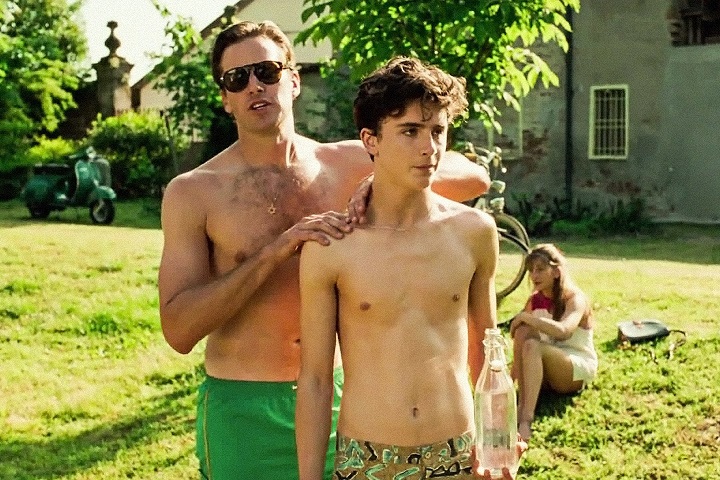
"Call Me By Your Name": Or Better Yet, Don't Call Me At All

 I didn't want to see Call Me By Your Name (2017).  Movies about teenagers struggling with same-sex desire in a world where gay culture doesn't exist are so 1990s -- Edge of 17, Beautiful Thing, Ernesto.  Plus the whole "call me by your name" thing makes me sick to my stomach, evoking the old homophobic myth that gay people are all narcissists, falling in love with themselves.

But Bob ordered it for movie night, as a break from the endless rounds of superheroes.  

It's 1983.  A wealthy (as in two servants), multinational, multilingual family is spending the summer in their huge house in Tuscany, where Dad dredges up archaeological artifacts and writes books that for some reason reference Heidegger (what does the meaning of ontology have to do with underwater archaeology?).  Mom has some sort of job translating Medieval French romances from German into English.  16 year old Elio (Timothee Chalamant) spends his time his time writing and transcribing music, usually while swimming so the paper gets all wet, and playing Bach through the lens of Chopin or something.  


Elio does not own a shirt, and the camera positively drools over his body.  Granted, some teenage physiques are attractive, but the actor kept playing Elio as so aggressively childlike that I couldn't think of him as anything but a little kid.  

There is no gay culture in this world, but Mom and Dad are ultra-laid back about gay people.  When a gay couple comes over for dinner, Elio snidely refers to them as Sonny and Cher, and Dad berates him for homophobia: one of them knows more about economics than anyone else in the world.  Who cares if he's gay?  He's important!

When 24-year old Oliver (Armie Hammer) arrives, Mom, Dad, and an unspecified friend fawn over him so exuberantly that I thought he was a famous movie star.  Turns out they're just absurdly over-enthusiastic about Dad's new research assistant, staying with them for six weeks to help catalogue some of his archaeological finds or edit the Heidegger out of his latest manuscript or dispute the Greek-Latin-Arabic etymology of the word apricot.  But Oliver doesn't do much work; he spends most of his time swimming, playing volleyball, going to village dances, and riding his bicycle endlessly through the countryside.

Elio instantly falls head-over-heels for the "arrogant" American.  It's unclear whether he has experienced same-sex attraction before, but he tries to counter by having sex with two girls (or with the same girl twice, I'm not sure).  


Oliver, busily courting a girl of his own (or it might be the same girl), pretends not to notice Elio's flirtation.  Then he says "We can't talk about this.  We just can't."  Finally he permits a kiss, but refuses to go farther: "We've been good so far.  We haven't done anything wrong.  But this has to stop here."

I was confused, and I'm still confused.  Why can't they date?  Is it the gay thing or the age thing?  Same-sex acts have been legal in Italy since 1890, and the age of consent is 14.  

Finally Oliver permits a sneaky clandestine relationship, which includes sex (while the camera shifts to a potted plant) and that "call me by your name" thing, which made me sick to my stomach to watch.

Oliver gets a little aggressive, forcing Elio to eat an apricot that he's just...um, never mind...and saying "Come here. Drop your pants," which gave me a bad feeling.  There's already a power differential, and now he's borderline abusive, after just one date?

Mom and Dad deduce that the two are dating, and are absurdly supportive.  Dad welcomes Oliver to the family.  Mom arranges for the two to go on a romantic vacation together.  But Oliver obviously wasn't planning on settling down with a 16-year old life partner; when his research assistant job ends, he says "it's been real" and high-tails it back to America.  


Six months later, he calls to tell Elio that he is getting married to a woman.  Dad tries to cheer Elio up with a long, rambling, convoluted heart-to-heart, but it doesn't work.  He sits by the fire and cries.  The end.

The movie is beautifully shot, with lots of scenes of the Italian countryside (no cities), but very, very long.  The two hours and 15 minutes drag and drag, as nothing happens, then nothing happens, then nothing happens. And I still don't understand why Oliver was so resistant: the gay thing, the age thing, or "I'm not into relationships.  With guys, anyway."   

Final thought: it's 1983  Why have I never heard of any of the songs they listen to?  

My grade: C+.

May 31, 2021

Jack Russell's Boyfriend: Werewolf by Night

Speaking of werewolves, the only Marvel/DC comic I read regularly in the 1970s was Werewolf by Night, which appeared from 1972 to 1977.

I bought the first issue because I figured it would the first time the character appeared in print, as opposed to other Marvel characters who moved in and out of each other's books at random.  Wrong -- Jack Russell had been around for a couple of years.

Why name a werewolf after a breed of dog?  

At least the first issue had an origin story. 

Jack Russell turns 18 and inherits the family curse; during the three nights of the full moon, he turns into a ravaging werewolf. Afterwards, of course, his clothes are gone, revealing an amazing physique.  In the second issue, he tries to explain his dilemma to the man he lives with -- "more than a friend" -- a middle-aged writer named Buck Cowan.


Buck also has an amazing physique and is allergic to shirts.


There is a "damsel in distress" being threatened on most covers, but surprise!  It's not some girl, it's his sister.  Jack doesn't have a girlfriend, girl admirer, or female crush, at least not in the issues I read.  

In 2013, he appeared in a guest spot on The Ultimate Spider-Man, voiced by Disney hunk Ross Lynch.

See also: Jim Steranko

Dec 22, 2020

"Cougar Town": Can A Rich White Heterosexual Get Laid at Age 40?


Gay men in their 40s and 50s are twink magnets.  By the time you reach your 60s (which I did last month), you are at the pinnacle of hotness; you have to swat them away.  It's considered perfectly normal in gay communities for a couple to differ in age by 20 or even 30 years.  Apparently straight men in their 40s and 50s have sorority girls lining up to have sex with them.  But heterosexual women over 40 are perceived of as "gross."  If they manage to get a younger guy interested, they are ridiculed: "What's wrong with you?  You're not a sexual being!  Act your age!"

That's the premise of Cougar Town (2009-2015), which Bob and I just started watching on Amazon Prime.  Jules (Courtney Coxm who had just finished playing a young adult on Friends) is in her 40s and recently divorced , though I'm not sure why:  her ex-husband Bobby (Brian Van Holt, above) is her best friend, always stopping over to offer advice on the crisis du jour.  


She lives in a palatial McMansion on a cul-de-sac on South Florida with her teenage son Travis (Dan Byrd), who is embarrassed by everything she says or does. 

She has a great job as a high-power realtor, selling McMansions to noveau-riche Florida couples.  

Her best friend (Christa Miller), who lives next door with her husband (Ian Gomez) and new baby, is constantly inviting her over for "wine and Scrabble."  

Sounds like a perfect life.  So, if this were a musical, what would Jules' "I want" song be about?  Sex.

I want to get laid today, or next week, or sometime before May.

But I'm 40 -- yuck!  And gross!  And all the men my age are broken, married, or gay.

So, why not date guys in their 20s?  Because then everybody will make fun of her.  She makes fun of the "cougars," who date guys young enough to be their sons.  


But why the double standard?  Both Bobby and her cul-de-sac neighbor BJ (Chris Zylka, left) bring home a different young girl every night.  Plus she gets encouragement from her party-girl coworker (Busy Phillips), who is in her 30s, and man-hungry boss (Carolyn Hennesy), who is in her 60s; both of them bring home guys in their 20s every night.  


So Jules gets out there and scores a hookup with the hunky Matt (David Clayton Rogers).  

Complications ensue: ex-husband and son catch her giving Matt a blow job by the pool (ex: "Hey, you told me you didn't like that!")..  

So when they begin a relationship, Jules insists that they sneak around: Matt hides until after her son leaves for the night  with his friend Ryan (Lil J McDaniel), and has to leave himself at 5:00 am, before any of the neighbors wake up and see him.

In the second episode, Jules is upset because she has no "war stories" about her wild 20s: she got pregnant and married at age 22 (no wild college days)?  So she goes out for a wild night, only to find that she's too old to stay up until 3:00 am, she gets drunk on two beers, and trying an athletic sexual position throws her back out.  

So, is it ok for people in their 40s to play Scrabble, watch tv, and go to bed by 9:00 pm, or are you supposed to be hanging out at the bars into your 60s?  I don't understand what this show is getting at.

In a subplot, Jules accidentally used a sexy picture for her realtor signs, and a junior high kid (Tyler Steelman) keeps stealing them to masturbate to (why does he need a roomful?).  Jules finds this extremely embarrassing, and tracks him down to yell at him.  What's the problem?  She has no control over who finds her attractive.

Rich People:  These people are all so affluent that their problems seem trivial, but that may be the pandemic talking.

White People:  The map in the opening seems to be zeroing in on Fort Myers, Florida, where 34% of the population is white, but here, Hispanic people do not exist. Two minor characters are black: Travis's best friend and the bouncer at the club (Gregory Hinton), to whom Jules says "Wow, you are really black!"

Gay People:  No. Several cast members have played gay characters in other series, but here, everyone seems obsessed with heterosexual sex except Travis.  But his main job is to be embarrassed by his mother, so he didn't really have time in the two episodes I watched.

Beefcake: Tons.  There are two shots of Courtney Cox in bikini underwear, but other than that, it's all shirtless and underwear-clad men all the time.

My Grade: The problems of rich white heterosexuals in 2009, which seems like ages ago. I would have put up the lack of gay and ethnic minority representation back in the day, but not anymore.   Meh.

Related Posts Plugin for WordPress, Blogger...