Showing posts with label pre-1950s. Show all posts

Jun 3, 2026

Beefcake and bonding in British boys' annuals

From the 1930s through the 1980s, British boys spent Christmas day unwrapping and reading "annuals," thick hardback books with stories and pictures derived from weekly story papers: Hotspur, Champion, Knockout, Perfect Book for Boys, Best Book for Boys, dozens of titles.

There were also annuals for girls and children, but the boys' annuals were notable for two reasons.


1. Shirtless and semi-nude covers and interior illustrations.  Hundreds of muscular teenage boys and men on display, many more than in the American adventure boys series.


They were playing sports, camping, fighting monsters. They were alone and in pairs.  Their muscles glistened in the Christmas firelight.


2. The stories inside did not involve the dating, romances, and overall girl-craziness that obsessed American teen stories in the 1950s and 1960s. They were about boys meeting, being rescued by, and establishing permanent relations with other boys and men.
More after the break

Dec 16, 2025

Gangster's Boy: Jackie Cooper Falls in Love

Born September 15th, 1922, the blond, pug-faced Jackie Cooper (left, with Freddie Bartholomew and Mickey Rooney) was the Ricky Schroder of his generation.  He got his start in Skippy, an adaptation of the comic strip about kids and dogs and the lunacy of adult society.  Jackie’s ability to shed realistic tears on cue (augmented by authoritarian directing: Taurog threatened to shoot his dog if he failed to deliver) won him a Best Actor Oscar nomination and catapulted him into the ranks of Hollywood royalty.  Sooky, The Champ, When a Fellow Needs a Friend, and Treasure Island followed, all box-office toppers.  By 1934 Jackie had his own fan magazine, half a dozen Big-Little book titles, and enough advertising tie-ins to shame Little Orphan Annie.

When Jackie hit pubescence, his box office draws declined, he re-invented himself la hard, masculine boys’ book hero.  He spent hundreds of hours at the gym, becoming an expert boxer, wrestler, and swimmer.  Movie magazines published photos of him in boxing trunks or skimpy swimsuits, displaying a hard-packed muscularity that made adult beefcake star John Garfield look downright scrawny.  Boys and men rarely appeared shirtless on camera in the 1930s, so instead Jackie wore tight dark-colored t-shirts that accentuated his v-shaped torso and mountainous biceps.


But even with a stunning boys’ book physique, he had become so thoroughly promoted as vulnerable, sensitive, and clingy that audiences simply wouldn’t accept him as tough, not even tough as a façade to hide a sensitive soul, so he was still asked to make with the waterworks in every picture.  And his pictures always featured gay subtexts, sometimes with heterosexual competition.

In Gangster’s Boy (1938),  Jackie plays Larry Kelly, a whiz-kid valedictorian, a letterman in every sport, yet also a fun-loving regular fella: he drives a jalopy covered with graffiti, plays the drums in a swing band, and litters his speech with goofy  expressions like “Who do you think you are?  Anyhow?”


He is stunningly attractive, so thoroughly desired by the guys, gals, teachers, and townsfolk that they always look like they want to rip his clothes off, but he is devoted to his long-term “particular friend,” Bill Davis (future Broadway star Tommy Wonder).  “We’ll always be together,” Larry exclaims in a tender moment, and indeed after their high school graduation they plan to enroll at West Point together.

When Larry stars dating a girl, Bill seems to resent the competition: every time Larry swoops in for a kiss, he finds some excuse to interrupt them. He claims that pictures of girls are not allowed in cadets’ lockers at West Point: “You’re not supposed to waste time thinking about girls. . .you’ve got important things to think about!”  This may or not be true, but Larry does not challenge him.

The somewhat strained romance is further interrupted when Larry’s father, Knuckles, returns from an extended “business trip” up the river and confesses that he is actually a reformed gangster, just released from prison (perhaps the name “Knuckles” should have provided a clue).

When the townsfolk discover the terrible secret, they turn into slathering bigots.  No gangster’s son has the right to sully their town: they kick Larry out of the nightclub where he’s performing, refuse to applaud after his valedictory speech, and forbid their children from seeing him.  On the night of the Big Dance, Bill and his sister both sneak out of the house to see Larry, positioning themselves both as “dates,” as competitors for his affection.  But then the sister is forgotten, and the rest of the movie maintains the gay romance.

Driving home from the Big Dance, they accidentally hit and injure a small child.  Bill was at the wheel, but Larry claims responsibility, recognizing that an arrest for reckless driving will ruin either of their chances of being admitted to West Point.  But Bill is unwilling to let Larry sacrifice his career.


They posture and argue about who will take the blame until the judge uncovers the truth and exonerates them both, intoning that they have “learned a lot about friendship.”  But really it is the adults who have learned a lot. Larry and Bill already knew that they were ready to fight and die for each other, that their bond far transcended any momentary flirtation with girls.  Instead of a heteronormative clinch, the movie ends with the boys gazing at each other with eye-shimmering affection.

Within the Hollywood community, there was considerable speculation that the teenage Jackie’s sensitivity and his many friendships with girls signified that he was gay.  Whispered “anecdotes” had Jackie and former costar Wallace Beery caught with their pants down, and once at a nightclub, brash blue comedian Milton Berle spotlighted him as a “fag”, to gales of humiliating laughter.  These jokes and rumors apparently had a profound effect on Jackie.  In his later years, in spite of his otherwise liberal politics, he has made some mildly homophobic statements,  and he has never formed a close friendship with a man, perhaps out of a fear of what masculine intimacy might signify.


Sep 24, 2025

Spirou and Fantasio: The Bellhop and his Boyfriend

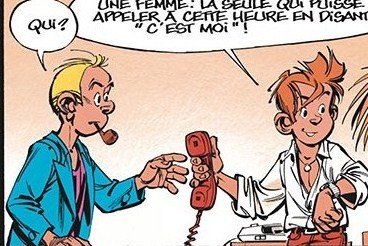
The young hunk and his blond, balding but still youthful boyfriend recline cozily on the couch, watching tv, their legs pressed together.  The young hunk places his foot atop his boyfriend's in a gesture of intimacy.


Suddenly the telephone rings.  "It's a woman," the young hunk announces.  "One who has the chutzpah to call us at this hour and say It's me."

His shirt is open, revealing a smooth, buffed chest.  His boyfriend is wearing a lavender t-shirt and a sky-blue jacket, a style that an older gay man might wear.


As his boyfriend takes the call, the young hunk cuddles their pet squirrel, adopting a nurturing, feminine pose. He's wearing extremely  tight pants.  The boyfriend glances over at him, apparently thinking "I'm lucky to have landed such a hot guy."


It's their coworker, Seccotine, asking for a ride to the airport.  "Sorry, tomorrow I'm going to a conference in Bali," the boyfriend says.  Ignoring the young hunk's frantic gestures, he continues: "...But don't worry, my partner will be glad to give you a ride."

A gay comic?  A parody?  A slash fantasy?  No, this is an actual excerpt from Spirou et Fantasio, a Belgian comic strip for children (and college students learning French).


The young hunk Spirou began his career in 1938 as a bellhop engaged in humorous antics.  In 1944, he met intrepid journalist Fantasio, and soon the two were pairing up for investigations, traveling through time and space, confronting gangsters, spies, dictators, mad scientists, and alien invaders, rescuing each other again and again.


 Like Tintin and Captain Haddock, Corentin and Kim,  and Alix and Enak, Spirou and Fantasio became domestic partners, and rather obviously lovers,  Occasionally Fantasio liked a woman (unlike Captain Haddock), but in the end he always returned to his true love.

During the 1990s, the couple was redrawn, becoming more naturalistic, with pleasantly muscular physiques -- and the gay subtext was revved up (it's hard to read them as anything but a modern-day gay couple).

Over fifty albums have been released to date.  Three have been translated into English.

Apr 30, 2025

Tintin and Captain Haddock

When I studied Spanish, I got songs about liking blonde girls ("Las rubias me gustan mas") and a story about Juan y Maria in love.  

When I studied French, I got comics: the muscular Roman Alix and his Egyptian boyfriend Enak; Asterix the Gaul;  the cowboy Lucky Luke; the race car driver Michel Vaillant; bellhop turned adventurer Spirou and his reporter boyfriend Fantasio; and of course, Tintin.


A teenage reporter, Tintin first appeared in the Belgian children's magazine Le Petit Vingtième.  23 comic albums, or bandes-dessinees, appeared between 1930 and 1976, sending Tintin to the Congo, Egypt, Tibet,  America, and eventually the Moon (a 24th, Tintin and Aleph-Art, was left unfinished at cartoonist Herge's death).  The albums have been translated into over 100 languages, and in an interesting twist, dozens of dialects. Would you like to know how the Antwerp and Oostend dialect differs from ordinary Dutch?  How about Picard and Gallois from standard French?
There was not a lot of beefcake in the comic stories or the animated films and tv series, but two live-action films starring Jean-Pierre Talbot took care of that.

Early on, Tintin made new friends in each adventure.  His most intimate relationship came in The Blue Lotus, when he rescued Chang, a Chinese boy victimized by the Japanese invasion of Manchuria.

But in The Crab with the Golden Claws, Tintin meets the blustering, irascible Captain Haddock and helps him reclaim his ancestral home, Marlinspike Manor.  Tintin moves in.  After that, there is no question: they are a couple..


During their adventures, Haddock and Tintin work as a team, rescuing each other over and over, hugging, pressing against each other.  At home, they are blatantly domestic, often shown sitting at breakfast, lounging around the parlor, going to movies, taking vacations.

Neither expresses any interest in women, but in Tintin in Tibet, when Tintin's old friend Chang writes to ask for help, Haddock blisters with jealousy and refuses to accompany him on the adventure (he relents later).  And when Haddock spends time with a new friend, Tintin mopes and pouts.

Many commentators, including Jamie Bell, who played Tintin in the 2011 movie, have noticed that Tintin and Haddock behave precisely as a gay couple.

Even Herge himself found it necessary to address the "accusations": he said that Tintin and Haddock could not actively pursue women because mostly boys read the comics, and they were interested in adventure, not romance.  But if that is the case, why did Herge put them into a relationship that looked and felt precisely like a romance?

Anyway, he was wrong: gay boys wanted both adventure and romance.  And they found both in Tintin.


Jan 21, 2024

Lil' Abner: Backwoods Adonis with No Interest in Women

During the 1930s and 1940s, gay kids could pick up any daily and Sunday comic strip to see a muscular, usually shirtless teenager who was not interested in girls, plus a committed same-sex couple.

Al Capp's L'il Abner, started in 1934, chronicled the adventures of 19-year old muscleman Abner Yokum, his elderly parents, and the colorful residents of Dogpatch, U.S.A.  It was part of the contemporary hillbilly fad.

Books, movies, and radio programs were presenting the hills (Ozarks or Appalachians) as an untouched wilderness, an Eden inhabited by rustic Adonises whose muscles and rude manners provided a remedy for the ultra-sophistication of Cary Grant and Clark Gable.

The backwoods Adonis became a common image, extending through Jethro of The Beverly Hillbillies to The Dukes of Hazzard.

The prelapsarian state had one drawback, at least for heterosexual readers: no place for heterosexual romance.  So uninterested were the men of Dogpatch that Al Capp instituted a Sadie Hawkins Day, an annual festival in which man-hungry spinsters chased "skeered" bachelors, and whoever got "ketched" had to marry.

But there was plenty of room for same-sex romance, notably the man-mountain Hairless Joe and his diminuitive Indian companion, Lonesome Polecat, who live together, embark on various money-making schemes together, and even count themselves as a "married couple" on their census form.  

When they think they are going to die, they hold each other: "I want to die in your arms."They are actually frozen, so two weeks of strips featured two men locked in an embrace, and maybe kissing.


In 1952, changing sociocultural mores -- such as the increasing awareness that a man who is not interested in women may be interested in men -- prompted Al Capp to marry off Abner.  Soon he became a father.

Increasingly conservative and unfunny as time progressed, the strip pushed forward in a dwindling number of newspapers until 1977.


There were two movie versions of the strip.  Everyone remembers the 1959 version, with Peter Palmer as Lil' Abner, and a plot about a "yokumberry tonic" that turns ordinary men into bodybuilders but has the side effect of making them uninterested in women.

See also: Li'l Abner, the Musical; and I Go Pogo: The Gay Possum of Okefenokee Swamp


Aug 20, 2023

Boxers and Boyfriends: Joe Palooka

The most famous fictional boxer of the 20th century was probably Joe Palooka in the long-running comic strip (1930-1984).   Tall and immensely strong but gentle, Joe Palooka was the creation of Ham Fisher, who observed lots of young Polish immigrant boys hanging around boxing arenas, hoping that their muscles would bring them fame and fortune.


In his heyday, Joe was appearing on the radio, in movies (starring Joe Kirkwood, left), in big-little books, and in comic books.

You could buy Joe Palooka toys, gum, lunch boxes, board games, and a cut-out mask on Wheaties cereal.  


 In 1948, the town of Bedford, Indiana  (near Bloomington) erected a statue in his honor.  It was moved to nearby Oolitic in 1984.

Joe was originally "a woman-hater" and "allergic to girls," although cheese heiress Ann Howe kept trying to snare him, like Daisy Mae in Li'l Abner.  In the 1930s, lack of heterosexual interest did not signify gay identity; although gay readers found ample subtexts. Joe was a "man's man," enjoyed buddy-bonds with his sparring partner, massively-muscular Humphrey Pennyworth.

The two adopted a mute orphan named Little Max, who became popular enough to get his own series of toys and comic book title.


As boxing declined in popularity,  Joe moved beyond the ring to fight gangsters, Nazis, spies, and mad scientists.  During the 1950s he became an all-purpose trouble-shooter, traveling the world to right whatever wrongs needed a muscular remedy.  He got a tv series in 1954.  Harve published a Joe Palooka comic book through 1955.

Since changing attitudes required even heroes to express hetero-horniness, Joe eventually married Ann How.  And Humphrey became short and round, a comic relief character.


The comic strip lingered in a dwindling number of small-town newspapers until 1984.  By that time,  everyone had forgotten about Joe Palooka. (Except for Ham Fisher's home town of Wilkes-Barre, Pennsylvania, which renamed a nearby mountain after him).

And the 1980s college boys scouring the discount bins at the Comics Cave for beefcake covers.

And the elderly gay men who remembered glimpsing homoromantic potential in their childhood, when they opened the comics page to read about L'il Abner, Flash Gordon, Prince Valiant, and Joe Palooka.


Aug 13, 2023

Prince Valiant

During the 1960s, the Rock Island Argus printed mostly depressing 50-year old comic strips with jokes about husbands hating their wives or friends betraying each other, with little bonding (Out Our Way was an exception) and very little beefcake. Alley Oop and Prince Valiant were exceptions -- 50 years old, but muscle-heavy.

Prince Valiant was a color strip that appeared only on weekends.  Like Gasoline Alley, it featured characters aging in real life, but it was unique in having no speech balloons; text appeared at the bottom of each panel, making the strip seem more like an illustrated novel than a comic.


When it first appeared in 1938, Val was a young prince from Thule (modern day Norway) who traveled to Britain to become one of King Arthur's knights. Later he returned to Thule to help his father regain his throne, then traveled across Europe and Asia, fighting Goths and Huns, visiting the Holy Land (long before the Crusades).  By the 1960s, the middle-aged Val had settled in North America.

Generally Medieval fantasies (and real epics like The Song of Roland) offer little beefcake; knights wear shining armor, and their northern climate doesn't permit much skinny-dipping.


Sigfried in The Nibelungenlied gets naked, and Sir George in The Magic Sword (1962),  and Lancelot (Nicholas Clay) in Excalibur (1981) take their shirts off, and that's about it.  But in Prince Valiant,  Val was shirtless more often than not.  His muscular physique was drawn in full color and in loving detail.


Unfortunately, through the 1960s, Val retained a 1930s page boy haircut, red lips, rosy cheeks, and long lashes, giving him a rather feminine appearance that didn't lend itself to romantic fantasies.  The name "Val" didn't help much.

And there was little buddy-bonding.  During the 1930s, Val sparred with rival prince Arn of Ord, but they became little more than grudging friends.  In fact, the main plotlines involved the fade out kiss.  First Val and Arn competed for the hand of the fair maid Ilene.  Then she died in a shipwreck, Arn was dropped from the strip, and Val turned his attentions to the fair maid Aleta.

They married, and in 1947 their son Arn was born (the first European baby born in North America).   Eventually they had three more children. When I started reading the strip in the 1960s, Arn was a mischievous teenager, but soon he, too, married.

 Hal Foster, the original cartoonist, also drew Tarzan for many years.   He died in 1982, but the strip is still going strong.


Jul 28, 2023

Alley Oop: The Time-Traveling Cave Man

When I was a kid in the 1960s and 1970s, the comics page of the Rock Island Argus was dismal -- no Peanuts, no Dennis the Menace, no Wizard of Id.  The Dispatch from the town next door got them, so all we had were bargain-basement knockoffs (like Winthrop) and relics from the Depression era that made no sense (like Out Our Way). The Golden Age of Newspaper Comics  (Little Nemo, Krazy Kat,  Buck Rogers) was thirty years past, and the Second Golden Age (Foxtrot, Pearls before Swine, Get Fuzzy) still thirty years in the future.

But at least there was some beefcake in Prince Valiant. And  I was intrigued by a cave man, square-headed, superbly muscled, with massive biceps and flat 8-pack abs, being held captive in a Middle Eastern palace.


What was a cave man doing in the Islamic Middle Ages?  Or in ancient Egypt, or among the Aztecs, or in the Wild West?


Eventually I discovered that the cave man was named Alley Oop, created in 1932 by V. T. Hamlin for a wacky-adventure strip set in a dinosaur-human prehistory (as in The Flintstones). But in 1939 he was zapped into the future by the grizzled Doctor Wonmug (a play on Einstein) and the young, black-haired G. Oscar Boom.  Unfazed by culture shock, Oop became a time-traveling research assistant for the duo, checking out whatever historical period the cartoonist found interesting.


Back in the prehistoric kingdom of Moo, Oop had a girlfriend, Oola; but during his time traveling adventures, he bonded mostly with men.  Often they were also semi-nude, with loving attention paid to their pecs and abs.


Oscar accompanied Oop on many of his adventures, sometimes an antagonist, sometimes a buddy.


At its heyday, the strip was a phenomenon, producing games, toys, Big-Little Books, comic books, and even a song, "Alley Oop," which charted at #15 in 1960. It still appears in 600 newspapers.  Modern continuities tend to bring Oola along as Oop's co-adventurer, but that doesn't eliminate the buddy-bonding.

Jun 23, 2023

Sabu: The Original Jungle Boy and His Boyfriend

An orphan, the son of a mahout, Sabu Dastigir was riding a real elephant around Mysore when he was signed to star in Elephant Boy (1937), an adaptation of the Kipling tale "Toomai of the Jungle."  Wearing only a dhoti and turban, his last name deleted to make him seem more savage, he became a media sensation.  He was transplanted to England as a ward of the state and enrolled in school, but he found little time to study when he was receiving almost as much publicity as Johnny Weissmuller.


After a starring role in the pro-colonial Drum (1938), he was cast in The Thief of Bagdad (1940), set in the mythical past, an "Arabian fantasy in technicolor."  In the 1924 silent version, Douglas Fairbanks plays a thief who wins a princess, but Sabu would not win any princesses.  Instead, the spunky, enterprising  thief Abu falls in love with Prince Ahmad (John Justin), who has been deposed by an evil uncle.  The two escape together, steal a boat, and plan to sail downstream from Bagdad to the ocean, where they might find a safe haven in the wilderness.  But then Prince Ahmad falls in love with a princess from another kingdom, and insists that they stay in Bagdad. The rest of the movie involves the prince ignoring, endangering, or simply abandoning Abu to make time with the princess.  In the throws of unrequited love, Abu often looks hurt but never complains.

After starring in a loose adaptation of Kipling's Jungle Book (1942), in which Mowgli befriends both a native girl and a British officer but falls in love with neither, Sabu moved to Hollywood and signed on with Universal, where he starred as a dhoti-clad Jungle Boy in three Technicolor romances, all set in distant lands where no one had ever heard of Hitler.   Sabu was in a rather precarious position.  Although he (or rather, his body) was the top-billed star, he was irrelevant to the plots, about swarthy adventurer Jon Hall wooing cool, mysterious Maria Montez.

Sabu became a darling of World War II beefcake photos.  His torso, v-shaped, barrel-chested, bronze-skinned, sculpted but softening slightly at the stomach, is often displayed in a bright light against a black backdrop, so that every muscle will stand out.  The only problem is, he has no one to desire; in movie after movie, his same-sex loves go unrequited.

 He courts Jon Hall's character aggressively -- hugging, grabbing, taking his arm, pressing against his chest, unbuttoning his shirt, mussing his hair, offering him flowers, chasing away other suitors with a barking "Get back, he's mine!"  Hall's characters respond with amusement and affection, but no longing.


Sabu is captured once, and once he and Hall are captured together, but otherwise Hall is tied, struggling, about to be drowned or fed to cobras, and the jungle boy comes swinging down on a rope or galloping up on a white horse to save him.

And Sabu's characters never expresses any heterosexual interest. In Arabian Nights, Ali (Sabu) enters a harem to deliver a message, and the sex-starved girls engulf him, groping and fondling. He screams "Please stop!  Stop it!" with shrieks of terror.  They back off, bewildered, as if no man or boy had ever resisted their advances before.


At the end of each movie, Sabu practically shoves Hall's characters into the arms of Maria Montez. Then, after the final clench, they offer to adopt him.  It seems absurd to emphasize Sabu's muscular physique, have him approach Jon Hall with blatant homoerotic desire, and then claim that he is just a little boy, not yet able to understand "adult" desires.

After the war, when Sabu was too old to play teenagers, he played heavily muscled, usually half-naked Jungle Men who get girlfriends.  He appeared briefly in his own comic book title.  Later in the 1950s, he invested in a real estate business and took whatever roles he could find that did not require wearing a loincloth.

Days after filming A Tiger Walks in 1964, Sabu died of a heart attack. He was in perfect health and only 39 years old. He left a legacy of superbly homromantic movies, and influenced two generations of dhoti-clad Jungle Boys,  from Gunga in Andy's Gang, Hadji on Jonny Quest, Haji of the Elephants, and Raji on Maya, to the various Mowglis of the 1990s.


Nov 26, 2022

Huckleberry Finn: Huck and Jim on the Raft

I don't remember a time when I didn't know Huckleberry Finn.  He was everywhere in my childhood: in a tv series starring Michael Shea, in movies starring Eddie Hodges, Mickey Rooney, Jeff EastElijah Wood, Anthony Michael Hall, and Brad Renfro, in the musical Big River (left).


One Saturday afternoon in the mid-1970s, I saw a weird prepubscent version that reminded me of  Journey to the Beginning of Time . Later I discovered that it was a Russian adaption called Hopelessly Lost (1972).


By the time I was 10 or 11, I began accumulating editions of the novel at garage sales and library book sales, mostly those with cover art emphasizing physicality, broad shoulders and muscular arms gleaming in the late afternoon sunlight. 

I already imagined Huck and Jim escaping from their bondage like Will fleeing the Tripods, and now -- in an eternal now -- rafting slowly, lazily down the Mississippi, free from the pressures of school and "after school sports" and "someday you'll find a girl." The raft became their good place, where Huck and Jim could gaze into each other's eyes, hug, kiss, alone with each other forever. 

But the novel wasn't really about that.  Huck doesn't have any romantic interest in Jim -- he thinks of the escaped slave as a child who needs protection.

He does spend a lot of time evaluating masculine beauty: "Tall, beautiful men with very broad shoulders and brown faces";"men just in their drawers and undershirts, and resting their hands on their thighs easy and comfortable...I never seen anything so lovely."

And he tries to find a lasting romance,  twice.

First he meets and buddy-bonds with Buck, a boy involved in a Hatfield-McCoy feud. They sleep together and smile at each other, and Huck is adopted into his family.  But then he is killed in a feud, and Huck cries and moves on.

Then Tom Sawyer, his old friend from Hannibal. Huck invites Tom to  "come here and feel me."  He does, and "he was that glad to see me again he didn't know what to do."


But when Huck discovers that Tom's Aunt Sally intends to adopt him, he rebels, and decides to "light out for the Territory." It is unclear why  he accepts adoption by Buck's family but not by Tom's. Maybe because he finds Tom immature and annoying.  Or maybe because Aunt Sally wants to "sivilize" him, like Daisy Duck civilizes Donald and Poil civilizes Spooky,  teaching him poetry and etiquette and how to open a checking account.  Love, even homoromantic love, domesticates a man, ends his story with "and they lived happily ever after," and Huck's story must continue.  Or not a story, an image, an eternal now to hang onto when we are overwhelmed by the problems and constraints of life.

We must not remember anything that came before or after, just Huck and Jim, muscular bodies glistening in the sunlight,  as they raft lazily down the river.

Nov 25, 2022

Jules Verne: The Disney Version

During the 1960s, every boy I knew loved Jules Verne -- journeys to distant corners of the world or to its center, lost civilizations, monsters, volcanoes, maelstroms, and nick-of-time escapes, all in an environment so masculine you could practically taste the homoerotic tension.

I read 20,000 Leagues Under the Sea, From the Earth to the Moon, Mysterious Island, and A Journey to the Center of the Earth in elementary school, in abridged Scholastic Book Club editions.  In high school, I read the originals, and collected some of the Ace paperbacks of Verne's lesser-known works: Michael StrogoffThe Begum's Fortune, The Carpathian Castle, Master of the World, The Village in the Tree-Tops.  

During the 1950s and early 1960s, "Disney" versions of these Verne classics appeared, with two important changes:
1. To draw the all-important Boomer audience, a teenager.
2. To ensure a Hollywood fade-out-kiss, heterosexual obsessions were added.

In 20,000 Leagues Under the Sea, the French scientist Pierre Aronnax, his assistant Conseil, and his Canadian friend Ned Land are captured by Captain Nemo, who holds them prisoner in his electronic submarine.  Nemo became an outcast after his wife died, but no other women are mentioned or longed for.

In the 1954 movie (the only one actually from Disney), Ned (Kirk Douglas, not a teenager) sings about "the girls I've loved on nights like this," whose kisses make him "bubble up like molten lava."


In A Journey to the Center of the Earth, Professor Lindenbrock, his nephew Axel, and their Icelandic guide Hans journey alone, although Axel does have a girlfriend waiting back home.  In the 1959 Disney version (actually from 20th Century Fox), the Professor meets a lady, and the girlfriend gets a more substantial role.  But at least there are substantial shirtless shots of teen idol Pat Boone as Alec (Axel).  And in the last scene he's completely nude except for a sheep.


In The Mysterious Island , five Civil War POWs escape in a hot-air balloon and end up on the mysterious island, where they fight giant bees and pirates, encounter Captain Nemo (Omar Sharif), and flee a volcano eruption. In the 1961 Disney version (actually from Columbia), there are women on the island for the men to fall in love with.

But at least they are shirtless or semi-nude most of the time, especially Herbert Brown (Michael Callan).  The scene where he and the girl hide from a giant bee in a honeycomb is still scary today.


In Five Weeks in a Balloon, three men explore Africa in a hot air balloon. Again, no women are mentioned or longed for.

The 1962 Disney version (actually from 20th Century Fox) changes the cast, adding pilot Jacques (teen idol Fabian Forte) and newspaper report O'Shay (Red Buttons).  Each falls in love with a woman en route; the movie ends with two couples enthusiastically kissing. And there's no beefcake (although Fabian, right, often appeared shirtless and nude in other productions).

This was also the era of the Disney Adventure Boys -- like Tommy Kirk, James MacArthur, and Kurt Russell -- hired to display Cold War masculinity, which meant two things: muscular physiques and heterosexual obsession.
Related Posts Plugin for WordPress, Blogger...