Sep 24, 2016

Pat Boone, Gay Icon

It's hard to imagine, but conservative spokesperson Pat Boone was once an icon for gay kids.  In a 1959 version of the Jules Verne classic Journey to the Center of the Earth, one of a series of adaptions of Jules Verne classics which Disney made during the period, Alec (Boone) journeys into the subterranean world with his geologist uncle, Professor Lindenbrook (James Mason), their guide Hans (Peter Ronson), and a love interest for the professor (Arlene Dahl).

While minimizing plausibility (they encounter giant lizards and the ruins of Atlantis), director Henry Levin maximized beefcake. As the explorers descend, Alec doffs his clothes, and the camera forsakes closeups of his prettyboy face to concentrate on his small, firm biceps and lean, tight chest.

Soon Hans doffs his clothes, too; he is blond and beefy, considerably more defined, a veritable Tarzan.


The men spend the rest of the movie falling into pits, fleeing from lizards, almost suffocating in salt pits, and almost drowning in oceans, and consequently rescuing, grabbing, holding, and comforting each other; Alec is especially likely to require rescue, followed by cradling in Hans' strong arms. When they reach a field of giant mushrooms that will replenish their dwindling food supply, they are so delighted that they break out into a dance while the Professor's love interest stands aside, a spectator only.

Hans is not interested in girls, but Alex has a girlfriend back home, whom he marries in the last frames of the movie.  But after two hours of half-naked men grabbing, holding, and comforting each other, we could put up with a fade-out boy-girl kiss.

In real life, Pat Boone is a conservative Christian who frequently makes homophobic statements, although my friend Randall said that he was "straight but open to suggestions back in the 1950s.

See: Dick Sargent's Hookup with Pat Boone


Sep 21, 2016

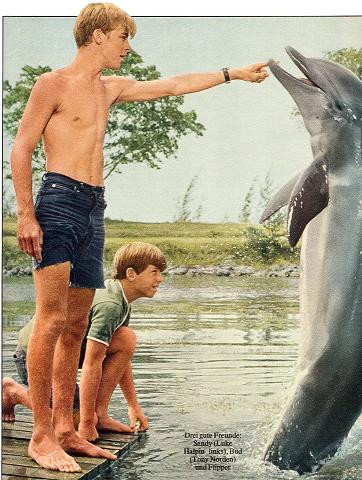
Flipper: Bodybuilder teen, twink brother, gay dad, and a dolphin


Flipper (1964-67),  was like Lassie or Skippy the Bush Kangaroo, except set n the Florida Everglades, with a dolphin instead of a collie or a kangaroo, and no women in sight. It seemed designed explicitly for the viewing pleasure of gay kids (your other choices on Saturday night were Jackie Gleason, for the grownups, and Shindig, for the teens).

It was about Ranger Porter Ricks (Brian Kelly), who lived in the Everglades National Park with his two sons, used boats more than cars, and didn't seem to own a shirt.


Nor dd his lithe, androgynous son Sandy Ricks (seventeen-year old Luke Halpin), who seemed to go to school once in a while, but otherwise was swimming, diving, boating, and getting into trouble.  He wore cut-off jeans that were way too tight for adequate modesty, and shrank even more whenever he got wet (which was all the time).


And can someone explain Bud Ricks (twelve-year old Tommy Norden)?  He's a kid with the pecs and abs of an adult bodybuilder.  Did they graft a 12-year old's head onto a grown-up's body, or what? (The same muscle spurt, incidentally, happened in comics to Richie Rich.)

Not that any gay kids were complaining.  Saturday night, summer or winter, was beefcake time.

 There was not a lot of buddy-bonding; Sandy and/or Bud needed rescuing a lot, but it was always Flipper who chirped to the rescue.  But -- and this was a big "but" for 1960s tv - none of the boys exhibited much heterosexual interest.  Porter and Bud, never.


Sandy had already grinned and flirted with a girl in the movie Flipper’s New Adventure (1964), yet he expressed an interest in girls during the tv series only twice. In “Love and Sandy” (1965), he has an unrequited crush on  a college girl (Cheryl Miller), and in “Cupid Flipper” (1966) he mistakenly believes that his girlfriend (Susan Abbot) is in love with his father. It was like a weekly vacation from the tedium of incessant "what girl do you like"?

There were lots of book tie-ins and toys available for the off-hours.

After a few 1970s tv appearances, such as The Mighty Isis, Tommy Norden retired from acting, and Brian Kelly was forced to retire in 1970 after a motorcycle accident paralyzed his right arm and leg -- he continued to produce movies like The Blade Runner (1982).  But Luke Halpin had a long career on television and in movies like Island of the Lost (1967) and  If It's Tuesday, This Must be Belgium (1969).  

See also: Flipper Toys

Sep 17, 2016

Toddler TV

Adults think that gayness is something that "happens" to you late in life, after a childhood of girls mooning over teen idols and boys grinning at the girl next door. But we know that they are wrong.  In every kindergarten classroom, in every preschool classroom, there are some boys who gaze at girls, and some boys who gaze at boys.

But what are they looking at?  Is their desire erotic, romantic, or something else entirely, something that we have forgotten as adults?  When gay boys watched Blue's Clues (1996-2006), did they think of Steve Burns as a cool big brother, or as a hot fantasy boyfriend with killer biceps?


Or Donovan Patton, who took over for Steve in later seasons?


When they watched Barney and Friends (1992-2010), did they want to hug and kiss Michael (Brian Eppes), or did physical intimacy never enter their minds?


When I was three or four years old, there wasn't a lot of toddler tv. On Saturday morning I probably watched what the older kids watched: The Alvin Show, Tennessee Tuxedo, Underdog, Beany and Cecil.  On weekday mornings I probably watched Romper Room, with a female host, and Captain Kangaroo, with an elderly male host.  And in the early evening, there was probably Yogi Bear and The Flintstones.

I was drawn to the homodomesticity (same-sex partners living together) and to the same-sex rescues. But did I think anyone was hot?

See also: Burr Tillstrom, the gay puppeteer behind Kukla, Fran, and Ollie.

Sep 6, 2016

Hugh O'Brian and the Gay 1950s

Hugh O'Brian, who died yesterday, was one of the few beefcake actors of the 1950s not discovered by gaydar-proficient talent agent Henry Willson -- although he was rumored to be gay.  He just wanted to be discovered for his talent, not for his biceps and bulge. A high school athlete and former Marine, he began acting in 1948, and appeared in a steady stream of B-actioners, mostly cowboy and war flicks, through the 1950s.

In 1955 Huge got his big break, playing legendary Wild West marshall and sharpshooter Wyatt Earp, who participated in the famous Gunfight at the OK Corral (1881), along with his brothers and his close friend Doc Holliday.

 A 1931 biography, Wyatt Earp: Frontier Marshall, omitted the gambling, prostitution, and shady business deals,  transforming him into a heroic character who brought "law and order" to the Old West. Movie versions of his life appeared in 1934, 1939, 1946, and 1957.

The tv series, The Life and Legend of Wyatt Earp (1955-61) whitewashed the character even farther, but didn't skip on the gay subtexts.  Earp isn't married, and falls in love no more than once per season.

He lives in a masculine-coded world of brawlers and gunfighters, renegade Indians and gun-shy dudes.  He has many friends, Doc Holliday, Deputy Hal Norton, Bat Masterson, Marsh Murdock, and his brothers, but never settles down to any long-term relationship.


After Wyatt Earp, the typecast Hugh performed as any number of heterosexual cowboys, detectives, and do-gooders. but he managed to draw in a gay subtext occasion.

In Love Has Many Faces (1965), he plays a male prostitute (coded as a "beach boy") out for revenge against his former pimp who has gone "straight" (Cliff Robertson).


In Africa: Texas Style (1967), cowboy Jim Sinclair (Hugh) and his Indian sidekick John Henry (Tom Nardini) go to Africa, where they buddy-bond and encounter scalawags.  They don't get girlfriends, but they do adopt a young native boy, Sampson (John Malinda). (It was adapted into a tv series starring Chuck Connors.)

Huge reprised the Wyatt Earp character several times, most recently in Wyatt Earp: Return to Tombstone (1994).

He married for the first time in 2006, at the age of 81, but according to close friend Debbie Reynolds, he was straight.  He just wasn't ready to settle down yet.

If he was straight, why were all of his friends gay?  Well, she says, there simply weren't a lot of straight beefcake actors in 1950s Hollywood, so you had to be gay-friendly if you wanted friends.
Related Posts Plugin for WordPress, Blogger...