Showing posts with label hustler. Show all posts

Aug 24, 2025

Peter McEnery: The First Gay Teenager

In Victim (1961), 21-year old Peter McEnery played the first explicitly identified gay teenager in film, a working class boy named Boy who commits suicide in prison.  His affluent, middle-aged lover, Melville Farr (gay actor Dirk Bogarde), tries to uncover the blackmail ring responsible for his death.  Portraying gay men as victims rather than monsters was revolutionary, and paved the way for the decriminalization of same-sex acts in Britain in 1967.

Peter moved directly from an amazingly courageous role to Disney, becoming an Adventure Boy with the two usual attributes: a muscular physique and heterosexual obsession.


In 1964, he starred in The Moon-Spinners as Mark Camford, a young banker who gets involved with spies in Crete, and in the process falls for vacationing British girl Nikki (regular Disney star Hayley Mills).  No buddy-bonding, but quite a lot of shirtless scenes, and more suspense than one usually gets from Disney.

In 1966, he played the titular role in The Fighting Prince of Donegal: Red Hugh, the 16th century Irish prince who started a rebellion against the oppressive English.  Hugh falls for a girl (Susan Hampshire), but also buddy-bonds with an older man.

Maybe the parallels with Victim were too great, or maybe Disney was being extra-cautious after the accidental outing of Tommy Kirk.  For whatever reason, Peter never worked for Disney again.  Instead, he continued his career of gay-vague and not-so-gay vague characters.

In I Killed Rasputin (1967), Peter played Prince Felix Yusopov, who was bisexual in real life, the lover of Grand Prince Dmitri Pavlovich (and enjoyed dressing in drag).  The movie tries to closet him, and all but eliminates Dmitri, but still Peter manages to imbue his character with a homoerotic passion (and he dances with a man).


Other sexually adventurous movies followed, but the most famous is Entertaining Mr. Sloane (1970), based on the play by gay writer Joe Orton.  Mr. Sloane (Peter) is a male prostitute who moves in with a closeted gay man (Harry Andrews) and ends up the unwilling boy-toy of both him and his sister.


I haven't seen any of Peter's later works, mostly British television and tv movies, but some of them look interesting, and with ample buddy-bonding potential: The Cat and the Canary (which has a "gay" keyword on the Internet Movie Database); a version of Shakespeare's Midsummer Night's Dream; and Clayhanger, from a series of novels by reputedly gay author Arnold Bennett.

I have not been able to discover his real-life sexual identity, only that he was married to Julie Peasgood for a time, and has a daughter.  But with all of his gay-vague and gay roles, who cares?

See also: Fighting Prince of Donegal.


Oct 18, 2024

Jonathan Taylor Thomas


Born in September 1981, Jonathan Taylor Thomas (JTT) became a star at age 11 through Home Improvement (1991-1998), playing Randy, the middle son of macho tool-show host Tim Allen. He was passive and somewhat feminine, gay-coded yet indefatigably girl-crazy from the start, and careful to rebel against any hint that he might be gay.

In “Groin Pull” (October 1992), Randy is cast as Peter Pan in the school play.  First he is horrified because he must “prance” rather than fly: as his father states, “Men don’t prance.  We walk, we run, we skip if no one’s looking. . .but we never prance!”  Then he discovers that Peter Pan is generally played by a woman, and almost drops out of the play, before Dad confinces him that he can re-create the role as heterosexual, “a man’s man. . .a man with hair on his chest.”  And it works: Randy comes home after the performance and exclaims triumphantly, “I saw Jennifer looking at me!"


The pubescent Jonathan Taylor Thomas soon began to dominate the teen magazines.  There are literally thousands of pin-ups and centerfolds, far overwhelming those featuring the more muscular Zachery Ty Bryan, who played his older brother, or Taran Noah Smith, who played his younger brother, or their various hunky friends (such as Josh Blake of Alf).

. His character became a teen dream operator, intensely attractive to girls -- never to boys -- and intensely heterosexually active and aware.

But Randy was not content to be just another of the girl-crazy hunks who populated 1990s tv.  He often supported liberal causes, in opposition to his conservative father, and his episodes often drew the series into serious themes, such as Randy questioning his religion or facing a possible cancer diagnosis. When JTT left the series in 1998, it was explained that Randy had been accepted into a year-long environmental study program in Costa Rica.


In his other projects, JTT more than made up for the "every girl's fantasy" plotlines of his conservative tv series.  He enjoyed a buddy-bonding romance with Brad Renfro in Tom and Huck (1995), and with Devon Sawa in Wild America (1997).  He played a bisexual hustler in Speedway Junky (1999), opposite Jesse Bradford, and a gay teenager in Common Ground (2000).


2 gay/bi roles in two years!  The gay rumors came fast and furious, but JTT, like his character on Home Improvement, always denied them: he said he didn't mind, but they made his elderly grandmother upset.

He moved into voice work, guest starred on Smallville, and went to college, graduating from Columbia University in 2010 with a degree in history. He has retired from acting, except for a four-episode plot arc on TV dad Tim Allen's Last Man Standing

 In 2011, tv personality Lo Bosworth re-ignited the rumors by stating that he was gay on the Chelsea Lately program.  He is not "yet" married.


Mar 13, 2024

"American Gigolo," 1980 and 2022: Frontal nudity and homophobia or underwear shots and gay erasure. Which do you prefer?

Link to NSFW version 

In 1980, American Gigolo became famous for Richard Gere's biceps, chest, abs, and penis -- the first  full frontal shot in any mainstream movie!   


Every gay magazine had an article on The Nude Scene, with a screen shot.  This was before you could buy a DVD or stream the movie, so every gay guy in the country, probably in the world, marched down to the Cineplexto see it.  Gere plays Julian, a hustler who specializes in women, and in fact rejects any assignment involving "fag tricks."  The plot involves Julian falling in love with one of his clients (of course), and being framed for murder.  (He was with a client that night, but she refuses to come forward.)

Gay men of the era didn't mind that the hustlers have 100% female clients, while in real life 97% of their clients are closeted gay/bi men.  They were used to being erased.

They didn't consider homophobic slurs a problem. You weren't allowed to mention gay people, even in slurs, before the 1960s, so in the 1970s and 1980s, most movie characters threw in a few "fags" and "fruits" to demonstrate that they were cool.

Nor did they get upset when the villain turned out to be gay: Julian's pimp (Bill Duke), whom he pushes out a window to his death. Straight people hated us; it was a given, a simple fact of life.  You couldn't escape it,  unless you managed to live and work in a gay neighborhood and avoid mainstream media altogether.  The rest of us would hear homophobic jibes, slurs, scandals and jokes from family and friends, from coworkers, from random strangers on the bus, so what difference did a movie make?  You got to see a dick on screen!


Writer/director Paul Schrader has been involved with a number of other homophobic projects, such as Mishima: A Life in Four Chapters, about the gay writer who developed a fixation with bodybuilders.  Again, being gay is all about darkness, destruction, death. Being gay is evil.

But not Richard Gere.  A year before American Gigolo,he  starred in the gay-themed (and not homophobic) Bent on Broadway, about gay men who are sent to a concentration camp in Nazi Germany.  In 1993 he appeared in And the Band Played On, about the first years of the AIDS crisis.

How did he manage all three?  Does he hate gay people, or not?  

In an interview in Entertainment Weekly.  Gere reveals that he took the part because Julian was so different from himself, into fashion and languages (which Gere was not), and with "a gay thing flirting through it," and he knew nothing about "that community."  Good enough explanation, I guess.


In 2022, an American Gigolo tv series appeared.  15 years after the events in the movie, the middle-aged Julian (Jon Bernthal) tries to find out who framed him (I thought Leon confessed?) and to reconnect with The Girl of His Dreams.  

Paul Schrader was not involved, so no homophobic slurs and no gay villain. But gay men are still erased; 100% of the hustlers' clients are women.  There's a lesbian cop, which is not nearly adequate representation.

And no frontal nudity, just a butt shot.
Is that progress?

Berenthal's butt and Richard Gere's dick are on RG Beefcake and Boyfriends

Jan 31, 2023

Laverne and Shirley

Laverne De Fazio (Penny Marshall) and Shirley Feeney (Cindy Williams) first appeared on an episode of Happy Days, when Fonzie hooks himself and Richie up with two "loose women" who are sure to "put out."

In 1976 (after Cindy Williams took time off to star in The First Nudie Musical)they spun-off into their own series, Laverne and Shirley (1976-83).  Theirr characters became more stable, friends and roommates who worked as bottle-cappers at Schotz Brewery in Milwaukee while waiting to "make all their dreams come true."  Those dreams involved snaring rich husbands.

It wasn't one of my top 10 programs, but everyone else in the family watched, so I saw it relatively often.  And, in spite of the heterosexist premise and standard 1970s obsession with sex, there was quite a lot of gay content.

1. In 1950s lesbian culture, you had to decide whether you were a butch or a femme, and date only the other type.  It was scandalous for two butches or two femmes to hook up.  Laverne was strong, aggressive, a good fighter and a hard drinker, into sports and home repairs, while Shirley was soft-spoken, polite, retiring, sexually repressed, and into frilly lacy things. I didn't know anything about 1950s lesbian culture in those days, but it wasn't hard to figure Laverne and Shirley out.


2. Shirley had a sort-of boyfriend, sort-of big brother in Carmine (Eddie Mekka), an aspiring actor-dancer-singer-boxer.  Carmine's main source of income was an older woman named Lucille, who gave him gifts and money in exchange for unspecified favors. Outside of work and friendship, Carmine didn't seem particularly interested in women. I didn't know much about hustlers in those days, but it wasn't hard to figure Carmine out.

Actor Eddie Mekka has been the subject of several celebrity hookup stories.


3. Carmine was amazingly hot, though rarely shirtless on the show (the photo is from Circus of the Stars).  And lots of other hunky guys paraded through Laverne and Shirley's apartment, as boyfriends or relatives,  including Christopher Guest, Ted Danson, Ed Begley Jr.,  and Ed Marinaro.


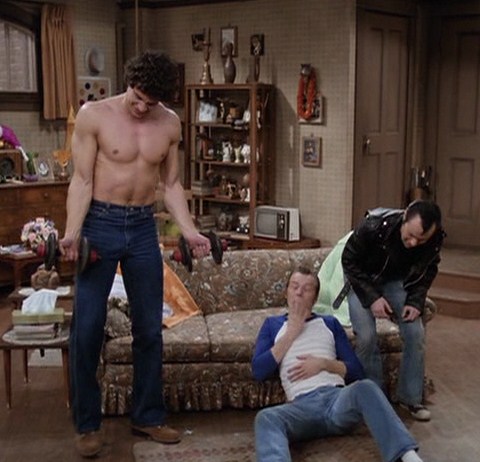
4. The annoying upstairs neighbors, Lenny (Michael McKean, middle) and Squiggy (David L. Lander, left), made the usual hand-biting gestures and kissing noises whenever they saw an attractive women (or in this case, an attractive man), but they rarely attempted to actually date anyone. They were  devoted to each other, permanent, exclusive, passionate partners.


In a 1996 episode of The Nanny, David L. Lander, swishing it up as Fran's gay-stereotype landlord, states that he has been with his partner "Leonard" for twenty years (that is, since Laverne and Shirley premiered).


Mar 10, 2021

"Neon Flesh": Hustler with a Heart of Gold Opens a Brothel for His Mother

The plot synopsis for Neon Flesh (Carne de Neón), on Amazon Prime,  says something about a guy opening a brothel to honor the memory of his prostitute mother, so one would expect a nonstop boob fest.  But the trailer shows a muscular, half naked guy being interrogated and threatened while playing chess, and no ladies in sight.  There must be some mistake; synopsis and trailer couldn't possibly be referencing the same movie.  

Turns out that the trailer shows the only beefcake scene, and there are surprisingly few boobs in the movie.   Interesting -- I wonder if writer/director Paco Cabezas was going for a gay male audience.  Probably not: he also wrote and directed Invasion Traversi (2000), about an invasion of evil transvestite aliens who turn everyone gay; the "last living heterosexual on Earth" has three days to find "a real man" and save the world.

On the other hand, star Mario Casas, seen here with his brother, has played gay characters several times (including gay porn, I think), and appeared at Gay Pride events with his girlfriend Blanca Suarez, so definitely an ally, if not bi/pan. 

On to the movie: 23-year old Ricky (Mario) has been living on the streets for years, getting by through the usual underground economy of petty theft, drug dealing, and hustling ("Everybody knows what your ass looks like!", he is told).  He's been saving up his money to open a high-class brothel in honor of his mother, a prostitute currently in prison (but not for prostitution -- that's legal in Spain).  


With the help of his friends, drag queen La Infantita (Dámaso Conde), pimp Angelito (Vicente Romano), and Angelito's muscular but dimwitted sidekick El Niño(Luciano Cáceres, left), Ricky buys an abandoned building and transforms it into a high-class brothel-nightclub, Hiroshima.

For girls, they get Angelito's favorite prostitute, a crack addict so strung out that she doesn't draw customers anymore; and several victims of human trafficking, one of whom is extremely pregnant.  They give the trafficked girls the standard spiel: "You owe us for getting you into the country.  As soon as you have paid off your debt by working for us, we will give you citizenship papers. You can leave anytime you want, but the police will arrest you and deport you."

Complication: When Mom gets out of prison, she turns out to be in her 60s, with Alzheimer's Disease.  She doesn't know who Ricky is.  But after she starts working as a bartender at the club, she seems to improve.  

Actually, all of the girls improve.  While they are still trafficking victims, they turn into a quasi-family.  When the pregnant girl has her baby, they plan to sell it to a rich family in an illegal adoption, but decide that the new family might not treat the child properly, so they keep it.


Complication: Chino (Dario Grandinetti), who runs all the other brothels in town, wants revenge on two cops who beat his son to death.  So he grabs them, plus the Wild Child boarding school girl who is dating the younger one.  Ricky knows who actually did the beating, so Chino tortures him to find out.  That's the beefcake scene from the trailer.

Oh, and he wants 50% of the club's profits, retroactive to when it opened months ago.

No way Ricky can afford to pay that.  He has to close up the club and help his friends and the girls escape (Angelito is killed in the process), plus rescue Wild Child.  

Beefcake: Just that scene, and  El Nino flexing his muscles.

Other Sights: The gritty underbelly of a Spanish city, I think Barcelona.

Boobs: Surprisingly few. 

Heterosexual Romance:  The cop and Wild Child.  El Nino gets a crush on the pregnant girl, but nothing comes of it.

Sexism: At the beginning, the girls are treated as property that can be bought, sold, and discarded.  That all changes.


Is Ricky Gay?

"Everybody knows what your ass looks like."

He tries to hug Angelito, but Angelito pushes him away: "We're buddies, but none of that fag stuff!"  Ricky convinces him to hug anyway.

Angelito disapproves of the sign for Hiroshima: too big, and too pink, like it's advertising a gay bar, not a brothel.

Ricky displays no interest in any girl, not even the Wild Child whom he rescues.  In the end he drives away with his mother! 

My verdict: Gay, but not specifically stated.  Maybe viewers are supposed to deduce that he's gay because Mario Casas has played so many gay guys in the past.

My Grade: B+.

Sep 2, 2020

River Phoenix: Running on Empty

River Phoenix died on Halloween night, 1993, at the Viper Room, a Sunset Boulevard hotspot a few blocks north of my apartment in West Hollywood.  Over 20 years have passed, but he remains a gay icon.

Though he had been performing for several years, including a starring role in a tv version of Seven Brides for Seven Brothers (1982), he first drew the attention of gay fans at the age of 14, in Explorers (1985), as the buddy of a boy (Ethan Hawke) who finds an alien spaceship.

After the heterosexist "coming of age" movie Stand by Me (1986), River starred in The Mosquito Coast (1986), as the son of an eccentric inventor (Harrison Ford of Star Wars).  There he moved perceptibly from child star to teen idol, revealing a smooth muscular chest and abs.


Most teen idol vehicles are fluffy, lightweight, feel-good concoctions, but aside from the teen sex comedy A Night in the Life of Jimmy Reardon (1988), River's movies were serious, even dark.  His characters in Little Nikita (1988), Running on Empty (1988), and I Love You to Death (1988) rarely smiled; they were in pain; they were searching, exhausted from searching, "running on empty."

And they ached with desire.  Like fellow teen idol Brad Renfro, like Leif Garrett a decade before, River Phoenix imbued every relationship with a unstated but intensely erotic desire.  Unvariegated, sometimes for women, sometimes for men, usually older men. Twice for Dermot Mulroney (in Silent Tongue and This Thing Called Love). 


Even his frequent shirtless and semi-nude scenes presented him more as someone aching with loneliness rather than as an object of desire.  He gazes at the camera, confused, wondering who is out there looking at him, asking, with Allen Ginsberg, "Are you my angel?"

Twenty years ago, the only gay teenagers in the movies were bisexual hustlers who abandoned their "gay lifestyle" for a girl (such as Jonathan Taylor Thomas in Speedway Junkie and Lukas Haas in Johns), but in My Own Private Idaho (1991), Mike (River) is gay, going with women only when necessary for his job, and he falls in love with an unresponsive straight hustler (Keanu Reeves). 


River enjoyed being an object of desire for both men and women, and he desired both men and women.  He had girlfriends and boyfriends throughout his life.  The rumor mill paired him with nearly every actor rumored to be gay at the time, including Keanu Reeves, Leonardo DiCaprio, and talk show host Merv Griffin.  Many of the twinks I knew claimed to have been with him.  Maybe some of them were telling the truth.


 But it wasn't his male partners that made River Phoenix a gay icon.  It was his combination of sexual knowledge and vulnerability, his neverending search not only for sex but for love.


Jun 26, 2020

Edd Byrnes: The Ginchiest Gay Hustler

During the 1950s, lots of young musclemen found ways to earn some extra cash with their  biceps and bulges, as bodybuilders, physique models, and hustlers for the newly-organized gay community.  A few of them broke into show biz, usually as Italian sword-and-sandal studs or Western heroes.

But Edd Byrnes became famous as a kook.

Born in 1933 in New York, he began bodybuilding as a teenager, and at age 17 began posing for physique magazines and hustling for a select group of well-moneyed gay clients.  One of his clients became a mentor, taking him to the best nightspots, introducing him literature and the theater, encouraging his interest in acting.

In 1955, Edd moved to Los Angeles at the height of the juvenile delinquent craze, and got some bit parts and surly James Dean-style roles: Reform School Girls (1957), Johnny Trouble (1957), Life Begins at 17 (1958). 


In Girl on the Run (1958), he played a killer opposite detective Stuart Bailey (Efrem Zimbalist Jr.).  Zimbalist, later the poster boy for 1970s homophobia,  was so impressed with Edd's work that he suggested him for the spinoff, the swinging detective series 77 Sunset Strip (1958-64).

But not as his partner -- that would be Roger Smith (the older Patrick in Auntie Mame).  He would be comic relief: Kookie Kookson III, a parking lot attendant who spoke nearly impenetrable hipster slang and obsessively combed his greaser hairdo.


Not surprisingly, given his gay-friendly past, he eyed the two detectives with palpable homoerotic appreciation.

Kookie became a standout star, eventually joining the detective team and appearing as "himself" on other swinging detective dramas, Hawaiian Eye and Surfside Six.  

He had a brief teen idol career, with a hit single, "Kookie, Lend Me Your Comb" (1959), actually a slang-heavy dialogue between Kookie and Connie Stevens:

Kookie: I've got smog in my noggin ever since you made the scene
Connie:  You're the utmost!
Kookie: If you ever tool me out, I'm the saddest, like a brain.
Connie: The maximum utmost!

His record also contained such hits as "Kookie's Mad Pad" and "Square Dance for Round Cats."


When 77 Sunset Strip ended, Edd found himself typecast as a slang-spouting hipster.  He starred in the beach movie Beach Ball (1965) and a few Westerns, and displayed his physique as a life guard in tongue-in-cheek slasher Wicked, Wicked (1973).  He did a softcore porn, Erotic Images, in 1983 (he was heterosexual in real life).

He continued to work through the 1990s, playing killers and detectives and aging beachboys.  But in the eyes of his fans, he never stopped being Kookie, his early years as a bodybuilder and gay hustler long forgotten.

Apr 20, 2018

Max Thieriot: The Gay Villains of Yesteryear

You probably remember Max Thieriot from Catch that Kid (2004), a teen heist movie in which a  girl and two boys (Max, Corbin Bleu of the High School Movie franchise) break into a bank vault).  It was more about "young love," hetero-romance, than buddy-bonding, but both of the boys received some teen idol treatment.


Next came some father-son or father-surrogate son roles, with Max as a teenager who doesn't express any romantic interest: The Pacifier (2005), with Vin Diesel; The Astronaut- Farmer (2005), with Billy Bob Thornton.  Plus the boyfriend of perennial girl sleuth Nancy Drew (2007) and a few other teens who find "young love."


My Soul to Take (2010) had a gay subtext, at least.  Max starred as Bug, a teenager who tries to save his friends from the dead serial killer who is stalking them, along with bromantic partner Alex (John Magaro).  But there's also the implication that the serial killer was a gay pedophile.  I know -- how about we have a horror movie sometime where the killer is not gay or transgender?


Recently Max has played a lot of damaged or evil teens, often gay-vague or gender-transgressive: an online hustler in Disconnect (2012), a killer in House at the End of the Street (2012), Norman Bates' even quirkier brother in the tv series The Bates Motel (2012-), a prequel to Psycho.  

Sort of a throwback to the gay villains of yesteryear, like Norman Bates himself.


Jan 17, 2017

On the Road: The Gay Beat Generation

On June 21st, 1985, I drove cross-country 1860 miles from my parents' house in Rock Island, Illinois to West Hollywood, my 10-year old Dodge Dart packed with bedding, dishes, clothes, and mementos.  There was only room for one box of books, so I took an Italian-English dictionary, a world atlas, Death in Venice, Les fleurs du mal, EarthfastsAlice in Wonderland, The Gayellow Pages, Pidgin to da Maxa complete Edgar Allen Poe, a guide to old movies, three Alix and Enak comics, three books from the Green LibraryThe Lord of the Rings trilogy -- and On the Road, by Jack Kerouac.

My heterosexist Modern American Literature professor mentioned the Beat Generation, briefly, as a literary movement that rebelled against 1950s conformity with drugs, jazz music, Eastern mysticism, and free love.  He didn't mention that the "free love" was often gay.  In fact, the main poem he assigned was: "Woman woman woman woman woman woman woman woman woman woman."


But when I looked more closely into the movement during the famous summer of 1981, I discovered lots of gay content:

William S. Burroughs, who wrote weird impenetrable "cut up" novel (where he tore the pages up and reassembled them at random), but the heroes were gay junkie outsiders.

Paul Bowles (right), who moved to Morocco in 1947, drawn by the Muslim nonchalance to same-sex practices.  In 1960 he met a young Berber named Mohammed Mrabet (left), and translated his autobiographical novel about rent-boys, Love with a Few Hairs. 

By the way, the 1959 movie The Beat Generation, with Steve Cochran, has nothing to do with the Beat Generation.

Allen Ginsberg (played by James Franco, top photo, in 2010), whose long poem Howl (1957) was about his alienation from materialist, heterosexist American society. It was tried for obscenity due to the overt references to gay sex.

Ginsberg's long-time lover Peter Orlovsky (right, with his brother), whose poetry was even more overtly homoerotic.

My friend Fangorn claimed that his first sexual experience was a three-way with Ginsberg and Orlovsky.

Leroi Jones, later Amiri Baraka, who renounced his gay identity to proclaim that gay men were devils.


And the counterculture classic that every hipster at Augustana College read, or claimed to: On the Road (1957), by bisexual Beat Generation guru Jack Kerouac (right), about his mostly unrequited love for Neal Cassidy.  In the novel, Sal Paradise is in love with Dean Moriarity (played by Sam Riley and Garrett Hedlund in the 2012 movie), who keeps talking him into leaving The Girl for wild homerotic jaunts across American.

They like sex with both men and women (they disapprove of "fags," who like only men), but are suspicious of women, who lead to marriage, settling down, domesticity, and conformity, a loss of something essential and noble.  Men represent freedom, adventure, nonconformity, being true to yourself.  In the end Sal chooses domesticity and rejects homoromance as "selfishness."

But on the way they are obviously lovers, and that in itself was freedom enough in the dull furrowed Midwest in 1981.

See also: Fangorn's Hookup with Allen Ginsberg.


Dec 13, 2016

Jay R. Ferguson, Teen Idol


Born in 1974, Jay R. Ferguson first received gay teens' attention in the short-lived tv adaption of The Outsiders, about boys falling in love with each other.  He had a lengthier tenure on tv series Evening Shade (1990-1994), with Burt Reynolds as Wood Newton, a high school football coach in one of those quirky small town that popped up everywhere in the 1990s.  Jay played his teenage son, Taylor, who was star quarterback, and as aggressively girl-crazy as most other teenagers on prime time in the 1990s.  But for many teens, being "dreamy" was enough.

Jay redeemed himself with The Price of Love (1995): he plays a gay hustler who shows the ropes to the "gay for pay" Bret (Peter Facinelli).


His dreaminess quotient decreased when he got a reputation as a hard partier.  Even tearing off his shirt during a party at Fox didn't help.  Kids like their teen idols wholesome and innocent.

During the late 1990s, Jay did a few buddy-bonding movies.

Blue Ridge Falls (1999), about four friends bonding over a murder. His Shane buddy-bonds with Danny (Peter Facinelli).

Hollywood Palms (2000), about the interconnected lives of residents in the Hollywood Palms apartment complex.  Jay plays rocker Riley, who buddy bonds with Dexter (Jeff Russo).  Together they try to prevent a murder.


But when he graduated to adult romantic leads, the buddy bonding dried up.  All I could find was a 2005 episode of Medium: Jay plays Tommy Lehane, best buddy of the medium's brother Michael (Ryan Hurst), who might be a murderer.


More recently Jay has played Stan Rizzo, the homophobic art director at the 1960s ad agency on Mad Men (2010-2012), the non-homophobic dad of a gay teen on The Real O'Neals (2016-), and a guy who tries to "Live Biblically."

He's still quite muscular, and not averse to stripping down to his underwear, in spite of his huge bulge.

See also: Living Biblically

Nov 29, 2016

Porgy and Bess: Black Beefcake Folk Opera

I never saw "the American folk opera" Porgy and Bess (1935) before my celebrity boyfriend took me in the spring of 1987, though we played some of the songs in orchestra in high school. They're fun, though sometimes tainted by casual heterosexism.  In "It' Ain't Necessarily So," we hear the Biblical story of Methuselah, who lived 900 years:

Who calls dat livin', when no gal will give in, to no man who's lived 900 years.

It's really not so much an opera as a Broadway musical (and there are musical versions), so it has the standard obsession over "love! love! love!"   But what other musical is going to give you blasphemy, drugs, murder, prostitution, beefcake, and gay symbolism?


Set in the Catfish Row neighborhood of Charleston, South Carolina, it stars Bess, a drug addict and prostitute who is looked down upon in the community.  When her pimp, Crown, goes on the lam after killing someone, Bess needs a new man. She selects disabled beggar Porgy.  They fall in love.

Meanwhile innocent bystander Peter is arrested for the murder. 

Many fishermen are killed in a storm. 

Their women mourn them.

Crown returns, rapes Bess, and is murdered.  Porgy is arrested.  Released, he returns, rich from a crap game, but Bess has run  off with oily drug dealer Sportin' Life.


With agony and bitter tears all around, the curtain falls.

And the end result, other than angst and sadness?

A mostly black cast displaying a lot of beefcake.  Muscular, semi-nude Joshua Henry (top photo, from Dream Girls), Norm Lewis (second photo), Donovan Singletary (left).  Black beefcake is rare on screen, and even more rare on stage, except maybe in productions of The Wiz.

And gay symbolism: every woman has her man, and mourns him when he is killed or put in prison, which always happens. Men are always unfaithful to their women.  Relationships are always temporary; "a woman is a sometime thing."


The moral: heterosexual romance is always doomed.

 What remains are men together, singing joyfully as they play craps or head out to the sea in ships.

What remains are women together, singing mournfully as they comfort each other over their losses.

Same-sex romance is, in the end, valued.

Sep 6, 2016

Hugh O'Brian and the Gay 1950s

Hugh O'Brian, who died yesterday, was one of the few beefcake actors of the 1950s not discovered by gaydar-proficient talent agent Henry Willson -- although he was rumored to be gay.  He just wanted to be discovered for his talent, not for his biceps and bulge. A high school athlete and former Marine, he began acting in 1948, and appeared in a steady stream of B-actioners, mostly cowboy and war flicks, through the 1950s.

In 1955 Huge got his big break, playing legendary Wild West marshall and sharpshooter Wyatt Earp, who participated in the famous Gunfight at the OK Corral (1881), along with his brothers and his close friend Doc Holliday.

 A 1931 biography, Wyatt Earp: Frontier Marshall, omitted the gambling, prostitution, and shady business deals,  transforming him into a heroic character who brought "law and order" to the Old West. Movie versions of his life appeared in 1934, 1939, 1946, and 1957.

The tv series, The Life and Legend of Wyatt Earp (1955-61) whitewashed the character even farther, but didn't skip on the gay subtexts.  Earp isn't married, and falls in love no more than once per season.

He lives in a masculine-coded world of brawlers and gunfighters, renegade Indians and gun-shy dudes.  He has many friends, Doc Holliday, Deputy Hal Norton, Bat Masterson, Marsh Murdock, and his brothers, but never settles down to any long-term relationship.


After Wyatt Earp, the typecast Hugh performed as any number of heterosexual cowboys, detectives, and do-gooders. but he managed to draw in a gay subtext occasion.

In Love Has Many Faces (1965), he plays a male prostitute (coded as a "beach boy") out for revenge against his former pimp who has gone "straight" (Cliff Robertson).


In Africa: Texas Style (1967), cowboy Jim Sinclair (Hugh) and his Indian sidekick John Henry (Tom Nardini) go to Africa, where they buddy-bond and encounter scalawags.  They don't get girlfriends, but they do adopt a young native boy, Sampson (John Malinda). (It was adapted into a tv series starring Chuck Connors.)

Huge reprised the Wyatt Earp character several times, most recently in Wyatt Earp: Return to Tombstone (1994).

He married for the first time in 2006, at the age of 81, but according to close friend Debbie Reynolds, he was straight.  He just wasn't ready to settle down yet.

If he was straight, why were all of his friends gay?  Well, she says, there simply weren't a lot of straight beefcake actors in 1950s Hollywood, so you had to be gay-friendly if you wanted friends.
Related Posts Plugin for WordPress, Blogger...