In order to get my mind off Christmas, last night I watched The Crazies (2010), which at least has nothing to do with egg nog, wrapping paper, or Saint Nick.
That's the only good thing I can say about it.
Picture it: a small town in Iowa as only Hollywood can imagine it, where everyone drives tractors and goes to the dime store downtown, where all the women are young blond supermodels and all the men are middle aged, bald, and scuzzy-looking, except for the young, hot sheriff, (Tim Olyphant) who happens to be married to the young blond supermodel town doctor.
Really, really married. I mean, wedding rings gleaming in every single shot, "I love you" every five seconds, announcements to everybody in earshot about how they can't live without each other.
The young blond supermodel wife is barely pregnant, not showing yet, but they have already furnished an elaborate nursery, so eager are they to demonstrate that they have reproduced.
Got it?
Ok, here's what happens: at an idyllic small-town high school baseball team, one of the middle aged, bald, scuzzy looking men pulls out a shotgun. Another middle aged, bald, scuzzy looking man kills his young blond supermodel wife and son. More people turn into homicidal maniacs, but mostly off-camera.
Just as the Sheriff and the Doctor figure out that a virus has infected the town water supply, the military marches in, blocks off the town, and separates the sick and the well. The well are taken to the bus station to be sent to Cedar Rapids, and the sick to isolation. The Doctor is identified as sick, along with most of the young blond supermodel wives, while the Sheriff and most of the bald middle-aged scuzzy-looking guys are identified as well.
But the Sheriff can't live without his wife, remember? After roiling with condemnation at a friend who doesn't love his wife adequately, he breaks into the isolation facility and breaks out the Doctor. They join up with the Deputy (Joe Anderson) and the Deputy's girlfriend, and try to escape.
After some trials and tribulations, including a murder attempt in the nursery, the Girlfriend dies, the Deputy sacrifices himself to save the married couple, and the Sheriff and the Deputy rush out of town just as the military drops an atom bomb on it.
You're probably wondering about the gay content.
None. Zilch. Zero. Everybody is heterosexual -- this is Hollywood Iowa, after all -- but, apparently, only two are heterosexual enough to escape together.
No beefcake either. These shirtless shots are from elsewhere.
Boy, do I hate this movie.
It's a remake of a 1973 George Romero stinker, with the location changed from Pennsylvania to Iowa, and a new cast of young blond supermodels and bald middle-aged scuzzy-looking men added.
And an endless paeon to heterosexual marriage.
Beefcake, gay subtexts, and queer representation in tv and other pop culture from the 1950s to the present
Dec 24, 2015
Dec 23, 2015
Noah Fleiss: 1990s Child Star Homophobia
Gay teens in the 1990s liked teenage Noah Fleiss for the beefcake: he appeared in his underwear in nearly every movie, often in the midst of autoerotic activity.
They disliked him for his roles as troubled, wounded, and abused kids in depressing, usually homophobic movies.
Josh and S.A.M. (1993). Concerned about "accusations" that he is gay, Josh (Jacob Tierney) concocts a wild scheme to prove his straightness, including convincing his brother Sam (Noah Fleiss) that he is a cyborg (S.A.M.).
It's not a comedy.
Chasing the Dragon (1996): A woman becomes addicted to heroin, and her son suffers.
Bad Day on the Block (1997): A deranged firefighter terrorizes his family, including his son.
Joe the King (1999): An abused kid commits crime and slips in and out of reality (left)
Things You Can Tell Just By Looking at Her (2000). A woman is shocked to discover that her son is sexually active (top photo)
Double Parked (2000): A mother is concerned when her asthmatic son (Fleiss) becomes friends with the son of her abusive ex-husband.
Storytelling (2001): Brady (Fleiss) worries about the gay rumors concerning his older brother Scooby (Mark Livingston).
Brick (2005): While searching for his missing girlfriend, Brandon encounters the sleazy, gay-vague drug dealer Tugger (Fleiss, left).
Ok, but has he done any gay-positive roles?
Two of them:
The Favor (2001): straight teen Steve (Fleiss) agrees to buy gay porn for his closeted friend Boomer (Jared Hillman).
The Laramie Project (2002): he plays Shannon, one of the friends of homophobic killer Aaron McKinley, who thinks it's all a big joke.
They disliked him for his roles as troubled, wounded, and abused kids in depressing, usually homophobic movies.
Josh and S.A.M. (1993). Concerned about "accusations" that he is gay, Josh (Jacob Tierney) concocts a wild scheme to prove his straightness, including convincing his brother Sam (Noah Fleiss) that he is a cyborg (S.A.M.).
It's not a comedy.Chasing the Dragon (1996): A woman becomes addicted to heroin, and her son suffers.
Bad Day on the Block (1997): A deranged firefighter terrorizes his family, including his son.
Joe the King (1999): An abused kid commits crime and slips in and out of reality (left)
Things You Can Tell Just By Looking at Her (2000). A woman is shocked to discover that her son is sexually active (top photo)
Double Parked (2000): A mother is concerned when her asthmatic son (Fleiss) becomes friends with the son of her abusive ex-husband.
Storytelling (2001): Brady (Fleiss) worries about the gay rumors concerning his older brother Scooby (Mark Livingston).
Brick (2005): While searching for his missing girlfriend, Brandon encounters the sleazy, gay-vague drug dealer Tugger (Fleiss, left).
Ok, but has he done any gay-positive roles?
Two of them:
The Favor (2001): straight teen Steve (Fleiss) agrees to buy gay porn for his closeted friend Boomer (Jared Hillman).
The Laramie Project (2002): he plays Shannon, one of the friends of homophobic killer Aaron McKinley, who thinks it's all a big joke.
Dec 21, 2015
Tom Cruise: All the Wrong Moves
If I were to compile a list of the gay community's biggest enemies, it would include the usual suspects, the preachers who want gays killed, the politicians who want them classified as subhuman, the producers who litter their movies or tv programs with offensive stereotypes. But near the top of the list, I would place an actor who hasn't said or done any of those things: Tom Cruise.
In 40 movies over a period of 30 years, we find few, if any offensive stereotypes. In innumerable public appearances, we find few, if any complaints that gay people are plotting the destruction of civilization. Yet by suing anyone who suggests that he might be gay -- for huge sums -- Tom Cruise continually broadcasts the message that gay people are unspeakably vile. He is not merely correcting misinformation, he is defending himself against allegations that he is a monster.
Was there ever a time when gay people could find even a moment of hope in any of his vehicles?
Not in the gay-free Mission: Impossible franchise. Not in his alien-fighting family man in War of the Worlds (2005), heterosexual lives in ruins in Magnolia (1999), or "show me the money" Jerry Maguire (1996).
But before that, there are many gay subtexts:
Interview with the Vampire (1994): the vampire Lestat (Tom Cruise) bites Louis (Brad Pitt), and they form an alternate family.
Days of Thunder (1990): race car drivers Cole (Tom Cruise) and Rowdy (Michael Rooker) move from enemies to buddies.
Cocktail (1988): novice bartender Brian buddy-bonds with his mentor, bartending pro Doug (Bryan Brown).
The Color of Money (1986): novice pool hustler Vincent (Tom Cruise) buddy-bonds with his mentor, pool hustler pro Fast Eddie (Paul Newman).
Top Gun (1986): a homoromance between air force pilots Maverick (Tom Cruise) and Goose (Anthony Edwards).
All the Right Moves (1983): up and coming football player Stefen (Tom Cruise) buddy-bonds with his mentor, coach Nickerson (Craig T. Nelson).
What happened after 1994 to end Tom Cruise's buddy-bonding roles and transform him into an enemy? His marriage to Nicole Kidman? His conversion to the Church of Scientology? His friendship with John Travolta (who is also quick to "defend" himself against allegations)?
His first lawsuit for a "gay allegation" came in 1996. Maybe he suddenly realized that gay people existed, that subtexts were possible.
Dec 16, 2015
Get Your Beefcake on Route 66
Speaking of buddy-bonding tv, Route 66 (1960-64) was before my time and never rerun, so I've only seen a few clips on youtube, but older Boomers tell me that it was one of the gay-friendly lights of the early 1960s.
It starred clean-cut Yale undergrad Tod (29 year old Martin Milner, who had just appeared in a loincloth in the risque Private Lives of Adam and Eve). Tod -- not Todd -- and his boyfriend traveled around in a blue 1960 Chevy Corvette "in search of America," like Jack Kerouac before them.
His first boyfriend, Buz (not Buzz -- evidently the producers didn't care for last letters), was a streetwise former juvenile delinquent from Hell's Kitchen, played by 32-year old George Maharis. A 1973 Playgirl centerfold, Maharis was gay in real life.
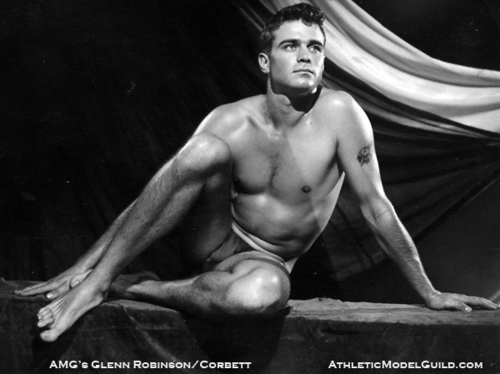
After 2 1/2 seasons, Maharis dropped out, citing the grueling schedule and a bout of hepatitis, Tod quickly found a new boyfriend, haunted ex-GI Lincoln (30-year old Glenn Corbett, recently of It's a Man's World). A former Physique Pictorial model, Corbett was bisexual in real life.
They didn't stick to Route 66; they crossed the U.S. and Canada several times, surfing in Southern California, working on a lobster boat in Maine and a ranch in Wyoming, going to Mardi Gras in New Orleans, vacationing in Toronto. As usual in road series, they got involved in the private dramas of people they met along the way.
The buddy-bonding seems rather intense, and virtually none of the episodes involved getting girlfriends. However, there were little else for gay kids to watch:
1. Very few rescues (usually they were taken hostage together).
2. Insufficient beefcake, considering the number of bodybuilders in the cast (these pictures are from other projects).
3. And the series ended with Tod getting married, his youthful spirit -- and his same-sex romance -- giving way to heterosexual destiny.
But sometimes just an intense friendship is enough.
After Route 66, Martin Milner starred in the beefcake-heavy Gidget, Adam-12 and Swiss Family Robinson (with Willie Aames). Glenn Corbett starred in The Secret of Boyne Castle and a few Westerns before moving behind the scenes. George Maharis had guest spots on many tv programs, performed in nightclubs, and pursued a second career as a painter.
It starred clean-cut Yale undergrad Tod (29 year old Martin Milner, who had just appeared in a loincloth in the risque Private Lives of Adam and Eve). Tod -- not Todd -- and his boyfriend traveled around in a blue 1960 Chevy Corvette "in search of America," like Jack Kerouac before them.
His first boyfriend, Buz (not Buzz -- evidently the producers didn't care for last letters), was a streetwise former juvenile delinquent from Hell's Kitchen, played by 32-year old George Maharis. A 1973 Playgirl centerfold, Maharis was gay in real life.
After 2 1/2 seasons, Maharis dropped out, citing the grueling schedule and a bout of hepatitis, Tod quickly found a new boyfriend, haunted ex-GI Lincoln (30-year old Glenn Corbett, recently of It's a Man's World). A former Physique Pictorial model, Corbett was bisexual in real life.
They didn't stick to Route 66; they crossed the U.S. and Canada several times, surfing in Southern California, working on a lobster boat in Maine and a ranch in Wyoming, going to Mardi Gras in New Orleans, vacationing in Toronto. As usual in road series, they got involved in the private dramas of people they met along the way.
The buddy-bonding seems rather intense, and virtually none of the episodes involved getting girlfriends. However, there were little else for gay kids to watch:
1. Very few rescues (usually they were taken hostage together).
2. Insufficient beefcake, considering the number of bodybuilders in the cast (these pictures are from other projects).
3. And the series ended with Tod getting married, his youthful spirit -- and his same-sex romance -- giving way to heterosexual destiny.
But sometimes just an intense friendship is enough.
After Route 66, Martin Milner starred in the beefcake-heavy Gidget, Adam-12 and Swiss Family Robinson (with Willie Aames). Glenn Corbett starred in The Secret of Boyne Castle and a few Westerns before moving behind the scenes. George Maharis had guest spots on many tv programs, performed in nightclubs, and pursued a second career as a painter.
Jason Gedrick
Born in 1965, Jason Gedrick broke into show business with The Heavenly Kid (1985), a comedy in which the nerd (Jason) wins The Girl with a little help from a dead teenager from the 1950s (Lewis Smith). In the process, he bonds with the teen angel (and exhibits the usual 1980s homophobia), and shows off an implausibly buffed physique.
The actioner Iron Eagle followed (1986): avid video-gamer Doug (Jason) rescues his dad from Islamic terrorists, with a little help from an older pilot (Louis Gossett Jr.), who is distraught over the many kids that he has seen die over the years, and isn't about to watch Doug die, too. More buddy bonding.
Teen magazines paid some attention to him, displaying his dark, sultry pout and lean muscles.
Gay teens in the 1980s saw a pattern developing: his characters always had girlfriends but found meaning with guys.
The pattern continued in Rooftops (1989): a homeless teen named T, who lives on rooftops, has a girlfriend, but is also in love with a boy. When his boyfriend is killed by drug dealers, T vows to use his dance-combat skills to clean up the neighborhood.

The pattern continued in Backdraft (1991), with Kurt Russell, and Crossing the Bridge (1992), with Josh Charles.
And we saw more of Jason's body in the nude shower scene.
I lost track of Jason in the 1990s. He apparently moved into television, playing a college boy in Class of 96 (1993), a Hollywood star accused of killing a teenage girl in Murder One (1995-96), and an ex-con trying to go straight in EZ Streets (1996-97), plus significant roles Desperate Housewives, Luck, Necessary Roughness, and Dexter. I haven't seen any of them.
But in 2007, for old time's sake, I saw Jason in Kings of South Beach (2007). He plays Chris Troiano, a New Yorker who moves to Miami to escape the Mafia and start a new life. He opens a nightclub and takes bouncer Andy (Donnie Wahlberg) under his wing.
Andy is actually an undercover cop who must choose between his love for Chris and his job.
There is a palpable chemistry between Andy and Chris which almost moves from subtext to text.
Labels:
1980s,
1990s,
cops,
dance,
nerd,
sex comedy,
teen angel
Dec 6, 2015
Shock-headed Peter: Castration and Gay Panic in a German Children's Story
![]() |
Its logo was a boy with wild blond hair and long sharp nails like Edward Scissorhands.
Nearby there was a statue of the same boy, along with some other children.
"You've never heard of Struwwelpeter?" Doc asked. "He's a national hero, like Bart Simpson in America!"

Turns out that all German schoolchildren read Der Struwwelpeter, written and illustrated by Heinrich Hoffmann (1809-1894), about children who misbehave and get their comeuppance -- usually a violent retribution.
A girl who plays with matches burns to death.
Kaspar, who won't eat his soup, wastes away and dies.
Hans, whose "head is always in the clouds," falls into a river.
Robert, who goes outside in a storm, blows away.
Hoffmann was a psychiatrist, though he lived before Freud's discovery of the unconscious, and many of his stories have been analyzed for their psychosexual undertones
The most obvious gay connection is in the story of Konrad, der Daumenlutscher (the Thumb-Sucker).
Though his mother warns him to not suck his thumb, Konrad persists in the bad habit. Then he encounters the Tailor with the Scissors (in modern versions, the monstrous Scissor-Man), who cuts both of his thumbs off.
Oral fixation, symbolic castration, gay anxiety, and a 19th-century Freddie Kruger!
The stories have been translated into several languages. They were adapted into a 1955 movie (available on youtube), an operetta (1992) and a musical (1998).
In 2010, Richard Mansfield filmed an explicitly homoerotic shadow-puppet version, of the Daumenlutscher story, "Suck-a-Thumb." It made the rounds of the gay film festivals.
In an even more explicitly gay sequel, Konrad is sent to a psychiatric hospital for a brutal "cure."
Don't worry, that's a door handle, not what you're thinking.
Bible Beefcake
When I was a kid, our church forbade any books except the Bible and authorized Nazarene books. My parents were more lenient, permitting comic books and Scholastic Book Club selections, but the Bible had an advantage -- you could read it anywhere, during choir practice or Sunday school or a screaming hellfire sermon, and the adults would pay no attention -- or they would think you were especially devout, as you got your quota of beefcake, bonding, and sex. Not to mention violence.
1. Beefcake. David looks like a veritable Conan the Barbarian, wearing only a loincloth, wielding a magic sword as he stands over the slain Goliath. And who knew that Cain assaulted Abel by kicking him in the crotch while they were both naked?
2. Bonding. David and Jonathan had a love "surpassing the love of women." That is, their homoromance far surpassed hetero-romance. If only David didn't insist on bring Goliath's head along on their dates. And why did Joseph reject women's advances to spend all of his time schmoozing with the Pharaoh ?
3. Sex. After the Flood, Noah was lying around drunk when his son Ham "uncovered his nakedness." But to "uncover" someone's "nakedness" means doing more than sneaking a quick peek, and God got so upset over the incest that He decreed that Ham and all of his descendants (the Africans) should be slaves. The Biblical support of slavery caused the first chip in the edifice of my fundamentalism.
Fast-forward a few thousand years to the New Testament, and Philip the Apostle sees an Ethiopian eunuch on the road, invites him to spend the night in his tent, and in the morning baptizes him. Eunuchs are castrated, unable to have sex with women. So who do they have sex with? Just ask Philip.
See also: The Sacrifice of Isaac.
Dec 4, 2015
The Wiz: Gay Manhattan in the 1970s
Dorothy is a 24-year old kindergarten teacher living with her Aunt Em and Uncle Henry in 1978 Harlem, New York. They were happy to raise her, but now they're dropping broad hints: "You're grown up, practically middle aged. Move out!"
But Dorothy is paralyzed by fear. She's never been south of 125th Street, which means that she's never been to the Museum of Modern Art, about a mile away, or the Empire State Building, or to the gay village of Chelsea. Like everyone in America in the 1970s, she has heard horrible things about Manhattan: skyrocketing crime, economic decline, a failing infrastructure. It's a cesspool of corruption, misery, and perversion. There are gay people there.
Then she follows her dog Toto out into a snowstorm, and gets lost in Manhattan -- which she calls Oz.
She encounters raw racism -- taxis invariably refuse to take her fare -- and many of the urban evils that 1970s critics bemoaned: graffiti, prostitutes, gangs, drugs, gay people.
But she still visits sites that are both beautiful and powerful -- the New York Public Library, the World Trade Center, Cony Island, and the glittering emerald fantasy of Park Avenue.
She makes more friends than she ever had before in her life: a Tin Man, a Scarecrow (played by Michael Jackson), a Lion.
And she is surrounded by beefcake. Cute "numbers runners." Munckins frozen in graffiti. Sweat-shop workers who escape their masks and uniforms to reveal muscular bodies, naked except for jockstraps. Many, if not most, are gay-coded.
In the end she defeats the evil Evilene, debunks the shyster Wizard, and goes back home to Harlem.
But she is no longer afraid. She knows now that for all its dangers, squalor, and decay, Manhattan is a beautiful, magical place, where you can find friends, where difference is accepted, where you can be free to be who you are. Where being gay is ok.
The Wiz is not a great movie. It's way too long, the acting is awful, and paralyzing fear is not the best attribute for a heroine -- Dorothy has none of the resourcefulness of her counterpart in the Baum books, none of the courage of the Judy Garland version. One gets the impression that she should be talking to a therapist rather than going on a heroic quest.
And the gay symbolism.
When I saw The Wiz in the fall of 1978, during my freshman year in college, I had visited 17 U.S. states and 5 foreign countries, but still, my world felt as constrained as Dorothy's. Faced with constant heterosexist pronouncements about my future wife and kids, I felt, like Michael Jackson's Scarecrow, that:
You can't win, you can't break even
And you can't get out of the game
The Wiz suggested that home might be a "good place" after all. All you needed was a copy of the Gayellow Pages.
Dec 1, 2015
Sabrina the Teenage Witch
Between 1996 and 2000, the TGIF adaption of the Archie Comics character Sabrina the Teenage Witch was the most gay-friendly of the 1990s teencoms, and not just because of the gay symbolism of outsider-with-a-secret, such as we see in that other witch sitcom, Bewitched.
It featured a surprising number of gay-friendly actors. I met Nate Richert (Sabrina's on-off boyfriend, Harvey) at a gay club in West Hollywood, and Jenna Leigh Green (her evil nemesis, Libby) spoke at UCLA during National Coming Out Week in 2000.
And references to gay people. In the first episode, Sabrina's aunts explain that they are "sisters, not an alternate couple." In "Dream Date," Sabrina is wandering the hallways looking for a boy to date. She casually asks "I wonder if that guy is taken?" Harvey says "Yeah, by that guy," thus making history by marking the first gay romantic couple in any teencom.
In "Sabrina the Teenage Boy," Sabrina transforms herself into a boy named Jack to find out what guys talk about. Jack has retained Sabrina's desire for boys. When he accidentally exclaims that a baseball player is "hot," Harvey stares in shock,so he quickly redeems himself by claiming that he meant the player's athletic prowess. But when the spell starts to fail, giving Jack makeup, Harvey says: "Your mascara is running. It doesn't bother me, but the guys will razz you." Apparently he has gotten used to the idea that his new friend might be gay.
Sabrina had no homoromantic couples in the tradition of Saved by the Bell or Boy Meets World, but in the fall of 1999, muscle jock Brad (Jon Huertas, who has played gay several times) moves to town, and falls into love-at-first-sight with Harvey. Their sizzling on-screen chemistry leaves little doubt that their attraction is both physical and romantic. They spend the rest of the season joyously making plans to be together tonight, tomorrow night, every night, while Brad and Sabrina jealously snipe at each other, and each devises schemes to get the Harvey out of the other's clutches.
In the fall of 2000, Sabrina moved from ABC to the WB Network, the writers were replaced, along with most of the cast, and Sabrina becomes aggressively homophobic. She goes to the Rocky Horror Picture Show, and is disgusted by a man in the audience wearing garters!
Her friend tells about how he met a girl and discovered while they were kissing that he was really a dude. He thinks it's a funny story, but Sabrina grimaces in disgust. Kissing a dude? She was never so homophobic in high school.
The addition of David Lascher and Trevor Lissauer (right, in the gay-themed Eden's Curve) didn't help.
The homophobia has continued. Today Melissa Joan Hart is infamous for her homophobic (and otherwise nasty) jibes. In 2009 she complained about someone else taking credit for her husband Mark's song: "Mark fully wrote every bit of that song except the new lyrics in the chorus... which are gay anyhow. They turned it into a fairy love song."
She is currently paired with Joey Lawrence in the sitcom Melissa and Joey.
See also: Nate Richert's Kielbasa.
It featured a surprising number of gay-friendly actors. I met Nate Richert (Sabrina's on-off boyfriend, Harvey) at a gay club in West Hollywood, and Jenna Leigh Green (her evil nemesis, Libby) spoke at UCLA during National Coming Out Week in 2000.
And references to gay people. In the first episode, Sabrina's aunts explain that they are "sisters, not an alternate couple." In "Dream Date," Sabrina is wandering the hallways looking for a boy to date. She casually asks "I wonder if that guy is taken?" Harvey says "Yeah, by that guy," thus making history by marking the first gay romantic couple in any teencom.
In "Sabrina the Teenage Boy," Sabrina transforms herself into a boy named Jack to find out what guys talk about. Jack has retained Sabrina's desire for boys. When he accidentally exclaims that a baseball player is "hot," Harvey stares in shock,so he quickly redeems himself by claiming that he meant the player's athletic prowess. But when the spell starts to fail, giving Jack makeup, Harvey says: "Your mascara is running. It doesn't bother me, but the guys will razz you." Apparently he has gotten used to the idea that his new friend might be gay.
Sabrina had no homoromantic couples in the tradition of Saved by the Bell or Boy Meets World, but in the fall of 1999, muscle jock Brad (Jon Huertas, who has played gay several times) moves to town, and falls into love-at-first-sight with Harvey. Their sizzling on-screen chemistry leaves little doubt that their attraction is both physical and romantic. They spend the rest of the season joyously making plans to be together tonight, tomorrow night, every night, while Brad and Sabrina jealously snipe at each other, and each devises schemes to get the Harvey out of the other's clutches.
In the fall of 2000, Sabrina moved from ABC to the WB Network, the writers were replaced, along with most of the cast, and Sabrina becomes aggressively homophobic. She goes to the Rocky Horror Picture Show, and is disgusted by a man in the audience wearing garters!
Her friend tells about how he met a girl and discovered while they were kissing that he was really a dude. He thinks it's a funny story, but Sabrina grimaces in disgust. Kissing a dude? She was never so homophobic in high school.
The addition of David Lascher and Trevor Lissauer (right, in the gay-themed Eden's Curve) didn't help.
The homophobia has continued. Today Melissa Joan Hart is infamous for her homophobic (and otherwise nasty) jibes. In 2009 she complained about someone else taking credit for her husband Mark's song: "Mark fully wrote every bit of that song except the new lyrics in the chorus... which are gay anyhow. They turned it into a fairy love song."
She is currently paired with Joey Lawrence in the sitcom Melissa and Joey.
See also: Nate Richert's Kielbasa.
Nov 29, 2015
Danny Nucci: Some of My Best Friends
During the early 2000s, the success of Will and Grace prompted producers to flood the market with clones like Some of My Best Friends (2001), about an upper-class Anglo gay guy (Jason Bateman) living in Manhattan (aren't all gay people affluent, Anglo Manhattanites?) who accidently gets a straight, homophobic, working-class, Italian roommate (Danny Nucci, left). Sounds more like Joey and Chandler of Friends than Will and Grace.Only five episodes aired during the spring of 2001. I saw half of one. Stereotypes were abundant.
The Advocate heavily promoted the show (before it aired). It even gave Jason Bateman and Danny Nucci a test to see who knew the most about gay people. Danny won.
No wonder. Jason Bateman hasn't had a lot of experience in gay and gay-friendly roles, but Danny Nucci has. As a teenager in the 1980s, he played a lot of buddy-bonding roles, and in the 1990s he transitioned to gay, bisexual, or "best buddy of the gay guy" roles. Plus he provides ample beefcake with numerous shirtless and nude scenes.
The Brotherhood of Justice (1986): a group of teenagers become violent vigilantes. Danny's character cuddles with brother Keanu Reeves.
An Enemy Among Us (1987). A CBS Schoolbreak Special. Danny plays a boy who contracts AIDS from a blood transfusion. But everybody thinks he's. . .you know.
Titanic (1997): Danny plays Fabrizio, Leonardo DiCaprio's buddy in the only gay subtext in the interminable movie.
The Unknown Cyclist (1998): a man dying of AIDS gets his gay and straight friends to participate in a charity bike race. Danny plays the bisexual Gaetano, who is HIV positive.
Friends and Lovers (1999): a group of friends hits the ski slopes. Danny plays a gay guy who gets his first boyfriend.
More recently, on "Mob Rules," an episode of House (2005): Danny plays a mobster who discovers that his brother is gay (he's going to become a witness so he can enter the Witness Protection Program and avoid harassment by his homophobic family).
Nov 19, 2015
Michael Sarrazin: In the Most Homophobic Movie of All Time?
Handsome "new sensitive man" Michael Sarrazin was a reliable source of beefcake and bulges through the 1970s; unfortunately, you had to look past an endless series of naked ladies to see him.
Born in 1940, he spent the 1960s miscast in Westerns before starring with Jane Fonda in the misnamed They Shoot Horses, Don't They (1969), which is not about shooting horses; it's about the angst-ridden, desperate lives of contestants in a Depression-era dance marathon.
He had found his niche: New Sensitive Men, quirky, sometimes amoral, sometimes criminals, who have lots of sex with The Girl en route to the denouement: Barbara Hershey in The Pursuit of Happiness (1971), Jacqueline Bisset in Believe in Me (1971), Trish Van Der Vere in Harry in Your Pocket (1973).
Spoiler alert: in The Reincarnation of Peter Proud (1975), which was a big hit in my high school, he makes out with Jennifer O'Neal, only to discover that he's the reincarnation of her father!
By the 1980s, Michael was getting a little long in the tooth for playing quirky young men, and his projects became increasingly sleazy. But in those days "sleaze" included "gay," so there was a bit of LGBT content:
The Seduction (1982): tv reporter is stalked by a one-night stand.
Mascara (1987): crossdressing police officer has a thing for his sister.
The Phone Call (1989): straight guy calls the wrong phone sex line and is stalked by a gay queen, in what has been called the most homophobic movies of all time.
Not a lot of buddy-bonding, with all that heterosexual sex going on, but there are some glimmers of a homoromance between Michael and Tim Henry in Eye of the Cat (1969).
I'm still going with Chuck and Buck as the most homophobic movie of all time.
Born in 1940, he spent the 1960s miscast in Westerns before starring with Jane Fonda in the misnamed They Shoot Horses, Don't They (1969), which is not about shooting horses; it's about the angst-ridden, desperate lives of contestants in a Depression-era dance marathon.
He had found his niche: New Sensitive Men, quirky, sometimes amoral, sometimes criminals, who have lots of sex with The Girl en route to the denouement: Barbara Hershey in The Pursuit of Happiness (1971), Jacqueline Bisset in Believe in Me (1971), Trish Van Der Vere in Harry in Your Pocket (1973).
Spoiler alert: in The Reincarnation of Peter Proud (1975), which was a big hit in my high school, he makes out with Jennifer O'Neal, only to discover that he's the reincarnation of her father!
By the 1980s, Michael was getting a little long in the tooth for playing quirky young men, and his projects became increasingly sleazy. But in those days "sleaze" included "gay," so there was a bit of LGBT content:
The Seduction (1982): tv reporter is stalked by a one-night stand.
Mascara (1987): crossdressing police officer has a thing for his sister.
The Phone Call (1989): straight guy calls the wrong phone sex line and is stalked by a gay queen, in what has been called the most homophobic movies of all time.
Not a lot of buddy-bonding, with all that heterosexual sex going on, but there are some glimmers of a homoromance between Michael and Tim Henry in Eye of the Cat (1969).
I'm still going with Chuck and Buck as the most homophobic movie of all time.
Nov 18, 2015
Bert Convy Spends the 1970s Nude
I suppose you're wondering who this Bert Convy was, who took his clothes off on both Love Boat (6 times) and Fantasy Island (4 times)?
I'm not sure. He seemed to just appear in the 1970s,. He was over 40 years old, with a 20-year career as a Broadway star and pop singer, and before that as a pro baseball player, but I didn't notice until he started strutting around with a Tom Jones Afro and a leisure suit unbuttoned halfway down his smooth, muscular chest. playing slightly befuddled New Sensitive Men in sitcoms and soaps: Mary Tyler Moore, The Partridge Family, Love American Style, Charlie's Angels, Murder She Wrote, and Hotel.
Google Images said this was him, but it might be wrong. The photo seems too recent -- Bert Convy would have been that age in the early 1960s. (It may be Steve Bond).
But not to worry, the real Bert Convy displayed his physique many during his tenure as the host of about a thousand game shows, including Password (1972), Match Game (1973-74), Tattletales (1974-77, 1982), Win Lose or Draw (1987), and Super Password (1984-89),
In the spring of 1976, he starred in a short-lived comedy-variety series, The Late Summer Early Fall Bert Convy Show.
He appeared in lots of movies, mostly sex comedies, like Dallas Cowboys Cheerleaders (1979), about...you know; Racquet (1979), about a tennis pro who beds women; and Help Wanted: Male (1982), about a career woman who wants a baby but not a husband. More beefcake shots....
He and Burt Reynolds were best buds (imagine the confusion: "Bert came to my party, but Burt didn't.") They starred together in the gay-subtext-heavy Semi-Tough (1977) and The Cannonball Run (1981), and produced two tv series together: Weekend Warriors and Win, Lose, or Draw.
There were some gay rumors, but not a lot. During the 1970s, men drew gay rumors only if they were on the feminine side. You could hang out with male buds all you wanted, and never make a dent in people's heteronormative expectations.
Besides, Bert was married throughout his career, to Anne Anderson (1959-1990), and, while he was terminally ill, to Catherine Hall (1991).
He died from a brain tumor on July 15, 1991, and was interred at Forest Lawn, among other Hollywood celebrities.
Burt Reynolds came to the funeral.
See also: Love Boat; Burt Reynolds Naked on a Bearskin Rug
I'm not sure. He seemed to just appear in the 1970s,. He was over 40 years old, with a 20-year career as a Broadway star and pop singer, and before that as a pro baseball player, but I didn't notice until he started strutting around with a Tom Jones Afro and a leisure suit unbuttoned halfway down his smooth, muscular chest. playing slightly befuddled New Sensitive Men in sitcoms and soaps: Mary Tyler Moore, The Partridge Family, Love American Style, Charlie's Angels, Murder She Wrote, and Hotel.
Google Images said this was him, but it might be wrong. The photo seems too recent -- Bert Convy would have been that age in the early 1960s. (It may be Steve Bond).
But not to worry, the real Bert Convy displayed his physique many during his tenure as the host of about a thousand game shows, including Password (1972), Match Game (1973-74), Tattletales (1974-77, 1982), Win Lose or Draw (1987), and Super Password (1984-89),
In the spring of 1976, he starred in a short-lived comedy-variety series, The Late Summer Early Fall Bert Convy Show.
He appeared in lots of movies, mostly sex comedies, like Dallas Cowboys Cheerleaders (1979), about...you know; Racquet (1979), about a tennis pro who beds women; and Help Wanted: Male (1982), about a career woman who wants a baby but not a husband. More beefcake shots....
He and Burt Reynolds were best buds (imagine the confusion: "Bert came to my party, but Burt didn't.") They starred together in the gay-subtext-heavy Semi-Tough (1977) and The Cannonball Run (1981), and produced two tv series together: Weekend Warriors and Win, Lose, or Draw.
There were some gay rumors, but not a lot. During the 1970s, men drew gay rumors only if they were on the feminine side. You could hang out with male buds all you wanted, and never make a dent in people's heteronormative expectations.
Besides, Bert was married throughout his career, to Anne Anderson (1959-1990), and, while he was terminally ill, to Catherine Hall (1991).
He died from a brain tumor on July 15, 1991, and was interred at Forest Lawn, among other Hollywood celebrities.
Burt Reynolds came to the funeral.
See also: Love Boat; Burt Reynolds Naked on a Bearskin Rug
Subscribe to:
Comments (Atom)


.jpg)