Showing posts with label sex comedy. Show all posts

Jul 10, 2024

Throb: How We Watched TV in West Hollywood

The 1980s were extremely homophobic.  If you could manage it, you took refuge in a gay neighborhood, and rarely spoke to a heterosexual.  You absolutely never came out to any heterosexual. If anyone found out accidentally, you could expect, at best, a deer-in-the-headlights stare and a stumbling protest that "I'm...I'm...not gay."  More commonly they would rush off in horror, never to speak to you again.

And you absolutely stayed away from mainstream media.  Newspapers were full of shrieking editorials about how "They're sick!!!!  They're disgusting!  Put them in concentration camps!"

Movies couldn't go five minutes without a homophobic slur.

TV was a little better, generally presenting a world where gay people did not exist.  Still, most programs were incessantly heterosexist, so it was best to keep the tv off.

So in high school and college, I watched eight or nine hours prime-time network tv shows every week, but when I moved to West Hollywood, the number decreased to a non-heterosexist two or three:  

21 Jump Street: Buddy-bonding among undercover cops, including Johnny Depp (left).

Night Court: Buddy-bonding among the denizens of a night court.

Head of the Class: Buddy-bonding among high school overachievers.

 The Golden Girls: Four heterosexual women live together and form an alternative family.

Kate & Allie: Two heterosexual women live together and form an alternative family.

But you had to be careful: even the most "gay friendly" could turn on you at any moment, with a limp-wristed hairdresser swishing in or a visiting relative coming out to horrified gasps and "I just don't get it." 

I don't remember any limp-wristed hairdressers or visiting gay relatives on the workplace comedy Throb (1986-88).

It starred Diana Canova of Soap as Sandy (right), the decidedly unhip newly-divorced 30-something who finds herself a fish-out-of-water in the young, ultra-cool, hipster office of a New Wave record company.

She was heir of Mary Richards of The Mary Tyler Moore Show, and the precursor of the dozen or so women in workplace comedies of the 1990s, such as Caroline in the City and Just Shoot Me.  

Her coworkers included:

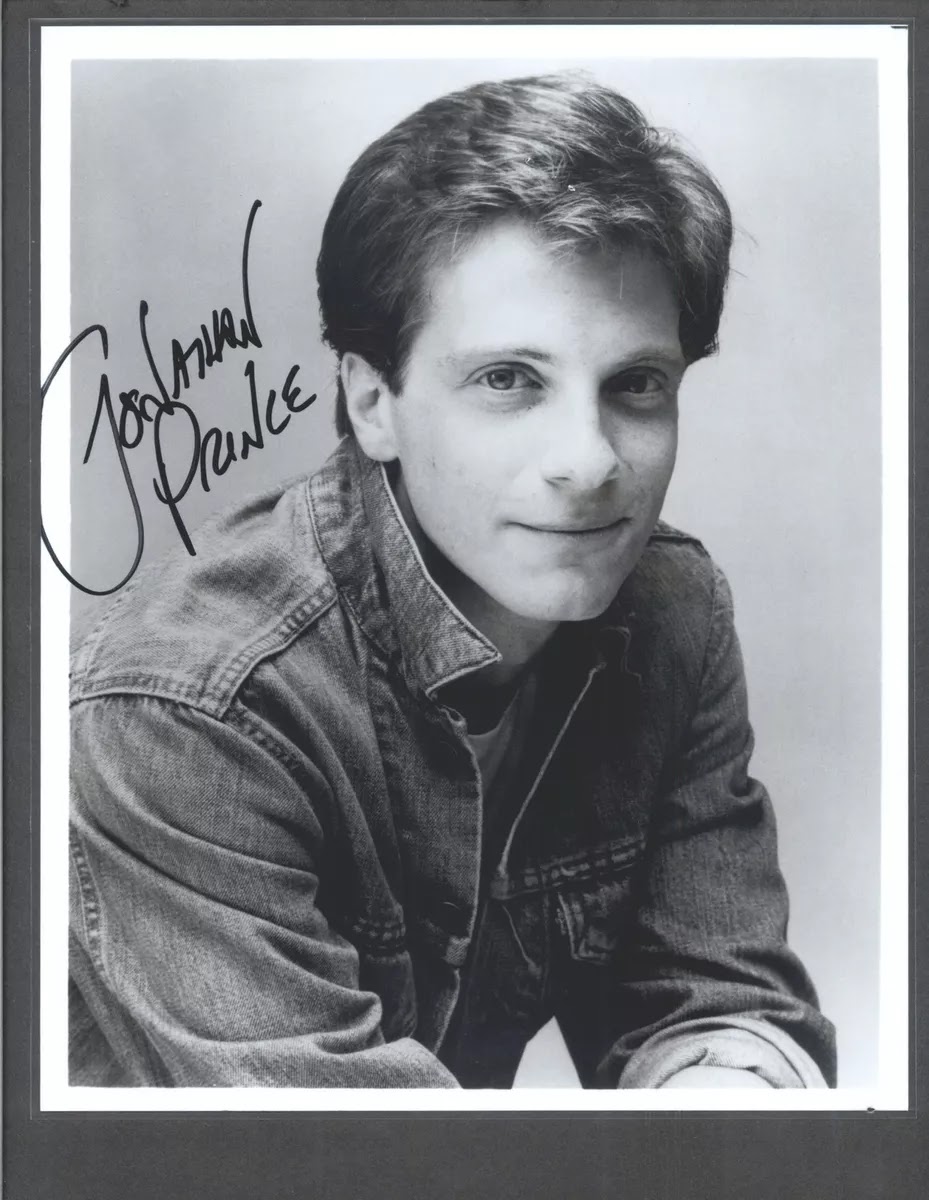
1. The boss,  diminuitive go-getter Zach (Jonathan Prince) channeling Michael J. Fox.  Today a writer and producer, Prince was at the height of a brief 1980s acting career: he played Johnny Depp's buddy in the sex comedy Private Resort and Clark Brandon's buddy on Mr. Merlin.


One of the cutest guys on the planet.  

2.  Hip business manager Phil (Richard Cummings, Jr., later to star in Northern Exposure).

3.  Spaced-out former singer Blue, probably based on the Andy Warhol superstar Ultra Violet (Jane Leeves, who would go on to play psychic therapist/housekeeper Daphne on Frasier).


4. Sandy had a 12-year old son at home, played in the first season by future screen hunk Paul Walker, and then by Paul Walker lookalike Sean de Veritch.

I actually don't remember any particular episodes, just the jazzy theme song, some buddy-bonding moments between Sandy and Blue, and the super-cute Jonathan Prince.

But I remember watching, and finding it a moment of freedom from the incessant homophobia of 1980s tv


May 4, 2024

We Got It Made: 1980s Sitcom with Gay Actor Tom Villard

When I was at Indiana University, lots of guys in my dorm watched the comedy We Got It Made (1983-84), about two nerds who hire Mickey (Teri Copley), one of those ubiquitous 1980s servants who provide joie de vivre along with the housework.   I watched because it was stuck between the must-see Mama's Family and Cheers.  It wasn't awful.

1. The odd couple, button-down attorney David (Matt McCoy, left, John Hillner) and goofy salesman Jay (Tom Villard), had a nice gay subtext going on, in spite of the cheesecake maid and their respective girlfriends.


2. A hot bear cop, Max (former pro wrestler Ron Karabatsos), lived downstairs, with his teenage son Max (Lance Wilson-White).

3. Like Three's Company, it was all about thinking people were doing things, not actually doing them: Mickey sleepwalks and ends up in the boys' bed; Mickey and Jay work on a screenplay, and David thinks they're having an affair; Mickey's diary entry makes everyone think that she wants to get with mike with David; Mickey sleepwalks and ends up in the boys' bed yet again.


4. Tom Villard (right) was gay.  In the mid-1980s, I occasionally saw him at Mugi, the gay Asian bar in Hollywood. He came out as gay and a person with AIDS in an Entertainment Tonight interview in February 1994, which at the time was career suicide; but he thought that speaking out was more important.


He was one of the nicest guys in Hollywood.

When he died in November 1994, his partner,  production designer Scott Chambliss, set up The Tom Villard Foundation to provide assistance to people living with AIDS.


Jan 27, 2024

Steve Antin: Radical gay representation, from "The Last American Virgin" to "Girllicious." With lots of bulges and butts


Steve Antin's bio on the Internet Movie Database claims that he "broke all the girls' hearts" in The Last American Virgin (1982).  Same old story: gay people don't exist, so all girls and no boys swooned over his character.

Spoiler alert: Steve is gay.  

Link to NSFW version

Born in 1958, Steve broke into film playing the Jesse whose girl Rick Springfield longs for in "Jesse's Girl" (1981).  Next came The Last American Virgin (1982).  In his first major screen appearance, he plays high schooler Rick, who has sex with dozens of girls, like "every high school boy" in the 1980s -- except for his his buddy Gary (Lawrence Monoson, below), the "last American virgin."  So he and a third buddy, David (Joe Rubbo), strive to get Gary laid.  


This is not the typical 1980s "sex with girls is the meaning of life" teen comedy. Horndog Rick gets Diane pregnant and dumps her, so Virgin Gary pays for the abortion and falls in love with her, but Diane dumps him!  Then Gary dumps Rick and drives off in tears. Rather a downbeat ending. 

But there's a obvious gay subtext relationship between Gary and Rick: Gary seems to like Diane only because Rick was intimate with her.

And there's a lot of beefcake.  Far more semi-naked male bodies than female bodies.  Muscle hunks in their underwear. Jocks stripped down in the locker room.

There is even a penis size contest, with the boys gleefully evaluating packages while their classmates parade by naked.

When was the last time heterosexual male teenagers were so happy to gaze at a row of naked men?

You might almost think that this movie with a gay star had a gay audience in mind.

Steve went on to play some teenagers on tv, the spoiled rich kid/horndog in The Goonies (1985), and some action/adventure and dramatic roles, all heterosexual.  But when he became the boyfriend of mogul David Geffen, he got some gay-positive roles.

He wrote, produced, and starred in the dramedy Inside Monkey Zetterland (1992), as a retired child actor turned screenwriter who lives with his overbearing mother and wacky/sad relatives.  He's straight, but he is friends with a gay man (Rupert Everett) and a lesbian posing as a married couple.  They are plotting to bomb an insurance agency that is denying coverage to people who are HIV positive. 


It's My Party
(1996), although extremely downbeat, was a classic of gay representation.  Nick (Eric Roberts) is dying of AIDS, with only a few days of mental awareness left, so he decides to kill himself.  His family and friends come to his "going-away party," including ex-boyfriend Brandon (1980s tv hunk Gregory Harrison).  Steve plays one of their friends.  
Brian To appears nude at the party.


After It's My Party, Steve moved into writing and producing.  His Young Americans (2000) is a teen soap featuring Ian Somerhalder (left) as a boy who develops feelings for his best friend, and thinks he might be gay.  It only lasted for eight episodes, so "there wasn't time"
 for him to come out. 

But Steve has also produced The Pussycat Dolls in Girlicious.  His writing credits include Burlesque, with Cher as the owner of an all-girl burlesque club; and Proud Mary, about a hit lady saddled with a kid.

And Chasing Papi, about a guy (Eduardo Verastegui) with three girlfriends, who dump him and find their own inner strengths. 

There's something to be said for female empowerment, but it seems clear that the days of Steve Antin's radical gay representation are long past.

Butts, bulges, and dicks of Steve and his crew on RG Beefcake and Boyfriends


Apr 24, 2021

Billy Warlock

Some teen idols never grow up.  As the years pass, they may hone their acting skills and take on more mature roles, but they never lose their youthful exuberance, their passion, or their innocence.  Every day they wake up newly surprised that they are the object of someone's desire.

It's a short list. I would include Shaun Cassidy, Robby Benson, Mario Lopez, and certainly Billy Warlock.

Born in 1961, Billy burst into the picture in 1982, during the last season of  Happy Days, hired to up the beefcake quota of the doddering sitcom by wearing a trademark cut-off t-shirt.  The teen magazines went crazy, and soon Billy's pin-ups were pushing aside such luminaries as Scott Baio and Ralph Macchio.


Some small roles in movies and tv shows followed, mostly of a type that would allow Billy to appear with no shirt at all, such as Swimsuit (1989) and Class Cruise (1989).  His starring role in Society (1989) was particularly memorable for three reasons:

1. The teenage Bill (Billy Warlock) feels that he is an outsider, not quite fitting in. Gay kids could relate.

2. Although he enjoys the company of woman, Bill enjoys some strong buddy-bonding and rescue moments with his friend Milo (Evan Richards)

3. A woman seduces Bill by ripping off his pants.  They kiss passionately. While this is occurring, the camera is aimed directly at his briefs.  You can imagine what happens next.


For three seasons (1989-1992), Billy played lifeguard Eddie Kramer on the beefcake- and cheesecake-heavy Baywatch.  After that he specialized mostly in soaps:

Days of Our Lives (1988-1991, 2005-2006)
General Hospital (1997-2003)
The Young and the Restless (2007-2008)
As the World Turns (2010)
One Life to Live (2010)


But Billy is more than a great set of pecs.  He is deeply involved in social issues, including gay rights.  A gay ally, in 2004 he made his Broadway debut, playing a gay writer who becomes one of the first casualties of the AIDS pandemic in The Normal Heart. 


Sep 2, 2020

River Phoenix: Running on Empty

River Phoenix died on Halloween night, 1993, at the Viper Room, a Sunset Boulevard hotspot a few blocks north of my apartment in West Hollywood.  Over 20 years have passed, but he remains a gay icon.

Though he had been performing for several years, including a starring role in a tv version of Seven Brides for Seven Brothers (1982), he first drew the attention of gay fans at the age of 14, in Explorers (1985), as the buddy of a boy (Ethan Hawke) who finds an alien spaceship.

After the heterosexist "coming of age" movie Stand by Me (1986), River starred in The Mosquito Coast (1986), as the son of an eccentric inventor (Harrison Ford of Star Wars).  There he moved perceptibly from child star to teen idol, revealing a smooth muscular chest and abs.


Most teen idol vehicles are fluffy, lightweight, feel-good concoctions, but aside from the teen sex comedy A Night in the Life of Jimmy Reardon (1988), River's movies were serious, even dark.  His characters in Little Nikita (1988), Running on Empty (1988), and I Love You to Death (1988) rarely smiled; they were in pain; they were searching, exhausted from searching, "running on empty."

And they ached with desire.  Like fellow teen idol Brad Renfro, like Leif Garrett a decade before, River Phoenix imbued every relationship with a unstated but intensely erotic desire.  Unvariegated, sometimes for women, sometimes for men, usually older men. Twice for Dermot Mulroney (in Silent Tongue and This Thing Called Love). 


Even his frequent shirtless and semi-nude scenes presented him more as someone aching with loneliness rather than as an object of desire.  He gazes at the camera, confused, wondering who is out there looking at him, asking, with Allen Ginsberg, "Are you my angel?"

Twenty years ago, the only gay teenagers in the movies were bisexual hustlers who abandoned their "gay lifestyle" for a girl (such as Jonathan Taylor Thomas in Speedway Junkie and Lukas Haas in Johns), but in My Own Private Idaho (1991), Mike (River) is gay, going with women only when necessary for his job, and he falls in love with an unresponsive straight hustler (Keanu Reeves). 


River enjoyed being an object of desire for both men and women, and he desired both men and women.  He had girlfriends and boyfriends throughout his life.  The rumor mill paired him with nearly every actor rumored to be gay at the time, including Keanu Reeves, Leonardo DiCaprio, and talk show host Merv Griffin.  Many of the twinks I knew claimed to have been with him.  Maybe some of them were telling the truth.


 But it wasn't his male partners that made River Phoenix a gay icon.  It was his combination of sexual knowledge and vulnerability, his neverending search not only for sex but for love.


Jun 13, 2020

Gay Teens in the Summer of Love


In Island of the Lost (1967), South Pacific Islander Tupana (Jose De Vega ) befriends a shipwrecked anthropologist and his clan. He grins at hula-dancing castaway Judy, and kisses her, and holds her hand.  When the rescue boat arrives, he says goodbye, but at the last minute he decides to forsake his homeland and swims out to join her.  At least, that is how the scene can be read.

But Tupana also befriends another castaway, Stu (Luke Halpin of Flipper); they go fishing, and learn to dance, and touch each other's shoulders, smiling.  It is Stu who actually pulls Tupana aboard the rescue boat.  We are not absolutely certain, amid the fade-out hugs, which one Tupana has decided to followed.

In 1966 and 1967, as the first of the Baby Boomers was driving off to college, or flying off to Viet Nam,  teenage boys gazing at girls were as common as tie-dye t-shirts and patchouli incense.  But, within their quest for The Girl who would give their life meaning, gay kids and teenagers often noticed them grinning at boys.


In The Fighting Prince of Donegal (1966), Renaissance Irish prince Peter McEnery rescues a princess, but he also spends an inordinate amount of time being rescued by an older man (Tom Adams).


In C'Mon, Let's Live a Little (1967), college freshman Jesse (Bobby Vee) woos the Dean’s daughter, but he also gleams at his grinning, redheaded boy friend Eddie (Eddie Hodges).  And while Jesse is off wooing a girl, Eddie sits alone in the dorm room, despondent, singing about lost love.


In It's a Bikini World (1967), teenage casanova Mike Samson (Tommy Kirk) trolls the beach in search of babes, but he also has a remarkably expressive bond with his best friend, Woody (Bobby Pickett).

In the comics, Robin and Jimmy Olsen date girls, but they are heartbroken when they believe that their superhero pals have found someone else.   Korak Son of Tarzan rescues a young African diplomat and introduces him to a girl, but not before the duo spends many panels gazing at each other with unparalleled delight


During the Summer of Love, nearly every teenage boy, whether star, buddy, or villain, was portrayed as aggressively and unequivocally girl-crazy.  Yet they often, perhaps usually, desired each other or fell in love with each other.

Their bonds were exclusive and permanent, yet always submerged beneath a girl-crazy façade.  They would gaze at each other while discussing how much they liked girls, or while competing over the same girl, or while consoling each other when their attempts at getting girls faltered.

Their bonds were intense and passionate, yet always tentative, fragile, easily disrupted.  They would express their desire through hints and innuendos, through subtexts and double-entendres, through ambiguities in spectacle or plot, through moments stolen from the “main” story, lest anyone notice. Lest anyone realize that two boys or two men could walk into fade-out sunsets together.

See also: Fighting Prince of Donegal


Dec 6, 2019

John Hamill: The First Nude Physique Model

Born in 1947, the boyish, good-natured John Hamill began his career as a physique model, one of the first to pose fully nude.  Sometimes he even had a partner, in explicitly homoerotic scenes aimed at the increasingly visible gay male audience.  He also appeared in both gay and heterosexual "blue movies."

But he aspired to become a serious actor, so he studied at the Webber Douglas Academy of Dramatic Arts and began appearing on stage, notably in the gay-themed Boys in the Band in 1969 (presumably as the hustler hired to become a "birthday present").


His film career began in 1970, with starring roles in the thrillers The Beast in the Cellar (not as the beast), Trog (not as the rampaging caveman), and No Blade of Grass.  He also had some guest spots on tv series such as Paul Temple, The Befrienders, and Crossroads.  


But, like many bodybuilders, especially those with a "gay reputation," John found himself stuck in minor roles as threatening bad guys or inarticulate hunks.  In Tower of Evil (1972), for example, his character is introduced, takes off his clothes, flexes his muscles and gets killed, all in about thirty seconds.


Anxious for work, he agreed to star in the sex comedy Girls Come First (1975), as an artist asked to paint nude models.  Released in both hardcore and softcore versions, it was popular enough to lead to two sequels, and parts in similar movies, like Hardcore (1977).

But nothing else.  After a two-parter on Space: 1999 in 1978, he retired from acting and became a furniture refinisher.


Being so open about sex, and so nonchalant about both male and female partners, limited John's career, but left him -- and his fans -- with many fond memories.

You can see the nude photos on Tales of West Hollywood.

Sep 26, 2019

Corey Haim


What gay boy in the 1980s didn't thinking of Corey Haim as a kindred spirit?  His cute lopsided smile, his metrosexual fondness for hair care products, his slight-but-firm physique, his well-publicized bromance with fellow teen star Corey Feldman.


Whether he was playing cute kids -- in Secret Admirer (1985), Silver Bullet (1985), Lucas (1986) and The Lost Boys (1987) -- or horny teenagers -- in License to Drive (1988), Dream a Little Dream (1989), and Fast Getaway (1991) -- Hollywood censorship decreed that his characters could not be gay.  Yet he often played them as gay anyway -- subtly, cautiously, with a leer at a passing hunk or an intensely emotional buddy-bonding moment that stood out like a beacon in the midst of the "fade-out kiss" plotlines, telling gay kids "You're not alone.  You're ok."


According to Corey Feldman, he was sexually abused by a "Hollywood mogul" as a child, and he doubtless did his share of same-sex one-nighters, but he was undeniably a ladies' man.  He had relationships with nearly every female actor, model, and singer in Hollywood: Alyssa Milano (of Who's the Boss), Nicole Eggert (of Charles in Charge), Spice Girl Victoria Beckham, Holly Fields,  Cindy Guyer, Tiffany Shepis.

During the 1990s, fame -- and his draconian workload -- hit him hard.  Like Tommy Kirk 30 years before, Corey abused drugs and alcohol; his teen idol dreaminess vanished, and he became haggard, craggy, and tattooed.  His movie roles grew sleazy and sinister.  He died of pneumonia in 2010.

To the end, Corey was welcoming and gracious to his fans, both gay and straight.

Jul 21, 2018

Lance Kerwin: The Golden Boy of the 1970s


Fall 1977.  Thursday night meant staying downstairs with the family to watch The Waltons (ugh!) or going up to the room I shared with my brother to watch the ABC lineup of hip sitcoms on our small black-and-white tv: Welcome Back Kotter, What's Happening!, Barney Miller, Carter Country.  But if my brother wasn't around, I changed over to CBS before Barney Miller to watch the opening sequence of James at 15 

James (17-year old Lance Kerwin) jumps out of bed, checks for acne, does overhead presses (shirtless), swims across the pool (displaying his bare shoulders) -- practices the flute, goes skateboarding, photographs some iconic sights of Boston, walks in the rain, walks through a crowd -- and walks through the locker room (in his swimsuit). Teenagers had never seen so much teen idol beefcake.  

I didn't actually watch the show because it was almost entirely about girls: James dates a girl who is "easy," a girl who belongs to a cult, who's taller than him, who plays basketball for a rival team; "becomes a man" with a Swedish exchange student (whereupon the series becomes James at 16), has a disease scare. But just seeing James in a swimsuit was a queer code.

Lance had already been a busy child star, with roles in Emergency, Police Story, Cannon, Gunsmoke, Wonder Woman, and lots of others.  Even as a child, he specialized in contemporary angst drama, like:

The Loneliest Runner (child abuse)

The Death of Richie (drug overdose)


Four episodes of the Roman Catholic "contemporary issues" series Insight (on alcoholism, stalking, unemployment, and hydrophobia).


Five After School Specials (on bullying, stepparents twice, being short, and being poor).

The guy staring at Lance's chest in "The Amazing Cosmic Awareness of Duffy Moon" is Ike Eisenmann, who would go on to a future of jaw-dropping physiques.


But it was James at 15, with its controversial decision to make a teenage boy active with girls, that made Lance the Golden Boy of the 1970s.  He had one memorable foray into horror, a gay-subtext buddy-bond with David Soul in the tv-version of Stephen King's Salem's Lot (1979).

But otherwise it was a lot of angst with his shirt off: buddy-bonding with alcoholic high schooler Scott Baio in The Boy Who Drank Too Much (1980)

Dealing with his parents' divorce (in Children of Divorce, 1980)

Accidentally shooting Wil Wheaton in "The Shooting" (1982)


Being threatened by his murderous Dad in A Murder in the Family (1983). 

Eric Stolz played another threatened brother (n*de photos on RG Beefcake and Boyfriends)

More after the break

Jun 11, 2018

Ken Olandt

During the 1980s, it seemed that every adult actor and teen idol spent eight hours per day pumping iron, so physiques that were merely stunning risked being overlooked in the exalted company of Robby Benson, Allan Kayser, Jon-Erik Hexum, Adrian Zmed, and Sylvester Stallone.

Ken Olandt was almost overlooked.  Trained as an advertising agent, he and his physique started making the rounds of tv guest shots in 1983 -- Love Boat, The A-Team, Simon & Simon, Hotel.  He got a recurring role as a streetwise dock boy on the short-lived Riptide (1984-85).  But he was rarely asked to do as much as unbutton a button by casting agents accustomed to walking, talking versions of Michelangelo's David.

 And the teen magazines, when they paid attention to him at all, showed off his smile (which, to be fair, was very nice).


In 1986, Ken -- or his agent -- hit on a gimmick to get him noticed.  If his pecs and abs were merely spectacular, why not show off the regions where he really surpassed mortal expectatons?  Most other actors were too timid or inadequately superhuman to agree to underwear and jockstrap shots, but Ken was more than qualified, and not at all timid.


April Fool's Day (1986) was a psycho-slasher -- a genre not generally known for male nudity, with the possible exception of Hell Night -- but Ken spent a long scene in his underwear (and, incidentally, buddy-bonding), and gay men and straight women finally started paying attention.


Summer School (1987), a comedy about a substitute teacher (Mark Harmon) who bonds with his students on the way to the beach, featured Ken as a student moonlighting as a stripper.

And so it went for the next decade.  Whether he guest-starred on a remake of the 1960s tv show Gidget,  set mostly on the beach, or Murder, She Wrote, set elsewhere, more likely than not, Ken would be asked to strip down to his underwear or appear nude except for a g-string or swimsuit.

Not that anyone was complaining.

Dec 16, 2015

Jason Gedrick


Born in 1965, Jason Gedrick broke into show business with The Heavenly Kid (1985), a comedy in which the nerd (Jason) wins The Girl with a little help from a dead teenager from the 1950s (Lewis Smith).  In the process, he bonds with the teen angel (and exhibits the usual 1980s homophobia), and shows off an implausibly buffed physique.

The actioner Iron Eagle followed (1986): avid video-gamer Doug (Jason) rescues his dad from Islamic terrorists, with a little help from an older pilot (Louis Gossett Jr.), who is distraught over the many kids that he has seen die over the years, and isn't about to watch Doug die, too. More buddy bonding.


Promised Land (1987): Davey (Jason) and Danny (Kiefer Sutherland) pursue an elite-working class friendship through high school and failed marriages.

Teen magazines paid some attention to him, displaying his dark, sultry pout and lean muscles.

Gay teens in the 1980s saw a pattern developing: his characters always had girlfriends but found meaning with guys.

The pattern continued in Rooftops (1989): a homeless teen named T, who lives on rooftops, has a girlfriend, but is also in love with a boy.  When his boyfriend is killed by drug dealers, T vows to use his dance-combat skills to clean up the neighborhood.


The pattern continued in Backdraft (1991), with Kurt Russell, and Crossing the Bridge (1992), with Josh Charles.

And we saw more of Jason's body in the nude shower scene.


I lost track of Jason in the 1990s.  He apparently moved into television, playing a college boy in Class of 96 (1993), a Hollywood star accused of killing a teenage girl in Murder One (1995-96), and an ex-con trying to go straight in EZ Streets (1996-97), plus significant roles Desperate Housewives, Luck, Necessary Roughness, and Dexter.  I haven't seen any of them.


But in 2007, for old time's sake, I saw Jason in  Kings of South Beach (2007).  He plays Chris Troiano, a New Yorker who moves to Miami to escape the Mafia and start a new life.  He opens a nightclub and takes bouncer Andy (Donnie Wahlberg) under his wing.

Andy is actually an undercover cop who must choose between his love for Chris and his job.

There is a palpable chemistry between Andy and Chris which almost moves from subtext to text.

Mar 4, 2014

Caddyshack: Masculine Women and Feminine Men

Danny gawks at Lacey, while his girlfriend gags
I saw Caddyshack (1980) during the summer after my sophomore year in college, shortly after I got back from my disastrous move to Omaha. It didn't make any sense to me then, and it doesn't now.  It seems to be several movies crammed into one.

1.  A snooty, easily riled judge (Ted Knight) runs the snooty Bushwood Country Club, where he butts heads with goldenboy golfer Ty (Chevy Chase) and boorish millionaire Czervik (Rodney Dangerfield).

2. There's some mild social critique: the club is restricted, no African-Americans or Jews.

3, The judge has boorish grandchildren and a niece, Lacey Underall, who sleeps with everyone she can find.

4. There's some class competition between the club snobs and the salt-of-the-earth caddies, who get to use the country club pool for 15 minutes once a year.  Somebody drops a candy bar in the pool.

5. The main caddy, Danny (Michael O'Keefe), butts heads with the more muscular Tony (Scott Colomby of One Day at a Time), sleeps with Lacey, has a pregnancy scare with his girlfriend, and wins a Caddy Scholarship so he can go to college.

6. Carl Spackler (Bill Murray) is a sleazy groundskeeper who keeps making visual penis gags (e.g., a water hose between his legs), and spends the movie fighting an animatronic gopher.  At the end of the movie, he blows up the golf course, and everybody dances.

Tony becomes Lacey's latest conquest

So is this absurdist comedy, nerd comedy, gross-out comedy, social satire, or what?

There are three things I'm sure of.

1. There are no gay slurs.

Most 1980s teen comedies have the characters spouting off against "fags" every five minutes, but there are no gay slurs at all. There are even a few minor gay references, as when Czernik is asked if he wants a driver (golf club) and quips "No, he's not my type.", or when Tony jumps up and down trying to spy on Danny and Lacey's tryst.

2. There is significant beefcake, if you like guys who are skinny and androgynous. Shirtless scenes, swimming pool scenes, underwear scenes while preparing for sex.

3. Androgyny is the rule.

Tony, the "hunk," is only mildly muscular, and Danny is downright skinny.  They both have big hair and pretty, androgynous faces.

Lacey is portrayed as the epitome of feminine beauty, so attractive that when she enters a room, every man's jaw drops.  However, she differs considerably from the 1980s "big everything" ideal of Lonnie Anderson and Dolly Parton, with short hair, a skinny frame, and breasts smaller than Tony's pecs.

Danny's "plain" girlfriend is likewise short-haired and small-framed.

Ty wants to be a human being
Tony has a little brother, Joey, who caddies with him.  But in a pivotal scene, the baseball cap comes off, and the boy turns out to be a girl.

Do feminine men sleeping with masculine women add up to gay symbolism?

Maybe the point is: gender should be irrelevant.  Be with whoever you want. As Ty said, "Let's pretend we're really human beings" (not masculine and feminine stereotypes).


Related Posts Plugin for WordPress, Blogger...