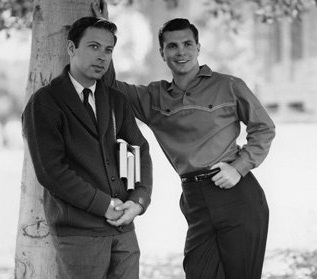
The beach movie crazy began with Beach Party (1963), and lasted through Catalina Caper (1967). During that 4 year period, American International Pictures churned out a dozen beach movies, starring former teen idol Frankie Avalon and former Mousketeer Annette Funicello, or if they were too busy, Dwayne Hickman, Tommy Kirk, Deborah Walley, and Yvonne Craig. Other studios churned out their own teen-idols-in-Speedos movies, starring Bobby Vinton, Fabian, James Darren, Tab Hunter, and when they ran out of teen idols, Rod Lauren, Frankie Randall, Michael Callan, James Stacy, and Edd "Kookie" Burns.
The plot of the beach movie is the same in every installment: a gang of teenagers arrives in Malibu for a summer vacation. Frankie and Annette (or their stand-ins) argue: she insists that they plan for marriage, the next step in embracing their heterosexual destiny, but he is too happy surfing, skydiving, and drag racing.
That is, he refuses to give up his homoerotic buddy-bonding with gay-vague chums.They separate, flirt with others, complain about each other to their friends, snipe at each other at the teen hangout, and walk forlornly on the beach.
Meanwhile a greedy corporation hopes to exploit the teenagers, or else salt-peter their heterosexual passions. Maybe some juvenile delinquents cause trouble. The climax comes in the form of a cartoonish teenagers vs. adults or delinquents brawl or car chase. Frankie and Annette save the day, reconcile without resolving their disagreement, and head for home.
The teens are staggeringly affluent, white, and free from parental intervention of any sort. They have all of the freedom of adulthood and none of the responsibilities. They are living in their own surreal world of spies and saboteurs, drag races and skydiving contests, musclemen hanging from helicopters, gorillas riding surfboards. There are Martians, mermaids, witch doctors, dime store Indians, bumbling crooks, and a girl whose gyrating hips cause volcanoes to erupt.
Every now and then Frankie mugs at the camera and asks "Can you believe this?"
And there is endless beefcake. There are many girls in bikinis, but the beach is crowded with swimsuit boys; bulges are displayed as prominently as cleavage. Jody McCrea's bulge makes a regular appearance.
John Ashley is dragged along the beach, the camera zooming in to capture the curve of his thighs, the tight muscles of his legs and calves, and even his frontside.
Tommy Kirk (left) wears a purple swimsuit so revealing that one can't imagine how it passed the sensors (not this photo).
Frankie doesn't bulge, but he is constantly shirtless, bedding down among his chums or standing tall and iconic beside his surfboard, his smooth, toned body preternaturally bright.
In Fireball 500 (1966), which doesn't have a beach scene and only counts as a beach movie because it stars Frankie and Annette, Frankie spends a long scene shirtless, being interrogated by the police in his hotel room. He never thinks to get dressed, though the officers stare at him, and one cheekily inserts his business card under Frankie's pendant, against his bare chest, like someone might insert a card into a woman's bosom.
Too bad the Disney Channel's Teen Beach Movie (2013) doesn't fare as well.
Next: The Duds
Beefcake, gay subtexts, and queer representation in tv and other pop culture from the 1950s to the present
Showing posts with label Dwayne Hickman. Show all posts
Dec 10, 2022
Jan 26, 2022
The Bob Cummings Show: Uncle Bob and Chuck
Dwayne Hickman (right) of The Many Loves of Dobie Gillis and 1960s beach movies started his tv career as Chuck, a high school boy who lives with his widowed mother and sleazy photographer uncle Bob (former film noir star Bob Cummings) in Love That Bob (1955-1959), aka The Bob Cummings Show.
At first Chuck is interested in hot rods and rock music but not girls, so Uncle Bob tries to instill in him an appreciation of "the important things in life." Since Bob's job involves drooling over, gaping at, and sometimes photographing girls, he's something of an expert on girl-craziness, and he has spent many episodes promoting heterosexual desire among gay-coded colleagues: his butch lesbian secretary (Ann B. Davis, later Brady Bunch); a butch lesbian buddy (Nancy Kulp, later on The Beverly Hillbillies); and a "girl-shy" male buddy (King Donovan).
Bob's overenthusiastic attempts to induce girl-craziness in Chuck looks unconfortably like an attempt to displace his own homoerotic attraction. Even the teen magazines seemed to notice, treating the two as a couple of "bachelors out on the town." The December 1957 issue of Teen shows Bob and Chuck slurping ice cream sundaeas, gazing into each other's eyes while wearing matching effeminate fur coats.
Eventually Chuck went off to college, his girl-craziness still tentative, in spite of Uncle Bob's constant girl-ogling, and Dwayne Hickman went off to play high schooler Dobie Gillis.
At first Chuck is interested in hot rods and rock music but not girls, so Uncle Bob tries to instill in him an appreciation of "the important things in life." Since Bob's job involves drooling over, gaping at, and sometimes photographing girls, he's something of an expert on girl-craziness, and he has spent many episodes promoting heterosexual desire among gay-coded colleagues: his butch lesbian secretary (Ann B. Davis, later Brady Bunch); a butch lesbian buddy (Nancy Kulp, later on The Beverly Hillbillies); and a "girl-shy" male buddy (King Donovan).
Bob's overenthusiastic attempts to induce girl-craziness in Chuck looks unconfortably like an attempt to displace his own homoerotic attraction. Even the teen magazines seemed to notice, treating the two as a couple of "bachelors out on the town." The December 1957 issue of Teen shows Bob and Chuck slurping ice cream sundaeas, gazing into each other's eyes while wearing matching effeminate fur coats.
Eventually Chuck went off to college, his girl-craziness still tentative, in spite of Uncle Bob's constant girl-ogling, and Dwayne Hickman went off to play high schooler Dobie Gillis.
Mar 13, 2021
Love, American Style: I will defend your right to shine
In November 1969, my bedtime changed from 8:00 to 9:00, and I felt terribly grownup as I watched Mission: Impossible, Hawaii Five-0, It Takes a Thief -- and Love American Style.
It was an anthology show. Every episode had 3 vignettes about heterosexuals interested in having sex with each other. Bosses chased secretaries around the office. A plumber seduced a coed. A wrong number turned into romance.
Sex was on everyone's mind, the unspoken impetus to every action. No one ever had any, but they often planned to, as Hollywood mirrored the sexual revolution. In the end the traditional "no particulars until your wedding night" was affirmed.
It was fascinating, a glimpse into a completely alien world. There was nothing like this on The Brady Bunch or The Partridge Family.
Yet it was familiar and comfortable, due to the endless parade of guest stars that I knew and liked from other programs: Davy Jones, Bill Bixby, Don Grady, Ted Bessell, Tony Randall (left), Barry Gordon (below).
The adults all insisted with knowing grins that in a few years I would be joining their motley crue, with my own tongue-lolling machinations after girls, so I watched to get a glimpse of my future.
And I found:
1. Beautifully decorated apartments, groovy threads, a world of light and color.
2. Beefcake. The men were always taking their shirts off.
3. Buddies. While the protagonist quested after girls, his quiet, loving best friend stayed home and waited. So wherever I went in life, at the end of the day there would be a man waiting.
In the first episode I saw, "Love and the Dating Computer" (November 3, 1969), a mixup at a computer dating service matches two men, Francis (Broderick Crawford, right) and Marion (Herb Edelman, left). They have everything in common -- they are perfecly matched -- except for that little matter of being of the same sex. But maybe that was what they were looking for all along.
See also: Love Boat/Fantasy Island
Nov 19, 2020
The Many Loves of Dobie Gillis
The Many Loves of Dobie Gillis (1959-63) was about a teenager (Dwayne Hickman of Love That Bob) so immensely girl-crazy that in the first season he announced it in every episode: "I'm Dobie Gillis, and I like girls. What am I saying? I love girls! Beautiful, gorgeous, soft, round, creamy girls!"
Other people in Dobie's world are peculiarly low on straightness, however. His proto-hippie buddy Maynard G. Krebs (Bob Denver, right, later of Gilligan's Island) shrinks away from the word "girl" as timidly as the word "work," both symbols of heterosexist destiny.
He expressed heterosexual interest only a few times, and usually in the first season. In "The Gigolo," he is sought after for dates because his lack of heterosexual interest makes him safe.
Scripts sometimes "explain" this lack of interest as shyness, but in his autobiography, Bob Denver insists that Maynard "isn't afraid of girls; he just wants to pursue his own life."
Tomboy Zelda Gilroy (Sheila Kuehl) has a crush on Dobie, but withdraws in horror when he pretends to acquiesce; maybe she is using the crush to avoid any realistic attachments to boys (in 1994, Sheila Kuehl became the first open lesbian elected to the California state legislature).
Even the foppish Milton Armitage (Warren Beatty) seems uninterested in girls for their own sake, merely using them as tools to one-up Dobie. After the first season, Warren Beatty left the series, replaced by the gay-coded cousin Chatsworth (Steve Franken), a mother-obsessed milquetoast who doesn't even bother with the pretense of liking girls. Instead, he openly competes with Maynard for Dobie's affection.
Even the intensity of Dobie's attraction to girls is open to dispute. The "I love girls" speech was dropped after the first season, and most episodes were about groups of friends rather than crushes and dates.
In one episode, Dobie is even suspected of being gay. He dates a girl who belongs to a family of trapeze artists (Francis X. Bushman, Jud Beaumont, Tip McClure), who wander around the house in togas, discussing the benefits of "the Greek way," an obvious double entendre.
To demonstrate their enthusiasm for Dobie, they mob him, rip his clothes off, and give him a toga of his own. Dobie's Dad arrives, mistakes the togas for dresses, and concludes that Dobie has "gone funny" in a household of drag queens.
Dwayne Hickman went on to star in the buddy-bonding Cat Ballou, with Michael Callan.
Other people in Dobie's world are peculiarly low on straightness, however. His proto-hippie buddy Maynard G. Krebs (Bob Denver, right, later of Gilligan's Island) shrinks away from the word "girl" as timidly as the word "work," both symbols of heterosexist destiny.
He expressed heterosexual interest only a few times, and usually in the first season. In "The Gigolo," he is sought after for dates because his lack of heterosexual interest makes him safe.
Scripts sometimes "explain" this lack of interest as shyness, but in his autobiography, Bob Denver insists that Maynard "isn't afraid of girls; he just wants to pursue his own life."
Tomboy Zelda Gilroy (Sheila Kuehl) has a crush on Dobie, but withdraws in horror when he pretends to acquiesce; maybe she is using the crush to avoid any realistic attachments to boys (in 1994, Sheila Kuehl became the first open lesbian elected to the California state legislature).
Even the foppish Milton Armitage (Warren Beatty) seems uninterested in girls for their own sake, merely using them as tools to one-up Dobie. After the first season, Warren Beatty left the series, replaced by the gay-coded cousin Chatsworth (Steve Franken), a mother-obsessed milquetoast who doesn't even bother with the pretense of liking girls. Instead, he openly competes with Maynard for Dobie's affection.
Even the intensity of Dobie's attraction to girls is open to dispute. The "I love girls" speech was dropped after the first season, and most episodes were about groups of friends rather than crushes and dates.
In one episode, Dobie is even suspected of being gay. He dates a girl who belongs to a family of trapeze artists (Francis X. Bushman, Jud Beaumont, Tip McClure), who wander around the house in togas, discussing the benefits of "the Greek way," an obvious double entendre.
To demonstrate their enthusiasm for Dobie, they mob him, rip his clothes off, and give him a toga of his own. Dobie's Dad arrives, mistakes the togas for dresses, and concludes that Dobie has "gone funny" in a household of drag queens.
Dwayne Hickman went on to star in the buddy-bonding Cat Ballou, with Michael Callan.
Jun 30, 2020
Michael Callan: A Gay Guy and His Pretend Wife
One of the most iconic beefcake moments of my childhood came in Mysterious Island, the 1961 adaption of the Jules Verne classic about some Civil War soldiers who end up lost on a mysterious island with giant crabs, prehistoric auks, and Captain Nemo.
The 1960s version added some women to up the hetero-romance, but made up for it by divesting Michael Callan of his shirt.
The scene where he and his girlfriend get trapped by giant bees is still frightening today.
Michael Callan was the go-to guy for teenage beefcake in the 1960s, wandering between Disney, ARP, and anyone else who would put a shirtless scene. I've seen him as a bulgeworthy circus aerialist in The Flying Fontaines (1959), a troubled high schooler in Because They're Young (1960), a gang member in West Side Story (1961), a teen dancer in Gidget Goes Hawaiian (1961), and a rascally cowboy in Cat Ballou (1965). He also took off his shirt in Bon Voyage (1962), The Interns (1962), The Victors (1963), and who knows what else?
Although he always seems to have his arms around a girl, many of Michael's early movies involve as much buddy-bonding as girl-kissing. He bonds with Warren Berlinger in Because They're Young, Cliff Robertson in The Interns, and Dwayne Hickman (left) in Cat Ballou.
The sitcom Occasional Wife (1966-67) seems to have been a sitcom about a gay guy and his "beard." Businessman Peter (Michael Callan) knows that he can't get ahead without being married, so he convinces his gal pal Greta (Patricia Hartley) to pretend to be his wife.
Plots involve backstabbing coworkers, people suspecting their secret, and Greta's boyfriend suspecting that they're really involved, but no hetero-romance for Peter. You can see some episodes on youtube.
In real life Michael was married three times, and doesn't have a lot of gay rumors attached to him, though Dwayne Hickman spends many pages of his autobiography describing their warm friendship.
Subscribe to:
Posts (Atom)