Showing posts with label surfing. Show all posts

Sep 26, 2019

Duke Kahanamoku: A Life Devoted to Surfing and Men

Born in 1890, Duke Kahanamoku was "the fastest swimmer alive," who popularized the sport of surfing, and to a great extent popularized Hawaii.  He won gold medals for swimming at the Olympics in 1912 and 1920, and a silver in 1924 (Johnny Weissmuller won the gold).


In 1925, he won even more international fame when he rescued eight drowning men from a sinking ship off Newport Beach, California, using only his surfboard.

He divided his time between Honolulu and Hollywood, where he appeared in 14 movies, playing a lifeguard, an Indian chief, an Arab, a pirate, and a "devil-ape," most notably as a Pacific Island chief in Mister Roberts (1955).  Later in life he appeared in the surfing documentaries Free and Easy (1967) and Surfari (1967).  He died in 1968.


He married Nadine Alexander rather late in life, at age 50. Although they apparently enjoyed ballroom dancing together, he spent most of his time with men, and surrounded himself with both Hollywood hunks and Speedo-clad beach boys.

He knew all of the athletes and beefcake stars of the day, including Buster Crabbe (top center), Wallace Beery, and Tyrone Power.  He was a particularly close friend of fellow Olympian and 1930s Tarzan Johnny Weissmuller (left, the one with the bulge).


The punk group The Queers has a song about him:

It ain't the waves you catch
It ain't the drugs you do
You'll never be as cool as Duke Kahanamoku


More conventionally, he has been honored with a statue in Waikiki (where the Oahu Gay Surfing Club meets) and a postage stamp.

See also: Jack London and the Gay Surfers.


Dec 2, 2018

Snakes on a Plane: Not Enough Buddy Bonding

Yes, I've seen Snakes on a Plane (2006), the heavily hyped, endlessly joked about vehicle for Samuel L. Jackson to say "I have had it with these  m___f___ snakes on this m___f___ plane!" 

Can't argue with that.

Snakes is actually not bad. It harkens back to the 1970s disaster movies like The Towering Inferno, and their parody in Airplane:  a disparate group of rich snobs, working-class stiffs, jive-talking black men, nuns, kids, dogs, and miscellaneous are trapped somewhere awful, and try to survive.

In this case, the slacker/surfer Sean (Nathan Phillips, left) is the witness to a murder that will bring down gangster Eddie Kim (Byron Lawson, below), and FBI agent Neville Flynn (Samuel L. Jackson) is assigned to protect him en route from Hawaii to Los Angeles to testify. 


Eddie, naturally, wants to kill him.  So comes up with the bright idea of filling the plane with hundreds of poisonous snakes, and pumping them with pheromones so they'll be extra aggressive. 

Like, how about shooting him?  Or pumping the snakes into his hotel room the night before the flight?

Enter a luxurious three-level airplane with a winding staircase. The staff consists of two 1970s-sex kitten flight attendants; a gay-male flight attendant; their supervisor on one last run before retiring (gulp); a 1970s sexist horndog pilot; and a married pilot anxious to get home to his wife and kdis.

The passengers are likewise escapees from the 1970s:
1. The pretentious "Do you know who I am?" jerk.
2. The ingenue with a dog in her purse.
3. The fat lady.
4. The guy afraid of flying.
5. The two kids flying alone for the first time.


6. Three G's (left), a famous rapper with only female fans, and his jive-talking entourage.
7. The Hispanic woman with a baby in her arms.
8. The blond prettyboy (Taylor Kitsch, below) and the blond sexpot, who want to join the mile high club.
9. The kung fu fighter who you expect to be karate chopping snakes, but he doesn't.

About halfway through the flight, the snakes come out and start picking them off, one by one.  There are lots of gross scenes and some shockers.  Both pilots get snake-bit.  The honor of landing the plane goes to Troy (Keenan Thompson), who has only flown planes in video games.

Meanwhile on land, FBI Agent Harris (Bobby Cannavale), who watches porn and talks about his wife, find a snake expert (Todd Louiso) who tries to track down antitoxins for the various snakes.

I rather liked the horror aspects, the self-referential jokes, and the 1970s feel.  All you needed were Hare Krishnas chanting in the airport.   I rather wish that Sean the slacker/ surfer had done something heroic to redeem himself, but he was mostly stuck with "stay back here where it's safe).

But what I couldn't abide was the intense, endless heterosexism. 

1. Every establishing shot shows a pulchritudinous woman or two walking by.
2. There are tons of sleazy hetero-sex jokes.
3. Both Sean and Neville hook up with stewardesses and smooch.
4. The flight attendant who everyone thought was gay smooches his girlfriend.

At least there's no dead wife in Neville's background.  Or maybe there is, and I missed that part.

Beefcake:  Sean takes off his shirt once or twice, the prettyboy is nearly naked before getting eaten, and a guy is bitten on the penis.

Gay References:  The flight attendant who everyone thinks is gay is not particularly swishy,but he's awfully interested in men, and he offers to suck the venom out of a guy who was bitten on the butt.  Is that a gay reference?

The movie ends with Sean taking Neville on a surfing vacation in Tahiti, but there was practically no buddy-bonding before, so the "fade into the sunset together" seems tacked-on and unbelievable.

My verdict:
Character development: 3
The gay subtext: 3
Beefcake: 2
Heterosexism: 8
The snakes: 10


Jan 25, 2018

Sausage Sighting of James Arness


I'm Ali, short for Alika, "Guardian."  I was born and raised in Makaha, the surfing capital of the world.

Kind of a bummer when you hate surfing.

I was a bit of a chubby kid, not at all athletic, and a "sissy" -- I got picked on a lot.   I liked to hang out on the beach and look at the surfers, but I didn't like hanging out with them.  They're, as a rule, macho, sexist, and way homophobic, surfing to "prove" their manhood, goading each other on with homophobic slurs.  Even today, there are no openly gay professional surfers.  You have to have a wife and kids back home.

Imagine what it was like when I was growing up in the 1960s!

The only surfer I could stand was my classmate Brian Keaulana  -- Native Hawaiian, with beautiful dark skin, brown eyes, and a smooth muscular chest.  He teased me all the time, but at least he wasn't mean.  No tripping, no hitting, just ribbing me on being momona (fat), and on watching tv all the time.

I did watch a lot of tv.  I longed to escape from the island, find my way into the world of Lost in Space (Billy Mumy, sigh!) or That Girl (I wanted to be Ann Marie, and get to kiss Donald Hollinger).

Or Gunsmoke.

Marshall Dillon (James Arness) was exactly my type: tall, broad-shouldered, deep-voiced, a Grade-A cowboy complete with 10-gallon hat and leather vest.  And what a bulge on him!  What I wouldn't give to be captured and tied up by the bad guys, and have Marshall Dillon burst in to save the day!  Maybe carry me off into the sunset, for lots of kissing and hugging!

Remember, I was like nine or ten years old.  I wouldn't be thinking about sex for a few years.

One day I told my friend Brian about my crush on Marshall Dillon -- omitting the kissing and hugging, of course -- and he said "I know him.  We buddies."

"Not!"  I exclaimed.  Surely he was putting me on!

"No lie, Brah.  He's a surfer, and his son, too."

"Not a surfer, a cowboy!"I protested, angry.  He had no right to pull my Archetypal Cowboy out of his mythic setting in the Old West and plop him down into the mundane, every day world of Makana Beach!

"Don't be buggin', Brah!  He an actor, right, come over here from the Mainland to surf.  His son, too.  They tight with my dad, come for dinner, play Matchbook cars, like that."  His father was Buff Keaulana, a lifeguard and former surfing great.

"You lolo, or pull my leg!"

"I can prove it!  Next time James Arness comes to Hawaii, you come over for dinner, too."

I figured he was just blowing hot air, but sure enough, a few weeks later, Brian invited me to lunch at James Arness' house!

Apparently he really was a surfer -- he and Rolf rented a bungalow on Makana Beach two or three times a year, and flew out from L.A. for a surfing vacation.

When Brian and I arrived, James, Rolf, Buff, Corky, and a couple of guys I didn't know were sitting on deck chairs in swimsuits, eating take-out bentos full of poke (raw fish), tako (octopus), chicken and rice, and liliko (passionfruit).

 An all-male party full of hot guys in swimsuits!  My hormones should have been spilling out all over the place, but I couldn't my eyes off James Arness.  Broad shoulders, smooth chest, gigantic bulge visible in his swimsuit.

The full story, with nude photos and sexual situations, is on Tales of West Hollywood.


Sep 6, 2017

Robert Ellis: Gay Best Friend of the 1950s

This rather buffed young man looking rather unhappy at being hugged by a girl is Robert Ellis.  He was famous during the 1950s as Dexter Franklin on Meet Corliss Archer (1951-52), the first of many sitcoms about unconventional young women (others included A Date with Judy, Meet Millie, My Little Margie, and Too Young to Go Steady).  

Corliss Archer was first introduced in a series of short stories by F. Hugh Herbert (published in book form in 1944): a bright, sassy teenager who kept trying to involve her unwilling best buddy Dexter in her wild schemes. Dexter was not interested in girls, but he liked hanging out with Corliss because, in spite of his grumbling, he enjoyed the excitement and adventure.

The various versions of Corliss included a stage play (1943), two movies starring Shirley Temple (1945, 1949), a comic book series, and a long-running radio series starring Janet Waldo (1943-1956). Dexter was shy, quiet, and feminine, a gay-vague best friend, though sometimes the Fade Out Kiss requirement pushed him into a grudging admission of his romantic interest.  He was played variously by Sam Edwards, Dwayne Hickman, and Warren Berlinger, but Robert Ellis was best at providing a "Holy Cow!" unwillingness.


Robert Ellis had many guest spots on 1950s tv series, including The Loretta Young Show, The Bob Cummings Show, Jim Bowie, Wyatt Earp, and The Lone Ranger.   

As Ralph on The George Burns and Gracie Allen Show (1956-58), he buddy-bonded with Ronnie Burns and tried his best not to get "snared" by a girl, in spite of his scripted girl-craziness.

In Gidget (1959), he played Hot Shot, a gay-vague surfer boy whom Gidget hires to make the Big Kahuna jealous.  He didn't go through with it, but he did manage to display some impressive muscles and a spectacular bulge.

Robert's last screen appearance was in The Jackie Gleason Special (1973).  He died in 1973, at the age of 40.

I just heard a story about Drake dating Robert Ellis in 1956, until Ricky Nelson stole him.  See Tales of West Hollywood.

May 18, 2017

Fabian Forte at the Beach


Born in 1943, Fabian (he didn't need a last name) was a superstar by age 16.  He was a competent singer, but in a market flooded by teen singers, it was his curly hair, heavy-lidded gaze, and buffed physique that sold his records.  He practically created the teen magazine market, with beefcake pinups boosting the sales of Teen Magazine, Teen Live, Teen Illustrated, and many others.  He even got his own magazine, Fabian: Boy of Mystery.  

After his film debut in Hound Dog Man (1959), buddy bonding with Stuart Whitman, Fabian played androgynous, gay-vague, girl-crazy teens against any number of men's men: Robert Mitchum, Bing Crosby, Stewart Granger, John Wayne.


Surrounding a fey teen idol with all that brawn created a problem: the boy simply did not seem straight, in spite of his girl-ogling, especially when he sang.  So, when Henry Koester directed Fabian, he simply gave up.  

Mr. Hobbs Takes a Vacation (1962) has Fabian on stage for about five minutes, long enough to dance with Jimmy Stewart's daughter and sing "Cream Puff."


He gets slightly more screen time in Dear Brigitte (1965), but no songs, and though he buddies around with Jimmy Stewart's next daughter, he is never identified as her boyfriend and never gets physical with her.  Instead, his part of the plot involves exploiting math prodigy Erasmus Leaf (Billy Mumy) for capitalist gain.


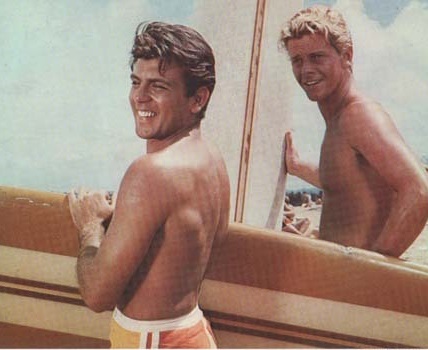
Ride the Wild Surf (1964) capitalizes on the star's androgyny.  College student Jody (Fabian) hits Hawaii's North Shore with his buddies Steamer (Tab Hunter) and Chase (Peter Brown), to surf amid crowds of male surfers and spectators (only a few girls). Surfing becomes intensely homoerotic spectacle: they stand, their power distilled into a sharp thrust of surfboard, and explode toward the shore, all bronze chests and thick biceps, war-whooping a triumph over the elements that has nothing to do with heterosexist civilization.


Should Jody stay in Hawaii forever, luxuriating in the male beauty, living as a beach bum, or get a girl, go back to college, and settle for the staid heterosexist future of wife, kids, job, and house?  You know how it will end -- he picks the girl. Yet there is no fade out boy-girl kiss: Jody wins a surfing contest and is enveloped by his jubilant buddies, all hugging and hollering, a solid mass of men as the camera pans out to a wide-angle shot of surf and sky.

Fabian continued to act through the 1960s and 1970s, starring in Fireball 500  and Thunder Alley with Frankie Avalon, in an adaption of Agatha Christie's Ten Little Indians, in a cautionary tale about the dangers of marijuana.  And he continued to display his physique, including nude shots in Playgirl.  

You can see the nude photos on Tales of West Hollywood.

Today he is still performing, based out of Branson, Missouri.

May 16, 2017

The Beefcake Bonanza of Surfing Ads, Logos, Decals, and Miscellanea

If you're a collector of beefcake art, check out surfing miscellanea: decals, logos, posters, and ads, meant to be thrown away after use, and so quite rare today.  You can get some surfing history and culture along with the muscular guys.

This is a parking sticker attesting membership in the San Onofre Surfing Club.  (San Onofre is a state park about 80 miles south of West Hollywood.)


Distressed wooden surfboards frame the decal for the North Shore Longboard Club in Oahu, Hawaii.


A wooden plaque advertising the North Shore of Hawaii.


Waikiki Beach, south of Honolulu, where the Hawaiian royalty surfed on longboards.  This plaque shows three hot guys and a surfing dog wearing a lei.


La Côte des Basques is a beach in Biarritz, in the Basque country of southern France.  La Côte Basque was a famous restaurant in New York City.

More after the break.


May 4, 2017

Beefcake and Bulges in Surfing Art

I expected paintings about surfing to highlight buffed male bodies and bulging swimsuits, but they tend to emphasize gigantic waves and crashing surf, making the bodies as small and insignificant as in traditional Chinese paintings.  Or they emphasize the surfing babes.  I only found a few that showed some beefcake.

Nathan Miller shows a buffed Polynesian in blue shorts against a stylized surf.


Bill Ogden shows a muscular, long-haired blond guy fighting a giant wave.


Michael Cass gives us a frontal view of the red swim trunks, with an almost photographic precision.


Vividly colored but stylized, Douglas Simonson's surfer polishes his board in rainbow colors.


Georgi Dmitrov offers a realistic surfer, but he's surfing on a shark.

More after the break.


Dec 25, 2016

Gay Surfers Down Under: Xavier Samuel


Speaking of the Twilight saga, Xavier Samuel, who plays muscular college-age vampire Riley Biers, has starred in many gay-positive movies and tv series back home in Australia.


2:37 (2006), a high school angst ensemble, with a gay dopehead facing homophobia (and getting a boyfriend).


Newcastle (2008), about surfing brothers Jesse (Lachlan Buchanan) and Fergus (Xavier).  Fergus has a boyfriend, Andy (Kirk Jenkins).  They frolick naked in the surf.

.


Best friend to a gay guy (Miles Szanto) in Drowning (2009).

And even when there's no explicit gay content, there's plenty of homoromantic buddy-bonding.  And nudity


September (2007), about two teenagers, the white Ed (Xavier, left) and the black Paddy (Clarence John Ryan, right), trying to hold their friendship together during the turbulent 1960s.

A Few Best Men (2011), about a bridegroom (Xavier) who can't choose one best man from among his three mates.


Two Mothers (2013), about two women who fall in love with each other's sons (Xavier, Ben Mendehlson), who happen to be best friends.  Haven't seen it, but apparently there's some beach frolicking.

Sep 16, 2016

Beach Movies 1: The Beefcake

The beach movie crazy began with Beach Party (1963), and lasted through Catalina Caper (1967).  During that 4 year period, American International Pictures churned out a dozen beach movies, starring former teen idol Frankie Avalon and former Mousketeer Annette Funicello, or if they were too busy, Dwayne Hickman, Tommy Kirk, Deborah Walley, and Yvonne Craig.  Other studios churned out their own teen-idols-in-Speedos movies, starring Bobby Vinton, Fabian, James Darren, Tab Hunter, and when they ran out of teen idols, Rod Lauren, Frankie Randall, Michael Callan, James Stacy, and Edd "Kookie" Burns.


The plot of the beach movie is the same in every installment: a gang of teenagers arrives in Malibu for a summer vacation.  Frankie and Annette (or their stand-ins) argue: she insists that they plan for marriage, the next step in embracing their heterosexual destiny, but he is too happy surfing, skydiving, and drag racing.

That is, he refuses to give up his homoerotic buddy-bonding with gay-vague chums.They separate, flirt with others, complain about each other to their friends, snipe at each other at the teen hangout, and walk forlornly on the beach.

Meanwhile a greedy corporation hopes to exploit the teenagers, or else salt-peter their heterosexual passions.  Maybe some juvenile delinquents cause trouble.  The climax comes in the form of a cartoonish teenagers vs. adults or delinquents brawl or car chase.  Frankie and Annette save the day, reconcile without resolving their disagreement, and head for home.


The teens are staggeringly affluent, white, and free from parental intervention of any sort.  They have all of the freedom of adulthood and none of the responsibilities.  They are living in their own surreal world of spies and saboteurs, drag races and skydiving contests, musclemen hanging from helicopters, gorillas riding surfboards.  There are Martians, mermaids, witch doctors, dime store Indians, bumbling crooks, and a girl whose gyrating hips cause volcanoes to erupt.

Every now and then Frankie mugs at the camera and asks "Can you believe this?"


And there is endless beefcake.  There are many girls in bikinis, but the beach is crowded with swimsuit boys; bulges are displayed as prominently as cleavage.  Jody McCrea's bulge makes a regular appearance.

John Ashley is dragged along the beach, the camera zooming in to capture the curve of his thighs, the tight muscles of his legs and calves, and even his frontside.

Tommy Kirk (left) wears a purple swimsuit so revealing that one can't imagine how it passed the sensors (not this photo).


Frankie doesn't bulge, but he is constantly shirtless, bedding down among his chums or standing tall and iconic beside his surfboard, his smooth, toned body preternaturally bright.

 In Fireball 500 (1966), which doesn't have a beach scene and only counts as a beach movie because it stars Frankie and Annette, Frankie spends a long scene shirtless, being interrogated by the police in his hotel room.  He never thinks to get dressed, though the officers stare at him, and one cheekily inserts his business card under Frankie's pendant, against his bare chest, like someone might insert a card into a woman's bosom.

Too bad the Disney Channel's Teen Beach Movie (2013) doesn't fare as well.

Next: The Duds

Jun 3, 2016

Mako Mermaids and Mermen

Mako: Island of Secrets (2013-), airing in the U.S. as The Mako Mermaids, is a sequel to H2O: Just Add Water that expands on the mythology and introduces that rarest of creatures, a merman.

Actually, anyone who comes in contact with the magic water on Mako Island will become a mer-person, but it never happened to a guy on the original series.

Here the protagonist is Zac (Chai Romruen), who becomes a merman after falling into the magic Moon Pool.  He heads back to Australia, trailed by three mermaids, Sirena, Nixie, and Lyla, who want to take away his merman powers.  They eventually befriend him and start dating mortal boys.

The mythology is further developed, with mermaid society skirmishes, dark secrets from the past, and a mysterious trident that may be the key to everything.


Heteronormativity still reigns supreme, but there's a tiny bit of homoerotic buddy bonding between Zac and his mate Cam (Dominic Deutscher), who quickly discovers his secret.


And Eric (Alex Cubis), a mysterious figure who belongs to a rival mermaid pod.

Plus, the beefcake quota is even higher.  In addition to Zac, Cam, and Eric:


Chris (Taylor Glockner), a dolphin trainer who suspects the secret.


Gabe (Chris Cocciolone), a lifeguard.


Karl (Mikey Wulff), a marine park worker.


Joe Davidson.  Ok, he was only in one episode as "Surfer Boy," but I couldn't resist.


Feb 9, 2016

Charlton Comics: More Gay Subtexts than Casper


When I was a kid in the 1960s, my staple was Harvey comics: gay-vague pacifist Casper the Friendly Ghost saving the world from science-fiction threats.  I liked the Gold Key jungle comics, Little Lulu, Archie, and occasionally a Marvel or DC title, but I hated the bottom-of-the-barrel Charlton comics: cheaply printed on bad paper, amateurish illustrations, horrible dialogue, stupid stories.

Until one day my boyfriend Bill  suggested that I take another look: "They're all full of best men."

That was our word for gay romantic partners.


I wasn't convinced.  "No way.  Harveys are lots better."  I picked up the first on the pile.  "Abbot and Costello?  My Grandma talked about them -- they were on tv like a thousand years ago."

"The big guy has to rescue the little guy all the time."

A same-sex rescue was our main test of whether two guys were friends or "best men."


"What about Timmy the Timid Ghost? It's stupid!"

It was a blatant knock-off of Harvey's Casper the Friendly Ghost.  There was even a tough derby-wearing ghost, Manny, a blatant knock-off of Harvey's Spooky the Tuff Little Ghost

"Do Casper and Spooky live together?" Bill asked pointedly.

No.  Casper lived with his uncles, and Spooky lived alone.  Their paths rarely crossed in the vast Enchanted Forest.

Domesticity -- male characters living together -- was our second test of best men!


The only original characters made no sense, like Surf n' Wheels: good surfers vs. evil motorcyclists in one issue, then crime fighting surfer-motorcyclists in the next.

But Bill pointed out that they had their shirts off for about half of every issue, more than you ever got with Harveys.

Beefcake -- guys taking their shirts off, or even better, wearing only underwear or swimsuits -- was our third test!


Bill pointed out that some Charlton titles, like Hercules, Jungle Jim, and Robin Hood, were even more beefcake-heavy than the Gold Keys.

Beefcake, same-sex rescues, and domesticity.  What else could you ask for in a comic book?

Good stories, interesting artwork, and dialogue that made sense.  I still didn't like Charlton.


Related Posts Plugin for WordPress, Blogger...