Showing posts with label swinger. Show all posts

Sep 5, 2019

Teen Angels

A year before they caused a counterculture-establishment standoff with their Smothers Brothers Comedy Hour (1967-70), comic duo Tommy  and Dick Smothers starred in an "I've got a secret" sitcom, The Smothers Brothers Show (1965-66).

Dick, the "straight man," plays a young, hip, self-absorbed bachelor in the Bill Bixby mold.  The paranormal event that jolts him out of his heterosexist stupor is not a crashed spaceship, but a knock on the door: his irreverent, anarchic, "queer" brother Tommy, lost at sea two years ago, has returned as "an apprentice angel," assigned to oversee Dick's life and do good deeds.

The plots involved Tommy's good deeds -- reforming gangsters and juvenile delinquents, helping the homeless, helping a musician change his tune -- and Dick's fruitless attempts to continue his skirt-chasing in instead of accepting a supernatural, well-night omnipotent same-sex bond.

I don't remember much about the series -- I was very, very young at the time -- but I remember Tommy's marvelous nonchalance about gender transgressions. To liven up a nursing home, he puts on old-lady drag and cavorts with the old men.


Fast forward thirty years, and the premise was recast in Teen Angel (1997-98), starring Corbin Allred  (left) as Steve, a young, hip, self-absorbed high schooler in the Michael Cade mold.  Again, a knock on the door: his irreverent, anarchic, "queer' best friend Marty(Mike Damus), who died last year after eating a spoiled hamburger, has returned as "an apprentice angel," assigned to oversee Steve's life and do good deeds.

The plots involved Marty's good deeds -- mostly helping Steve pass tests, get on the wrestling team, get the lead in the school play, and so on.  The sibling relationship gone, Marty and Steve become a more obvious romantic couple; though they both display heterosexual interests, they are obviously devoted to each other.


Again, Marty displays a marvelous nonchalance about gender transgressions.  When Steve likes a  cheerleader named Jessica, Marty senses that she will reject him, so he morphs into Jessica to go on the date.

What can we learn about the social changes between 1965 and 1997:
1. MORE heterosexism.  More tongue-lolling, leering, moaning insistence that boys and girls together are the meaning of life.
2. MORE subtext. More touching, more tenderness, more caring.
3. Humorous gender transgressions are ok, but you still aren't allowed to be gay.

Jul 30, 2019

Swinging Bachelor Detectives of the 1960s

The early 1960s was overloaded with tv shows about "swinging bachelors" who dug the ladies but found their deepest emotional bonds with each other: Route 66, Follow the Sun, Bourbon Street Beat, It's a Man's World, Hawaiian Eye, 77 Sunset Strip, Surfside 6.  (Sea Hunt was an exception, about a solo scuba diver.)

They usually had a female friend who worked the switchboard or sang at the local bar and provided opportunities for leering, but few if any plots involved them finding heterosexual romance.

The bachelors were often discovered by gay talent agent Henry Willson, so they were often gay, bisexual, or gay friendly.

77 Sunset Strip (1958-64) paired Efrem Zimbalist Jr. (straight) and Roger Smith (straight) as detectives who lived in Los Angeles. Edd Byrnes (rumored to be gay) played Kookie, a hipster who worked at the nightclub next door, and eventually became a business partner. Jacqueline Beer played Suzanne, their telephone operator.

Bourbon Street Beat (1959-60) paired Richard Long (rumored to be gay) and Van Williams, left (rumored to be gay), detectives who lived in New Orleans.  Cal Duggan (straight) was their business partner.  Arlene Howell played Melody, their secretary.


Hawaiian Eye (1959-63) paired Anthony Eisley (rumored to be gay) and Robert Conrad (straight) as detectives who lived in Hawaii.  Connie Stevens played Cricket, who sang at the Shell Bar.


Surfside 6 (1960-62) paired Van Williams (just before he played The Green Hornet),  with Lee Patterson (gay) as detectives who lived on a houseboat docked at Miami Beach.  Troy Donahue, left (rumored to be gay) played their friend, a wealthy playboy who lived on the yacht next door.  Margarita Sierra played a woman with the odd name "Cha Cha," who sang at a bar with the odd name "Boom Boom Room."


Follow the Sun (1961-62) paired Brett Halsey (rumored to be gay) with Barry Coe, left (straight) as writers who solve crimes in Hawaii. Gary Lockwood (bisexual), who appeared shirtless in The Magic Sword, played their assistant.  Gigi Perreau played their secretary.

What are we to make of this abundance of beefcake and buddy-bonding?

An idolization of the unmarried and unattached heterosexual swinger, after years of 1950s Family Men.
A fear of the feminine: women were portrayed as a pleasant distraction from the important things in life. But inadvertently it gave Boomer kids a glimpse of homodomesticity, men who lived together, loved each other, and didn't need a woman to fulfill them.

Aug 1, 2018

The Gay Rat Pack

Between 1960 and 1965, when all-American beefcake was giving way to suave, sophisticated, and cool, The Rat Pack ruled Las Vegas.  They were five actors and singers, performing regularly at casinos like the Sands.  They were famous for living the Cool Life, drinking, gambling, sporting, chasing dames, and having fun. They were famous for their connections to the mob and the Kennedys.  But mostly they were famous for being friends. When one appeared, he was asked about the others.  Their spats and reconciliations made front page news.

The homoerotic subtext of the Rat Pack bond is obvious -- today, anyhow.  They were all about male bonding, with the intensity and physicality of romance.  And audiences cheered them for it.

Some of them were bisexual in real life.  Others were homophobic -- even more than what one expects in the homophobic 1960s.  In order, from least to most gay-friendly, they were:


5. Frank Sinatra, age 45 in 1960 (top photo), The Chairman of the Board, a teen sensation of the 1940s, still releasing old standbys and finding a whole new generation of fans. Although he starred in the gay symbolism-heavy On the Town, he also starred in one of the more homophobic movies of the 1960s, The Detective (1968), and was reputedly so homophobic in real life that he threatened reputedly-gay Johnny Mathis.

4.Joey Bishop, 42-year old comedian, sitcom star, later talk show host. Married during the days of the Rat Pack womanizing, kept to himself a lot.  Bff of future talk show host Regis Philbin.

3. Dean Martin (left), age 43, whose comedy act with Jerry Lewis in the 1950s had distinctive, perhaps intended homoerotic undertones.  In the 1960s he released some popular songs, had a comedy-variety show and starred in the detective-spoof Matt Helm series. His son, Dean Paul Martin, was bisexual.


2. Peter Lawford, 37 year old former child actor, later a tv star (he was on The Doris Day Show).  Everyone thought he was gay; Louis B. Mayer went as far as to order testosterone injections as a "cure." Got married to Pat Kennedy, the future President's sister, over the objections of her father -- he didn't want his daughter married to a gay guy. Reputedly had relationships with Tarzan Gordon Scott, Rock Hudson, and Merv Griffith.


1. Sammy Davis Jr., age 35, "Mr. Show Business," dancer, singer, actor.  Converted to Judaism.  Kissed Archie Bunker on a famous episode of All in the Family.  Bisexual, tended toward men, preferred clean-cut all-American types.  Closeted to the other Brat Packers (except maybe Peter Lawford), but opened up to teen idol Paul Anka, whom he thought was gay (everyone did at the time).  Mentioned being bisexual in print as early as 1978. Died in 1990.

See also: Dean Paul Martin

May 26, 2018

If It's Tuesday, This Must Be Belgium

 If It's Tuesday, This Must Be Belgium (1969) was advertised as a hilarious comedy about a group of Ugly Americans on a whirlwind tour of Europe, but I found it heartbreaking.  In fact, I was hesitant about revisiting it after forty years, for fear that it would bring back the intense feelings of longing and loss that had me almost in  tears as a kid.

When you find something heartbreaking that the rest of the world thinks is hilarious, there must be a subtext somewhere.


There was beefcake.  Lots of it.  Ian McShane, the Swinging Sixties Bachelor who herds the tourists around Europe, displays his body frequently as he falls for and loses prim librarian Suzanne Pleshette.


Luke Halpin, formerly a teenage hunk on Flipper (1964-67), wanders around Europe as a hippie in painted-on jeans as he falls for and loses apathetic teen Hilary Thompson.


Even the hunky Sandy Baron, fresh from his odd-couple sitcom Hey, Landlord (1966-67), displays a toned hairy chest as he rips his shirt off and dives into a Venetian canal to avoid a marriage-crazy relative.  (Incidentally, Sandy Baron would become famous thirty years later on Seinfeld, as the doddering oldster Jack Klompus).

But beefcake doesn't make for poignancy.

Sandy Baron's character doesn't seem to be interested in girls, but otherwise I find no significant gay content.  No male bonding, no same-sex rescues.

So why was it heartbreaking?

Maybe it was the metaphor of escape. Dozens of Boomer movies and tv programs were about people trapped in a dangerous alien world -- Gilligan's Island, My Favorite Martian, Danger Island,  H.R. Pufnstuf, Lost in Space.  They are desperate to get home, to return to their conventional lives, to their jobs and houses and husbands and wives and stark heterosexist conformity.  But If It's Tuesday has it backwards -- the alien world is a Paradise, an escape from their conventional lives to a world of light and color and infinite possibility.

At the end of the movie they all reject the romantic partners they've fallen in love with and go home -- you can't stay in Oz forever -- as the theme song says, "Can't wait to tell the folks back home."  But for a nine-year old in a dull factory town, it was heartbreaking to know -- or to suspect -- that Oz existed, that there was a good place out there somewhere.


Apr 12, 2018

It's a Man's World: A Gay Threesome from the 1960s


 Speaking of Ted Bessell, before That Girl, he starred in It’s a Man’s World (1962-63) as Tom-Tom, a college student obsessed by Beat poetry and jazz, both emblematic of the multisexual bohemian subcultures of the 1950’s.  


Tom-Tom lives on a houseboat with his teenage brother Howie (Michael Burns, right) and boyfriend Wes (Glenn Corbett, above, who by the way was bisexual, and appeared in Physique Pictorial under the name Glenn Robinson).

But the couple is not happy; they are always arguing about chores and money.  One night Tom-Tom can’t take it any more.  He wanders into a waterfront tavern, where newly-arrived country boy Vern (Randy Boone, left) is playing the guitar. 

In perhaps the first gay pick-up in television history, the two exchange suspicious glances and then knowing grins.  The next scene shows them returning to the houseboat to spend the night together, and in the morning Tom-Tom tells Wes that it was not just a bar pick-up – Vern is moving in.  


Wes gets somewhat snippy about this new threat to his dominance, but soon he decides that having a cute farmboy around might be fun, and the episode ends with the trio splashing about in the water, the first gay three-way relationship in television history.

This series was before my time, and I only saw one episode, thanks to an ebay collector.  Unfortunately, according to tvobscurities.com, later episodes backed away from the gay subtext -- really more of a text -- and gave them girlfriends.

See also: That Girl: Will and Grace for the 1960s; and Get Your Beefcake on Route 66

Jun 15, 2017

Bill Bixby: My Favorite Martian


Bill Bixby played swinging 1960s bachelors with glamorous jobs, cool pads, boss threads, and a never-ending supply of babes -- until one day something happened that changed everything, made his heteronormative hedonism seem trite and crude.


In My Favorite Martian (1963-66), his Tim O'Hara rescued a Martian scientist from a crashed spaceship, and had to keep him hidden from the world.  But what started out as a standard "keep your unique talent hidden" sitcom like I Dream of Jeannie and Bewitched quickly developed into something more.  Tim and his so-called "Uncle Martin" share a home and a life and generally ignore the attentions of female suitors.  And though they rarely if ever disrobe on camera, they surround themselves with cute and muscular men:


In The Courtship of Eddie's Father (1969-72), his Tom Corbett is widowed, left with a young son (Brandon Cruz), like the Dads on a dozen other 1960s sitcoms.  But what started out as a standard "fix up Dad with a girl" plot quickly developed into something more.  Tom isn't really interested in marrying again.  Instead, he bonds with a coworker, magazine photographer Norman (James Komack).


 In an iconic photo, the three share the same  banana split, quite an unconventional family for the 1970s:

Bill went on to buddy-bond with Lou Ferrigno off-camera, while they were both starring in The Incredible Hulk.

May 5, 2017

Chad Everett

Chad Everett, who died in 2012, had a nicely toned physique and amazingly tight pants that became familiar to Boomer kids through beefcake appearances on many 1960s Westerns and swinging detective tv series: 77 Sunset Strip, Hawaiian Eye, Surfside 6, Maverick, Branded.  


He also starred in movies such as Made in Paris (1966) with 1960s standby Ann-Margret; Johnny Tiger (1966), as a Seminole boy trying to survive in the Anglo world;  and The Impossible Years  (1968), as the anti-establishment boy who dates the daughter of a stuffy college professor.


But he became most famous as a new Ben Casey, the young, idealistic Dr. Joe Gannon, who clashed with establishment Dr. Paul Lochner (James Daly) on Medical Center (1969-76).  No beefcake, but his square jaw and blue eyes, and tight pants caused him to become the first crush of lots of Boomer kids, and apparently there were several gay-themed episodes: a gay research scientists is blackmailed (1970); a "sexually confused" girl is assured that she's not a lesbian (1973); a transsexual doctor (played by Robert Reed) decides to have sex reassignment surgery (1975).


Chad was quite conservative in real life.  He caused a bit of a scandal in 1972, during a talk show appearance, by referring to his wife as "his property." The host laughed, but Lily Tomlin became so outraged that she stormed off the set.

But he still managed to play a gay cop on a 2006 episode of Cold Case, about re-investigation of old murder cases.  In 1968, Jimmy Bruno (Brian Hallisay) was seeing his partner, Coop Cooper (Shane Johnson).  Then Coop was shot and killed in a gay-bashing incident that the precinct covered up. 40 years later, Jimmy Bruno (Chad Everett) still remembers his lost love.

Jan 13, 2013

Love, American Style


In November 1966, my bedtime changed from 7:30  to 8:00, and a dozen beefcake and bonding shows were opened up for me:  It's About Time, Run Buddy Run, Time Tunnel, and My Three Sons, 

In November 1969, my bedtime changed from 8:00 to 9:00, and I felt terribly grownup as I watched Mission: Impossible, Hawaii Five-0, It Takes a Thief -- and Love American Style.  

It was an anthology show.  Every episode had 3 vignettes about heterosexuals interested in having sex with each other.  Bosses chased secretaries around the office. A plumber seduced a coed.  A wrong number turned into romance.

Sex was on everyone's mind, the unspoken impetus to every action.  No one ever had any, but they often planned to, as Hollywood mirrored the sexual revolution.  In the end the traditional "no particulars until your wedding night" was affirmed.

It was fascinating, a glimpse into a completely alien world.  There was nothing like this on The Brady Bunch or The Partridge Family.

Yet it was familiar and comfortable, due to the endless parade of guest stars that I knew and liked from other programs: Davy Jones, Bill Bixby, Don Grady, Ted Bessell, Tony Randall (left), Barry Gordon (below).


The adults all insisted with knowing grins that in a few years I would be joining their motley crue, with my own tongue-lolling machinations after girls, so I watched to get a glimpse of my future.

And I found:

1. Beautifully decorated apartments, groovy threads, a world of light and color.


2. Beefcake.  The men were always taking their shirts off.

3. Buddies.  While the protagonist quested after girls, his quiet, loving best friend stayed home and waited.  So wherever I went in life, at the end of the day there would be a man waiting.


In the first episode I saw, "Love and the Dating Computer" (November 3, 1969),  a mixup at a computer dating service matches two men, Francis (Broderick Crawford, right) and Marion (Herb Edelman, left).  They have everything in common -- they are perfecly matched  -- except for that little matter of being of the same sex.  But maybe that was what they were looking for all along.

See also: Love Boat/Fantasy Island


Dec 7, 2012

Gary Conway: Art, Wine, and Bodybuilding


 In I Was a Teenage Frankenstein (1957), #5 on my list of the Top Horror Movies of the 1950s, Whit Bissell plays an obviously gay Dr. Frankenstein who reads of a high school track team dying in a plane crash, exclaims with homoerotic ardor, "All those fine athletic bodies gone to waste," and hustles out to the cemetery to collect the choicest parts.

The resulting creature is not the groaning, green-faced slug of the Universal picture, but a teenage hunk with the "hands of a wrestler" and the "legs of a football player."

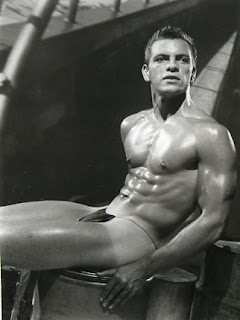
Producer Herman Cohen denies that there was anything special about Gary Conway, hired to play the monster; they just went down to Muscle Beach and grabbed the nearest hunk.  But surely it is no coincidence that Gary was studying art at UCLA (a gay-coded major) and posing for the proto-gay magazine Physique Pictorial.

Gary was actually heterosexual (he married in 1958), or, according to the rumor mills, bisexual, but being an art student, a model in publications aimed at at gay men, and a bodybuilder marked him as "gay."


His Monster has a hideously disfigured face but a beautifully sculpted body, displayed as he lift weights, shirtless (Dr. Frankenstein insists that "our main concern is your physique!").  But when he discovers that he has been constructed out of the stray body parts of dead athletes, he begins to cry.  The doctor muses, "We have a very sensitive teenager on our hands.

 Sensitive, code for gay, was not part of the master plan, and comes as an unwelcome surprise.

To remedy the problem of his deformed face, the boy monster and the doctor go shopping for a new one.  They park at a lover's lane, an oddly incongruent same-sex couple amid the heterosexual teens necking to big-band music.  One wonders why they don't just grab a teen hunk from the locker room.  Evidently, they need someone who has engaged in heterosexual practice to give the monster a heterosexual face."  So they unglue a blond prettyboy from his girlfriend's lips and take him back to the lab to become a face donor.

But even after the operation, the boy monster is not a man: he can't stop staring at his image in the mirror and stroking his cheeks.  "Quite handsome!" Dr. Frankenstein agrees.  "Quite, quite handsome!"  Of course, he is not really looking at his own face; he is admiring the beauty of the blond they harvested, that is, expressing homoerotic desire.

He is still a monster, not because he is violent or disfigured, but because he has failed to express the heterosexual desire necessary to become a real boy.  The film ends quickly and ludicrously when Dr. Frankenstein decides to disassemble the boy, ship the parts to England, and reassemble them there.  The boy naturally disapproves, and feeds Dr. Frankenstein to the alligators that conveniently live in a pit beneath the house.  Then he is accidentally electrocuted,dying because he cannot live.  There is no place for a "sensitive" teenager who admires male beauty in the 1950s.

During the 1960s, Gary had guest spots on nearly every Swinging Bachelor Detective drama and starred in Burke's Law (1963-65), as the assistant (but apparently not the boyfriend) of debonair detective Burke (Gene Barry).

In the late 1960s, he appeared on one of my favorite sci-fi programs, Land of the Giants (1968-70), as Steve Burton, pilot of a spaceship that crash-lands on a planet where everybody is. . .well, a giant.  Steve never took his shirt off, but at least he didn't display any heterosexual interest, and he sometimes buddy-bonded with one of the male castaways, Mark (Don Matheson), who became a close friend in real life.


During the 1970s and 1980s, he continued to act, as well as write (three covertly homoerotic Man-Mountain movies, including American Ninja and Over the Top), but he was increasingly involved in his first passion, art.  He also studied architecture and became an accomplished violinist, performing at the Hollywood Bowl.  And, lest anyone forget that he still had a spectacular physique, he posed nude for Playgirl.

If that wasn't enough to keep the multitalented performer busy, he bought a ranch in California, converted it to a vineyard, and developed his own wines.  And he wrote and illustrated The Art of the Vineyard. 

Related Posts Plugin for WordPress, Blogger...