Showing posts with label Washington. Show all posts

Oct 8, 2025

Bridger Buckley: Titan, pizza guy, kidnapped footballer, with a practically perfect physique and a donkey...or is it a camel?


Link to the n*de dudes


I've been watching The Neighborhood (2018-2025) about two nuclear families who are...um...neighbors, because someone on Reddit said that the femme, long-haired Grover (Hank Greenspan) was gay.  So far he hasn't expressed any interest in men or women, or really interacted with anyone outside the two families.

He doesn't appear in Episode 4.10, "Welcome to Jury Duty," (2022), but in the B-plot, Malcolm and Mary rent out their house for a movie, without realizing that it's going to be a porno.  They watch as the Hot Pizza Guy comes to the door -- and are shocked when he starts stripping off-camera.


Hot Pizza Guy is Bridger Buckley -- great name, attractive face, beautiful physique (pectoral perfection except for a dumb tattoo).  He's got one movie and two tv appearances listed on the IMDB, and I'm going to try to watch all of them.


An article in the Washington State Pullman student magazine provides some biographical details: Bridger Buckley grew up in Snohomish, Washington, a suburb of Seattle.  He was an "angry fat kid" who changed his diet, bulked up, and went out for football. -- Snohomish Panthers, class of 2014.  

He went to Washington State Pullman on a football scholarship, but was hit by a car during his sophomore year, resulting in a concussion and two fractured vertebrae.  It took a long time to recover, but eventually he returned to WSU and the football team.  Another injury, this time a badly sprained ankle, put an end to his football career, but not to his fitness goals.

By 2018, he was ranked #44 in West Coast Men in the Crossfit Games.


In 2019, he competed in The Titan Games, a sports reality show hosted by Dwayne Johnson: Fitness trainers, paramedics, accountants, soccer coaches, and other amateurs with amazing physiques faced Greek mythology-type challenges. 

Bridger won the Hammering Ram and Mount Olympus, permitting him to go on to the Battle of the Titans and win Herculean Pull,  In the season finale, The Titan Championship, he lost the Uprising (pulling an anvil through a series of concrete barriers).

 James-Jean Louis, a truck driver from Miami Beach, was named top male Titan.


After graduating from WSU Pullman in 2019, Bridger pursued a career as a fitness trainer and model.  He won #3 in the Male Commercial Actor of the Year Awards at the IMTA (International Modeling and Talent Association).

And he began auditioning:


More after the break

Mar 21, 2025

"The Residence": Murder at the White House, with a gay President, suit guy d*cks, and Randall Park's backside


Link to the suit guy d*cks

I wanted to see The Residence, a new Netflix comedy about a murder at the White House, because it has a gay character: the President. The Observer review specifies: "it's rarely discussed and simply accepted as part of the narrative landscape."  Buttigieg in 2028!  

Besides, I love a guy in a suit, and the White House will be full of them.

Episode 1 is "The Fall of the House of Usher," a reference to the Poe story 


Scene 1
: Thunder rumbles.  We pass the busts and portraits of former presidents.  An older man in a tuxedo (Giancarlo Esposito) walks down a busy hall, being greeted by passersby.  He peers down at a reception, and then a formal dinner with hundreds of people attending, including the Prime Minister of Australia.  There's a knock on the door, a woman screams, and we cut to the evening's entertainment, Kylie Minogue. The camera zooming through the hallways is making me dizzy.  Back to the screaming woman, who looks like Jane Curtin.  The older man is dead!

Giancarlo's backside and p*enis are on RG Beefcake and Boyfriends. 

Scene 2: The Capitol, a few months later.  A Congressional Hearing about the murder and the investigation that followed.  First to witness: Jasmine, the Chief Usher, in charge of overseeing the Executive Residence (the 3rd floor residence of the President and his family). 

Flashback to Jasmine sitting in the very authentic-looking Blue Room, drinking while she's supposed to be working. A waiter asked if she talked to him, and advises that she not do something she'll regret. Like murder?  "Too late, I already did."  


Suddenly Agent Rausch (a woman) appears, and brings her upstairs, where the President's best friend Harry Hollinger (Ken Marino, left) says that there's been an incident, and she has to keep everyone away from the second and third floors.  

Jasmine refuses to do it because she's only the assistant usher.  She thought she was going to be the chief usher, but it was made very clear that she wouldn't, so ask the actual Chief Usher, A. B. 

Ulp -- A.B. is the murder victim!

Scene 3: Jasmine takes the elevator down, and flashes back to meeting A.B. on the same elevator earlier that evening. She congratulates him on his upcoming retirement, but he announces that he's not retiring after all, so no Chief Usher job for her.  She bangs the doors and screams.  

Later Jasmine returns to a roomful of people, including the President's friend Hollinger, Secret Service Agent Trask, the FBI director, the head of the National Park Police, and Lawrence Dokes, chief of the Washington, DC metropolitan police. 

Scene 4: Testimony switches to Chief Dokes (Isiah Whitlock, Jr.).  He explains that the White House is his jurisdiction.  No, it's not.    

Back at the crime scene, he brings in Cordelia Cupp, the greatest detective in the world, to help out.  She's on the South Lawn, bird watching. Best Friend Hollinger insists that it was a suicide, so they don't need an investigation.


Cordelia enters, discussing Teddy Roosevelt's list of birds (a real thing), and examines the body and the room -- it was locked from the inside -- a locked room mystery!   

Next she interviews the person who found the body: the President's mother-in-law, Jane Curtin in a bathrobe, who was watching a movie on tv.  She didn't go to the dinner because she doesn't like talking to people, especially her son's husband, the President.  First indication that the President is gay at Minute 14.  She heard a thump and a door close, and investigated to find the body in the Game Room.  


Cordelia gets a tour of the various other bedrooms, gym, music room, and solarium.  The President's brother Tripp was asleep, heard the scream, and went back to bed.  Best Friend Hollinger has a room there, too, which makes Cordelia suspicious.

Hollinger explains the severity of the situation: the last administration pissed off the Australians (and the Canadians, and the Danes, and...well, everybody), and this is a state dinner designed to smooth over relations.  They need to figure out what happened and put the least disastrous spin on it in 45 minutes.

More after the break. 

Feb 12, 2025

"Twin Peaks: The Return": Paranormal weirdness 25 years later. See if you can figure it out. With Kyle's backside and James' d*ck


Link to the backsides and d*cks

We've been watching the 1990s cult classic Twin Peaks, about paranormal, cryptic, and just weird events befalling FBI agent Dale Cooper (Kyle MacLaughlan) as he investigates the murder of high schooler Laura Palmer, who had "lots of secrets."  And now we're on Twin Peaks: The Return (2017-18), a continuation of the original story.  

Some problems:

1. People stare for lengthy periods before speaking, and then speak slo-www-ly.  If conversations occurred at a normal pace, each episode would be ten minutes long.

2. About half of every episode consists of a naked woman talking to a fully-clothed man.  Granted, some of the men are attractive, but there's no way to look at them without seeing a lot of lady parts.

3. The story makes no friggin* sense.

See if you can figure out what's going in the first 2 episodes, plus a scene.


Red Room: 
 The original series ended with many unresolved plotlines, notably Agent Cooper (left) losing his (second) True Love and being possessed by the malevolent spirit Bob.    

In 2016, we discover that Agent Cooper was split into three parts.  The Doppleganger, controlled by the evil Bob, was loosed upon the world.  His body, now named Dougie, moved to Las Vegas, got a job in insurance, had a wife and a kid, and now consorts with hookers who stare at him for a lo...ong time while totally n*ked.  Agent Cooper's spirit was trapped in the Red Room, where the other spirits make cryptic remarks, talk backwards, and stare at him for a lo...ong time. 

Still trapped, Agent Cooper's spirit is talking to the Giant Alien, who told him that "the owls are not what they seem," one of the big unresolved mysteries of the original.  Now he tells him to listen to the sounds on an old Victrola. 

Twin Peaks: The psychiatrist who counseled and had s*x with Laura Palmer, now batshit crazy, is in his survivalist cabin, waiting for delivery of a bunch of shovels. 


New York:
 A young man (James Croak) has a job sitting in an empty room, staring at a large round window, to see if anything happens.  A girl from the coffee shop drops by, hoping to have s*x with him, but he can't because the security guard is watching, and he's not allowed visitors.  No one should know what's going on.  Doing a good job!

Twin Peaks: Benjamin Horne (Richard Beymer of West Side Story, top photo), owner of the Great Northern Hotel and the One Eyed Jacks casino and brothel, who had s*x with Laura Palmer before she died, was last seen going batshit crazy and thinking that he was a Civil War General. In 2016, he is telling a newly hired lady about the hotel rules.   His younger brother comes in, lambasts him for hiring someone else to have s*x with, and talks about his new business, marijuana.

Meanwhile, at the sheriff's office, Lucy the Receptionist turns away a salesman who wants to see "the sheriff," because he doesn't know which he wants: there are three of them, two named Truman, and one is sick.  The other is Robert Forster, the brother of the Sheriff Harry Truman who buddy-bonded with Agent Cooper 25 years ago.

Unknown Location: The Agent Cooper Doppelganger gets out of his car and bangs on the door of an isolated house.  After disabling the guard, he goes inside and stares for a lo...ong time at several people who will never appear again. He criticizes one for having inadequate guards, but she explains that "it's a world of truck drivers."  

She fetches a man (George Griffith) and a woman, and they hug everyone else in the house -- I forget how many people -- and leave with the Doppelganger.

New York: The coffee shop girl visits the young man who has a job staring at a window, with more coffee.  This time the security guard is out, so he invites her in.  They begin s*x, her backside bouncing, her boobs heaving, while we get a glimpse of his chest. Pay careful attention, as that's the only beefcake you'll be seeing amid the endless heaving breasts.  Then a wraith comes through the window and slashes them to death.  

Buckhorn, South Dakota.  An apartment has a weird smell coming out of it, so a resident calls the police.  There's a long, involved bit about who is in charge and who has the key, with a lot of characters who never appear again, until the lady realize that she has the key.  Oy vey.   Inside the apartment is the school librarian's head on the decapitated body of an older, chubby man.  We never find out who he is, or why the killer arranged them like that.

Twin Peaks: Sheriff Hawk receives a phone call from the batshit-crazy Log Lady, whose pet log has  psychic powers.  It has a cryptic message revealing that the disappearance of Agent Cooper 25 years ago was related to Sheriff Hawk's Native American heritage and "something missing."


Buckhorn, South Dakota
: The Forensics Lab has a match on the fingerprints in the decapitated librarian's apartment: they belong to the high school principal. (Matthew Lillard). So two agents and two cops, including the principal's best friend George, arrest him.  "It's all a mistake," he yells. 

Twin Peaks: To discover "what's missing," Sheriff Hawk pulls all of the files on Agent Cooper, and he and Receptionist Lucy go through them.  She ate a chocolate rabbit from some Easter evidence, but that's not it: his heritage has nothing to do with Easter bunnies.

Buckhorn, South Dakota: The Principal is interrogated about the decapitated people.  He was not having an affair with the librarian, and he was never in her apartment.  He can account for all of his activities on Thursday, except for about 15 minutes.  They lock him up, then get a warrant to go search his car.  There's either a human tongue or a piece of fish in the trunk.

The wife visits the Principal in prison to tell him that she framed him so she can pursue a romance with his best friend, George (Neil Dickson).  As she leaves, we see another cell occupied by a guy in an old-fashioned Davy Crocket outfit, covered with soot.  He vanishes.

At home, the Doppelganger tells the wife that she did a good job pretending to be a human being, and shoots her.

More non sequiters after the break

Mar 24, 2024

The Kensington Runestone

Every summer from kindergarten to college (when I decided to stay home), my parents dragged me on a week's camping trip somewhere up north, to Minnesota, Michigan, Wisconsin, or Canada.  It was usually pretty dismal, with no tv, no museums, no historic sites, nothing to do but hunt, fish, swim, and mess around in boats.

But during the summer after eighth grade, we went camping in Alexandria, Minnesota, site of the Kensington Runestone.


Young Swedish immigrant Olof Ohlman discovered the 200-pound slab of sandstone covered with Medieval runes in 1898.  It tells about a group of 30 Vikings who left Vinland "on an exploration journy" in 1362, and somehow made it to Minnesota.  One day some of them went fishing, and returned to find the men they left behind "red with blood and death," probably attacked by Skraelings (Indians).

Historians at the time -- and my junior high history textbook 70 years later -- stated categorically that no Europeans made it to the New World before Columbus, so this was a startling discovery, and immediately controversial.  The academic establishment decreed the runestone to be a fake, carved by Ohlman for financial gain.


In 1907, a historian named Hjalmar Holand bought the runestone, and spent the rest of his life trying to prove it genuine, describing how Vikings could well have made it to Minnesota in books like Westward from Vinland (1940) and A Pre-Columbian Crusade to America (1962). 

Most historians today contend that Holand was wrong: the runestone is indeed a forgery. But Alexandria loves its claim to fame.  There's a runestone museum and gift shop, and a 28-foot statue of a Viking, Big Ole.

Today, regardless of whether they believe that the Vikings got as far as Minnesota, all historians recognize that they reached the New World before Columbus, and established a permanent settlement in L'Anse aux Meadows, Newfoundland.


What's the gay connection?

1. The Vikings who explored Minnesota were all male.

2. Olof Ohlmann was rather cute.

3. My junior high history textbook was wrong.  The adults either didn't know about the Viking exploration of America, or they were lying about it.  What else were they hiding? Maybe the upcoming "discovery of girls" that everyone at Washington Junior HIgh was always evoking was a lie, too.

Nov 29, 2023

Archie Comics Queer Hint: My Date Must Be a Boy

When I was growing up in the 1960s and 1970s, heterosexual desire was assumed a constant, a universal of human experience.  Same-sex desire was not only never mentioned, it could not be mentioned.

It not only didn't exist, it could not be conceived of.

It wasn't just a certainty that no boy on Earth had ever longed for the touch of another boy, not once in the history of the world.

We were unable to even imagine the possibility.

Boys who obviously longed for boys?

They were looking for a buddy or a role model.


Boys who obviously didn't care for girls?

They were shy, or immature, or hadn't found the right girl yet.


Boys who were derided as "fairies" and "fags"?

Their interest in art and ballet, their inability to catch a ball, obviously represented deficient masculinity, but they desired girls as heartily as every other boy.

Desire for the same sex was simply beyond the boundaries of our imagination.

It was easier to conceive of hobbits.


But there were hints, mysteries to mull over, to contemplate like zen koans, to puzzle out like cryptograms.

Men on tv or in movies who cared for each other, fought for each other, and walked side by side into the future.

Men who didn't marry, who lived alone or with other men.

Boys smiled at me, or touched me on the shoulder.

The sight of a muscular frame that filled me with inexplicable joy.

Small subtle signs.

With a bit of a mind flip, you're into the time slip.

It's not raining upstairs.

Sometime in junior high, I read an one-page story in an Archie comic book.  Big Ethel's friends criticize her for being indiscriminate, accuse her of accepting dates with anyone, anytime, anywhere.

On the contrary, Ethel says, she has very exacting standards.
1. Her date must be a boy.
2. He must be breathing.
3. He must be a slow runner (so she can catch him as he's fleeing in terror).


It was just a throwaway joke with the punch line of "slow runner."  But I was mesmerized.  There was something -- a logical fallacy -- a paradox -- a hint.

Slowly it dawned on me: Ethel has a rule about dating only boys.

Such a rule is necessary only if there are other groups of people whom she could date.

Does she only date teenage boys, and not adult men?
Or only date boys, and not girls?

Could a girl date a girl?
Could a boy date a boy?

It's not raining upstairs.

Sep 1, 2023

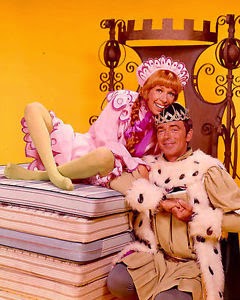
Once Upon a Mattress: The girl named Fred


December 12, 1972.  I'm in seventh grade at Washington Junior High.  After our usual Tuesday night dinner of tuna casserole, we gather in the living room and light up the Christmas tree-- we just set it up last night -- to watch tv.  But Maude and Hawaii Five-O are pre-empted by a musical called Once Upon a Mattress.  

A musical!  Gross!  "Can I be excused?" I ask.

"Don't be antisocial!" my father exclaims.  "Whatever you got to do, you can do it in here with the family."

I'm used to playing, reading, and doing homework in front of the tv  -- when I try to spend some time alone in my room, my father always yells at me to "Don't be antisocial!" and "Get out here with the family!"

What do they think I'm doing down there, anyway?

 But I have to get out of this stupid musical somehow!

"Um...I have to practice my violin."  I just joined the orchestra.

"Hey, if Boomer doesn't have to watch this junk, then I don't either!" my brother Ken complains.

So we get permission to hide in our  basement room.  But eventually I have to go to the bathroom, which means passing right in front of the tv set where that...ugh!...musical is playing.  I brace myself to rush through quickly, but I can't help glancing at the tv set.

It's Ken Berry from The Carol Burnett Show, who has nice muscles and a rackish smile.  He's singing "I'm in love with a girl named Fred."

Wait -- Fred is a boy's name.  Could he be...in love with a boy?

No, "Fred" is played by Carol Burnett.  But Ken goes on to explain why he loves her:


She is very strong.
She can fight.
She can wrestle.

These are the reasons that boys like boys!

I sit down to watch the last half.  It's a version of the "Princess and the Pea" fairy tale, about Queen Agrivain, who doesn't want her sissy son, Prince Dauntless, to get married, so she forces every potential bride to take impossible tests.

 But Winnifred, nicknamed Fred, is so tough and strong that she passes every test, so the wedding can take place.

(In 2005, Carol Burnett returned to the production as Queen Agrivain, with gay actor Denis O'Hare, below with his husband Hugo Redwood.)


I don't realize that,  when the original musical appeared in 1959, "clinging mothers" were assumed the cause of gay identity, so Prince Dauntless would be assumed gay.   I don't catch the sexual symbolism of the mute King who suddenly finds his voice.  And of course I have no idea  that director Ron Field is gay in real life.

But I know all about liking people who are tough and strong,  liking biceps and pecs instead of the soft curves that boys are supposed to long for.

And I know all about doing things on mattresses.

See also: Looking for Muscles on The Carol Burnett Show

Jul 23, 2021

Carl Sandburg's Two Gay References

Carl Sandburg (1878-1967) was from Galesburg, 60 miles south of Rock Island, so my teachers loved him.

I didn't.

Although he does look nice naked.

It seems that every English, language arts, writing, and history teacher from third grade through college foisted Sandburg upon us.

Chicago Poems!  Cornhuskers!  Smoke and Steel!  Slabs of the Sunburned West! The People, Yes! 

He was a two-bit Walt Whitman wannabe, with none of Whitman's homoeroticism.

When Sandburg mentions a man, it's only to pair him with a woman.

A Polish boy is out with his best girl; they marry next month; to-night they are throwing you kisses.


But mostly he's desperate to tell you how much he likes women.  Over and over and over and over.

Each morning as I move through this river of young-     woman life I feel a wonder about where it is all going, so many with a peach bloom of young years on them and laughter of red lips and memories in their eyes of dances the night before and plays and walks.


This wouldn't be so bad, except that he expects his intended audience to agree.  All beauty is feminine beauty, the Eternal Feminine is everybody's goal in life.

In high school we had to read Always the Young Strangers, maybe because it mentioned Rock Island and Augustana College.  But it's not, as you might suspect, about cruising for late-night pickups.

It's about Sandburg growing up in Galesburg,with no interest in male friendship, just devotion to family, the thrill of the feminine, and heterosexual sex.

He liked to imagine heterosexual sex.  Even when it was between his mother and father:

They were a couple and their coupling was both earthy and sacramental to them. There were at times smiles exchanged between them that at the moment I didn't understand but later read as having the secret meanings of lovers who had pleasured each other last night.

Do heterosexuals usually spend a lot of time imagining their parents having sex?

But the very worst was Rootabaga Stories, American fairy tales with an Edward Lear twist that were foisted on us in 3rd grade.

The titles didn't make sense:
"The Story of Blixie Bimber and the Power of the Gold Buckskin Whincher"
"How the Hat Ashes Shovel Helped Snoo Foo"
"Only the Fire-Born Understand Blue."

And once you got past the title, you got endless hetero-romance between men and women, boys and girls, and gender-polarized inanimate objects.

Except for one weird story about two skyscrapers who decide to have a child together.  Their genders aren't specified, but since they're phallic symbols, I'm going to assume both male.  Sandburg doesn't explain how their child comes about.  Maybe they adopt.

The only gay potential anywhere in Sandburg's work is in his 4-volume biography of Abraham Lincoln.  In The War Years (1926), he writes that Lincoln's relationship with Joshua Speed had "a streak of lavender, and spots soft as May violets."

And maybe in the poem "Planked Whitefish," in which a "demon driver" named Horace Wild tells Sandburg about an experience in World War I in Ypres (site of a major battle): a Canadian soldier nailed to a wall with bayonets, his sex organs cut off and shoved into his mouth.  The sight made him a pacifist.

Not exactly a gay-positive image.

See also: Gather the Faces of Men

May 20, 2019

Imposters: Gay Subtexts in a Long Con

The first episode of Imposters is nightmarishly heterosexist, but hang in there -- it gets better.

The awkward, shy, but somehow extremely wealthy Ezra (Rob Heaps) works for his father's shoe company, where water-cooler banter involves mostly boobs and how much you are getting. 

Somehow Ezra grew up less sexist, and married the "the woman of his dreams," the French-accented Ava (Inbar Lavi),  even though he has to negotiate his Neanderthal brother (Adam Korson) and boorish father (Mark Harelik), with their "does she like it when you have sex with her?" leering.

It's no wonder that she vanishes a month after the wedding, draining his bank account and leaving a very nice "it's not you, it's me" video.

Then Ezra meets dumb but formerly extremely wealthy jock Richard
(Parker Young, top photo), who married the same woman, only she called herself "Alice."  One month, bank account drained, vanished.

 And lesbian artist Jules (Marianne Rendon), who married Cece.  One month, bank account drained, vanished.

The trio vow to track down the elusive scammer, to get their money back, or at least say "how could you treat me like that?  I thought our love was real." (Their only cue is a story about her pet dog, which she told to each of them).  They are brok, so they indulge in some cons and identity-theft tricks to raise money, and become quite proficient at it.

Eventually they track down the scammer -- real name Maddie -- in Seattle, where she is working on her new mark, a disagreeable, violent-tempered banker (Aaron Douglas).

She has two older associates with the ridiculously 1940s names Max and Sal (Brian Benben, Katherine LaNasa), and a big boss, the ridiculously malevolent Doctor.  If ever she tries to get out of the game or shirk her duties by getting a boyfriend on the side, the Doctor will send in his cool-as-ice fixer (Uma Thurman).

 Things get complicated when Maddie falls in love for real with the extremely wealthy Patrick (Stephen Bishop).

And even more complicated when her banker mark ends up murdered.


And even more complicated when Patrick turns out to have a game-changing secret of his own.

And even more well, you get the idea... when the Bumblers (Ezra, Richard, and Jules) show up in Seattle, and agree to work with Maddie and her associates to bring the Doctor down.

Gay characters:  Jules, who starts dating Patrick's "sister" Gina, even though they're both working on cons against the other.

Maddie is bisexual, I suppose, but it's never referred to.

Gay subtext:  Richard strikes me as gay but not out (Jules even refers to this or that hot guy as his new "boyfriend" or "man-crush").  He has a gay-subtext bromance with Ezra, and then switches to Maddie's associate Max.  Side note: Silver Daddy Brian Benben was last seen as a bare-butt Dad on Dream On?

Beefcake: Occasional shirts off. The cast is surprisingly top-heavy with hot guys.  For example, Samuel Patrick Chu plays a nebbish working at the bank, not part of any scams, with only a few lines.  And here's his physique.

I've only seen one season of The Imposters.  My grade: B

See also: Chris Demetral

Oct 7, 2014

Fall 1972: How M*A*S*H Saved My Life

I hated my childhood church.  Everything was a sin: movies, comic books, rock music, books beside the Bible, games with cards, games with dice, restaurants that served alcohol, stores that sold alcohol, dancing, mixed swimming, carnivals, circuses, theaters, curse words, premarital sex, extramarital sex, nonmarital sex, thinking about sex....

Plus we had to sit through three services per week, on Wednesday evening and twice on Sunday, and they were all the same: tedious hymns from Victorian times, 45 minutes of the Preacher pacing and screaming and literally pounding his Bible, and then an endless exhortation to come down to the altar and "get raht with God."

We usually skipped the Wednesday service, and I didn't mind Sunday morning so much; the service ended at 12:00 sharp, and there was nothing good on tv anyway.  But Sunday night services had no limits -- they could go on for two hours or more, with a tv paradise back home: Voyage to the Bottom of the Sea, It's About Time, Flipper, Land of the Giants, The Young Rebels, Hogan's Heroes...

How to get out of going to church on Sunday night?  When I was in grade school, I tried four tactics:

1.  "I don't want to go!!!! I hate it!!!!"

That didn't work.

2. "I have a lot of homework to do."

No.  Nazarenes were forbidden from working on Sunday, including homework.

3. "I have a stomach ache."

Stomach aches were foolproof...there was no way to prove that you didn't have one, and you weren't necessarily sick. Maybe you just ate something that disagreed with you.

That worked once.  But my parents picked up pie and ice cream on the way home, and some jello for me.  Nazarenes weren't supposed to buy things on Sunday, but...

4. "Bill invited me over for a sleepover.  I can go to his church."

Nope.  Bill was a Presbyterian, and Nazarenes couldn't set foot in a "liberal so-called church."


When I started seventh grade at Washington Junior High, my parents began to watch me carefully, searching for any sign that I had "discovered" girls and thereby become a man.  Did I hang out with girls?  Did I mention any girls, even in passing?  Did I sign up for a mostly-girl club?  Did I notice an actress on tv?

Notice an actress on tv!

The biggest buzz in the 1972-73 tv season was M*A*S*H, a comedy-drama about doctors sexually harassing nurses and getting drunk during the Korean War.  TV Guide was particularly ecstatic over the sexually promiscuous Hot Lips Houlihan, played by Loretta Swit (right).

5. "I want to stay home and watch M*A*S*H.  It sounds good...."

I didn't even have to mention Hot Lips Houlihan.  My parents nudged each other, beaming with pride, and joyfully gave me permission to stay home.


Turns out that I hated M*A*S*H (except for Gary Burghoff as the cute Radar O'Reilly), and there was nothing else good on Sunday nights anymore.

But anything was better than being screamed at for 45 minutes.

And I learned a valuable lesson: my parents were so anxious for me to be heterosexual that they would give me permission to do anything, if there was even a hint of a girl involved.

See also: Slow Dancing at the Canteen

Oct 6, 2014

Homophobic Moments in Music: My Girl, Bill

In the spring of 1974, while I was arguing about Freedom to Marry in Mrs. Dunn's class at Washington Junior High, a ballad-style song by Jim Stafford called "My Girl, Bill" began  playing on KSTT radio.  But not for long.  Parents and preachers started screaming, and radio stations cut it from the air, and record stores yanked it from the shelves.

In order to find out what all the fuss was about, my boyfriend Dan and I had to wait until his album, Jim Stafford, appeared.

We still didn't understand.  It seemed to be a straightforward song about two men who are in love with the same women.  They meet to talk things through.  The narrator says: "I know that we both love her, and I guess we always will, but you're going to have to find another, because she's my girl, Bill."

What was the problem?  Maybe parents got riled because it mentions wine?

Two years later, when I figured out what gay people were, I realized that Jim Stafford was playing a trick on listeners: the comma was inaudible, so they thought that Bill was "my girl," a gay relationship was being described.  Unthinkable in 1974!

Of course, gay men never referred to their partners as "my girl."  In the 1970s, the most common terms were "my lover" or "my boyfriend."  It was only clueless heterosexuals who imagined that gay relationships must be divided on gender lines, with "a boy" and "a girl."

I don't know who was more homophobic: Jim Stafford, with his  nasty "joke," or the audience, who got all riled over the possibility that two men might be in love.

Stafford hasn't had a charting song since "Turn Loose of My Leg" hit #98 in 1977, but apparently he's still performing in Branson, Missouri.  I wonder if "My Girl, Bill" is still part of his repertoire.

See also: Discovering what "Gay" Means; and 12 Songs I Hate.

Jun 20, 2014

Fall 1973: Have You Had a Squirt Today?

When I was a kid, whenever I had the flu or an upset stomach, my parents would force-feed me 7-Up, the carbonated lemon-lime flavored soft drink.

As a direct consequence, I hated all lemon-lime flavored soft drinks.  I wouldn't go near them unless I was sick.

I still won't.


So I have never actually tasted Squirt, the grapefruit-flavored soft drink that gave 7-Up some competition in the 1960s and 1970s, before fading to the obscurity of the "off-brand" aisle.

But when I was going to Washington Junior High, my friends Dan and Darry and I had some fun with the name.  We were just becoming aware of some other things that squirted, so we greeted each other with dirty-sounding questions like:

"Have you had a Squirt today?"
"Want a taste of my Squirt?"
"Little Squirty has a present for you."

Little Squirty was the advertising mascot, a small blond boy carrying an oversized phallic symbol...um, I mean pop bottle.


Was the company aware of the dirty connotations of its product?

Maybe. This ad is captioned "When taste grows up, Squirt shows up."

The nerd in the striped swim suit and lollipop likes those other soft drinks, but once you grow up, you get muscular and start looking at ladies (or, in the case of the middle guy, your male friends).

And you suddenly find yourself wanting a Squirt.


Little Squirty was quite attached to that bottle, wasn't he?

Maybe he was trying to figure out a way to get to the Squirt without a bottle opener.  Hint: treat it like Aladdin's Lamp.

See also: My Junior High Fantasies of Paul Getty Jr.; and He'll Eat Most Anything.

May 31, 2014

Fall 1973: Junior High Fantasies of Paul Getty Junior

During the summer of 1973, just after 7th grade at Washington Junior High, I started reading newspaper articles about Paul Getty Jr., the 16-year old grandson of oil tycoon J. Paul Getty, who had mysteriously disappeared from his apartment in Rome.

Soon I discovered that it wasn't a paranormal disappearance: he had been kidnapped, with a ransom demand of $18 million.  His father and grandfather refused to pay, believing that he had somehow arranged the kidnapping himself.

The articles didn't say anything else about Paul, but the photos showed a cute, long haired guy with a slim build and dainty, feminine hands.

He obviously liked boys, not girls.  I imagined flying to Italy to mount a daring rescue, and getting a "my hero" hug and kiss.

Was he tied up with his shirt off?  Or naked? Was he struggling against the bonds, his chest heaving, his slim biceps straining?

On November 10th, a week before my 13th birthday, the kidnappers sent Paul's mother a package containing his severed ear, and warned that they would start returning him "by bits."  What body part would they cut off next, I wondered.  A finger -- or maybe his penis.

How big was his penis, anyway?

When I stormed into the dungeon where he was tied up naked, I would find out.  Then we would...

It never occurred to me to feel guilty over using Paul's ordeal as the subject of my junior high fantasies.

The elder Getty finally negotiated a deal, and delivered $2.9 million.  On December 13th, Paul was released.


He dropped out of the news, and I heard nothing more about him; I didn't even realize that Balthazar Getty, a noted actor of the 1980s, was his son.  But recently I began to wonder about the object of my junior high fantasies, and looked him up.

Apparently Paul was not as innocent as I imagined: living with a girlfriend, hanging out with criminals and mafiosi, using and selling massive quantities of drugs.

But he was bisexual: his biography notes experiences with both men and women.

After the kidnapping, he continued his jetsetting, bon vivant life.  He was married from 1975 to 1991, but pursued many friendships with gay men.  He partied with gay celebs like Elton John and Andy Warhol, who managed to talk him into nude photos.

It didn't take much talking.  Friends describe him as amiable, uninhibited, and eager to explore the risque.

And his tastes in clothing veered toward the Quentin Crisp style.

Paul was interested in show business, and starred in two movies, The Territory (1981) and The State of Things (1982).

But he continued to use massive quantities of drugs.  In 1981, at the age of 24, he drank a nearly-lethal mixture of alcohol, valium, and methadone, and suffered a massive stroke that left him paralyzed and nearly blind.

The tragedy did not destroy his spirit.  Friends say that he remained positive, amiable, and charming up to his death thirty years later.

See also: The Gay Anthropologist and the Cannibal; and The Disappearance of Sean Flynn.


Related Posts Plugin for WordPress, Blogger...