Showing posts with label novelty song. Show all posts

Dec 22, 2025

The First Bad Kid: Barry Gordon gets nuttin' for Christmas in 1955, plays gay-subtext teens, nebbishes, nerds, lawyers, and the Quik Bunny

In December 1954, three-year old Barry Gordon made the scene with Art Mooney's "I'm Getting Nuttin' for Christmas (because I've been nuttin' but bad)":

I broke my bat on Johnny's head;
I hid a frog in sister's bed;
I spilled some ink on Mommy's rug;
Bought some gum with a penny slug;
Somebody snitched on me.


Far more mischievous than Dennis the Menace or Peck's Bad Boy of the 1920s, he was a humorous precursor to the threatened or threatening kids whom the adults would fear through the 1960s. Audiences were amazed; the record sold a million copies, and hit #6 on the Billboard pop chart, beating out "Autumn Leaves" and "Love is a Many Splendored Thing."

But you couldn't have a kid miss out on Christmas forever, so they made him record "I Like Christmas" in 1955.  


During the 1950s and 1960s, Barry (who recorded many other songs, with  "Rock Around Mother Goose" and "I Can't Whistle" gradually giving way to "True Love Can Never Die," "Sealed with a Kiss," and "The Girl I Left Behind."  In the days of acid rock and Yellow Submarine, none of them charted.


He made some movies,  including Hands of a Stranger, Pressure Point (with Peter Falk and Sidney Poitier), The Spirit is Willing, and Out of It, in which a high school brain (Barry) buddy-bonds with a jock (John Voight).

Barry was nominated for a Tony for his performance in the Broadway play A Thousand Clowns (adapted for film in 1965), as a gay-vague teenager crushed when his free-spirit guardian (Jason Robards) caves to the establishment.


Barry also made the rounds of tv guest spots: Leave It to Beaver, Davis the Menace, Make Room for Daddy, Jack Benny, and Love American Style (in the 1969 episode "Love and the High School Flop-Out").  Why is he sitting with his hands like that?


He had bad luck with starring roles:

The New Dick Van Dyke Show (1971-74) pushed Dick into a "backstage at a tv studio" premise that his former co-star Mary Tyler Moore was already doing, in one of the most popular tv series of all time.  You can imagine what happened to the lifeless imitation. Dick's muscular son Barry as his announcer failed to incite much audience interest.

Our Barry played a writer on Dick's soap opera as the third season eked by. 

More after the break

Jan 26, 2025

Jozin z Bazin: The Czech Swamp Monster and His Boyfriend

The Czechs and the Slovaks were joined into Czechoslovakia from 1918 to 1993 because they have similar histories, cultures, and religions.  Their languages are mutually intelligible:

English: My penis is as big as a baseball bat
Czech:  Můj penis je stejně velká jako baseballovou pálkou
Slovak: Môj penis je rovnako veľká ako baseballovou pálkou

They have the same pop culture icons, like model Jozef Mikovčák (left).


Pop singer Miroslav Šmajda (aka Max Jason Mai), a contestant in the 2012 Eurovision Song Contest.


And Ivan Mládek, the Weird Al Yankovich of Eastern Europe, whose novelty song Jožin z bažin (Joey of the Swamp) has been popular since its tv premiere in 1978.

Like the American Monster Mash parodies monster movies, Jožin z bažin  parodies Czech heroic sagas, in which a swordsman kills a dragon and thereby win "half of my kingdom and my daughter's hand in marriage."


Except instead of a dragon, it's a swamp monster named Jožin (Joey), who lives in Moravia (near Brno) but mostly eats people from Prague.  The mayor of the village of Vizovice  offers the narrator half of the collective farm and his daughter's hand in marriage for capturing the beast.  So he drops sleeping powder from a crop duster, putsJoey to sleep, and sells him to a zoo.

Sounds heterosexist, except it's typically acted out with men playing all the parts.

Sometimes the daughter is never mentioned again.

And sometimes the narrator marries the monster.

You can see versions in Czech, Lithuanian, Polish, German, and Hungarian on youtube. With the proper tweaking of the lyrics, it can be turned into a political satire.


By the way, the older guy who pops up out of nowhere and makes frenetic dance moves is Ivo Pešák (1944-2011), who performed in Mládek's Banjo Band in the 1970s, and was a familiar face on Czech tv.  Want to see him with his shirt off?

Oct 30, 2024

Bobby Boris Pickett and the Gay Monster Mash

Born in 1938, Robert Pickett was a minor tv star, with roles in Dr. Kildare, The Beverly Hillbillies, Bonanza, and Petticoat Junction.  He displayed a respectable physique opposite gay teen icon Tommy Kirk in the beach movie It's a Bikini World (1967).  


(Left:  more respectable physique from Bikini World).

He recorded many songs, mostly  horror parodies: "The Werewolf Watusi," "Monster Man Jam," "Monsters on the Prairie."  But his biggest claim to fame was the novelty-horror song "The Monster Mash" by "Boris" Bobby Pickett and the Crypt-Kickers, which sprang to the top of the charts in 1962, 1970, and 1973.

 It has been covered by everyone from Boris Karloff to Alvin and the Chipmunks, heard on every tv series from Cheers to The Office.  


There isn't a lot of specifically gay or heterosexist content. Dr. Frankenstein is "working in the lab, late one night," when his Monster rises from the slab and wants to dance. Other Universal monsters appear and join in. The only conflict comes when Dracula prefers "The Transylvania Twist."  Nobody expresses any heterosexual interest, though Dracula has a son.

There's a video on youtube starring more explicitly gay versions of the monsters: they hug, hold hands, and collapse into each other's arms.


The 1995 Monster Mash: The Movie channels The Rocky Horror Picture Show, with two teenagers dressed as Romeo and Juliet (including Ian Bohan, left, later photo) trapped in a castle with the monsters, who want to use them for various nefarious purposes. Gay actor Adam Shankman plays a gay Wolfie, who wants to eat them.  It's not on DVD, but there are VHS tapes out there, and there's a trailer on youtube.

Bobby Pickett died in 2007.

See also: Jozin z Bazin, the Czech Swamp Monster.


Aug 25, 2020

Ocho Rios: Tracking Down a Jamaican Bodybuilder


Sometime during the 1990s, I was walking through the living room, and I caught the end of a music video.  It was about a frizzy-haired musician in a 1970s suit trying to sell his new song.

As he acts it out, we see him in drag, in a blond wig and a muumuu,  in a lush tropical setting, singing to a drag queen chorus

Musician:  I met a Negro in something something (four syllables). I didn't notice the inherent racism of the scenario at the time.

The drag queen chorus squeals as a massive bodybuilder walks by, thrusts out his bulge, and flexes his bicep.
Musician: I met a Negro...

Jamaican-accented bodybuilder:  I'm a Negro...

The bodybuilder then takes the drag musician rowing, where he sings:
Something something...I'll make you mine.

He lowers his swimsuit, and her eyes widen, shocked at his enormous penis.

That's all I remember: no title, no names of performers, not even the full video.  But it kept getting stuck in my head, inappropriate term and all.

I would be at the supermarket, or on the bus, and suddenly catch myself singing I met a Negro in something something.  I got quite a few stares!

Recently I decided to use my internet sleuthing skills to track down the music video, and the Jamaican-accented bodybuilder.  All I had was: 1990s, frizzy hair, Jamaica, drag, and the term "Negro."

Dozens of keywords searches on Google and Bing turned up nothing.

Wait -- this musician was obviously gay and from the 1970s.


"Gay composer" and "1970s"eventually  led me to Paul Jabara (1948-1992), who composed such disco hits as "It's Raining Men" for the Weather Girls, my favorite song of all time, and "Last Dance" for Donna Summer (which won the Academy Award for  Best Song in 1978).

There was a song called "Ocho Rios" in his discography.  No lyrics online.  But the right number of syllables, and Ocho Rios is the name of a town in Jamaica!  Could it be the source of my elusive music video?

Digging deeper, I found an article about a "pop operetta" De La Noche: The True Story," which Jabarra tried to get produced in 1985.  It was about a "lady of the evening" who finds true love with a 7'2", 300 lb  Jamaican bodybuilder!  Their union results in female octuplets, who are stolen and sold on the black market.  She searches for 21 years, and finally finds them, performing as a musical group, the De La Noche Sisters.

Sounds silly; no wonder Jabara couldn't get the funding to make a stage musical.

"Ocho Rios" is a track on the album, also released as a single.  It didn't get much airtime, as the term "Negro" was deemed offensively racist.  So Jabara produced a music video about his troubles, and got it played on MTV.  A least once.

I finally found a synopsis: turns out that there were no drag queens, just bizarrely over-made up women. The lady in the muumuu was Pat Ast, formerly a member of Andy Warhol's Factory.  And "The Negro" was voiced by Paul Jabara himself, feigning a basso-profundo Jamaican accent.

But who modeled the Jamaican bodybuilder?


More searching revealed that in 1973, Paul Jabara wrote and produced a musical, Rachel Lily Rosenbloom (And Don't You Ever Forget It), which folded after only a few performances.  Perhaps it was an early version of De La Noche: there was a song entitled "Oh, Ocho Rios," and a cast member named "That Negro."

Played by Andre de Shields, who would become a renowned stage actor, with credits including Hair, The Full Monte, Joseph and the Amazing Technicolor Dreamcoat, and Ain't Misbehavin'.  

Obviously not the same person as the Jamaican bodybuilder, whose identity remains a mystery.

But at least it's not an ear worm anymore.

See also: Subtext Songs of the 1980s.

Apr 25, 2016

Big Bad Brucie

I am a child of the television era; the tv was on from the moment we got home from school until well past bedtime, except during dinner.  We watched while playing, doing homework, reading, a constant, pleasant background to our lives.

Radio was trivial: the KSTT Top 40 Hits played every morning as we were getting ready for school, and sometimes late in the evening.  It was like an alarm clock.  You never deliberately listened.

Until the fall of 1975, my sophomore year in high school, when a friend told me about a late-night radio program, Dr. Demento.

It specialized in parodies and novelty songs.

The first night I listened, the playlist included:

"Dragnet Goes to Kindergarten"
"Pickle in the Middle with the Mustard on Top"
"Marvin's Duckie"
"Chicken Fat"
"They're Coming to Take Me Away"
"The Lumberjack Song"


And "Big Bruce," by Steve Greenberg.

Well at the beauty salon every morning at ten
Big Bruce arrived and kind of tip-toed in
He wore bell bottomed pants and a polka-dot tie
And whenever he spoke, it was just to say 'Hi'

And everyone knew when he swished into town
You could smell his perfume for miles around
He stood six foot five, and weighed 106
With a curl in his hair and a smile on his lips

He dies when his beauty salon catches on fire, and he goes back inside to fetch his purse.

That's what heteros thought gay men were like in 1975.

Many still do. This is Big Gay Al, from Southpark.  Grant Stone and Trey Parker still think gay men lisp and swish.

I had no idea that gay men existed in 1975, but I knew all about swishes:  boys who believed so strongly that they were girls, that they actually became girls, or rather a monstrous boy-girl hybrid: though male in form, they lisped, minced, swished, carried purses, wore dresses and perfume and make-up, called you "Thweetie," and were usually named Bruce.

Except the swishes I knew were figures of disgust and dread: they waited patiently in schoolyards and back alleys, breathing softly in the shadows, until an unsuspecting boy approached.  Then they pounced!  All it took was a slim, bejeweled hand placed on your shoulder, or a soft lisping whisper in your ear, and you would change, inevitably, into a swish.

Big Bruce was certainly ridiculed, laughed at, and looked down upon, but he was no threat.


"Big Bruce" was first released by Randy Sparks of the New Christie Minstrels in 1961.  He meant it as a parody of "Big Bad John," a Western ballad by Jimmy Dean (the guy who sells sausages)

On the queer music website, Randy Sparks writes: "Most gay men had no problem with laughing at the ditty, but any lesbians in my audiences seemed to immediately take offense, so I was careful where I sang it. I didn't want to make anyone uncomfortable."

I would certainly be yelling "homophobe!" now, but in 1975 it was a pleasant alternative to the horror the swishes usually brought.

The song was very popular in the homophobic 1960s, recorded by several other groups, including The Country Gentlemen (1966), The Faux Pas (1967),  Bill Stith (1973), and most recently Bird & MacDonald (1993).  Steve Greenberg's version is from 1969.

Jan 29, 2015

Dude Looks Like a Lady: Not as Homophobic as You Think

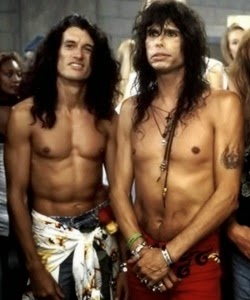
The hard-rock band Aerosmith, consisting of the extraordinarily ugly but extremely bulgeworthy Steven Tyler, Joe Perry, Tom Hamilton, and Joey Kramer, had a string of hits when I was in high school and college.  Mostly about heterosexual sex,  with slang, innuendo,  double-entendres, and obfuscation to keep the censors away:

She just loves my big 10 inch...record of her favorite blues.

Goin' downtown, goin' down, goin' down, neath the city, eatin' ground round

Their most famous song, "Walk This Way" (1975) is surprisingly explicit, to those familiar with 1970s slang:

You ain't seen nothin' till you're down on a muffin, then you're sure to be a-changin' your ways


"Dude (Looks Like a Lady)" (1987)  is often cited as the epitome of hard rock homophobia, a viciously anti-gay diatribe.

Except when I heard the song and watched the music video, it wasn't anti-gay or anti-transgender at all.  Steven Tyler meets a woman, goes into an alley to have sex with her, and is surprised when: "She whipped out her gun and tried to blow me away."  

But after his initial surprise, he doesn't attack, lash into a diatribe, or run away screaming.  He decides to go through with it anyway: "Baby, let me follow you down  -- do me, do me, do me, do me.  What a foxy lady!"

Even with the "gun," the lady turned out to be "foxy."

I would not be so accommodating to a Lady who Looks Like a Dude.

Songwriter Desmond Child describes working on the song with Aerosmith.  Joe Perry was worried that gay people would find it offensive, but Child said "I'm gay, and I'm not offended."

In fact, it was very accepting, especially during the conservative retrenchment of the 1980s:

Don't judge a book by its cover, or who you're going to love by your lover. 

See also: My Girl Bill; and Subtext Songs of the 1980s.


Oct 6, 2014

Homophobic Moments in Music: My Girl, Bill


In the spring of 1974, while I was arguing about Freedom to Marry in Mrs. Dunn's class at Washington Junior High, a ballad-style song by Jim Stafford called "My Girl, Bill" began  playing on KSTT radio.  But not for long.  Parents and preachers started screaming, and radio stations cut it from the air, and record stores yanked it from the shelves.

In order to find out what all the fuss was about, my boyfriend Dan and I had to wait until his album, Jim Stafford, appeared.

We still didn't understand.  It seemed to be a straightforward song about two men who are in love with the same women.  They meet to talk things through.  The narrator says: "I know that we both love her, and I guess we always will, but you're going to have to find another, because she's my girl, Bill."

What was the problem?  Maybe parents got riled because it mentions wine?

Two years later, when I figured out what gay people were, I realized that Jim Stafford was playing a trick on listeners: the comma was inaudible, so they thought that Bill was "my girl," a gay relationship was being described.  Unthinkable in 1974!


Of course, gay men never referred to their partners as "my girl."  In the 1970s, the most common terms were "my lover" or "my boyfriend."  It was only clueless heterosexuals who imagined that gay relationships must be divided on gender lines, with "a boy" and "a girl."

I don't know who was more homophobic: Jim Stafford, with his  nasty "joke," or the audience, who got all riled over the possibility that two men might be in love.

Stafford hasn't had a charting song since "Turn Loose of My Leg" hit #98 in 1977, but apparently he's still performing in Branson, Missouri.  I wonder if "My Girl, Bill" is still part of his repertoire.

See also: Discovering what "Gay" Means; and 12 Songs I Hate.
Related Posts Plugin for WordPress, Blogger...