Mar 18, 2022

Logan's Run


Based on a 1967 anti-counterculture novel, Logan’s Run (1976) is set in a post-Apocalyptic Love, American Style paradise, where hundreds of young, beautiful heterosexuals with blow-dried hair, the girls outnumbering the boys five to one, stroll the corridors of a gigantic shopping mall, shopping mostly for sex. If they are unsuccessful in hooking up at the mall, they drop by a “Love Store” for slow-motion orgies, or go home and dial up one-night stands on a teleportation circuit. The downside is everyone explodes on their thirtieth birthday. A few deviants called “runners” hide to avoid exploding, and try to break the city’s bonds and head out for the distant, mythical Sanctuary. It is the job of “sandmen” to hunt them down and kill them.


Michael York, straw-haired with languid blue eyes, and Richard Jordan, square-jawed and passionate, play sandmen partners Logan and Francis. Strolling down the airy causeways side by side, the two make a startling contrast to the crowds comprised entirely of boy-girl or boy-multiple girl groups. In the first scene, they gaze lovingly at Logan’s test-tube son in the City nursery as if they are both its parents. And Francis can’t seem to keep his hands off Logan: he is always grabbing him, hugging him, putting his arm around his shoulders or waist as they walk, and in one scene he literally orders Logan into a hot tub with him. In the original novel, Francis is practically a stranger.

Logan receives an assignment to go undercover as a runner and find Sanctuary, so the City can have it destroyed. He teams up with runner-friendly Jessica (Jenny Agutter),. Francis, meanwhile, thinks that Logan is really a runner, and follows, but not to kill him – to talk “sense” into him. 


Logan and Jessica, with Francis close behind, journey through the Cathedral, where wilding teenagers run rampant and shirtless; through endless underground corridors where renegade Sanctuary sympathizers hate sandmen; through an ice palace, where a giant robot named Box tries to freeze them; and finally though the wilderness beyond the City. They end up at the Library of Congress in the ruins of Washington, DC, and discover that there never was a Sanctuary.

Francis goes to great extremes, far beyond sandman duty, to stay close to Logan. He is injured, his uniform is shredded, and he even breaks the bonds of the City, an absolute taboo. When he finally corners them, he approaches Jessica not as a runner but as competition: “What did you do to him? He was happy. Now you’ve ruined him!” Then he rages against Logan, not because he has betrayed sandman principles, but because he has run off with a girl: “Why, Logan? We had good times. Why did you let her. . . .” Logan tries to explain that exploding at age thirty is unnecessary, that “we can grow old together.” It is unclear whether “we” means all humanity or he and Francis.

They fight, and Francis is mortally wounded. Logan cradles him in his arms; Francis seems to see him for the first time, smiles, and grabs his hand. “Logan!” he exclaims happily, “You’ve renewed!” And he dies.

Of course he has to die, so Logan and Jessica can have a “happy” heteronormative ending. Still, one rarely finds a more touching portrayal of same-sex love in 1970s film.

Mar 15, 2022

Andre Norton: Gay Subtext Science Fiction in My Junior High Library

I found The Hobbit during fifth grade, in the Folklore section of the Denkmann Elementary School Library, and thought it the best book ever written.  There were rumors of a sequel, something about "rings," so I checked out Moon of Three Rings, by Andre Norton.

That wasn't it.

Thereafter, through junior high and high school, I hated Andre Norton, and refused to read any of her works.

But when I was in college, the bookstore gang loved Andre Norton, so I gave her another try.  

And found a homoerotic paradise, where men forged intense, passionate, loving bonds with men, mostly with covers that were beefcake-heavy masterpieces.

The Time Traders: crosstime adventures of crook-turned-adventurer Ross Murdock and his far-future companion Ashe.

Galactic Derelict: Ross and Ashe are accompanied by muscular Apache Travis Fox to investigate a space ship from another galaxy.

Storm Over Warlock: A Terran survey expedition is attacked, leaving only two survivors: elite Scout Ragnar Thorvald and servant Shan Lantee.  They must travel together across the hostile planet to safety.

Voodoo Planet: Same plot, Voodoo Planet.

 Star Man's Son: Two muscular barbarians bond in a post-apocalyptic world.


Operation Time Search: Photographer Ray Osborne is accidentally transported back to ancient Atlantis, where he befriends the muscular young Cho and gets involved in royal intrigue.  And the most explicit gay romance I had ever seen in science fiction.

And on and on -- she wrote hundreds, and is still publishing, though she died in 2005.

There are also a lot of novels about women forming strong same-sex bonds, and a few with heterosexual romances.

I don't know why the gay subtexts predominate.  Maybe Norton was writing for an audience of juvenile boys, and assumed that they wouldn't be interested in hetero-romance "yet."?  Or maybe she thought that the world of intergalactic exploration would exclude women, just as her contemporary society excluded women from the sciences and technology.

I just wish I had read them in junior high.


Mar 14, 2022

Davey and Goliath: Gay Christian Allies


During the 1960s, if you happened to be too sick to go to church but not too sick to stay in bed, you were stuck watching Rocky and Bullwinkle, Totalitarian Cartoons, Wild Kingdom, or the claymation program Davey and Goliath (1961-65, with many tv specials afterwards), about a 10-year old boy who depends on God (and his talking dog) to get him out of Timmy and Lassie-style scrapes. He gets lost in a cave, trapped in an abandoned mine, falls through the ice, and so on.

He also learns God's opinions on cheating, stealing, helping others, forgiveness, obeying police officers, and being prepared to administer first aid.

My parents disapproved, because it was produced by the Lutheran Church, which was nearly Catholic.  But I was fascinated -- this was my first glimpse of a religion that didn't involve constant shrieks of "God hates everything!"

At church, the list of what God hated was endless: movies, comic books, dancing, swimming, theater, card games, tv shows about witches, science fiction.  And people: Catholics, Jews, Presbyterians, liberals, rich people, movie stars, people who don't go to church, single parents, divorcees, hippies, anti-War protesters, feminists, college professors.  But the God of Davey and Goliath was a lot more inclusive:

"The Polka Dot Tie": Davey and his friends make fun of a boy who wears a funny tie, until they realize that God doesn't reject anyone for being different.

"Blind Man's Bluff": Davey's friend doesn't like white people, until he realizes that God doesn't reject anyone for being different.

"Louder Please": Davey doesn't know how to deal with a deaf neighbor, until he realizes that God doesn't reject anyone for being different.

Besides, Davey and his friends never expressed any heterosexual interest, and they were kind of cute.


In a "queer" connection, Davey was voiced by Dick Beals, who had a long career in voiceovers (he was the voice of Speedy, the Alka-Seltzer spokesman, and the singing voice for Bobby Riha in Jack and the Beanstalk).  

Due to a hormone problem, Dick never went through puberty, allowing him to perform high-voiced roles through his life, and also marking him as a sexual outsider (he doesn't mention a sexual orientation in his autobiography).

He remained the size of a child throughout his life, but didn't let that stop him from driving a car and learning to fly an airplane.  He died at the age of 85 in 2012.


The Cartoon Network's Moral Orel (2005-2008) parodied Davey and Goliath with a world full of bitter, sadistic adults and an Orel who takes every Biblical metaphor literally.  Two gay kids are portrayed as perfectly nice, but the "moral" adults hate them.  The only really moral person in town is the lesbian who runs the local sex shop.


Mar 9, 2022

The "Better Nate Than Ever" Series: Gay Theater Kid from Pennsylvania


I have reconciled myself to the fact that the Better Nate Than Ever series by Tim Federle has nothing to do with the Big Nate series by Lincoln Peirce.  The characters just have the same name and age, the authors have both introduced coming-out story arcs, and googling on "Big Nate," "Lincoln Peirce," and "gay" brings you directly to a review of Better Nate than Ever.  

After you stop looking for connections, you find a very funny series of young adult novels about a gay theater kid.  Every book is written in the first person and present tense, which adds immediacy.  However, nothing can be included that Nate doesn't know at that moment, leading to some awkward attempts to position him in exactly the right spot to overhear vital information. 

In the first book of the trilogy, Better Nate Than Ever, 13-year old Nate sneaks from his small town of Janksville, Pennsylvania to audition for the part of Elliot, the boy who befriends a stranded alien visitor, in E.T.: The Musical.  Most of the story involves interesting real-life details of the extenuated audition process. 

Although Nate says that his sexual identity is "undecided," there are a few clues.  He sees two guys kiss through the open door of a bar, and no one beats them up; later he says that this was his favorite part of New York.  Plus he befriends Aunt Heidi's hot roommate, and watches him from the back as he walks down the street: "the pants fit very well," Nate comments. (The roommate will not appear in the 2022 movie version.)


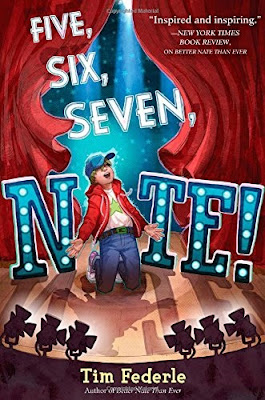
In the second book, Five, Six, Seven, Nate, Nate is cast, but not as Elliot: as the back-up understudy for E.T,, which means he has to learn all the lines and dances, but will only go on if both the actor cast as E.T. and his understudy fail.  Most of the book involves the interesting details of prepping and rehearsal for a stage play.  Plus Nate starts dating Jordan, the practically perfect experienced child actor cast as Elliot (he doesn't appear in the 2022 movie version, either.)

In the third book, Nate Expectations, the musical has closed, and Nate, now 14, is back home, in high school.  He and his friends produce a musical version of Great Expectations for English class, but can't perform it because they can't get the rights to the songs.  

There are also asides about Nate's parents trying to signal that they're ok with his gay identity without actually saying anything.   Plus Jordan, now cast in a tv show, begins ghosting Nate, and a new boy, Ben, starts expressing interest, culminating with a gigantic song-and-dance number to ask him to the Homecoming Dance.  We don't actually see the dance: the book ends when the English teacher assigns Nate a thousand-word essay on how he became his "best self," and he decides to title it Better Nate than Ever.

Now, if only someone could figure out how this all is connected to Big Nate.

See also: Better Nate Than Ever.

Related Posts Plugin for WordPress, Blogger...