Showing posts with label alien. Show all posts

Nov 2, 2025

Running from the Tripods


The first book that I thought of as “good beyond hope" as a kid, other than The Wonderful Flight to the Mushroom Planet from my earliest childhood, was The White Mountains (1967), by John Christopher.   Centuries ago, huge, lumbering tripods invaded the Earth, destroying human civilization and forcing the survivors to live in quaint Medieval villages, where they retain no memory of their former technological prowess.   At the age of fourteen, all children undergo a “capping” ceremony: they are carried off by the tripods, and return later as adults, heartily praised by their elders and plied with tablesful of “today I am a man” presents.  They also have wire mesh “caps” fused to their skulls to ensure absolute obedience to the Tripods.

Capping is obviously a metaphor for the onset of heterosexual desire, the glorious hormone-drenched "discovery of girls" that all of the adults drone on and on about once a boy reaches the age of twelve or thirteen.


Jack and Will (played by John Shackley in the BBC television production) live in a quaint post-Tripod village in rural England.  Jack is rapidly approaching his capping day, and has misgivings about his destiny as a thrall of the Tripods.  He and Will make vague plans to run away, but it is just a pipe dream; with the full force of adult society behind the practice, resistance is futile.  Soon Jack goes to be capped with the others, and he returns changed.  He now realizes that capping is wonderful: “You can’t understand now, but you will understand when it happens.  It’s. . .I can’t describe it” (19).  I heard many similar statements from older friends who had already acquiesced to their heterosexual destiny.

Despondent and alone, Will wanders aimlessly through the ruins of the long-lost technological England that stand everywhere beyond his village.  One day he encounters a vagrant named Ozymandias, who eyes him appreciatively and quotes a compellingly homoerotic Shakespeare (“Under the greenwood tree / Who loves to lie with me?).   After several similar flirtations, Ozymandias suggests that a rendezvous in the old ruins at night, when they will not be disturbed.  It is a frightening invitation, since Vagrants have been known to murder boys (or worse), but something compels Will to forsake his safe, gender polarized, heteronormative world and venture out onto the blasted heath.

Ozymandias does not have murder (or sex) on his mind, however.  He tells Will about the White Mountains (the Alps), too high for the tripods to climb, where a small group of men and boys live free from tripods and caps.  It’s a long and dangerous journey, “and a hard life at the journey’s end.  But freedom.”

Will jumps at the idea of escaping the tripods, and, along with his cousin Henry, sets out for the sanctuary in the White Mountains.  After crossing the English Channel, they are joined by another boy, a misfit science nerd named Jean-Paul, so tall and thin that they call him Beanpole.

Gay boys "knew" that the tripods were coming for them.  All of the adults said so.  In a day, or a week, or a month at the most, they would "discover girls," and no longer dream of boys and men.  No wonder The White Mountains was "good beyond hope." It offered a glimpse of that other place, the possibility of escape.

May 6, 2025

Austin Butler: Buddy-bonding teen idol, heteronormative adult hunk

This  amiable, grinning face -- and this well-defined chest -- are familiar to millions of gay and straight teens. They belong to Austin Butler, an Orange County boy who was discovered by a talent agent in 2005, when he was 13 (apparently such things still happen).

Soon he was appearing all over the Disney Channel and Nickelodeon, on Hannah Montana, ICarly, Zeke and Luther, The Wizards of Waverly Place, Zoey 101, and Jonas, usually as the boy that Hannah or Carly or Alex has a crush on.


And not just the Disney Channel. In Rudy and the Rockits (2009-2010), Austin played Jordan Gallagher, son of former teen idol Patrick Gallagher (Patrick Cassidy), who has a crush on his cousin Ruby (daughter of David Cassidy's character).

 In 2011, he starred in the High School Musical spin-off Sharpay's Fabulous Adventure, as the boy Sharpay hooks up with.


He starred in the tv series The Carrie Diaries (2013), a prequel to Sex in the City about Carrie's high school years, as one of the boys Carrie hooks up with.

You'd think that with so many roles as the object of a girl's crush, Austin would have little time for buddy-bonding. Incorrect.


In Aliens in the Attic (2009), the nerdish Tom (Carter Jenkins of Unfabulous and Struck by Lightning) and his hunky cousin Jake (Austin) must work together to save the world from the aliens in the attic.  When Jack is captured, Tom must lead a daring rescue, along with his sister (Ashley Tisdale) and her boyfriend Ricky (Robert Hoffman).  Jake doesn' t display any heterosexual interest, but seems to like Tom quite a lot


More after the break

Feb 10, 2025

Twin Peaks: The owls are not what they seem

In the spring of 1990, many tv viewers were persuaded to turn away from the Thursday night juggernaut of The Cosby Show -- A Different World -- Cheers -- and Wings to watch Twin Peaks, a tv series created by surrealist director David Lynch, to learn "Who killed Laura Palmer?"

No one knew that the answer would become so darn convoluted.

The premise: popular high schooler Laura Palmer of Twin Peaks, Washington, is found murdered.

FBI Agent Dale Cooper (Kyle MacLachlan, best known for Lynch's homophobic Blue Velvet) is called in to investigate, and works with local sheriff Harry S. Truman (Michael Ontkean, best known then as the gay guy from Making Love).


Gradually they discover that everyone in town has multiple dark secrets.  There are weird alliances and interconnections.  A middle-aged woman regresses to a teenager.  Laura's psychiatrist commits suicide.

Cooper has a dream of a backward-talking dwarf who is From Another Place, who makes cryptic utterances like "when you see me again, I won't be me" and "everybody is full of secrets."


Laura had several secrets of her own.  One wonders how she found time to hang out with her boyfriend  (played by Dana Ashbrook, left), when she was having affairs with several older men, as well as working as a prostitute to support her drug habit.  (In David Lynch's world, prostitution is the Ultimate Evil).

After seven episodes, the first season ended, with lots of clues but no answers.

During the summer of 1990, The Secret Diary of Laura Palmer was published, and became a must-read.  It offered no new clues.

You could also get Twin Peaks: An Access Guide to the Town, with tourist information about the town, including the cafe where Cooper got his "damn fine coffee!" and cherry pie.


In September 1990, the second season began, on Saturday nights.

A giant who may be an alien warns Cooper that "The owls are not what they seem."

Whatever that means.

Laura appears in a vision and says "Sometimes my arms bend back."

Whatever that means.

Cooper learns of Black Lodge, which can manipulate world events.

There was no way to unite all of the plot threads into a coherent whole, so in December they threw in a lame explanation -- Laura was murdered by her father, who was being possessed by a being named BOB, who was working for the Black Lodge, who...or something like that.  And everyone scratched their head and said WTF?  All this to murder a teenager?

This was the homophobic David Lynch, so of course there were no gay characters, other than some leering effeminate villains, and some unintentional gay subtexts in the interaction between Truman and Cooper.

No beefcake to speak of.

So why did Twin Peaks gain so many gay fans?

Maybe it's the sinister small towns.  In West Hollywood many of us came from small towns, and remembered them as prisons where everyone had lots of secrets.


Maybe it was wishful thinking.  We were waiting for one of the "secrets" to be about being gay.

Or maybe it was our own hidden knowledge.  Before the 1980s, and often after, kids grew up unaware that gay people exist.  There was a conspiracy of silence that could be overcome only through seeking out subtexts, euphemisms, things left out, clues hidden from view.  We knew more than anyone that "the owls are not what they seem."


May 1, 2024

Pinocchio in Outer Space: Gay Subtext Classic Cartoon

Most of the various renditions of Pinocchio, the Italian puppet who becomes a real live boy, emphasize heteroromance, giving Pinoke or his creator Gepetto a girlfriend.  But the odd film Pinocchio in Outer Space (1965), goes the other way, giving Pinoke a very obvious boyfriend.

It's unusual in other ways, too.  After an intro set in a quaint Medieval century village, it rather jarringly pushes us into the twentieth century when Pinocchio studies space flight, and the Blue Fairy and an older woman, perhaps a goddess, discuss how crowded outer space is getting.

After some medieval adventures, Pinocchio encounters an alien space ship, piloted by an evolved turtle named Nertle (Arnold Stang).

They zoom into space (as the Earth recedes, we see that Pinocchio lives in Massachusetts).  They explore an ancient Martian city, drawn in realistic science fiction style. 

With Gepetto all but absent, Pinocchio and Nertle buddy-bond.  Nertle points out that the two moons of Mars are "perfect for romance."  Then he bats his eyes at Pinocchio.

Later Nertle asks "Have you ever seen anyone so lovable?", and Pinocchio bats his eyes at him.

Apparently the Martians were all killed by Astro, the giant space whale, who is now on his way to devour Earth. Pinocchio sacrifices himself to save the world, and Nertle appears weeping at his deathbed.  Not to worry, he is resurrected by the Blue Fairy, and father, son, and boyfriend rejoice. 

Some internet reviewers have even found some homophobic jokes.  Nertle is a Twertle, pronounced with a lisp like gay stereotypes (in French, his name is Twortu, from tortue, "Turtle"), and he comes from the planet DV-8 ("deviate," get it?). 

Where did this crazy movie come from?

It was produced in Belgium by animator Ray Goosens, who directed a lot of Belgian cartoons, including TinTin and Asterix, and translated into English by Frank Ladd.  It was very popular in Europe, even used to advertise candy.


Pete Lazer, who voiced Pinocchio, was a former child star who was making the rounds of adult tv series, including Mr. Novak and The Defenders.  His last screen credit was a 1967 episode of Felony Squad.

Baby Boomers remember Arnold Stang as the voice of Top Cat.  He had a 60-year old career, specializing in big-talking little guys.

There's no documentary evidence that any of them were gay.


May 6, 2023

Robinson Crusoe on Mars

Ask any male boomer when he realized that he was gay, and he’ll most likely say when he saw Robinson Crusoe on Mars (1964). I saw it in the spring of 1968, on the family’s brand new color tv set.


The plot is obviously a version of Robinson Crusoe: after crash landing on the frigid Red Planet, astronaut Kit Draper (Paul Mantee) builds a cave habitat so warm he can walk around shirtless or in a tight-black t-shirt, displaying an amazingly buff, hairy chest.


He has food, water, and a pet monkey, but he is intensely lonely. Then an alien mining company establishes a beachhead nearby, and he helps himself to one of their slaves. “I prayed for a companion,” Kit exclaims, “And I finally got one!” 

Somewhat Aztec in appearance, “Friday” (Victor Lundin) is so accustomed to the Martian cold that he can comfortably walk around in nothing but a kilt, displaying a massive, sculpted body, with golden skin, thick arms and shoulders, and a smooth, hard chest.

The two men are extremely physical in their interaction. Shortly after they meet, Kit takes Friday’s hand and places it on his own knee, an image that is intensely intimate and sensual. Kit is buried in a shower of space debris and nearly suffocates, and Friday rescues him. As they walk away, Kit wraps his arm around Friday’s waist.  At the end of the movie, they are rescued, and go back to Earth together, permanent partners.

Who would produce such a film, about two men who love each other and build a home together, in the dark homophobic days of 1964?

This was Paul Mantee’s first credited acting role; he went on to make dozens of two-fisted movies, sometimes with “man” in the title to emphasize the intended audience, such as A Man Called Dagger (1967) and That Man Bolt (1973), and he then settled down to write novels about heterosexual Italian-American adolescents.  And he obviously stayed in shape.

Victor Lundin played a series of Klingons, Indians, savages, and bad guys, and cut some country-western records. Today, on his website, he sells a cd with a song about how much he likes girl-watching.


Neither of the writers seem obvious gay allies, but when we look at the director, Byron Haskin, we find movie after movie set in steaming jungles, where men wear next to nothing and fall into each other’s arms a lot: Man Eater of Kumaon (1948), Tarzan’s Peril (1951), His Majesty O’Keefe (1953), Little Savage (1959). That explains the beefcake; what explains the bonding?


Mar 15, 2022

Andre Norton: Gay Subtext Science Fiction in My Junior High Library

I found The Hobbit during fifth grade, in the Folklore section of the Denkmann Elementary School Library, and thought it the best book ever written.  There were rumors of a sequel, something about "rings," so I checked out Moon of Three Rings, by Andre Norton.

That wasn't it.

Thereafter, through junior high and high school, I hated Andre Norton, and refused to read any of her works.

But when I was in college, the bookstore gang loved Andre Norton, so I gave her another try.  

And found a homoerotic paradise, where men forged intense, passionate, loving bonds with men, mostly with covers that were beefcake-heavy masterpieces.

The Time Traders: crosstime adventures of crook-turned-adventurer Ross Murdock and his far-future companion Ashe.

Galactic Derelict: Ross and Ashe are accompanied by muscular Apache Travis Fox to investigate a space ship from another galaxy.

Storm Over Warlock: A Terran survey expedition is attacked, leaving only two survivors: elite Scout Ragnar Thorvald and servant Shan Lantee.  They must travel together across the hostile planet to safety.

Voodoo Planet: Same plot, Voodoo Planet.

 Star Man's Son: Two muscular barbarians bond in a post-apocalyptic world.


Operation Time Search: Photographer Ray Osborne is accidentally transported back to ancient Atlantis, where he befriends the muscular young Cho and gets involved in royal intrigue.  And the most explicit gay romance I had ever seen in science fiction.

And on and on -- she wrote hundreds, and is still publishing, though she died in 2005.

There are also a lot of novels about women forming strong same-sex bonds, and a few with heterosexual romances.

I don't know why the gay subtexts predominate.  Maybe Norton was writing for an audience of juvenile boys, and assumed that they wouldn't be interested in hetero-romance "yet."?  Or maybe she thought that the world of intergalactic exploration would exclude women, just as her contemporary society excluded women from the sciences and technology.

I just wish I had read them in junior high.


Mar 24, 2021

Bill Bixby: My Favorite Martian


Bill Bixby played swinging 1960s bachelors with glamorous jobs, cool pads, boss threads, and a never-ending supply of babes -- until one day something happened that changed everything, made his heteronormative hedonism seem trite and crude.


In My Favorite Martian (1963-66), his Tim O'Hara rescued a Martian scientist from a crashed spaceship, and had to keep him hidden from the world.  But what started out as a standard "keep your unique talent hidden" sitcom like I Dream of Jeannie and Bewitched quickly developed into something more.  Tim and his so-called "Uncle Martin" share a home and a life and generally ignore the attentions of female suitors.  And though they rarely if ever disrobe on camera, they surround themselves with cute and muscular men:


In The Courtship of Eddie's Father (1969-72), his Tom Corbett is widowed, left with a young son (Brandon Cruz), like the Dads on a dozen other 1960s sitcoms.  But what started out as a standard "fix up Dad with a girl" plot quickly developed into something more.  Tom isn't really interested in marrying again.  Instead, he bonds with a coworker, magazine photographer Norman (James Komack).


 In an iconic photo, the three share the same  banana split, quite an unconventional family for the 1970s:

Bill went on to buddy-bond with Lou Ferrigno off-camera, while they were both starring in The Incredible Hulk.

Feb 29, 2020

"Star Trek: Discovery: Any Gay Characters or Bicep and Bulges?

I've seen every episode of the original Star Trek series, The Next Generation, Deep Space Nine, Voyager, and Enterprise, over 500 hours of television, plus several of the Star Trek  movies.  I've watched the "struggling to be human" character development of Spock, Data, Odo, and Seven of Nine.  I know where Klingons go when they die, what religious holidays the Bajorans have, and how to get a Ferengi aroused.  

After all that, do I really need to watch Star Trek: Discovery?

The contemporary series, on CBS All Access and Vudu, is set about a decade before Kirk and company started exploring their strange new worlds in the Original Series, But instead of self-contained encounters with parallel Earths and omnipotent aliens, Discovery has an ongoing plot arch with a complex mythology.  I've read the plot synopsis on wikipedia, and it's clear as mud: something about a Klingon prophecy and mirror universes.

But I'll still watch a series if it has 1) gay characters or 2) beefcake.

Gay Characters: Check.  Paul Stamets (gay actor Anthony Rapp), a fungus specialist, is married to medical officer Hugh Culbert (gay actor Wilson Cruz).  Hugh succumbs to "bury your gays" in Season 1, but comes back in Season 2.


Beefcake: 

1. Jason Isaacs (top photo) as the mysterious Captain Lorca, who has an agenda of his own (who doesn't?).

2.-3. Anthony Rapp and Wilson Cruz aren't bad.  

4. Shazad Latif as Voq, an albino Klingon going undercover as a human.


5. The extremely gifted-beneath-the-belt Anson Mount as Christopher Pike, captain of the Enterprise before Kirk took over.  He appeared as a prisoner of omnipotent aliens in the pilot of the original series.


6. Ethan Peck as Spock, chief science officer on the Enterprise.


7. James Frain as Sarek, Spock's father.

There are a lot of characters from the original series, like comic relief flim-flam man Harry Mudd (Rainn Wilson).  But will we see any biceps and bulges?

Not many: According to Entertainment Weekly, the series tries to stay away from shirtless scenes.  It's about the mythology, not about the bare chests. 

Deal breaker.  Let Discovery spin into its own complex, fully-clothed mythology.  I'll go back to the original series, with Kirk getting his shirt ripped off in every episode.

Jan 23, 2019

Star Trek

Star Trek (1966-69) represents the beginning of a franchise that eventually encompassed 6 tv series, 12 movies, and an infinite number of tie-in novels, comic books, games, and toys. But at the time my parents didn't approve of science fiction, all about evolution and atheism, so I didn't see most episodes until reruns started appearing in the 1980s.


I only remember one moment of joy: in the 1966 episode "Naked Time," the space explorers contract a virus that makes them act irrationally. Navigator Sulu (George Takai), imagining that he is D'Artagnon of the Three Musketeers, rushes down the corridor, sword in hand, his chest hard and bronze and gleaming.  

And later, cured, he returns to the room he shares with Ensign Chekhov (Walter Koenig).  Chekhov, already in bed, rises on one elbow.  "Are you ok?" he asks.  "I was worried."  "I'm ok now," Sulu says, sitting next to him.  They smile.

Like the smile shared by Rich and Sean in The Secret of Boyne Castle, it became an iconic memory of my childhood.  I wanted that smile more than anything.

Except the scene never happened.  Chekhov wasn't even in the episode, and he and Sulu were never shown sharing a room.  I invented the memory.


So, what are we left with:

1. A universe where heterosexual desire is a constant.  Remember when they meet early explorer Zephram Cochrane (Glen Corbett), trapped on a planet with an alien energy cloud.  It's female, and in love with him.  

2. An endless supply of alien babes for Captain Kirk (William Shatner) to smash his face against: "Kiss?  What is kiss?"


3. Some beefcake: Kirk got his shirt ripped off in many episodes, occasionally Kirk or another character (such as Frank Gorshin) bulged, and occasionally an alien dude, such as David Soul or Michael Forest,  wear a revealing outfit.  

4. No significant buddy-bonding.  Some people see a spark of homoerotic desire between Kirk and Spock (Leonard Nimoy), but I don't see it.

5.  No gay characters, ever.  Ok, we can forgive the 1960s series, but what about The Next Generation, Voyager, or Deep Space Nine?  Obviously this is a world where gay people are unknown and unwelcome. No wonder my friends and I spent our time watching something else, or listening to The Monkees.  

Nov 21, 2018

UFO: the Shirtless SHADO Warriors


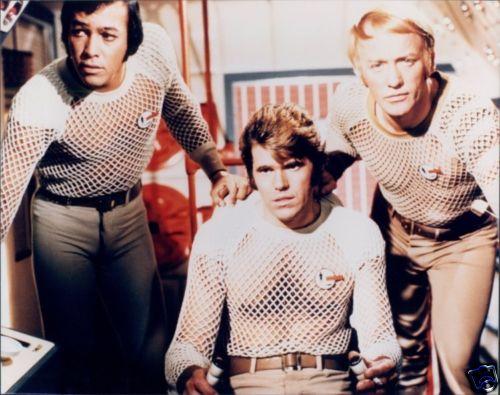
Before books like Whitley Strieber's Communion (1985) and Budd Hopkins' Missing Time (1988) popularized the idea of aliens grabbing people from their beds to perform scientific experiments on, the  tv series UFO (1970-71), part of the 1970s British invasion (The Prisoner, The Tomorrow People, The Hitchhiker's Guide to the Galaxy), had a similar premise: in the near future, the worlds' governments become aware that aliens are abducting people to harvest their organs.  They set up the secret organization SHADO to combat them from a fake movie studio, a submarine, and a base on the Moon.

Oddly, everyone at SHADO headquarters, men and women both, wear see-through shirts, so there was a huge amount of beefcake for a science-fiction series.


At first the protagonist was former American astronaut Edward Straker (Ed Bishop).

In the second episode, lone wolf British test pilot Paul Foster (Michael Billington) witnesses a SHADO operation, and is given the choice of signing up or being killed.  Foster decided to join, and Michael Billington soon became the standout star, and a favorite of teen magazines.


In the third episode, Foster is brainwashed by the aliens into attempting to kill Straker.  Later Foster is captured by the aliens, and Straker has to come to the rescue.  The grudging love-hate relationship continued  through the series, and provided fodder for many slash fiction stories.

Only 26 episodes were aired, but there were two novels, comics, toys, action figures, a board game, and eventually a video game. And from 1975 to 1977, the same universe was used for Space: 1999, in which the Moonbase (and the moon with it) is swept away from the Earth's orbit for interstellar adventure.

Later Michael Billington played two-fisted heroes on many British tv series (The Onedin Line, Spearhead, The Collectors) and attended innumerable fan conventions.  He never married. He died in 2005, five days before his UFO costar Ed Bishop.

Sep 13, 2018

Barney Hill: Alien Abduction or Sexual Assault?

There haven't been a lot of alien abduction stories recently, but for about ten years, they were all the rage.

People having weird "missing time" experiences or strange screen memories, going to a therapist, and uncovering years of abductions, painful medical procedures, and forced sexual acts orchestrated by groups of greys, praying-mantis beings, and humans.

Contrary to popular myth, the average abductee is a well-educated, wealthy young woman trying to deal with a history of traumatic abuse.

Unfortunately, the accounts try to heterosexualize the abductees whenever possible, reducing gay hints to "two women on a camping trip" or "two men sitting in their car."

The first well-publicized alien abduction case involved Betty and Barney Hill (left: James Earl Jones, who played Barney in a tv movie. Or at least, when I searched for "James Earl Jones" on google images, this is what it showed me).

  They were a middle-aged, middle-class couple, well educated, and active in politics: the local civil rights committee, the Unitarian Church and the NAACP.  They were interracial in the racist 1960s, but if you were careful, you could avoid most of the prejudice.  They got occasional stares, and some of their relatives wouldn't talk to them, but they had never been assaulted, yelled at, or turned away from a hotel.


On the night of September 19, 1961, they were driving home to Portsmouth, New Hampshire after a delayed honeymoon trip to Niagara Falls and Montreal.  Around 10:30 pm, they saw a bright light on the road ahead.  It got closer and closer, until they saw that it was a gigantic flying object about 60 feet across.  They could see beings through a row of windows: short humanoids wearing shiny black suits with matching caps and weird snake insignias.

One gave Barney a coquettish, over-the-shoulder smile, so intense that it frightened him.

A suggestion of sexual desire?

The next thing they remembered was arriving at home, two hours later than expected.  They showered extensively, feeling unclean.  Their clothes were ruined, as if they had been torn off.

Later Betty began having vivid dreams, and under hypnosis she and Barney both recalled stopping for a road block, being taken from their car and brought aboard the spaceship, and being subjected to medical procedures.

 Betty had extensive conversations with her captors, one of whom spoke English (or used telepathy). They showed her a star map, and offered to give her a book (but the offer was rescinded later).

Barney didn't interact with them, and mostly kept his eyes closed, but he said that the aliens moved "with the cold precision of German soldiers."  In another session, he elaborated: "He looks like a German Nazi.  He's a Nazi."

The alien who smiled at him looked like "a redheaded Irishman," which made Barney nervous, due to his past experiences with racist Irishmen.

 Barney had a long tube inserted up his rectum, and a device placed over his penis to extract semen (but, he said, he experienced no arousal).

(Left: Barney's bulge).

The case was written up in Look magazine, then in a bestselling book, The Interrupted Journey (1966).  Barney died in 1969, but Betty became a lifelong advocate of the alien abduction phenomenon, dismissing other explanations, insisting that they encountered beings from another world that night.


What other explanations have been suggested of the Hills' experience?  Other than fatigue and leading questions by the hypotherapist, the most cogent is an encounter with a motorcycle gang -- the bright lights, the uniforms -- who stopped them, questioned them, and subjected Barney but not Betty to a sexual assault: something over his penis, something inserted into his butt.

They both felt unclean afterwards, and showered and wanted to burn their clothes, but Barney seemed more traumatized.

But why would your mind transform a sexual assault into an alien abduction which was just as traumatic, but would subject you to scorn and derision for the rest of your life? 

Maybe, for some guys in 1961, an alien abduction was easier to accept than being anally entered and having "semen extracted" by men.

I read The Interrupted Journey around the end of grade school or the beginning of junior high, and I was fascinated.  Not only by the abduction:

1. You never saw black men and white women together on tv, in movies, or in real life.  I didn't know that interracial relationships existed.  If they were possible, what other desires were erased, hidden from view?

2. This was the first time I read the word "penis," anywhere.  It felt liberating and rather naughty to be thinking of Barney's penis.

3. Barney's experience, however much he denied it, was obviously sexual.  And it occurred at the hands of men, or male beings.  If same sex acts could occur in an alien abduction, certainly they could occur in real life!


Mar 21, 2017

Daniel Clark: Brother for Life


Speaking of Robert Clark, if you watched any children's tv during the early 2000s, you probably saw his older brother Daniel (born in 1985) in a series of buddy-bonding roles.

On Eerie, Indiana: The Other Dimension (1998), a spinoff of the homoromantic subtext classic that paired Stanley Hope (Daniel) and Mitchell Taylor (Bill Switzer) as teenage paranormal investigators in an alternate universe.

On I Was a Sixth Grade Alien (1999) as Tim Thompkins, who buddy-bonds with the purple-skinned alien boy (played by Ryan Cooley).

In Model Behavior (2000), as the little brother of a girl involved in a Prince and the Pauper-style switch.

Plus Are You Afraid of the Dark, Goosebumps, The Zack Files, and Darcy's Wild Life.


As an adult, Daniel played a jerk in Juno (2007) and buffed bad boy-turned-hero Sean Cameron on the Canadian teen soap Degrassi: The Next Generation (2001-2008).  He's assumed to be homophobic after he pushes the gay kid Marco, but he insists that he's not.  At least he managed to display his increasingly buffed physique, with semi-nude and underwear shots nearly as impressive as those of his brother.

Daniel also managed to do some teen buddy-bonding, in the Australian slasher flick Left for Dead (also released as Devil's Night). 


He retired from acting to go to college, where he majored in Political Communication.  He's currently working as a news associate for ABC, and he's involved with environmental causes.


Mar 7, 2017

Ryan Cooley: Queer as Folk


Born in 1988, Canadian actor Ryan Cooley has appeared in several gay- and lesbian-subtext programs, such as I was a Sixth Grade Alien (1999-2001), as the alien, with future bodybuilder Daniel Clark as his human buddy, and the Disney Channel's Color of Friendship (2000), about a white South African girl and her black American friend.

Also four tv programs with gay characters:

1. The sci-fi series Lexx (1997-2002), about intergalactic explorers, including the bisexual cluster lizard Zev/Xev (Eva Habermann, Xenia Seaberg).  He played the psychopathic schoolboy Digby in a three-episode story arc.

2. The gay-themed Queer as Folk (2000-2005): Hank, son of Dr. David Cameron (Chris Potter).


3. Degrassi: The Next Generation (2001-2007): Class clown J.T. Yorke, who likes girls, sells drugs, and is murdered.  Several gay characters.

3. Lost Girl (2010-), about a succubus (girl who draws energy from her sex partners) trying to live a normal life.  Several lesbian and bisexual characters.

Actually, almost all of Ryan's on-screen appearances have had gay texts or subtexts.  As well as frequent shirtless shots.   But he's never played a gay character himself. Wonder why.

Well, let's see who he follows on twitter: Jerry Seinfeld, Tiger Woods, Dick Van Dyke, Chuck Norris, Don Rickles, Charlie Sheen, Jim Carey, and Ryan Seacrest.  No supermodels in the bunch, but not a lot of beefcake models, either.

I'd have to judge this one as inconclusive.
Related Posts Plugin for WordPress, Blogger...