Showing posts with label outer space. Show all posts

Jul 26, 2026

Orphans of the Sky: Gay Hints in a Curmudgeon's Science Fiction Universe


When I was growing up, I loved the juvenile science fiction novels of Robert Heinlein (1907-1988): originally published during the 1950s Cold War, they featured boys bonding in a rip-roaring cowboy future.  Plus the Ballentine paperbacks often featured beefcake.


His adult novels were unreadable, loaded down with disgusting s*x scenes, right-wing politics, and curmudgeonly grumbles about the state of the world. But in junior high and high school, I found a universe of gay hints.

My favorites, in order:

#10: Starman Jones (1953).  A muscular farmboyta longs to go to the stars.  Unfortunately, he gets a girlfriend.

#9: Stranger in a Strange Land (1961): A boy raised by Martians founds a hippie cult.  When he learns to kiss, he offers to demonstrate on his male mentor, who refuses.  But I learned that boys can kiss.


#8: Citizen of the Galaxy (1956): A rich kid is sold into slavery, but forms a buddy-bond with the guy who buys him.

#7: Time for the Stars (1956): Telepathic twins.  One stays home, goes into business, gets married, has children, the whole heterosexist trajectory.  The other goes into space for masculine adventures at near-light speed, so he stays a teenager forever.  The symbolism is obvious.


#6: Have Space Suit-Will Travel (1958): Heinlein wasn't good at envisioning social changes in his future societies.  The title is a parody of the tv series Have Gun -- Will Travel (1957-63), and the boy wins a used spacesuit in a tv jingle-writing contest.  He and a girl are captured by aliens. This edition makes her look much older, but she's only 11, and there's no hetero-romance.


#5: Starship Troopers (1959).  Rico trains to be a soldier in the war against the evil Communists -- um,  I mean aliens.  No hetero-romance.  The 1997 movie starred Casper Van Dien (top photo), Patrick Muldoon (left), and Neil Patrick Harris, and gave them girlfriends.

More after the break

Mar 26, 2026

Lost in Space (the original series): Camp sci-fi with with a cute boy and a cool robot. Plus Billy Mumy all grown up.


My parents didn't approve of science fiction -- they thought it would promote atheism.  But   Lost in Space (1965-68) aired before their favorite hayseed comedies, The Beverly Hillbillies and Green Acres -- so we watched.  

In the far-future year 1999, a family of space colonists sets off for Alpha Centauri in their cool flying-saucer spaceship, the Jupiter 2.  An evil spy sabotages the ship, so they veer off course, and are "lost in space."  Presumably they have warp drive.

The first season featured realistic science-fiction adventures, but then it become more and more camp, like Batman, the competition on the other channel, culminating in a giant talking carrot that wanted to change the Robinsons into trees. 


I don't remember much, just scattered images: 

A lonely boy from the other side of the looking-glass.
A demonic being claiming that he's as human as the rest of them.
The robot saying "Danger, Will Robinson!"
An alien robot saying "Crush! Kill! Destroy!"

And I remember the fandom.  Kids loved Lost in Space.  Star Trek was too grown-up -- Captain Kirk was always kissing a scantily-clad alien babe -- but Lost had no hetero-romance (at least we didn't notice any).  


And Star Trek had no kids.  Lost had Billy Mumy (pronounced moo-mee), a busy child star with previous roles on The Twilight Zone and Village of the Giants Not only because he was cute, and knew it, getting teen idol attention at the age of twelve -- but because his character, Will Robinson, was bright and resourceful, a respected crew member, never told "you're just a kid" or "wait here where it's safe."


Star Trek had no comic relief, but Lost had Dr. Smith (Jonathan Harris), an accidental stowaway (originally an enemy spy trapped aboard while trying to sabotage the voyage, but they soon forgot about that).  Some fans think today remember him as a pedophile with an inappropriate interest in Will, but I recall their relationship was completely innocent.  They were friends because he was a big kid himself, an unrestrained id.  Plus lazy, cowardly, and  incompetent, so none of the adults wanted to hang out with him.


John Robinson (Guy Williams), the patriarch of the family (Guy Williams), didn't have much to do: Will and Dr. Smith stole the show.  But I recall that he was not at all interested in girls. He had a wife, Maureen (June Lockhart), but they behaved like colleagues, with few moments of tenderness and none of intimacy. 

Guy Williams had previously starred in several buddy-bonding projects, including Zorro (1957-59) and Damon and Pythias (1962), leading to speculation that he was gay in real life.  
    

More after the break

Oct 9, 2024

Boy Scientist Tom Swift: From gay to straight and back again.

When I was a kid, I liked the juvenile science fiction novels of Heinlein and Silverberg, and Tolkien's Lord of the Rings, of course, but not the Hardy Boys.  The Tom Swift series especially bored me, in spite of the science fiction elements and occasional beefcake covers, probably because of the move into heteronormativity.

There have been five incarnations of the boy scientist.

1. Tom Swift, Senior (40 books, 1910-41): Gay.

This Tom is a young adult, working for his father's construction company and inventing things (a motor-cycle, a motor-boat, an electric rifle). He adventures with a friend, Ned, but while most adventure boys of the era have no interest in girls, Tom practically shoves Ned aside the moment their gyro-copter lands at Shopton Airport in his haste to hold hands with Mary Nestor.


2. Tom Swift, Junior (33 books, 1954-71): Straight.

This Tom is the son of the original, a teenager who uses Dad's vast laboratories to invent things (a space solartron, a triphibian atomicar, a polar-ray dynosphere).  Mostly he uses them to fight the Communists. It's all very mechanical rather than scientific, like shop class.

Tom engages in some buddy-bonding with his friend Bud Barclay, but both have girlfriends -- with relationships much more overtly romantic than those of the Hardy Boys:

Tom grinned. "How about another dance, Phyl?"
As the music struck up again, he squeezed Phyl's hand. Phyl blushed as she returned the squeeze. "You rate with me," she confided shyly.


3. Tom Swift III (13 books, 1981-84): Not sure.

This Tom is from the future (he's probably a descendant of the original Toms, but his paternity is never explained).  He doesn't really invent anything; he travels through space on a faster-than-light craft, along with two companions, Ben and Anita. I haven't read any of these.


4. Tom Swift IV (15 books, 1991-93): Absurdly hetero-horny.

The son of the original Tom (who got a time jump), this teenager stays on Earth, invents things, studies Karate, and collaborates with the Hardy Boys.

He has a best friend, a practical joker named Rick, but again, they both have girlfriends, with lots of hand-holding and kisses on cheeks, and discussions of feminine beauty are almost as common as discussion of science.

For whatever reason -- a desire to be "relevant," to attract female readers, to avoid the obvious gay subtexts in the Hardy Boys series -- the ghost-writers introduced an incessant girl-craziness.  There was some buddy bonding, too, but it was drowned out by Tom blushing as he held the hand of some girl.


5. Tom Swift, a 2022 tv series, features a Tom who is black and gay, quite a change from tradition.  He goes to gay parties in ridiculous but bulging outfits and kisses dudes.  I watched one episode, hoping for a paradise of gay representation, but turned out to be rather dull.  It was cancelled after one season, but not for the reason you think.


Jan 7, 2024

A Wrinkle in Time


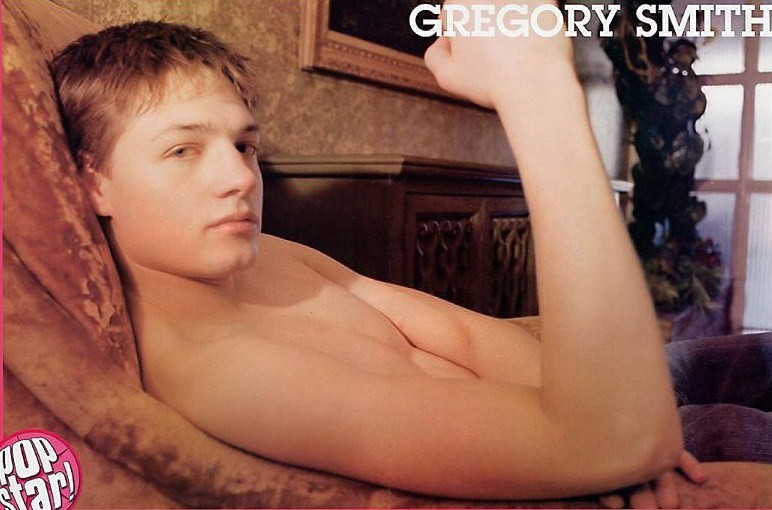
When I read Madeleine L'Engel's A Wrinkle in Time in grade school, I identified with Charles Wallace Murry, a shy, intelligent boy who  sees things other kids can't.  He seems to have a crush on misunderstood high schooler Calvin (played by David Dorfman and Gregory Smith in the 2003 movie).


Charles Wallace, his older sister Meg, and Calvin are drawn into a cosmic battle against the Black Thing, which is devouring entire solar systems and transforming them into suburbs, "houses made of ticky tacky, and they all look just the same."

The Black Thing brings conventionality, constraint, and heterosexism.  I found it a powerful critique of the mind-control chants of "What girl do you like?  What girl...what girl...what girl."


I thought it was a self-contained story.  Years later, when I was living in California, I stumbled across a sequel, Many Waters. Charles Wallace and Meg are minor characters.  Their brothers, twins Sandy and Denys, are swept away into the world of Noah just before the Flood.

They are fifteen years old in the novel, but the cover illustration pictures them as much older.
Here's another edition that shows them at the proper age, with feminine teen-idol faces, but with their muscles and phallic symbols still emphasized.

More digging revealed that Madeleine L'Engel wrote four science fiction- young adult novels with Calvin and Meg falling in love as a major plot arc..  Then they marry and have seven kids.  Their eldest daughter Polly stars in four novels of her own, mostly involving falling in love with a rich college boy named Zachary.


Meanwhile, Vicky Austin is featured in eight novels, sometimes with crossovers with the Calvin-Meg brood.  She has a troubled, on-off romance with marine biologist Adam Eddington (played by Ryan Merriman in the 2002 Ring of Endless Light).  

You get the idea: heterosexism rules.  You can be as unconventional as you want, as long as you obey the "fade out kiss" mandate.

The beefcake covers were apparently designed only for heterosexual girls.

And that's not all.  L'Engel doesn't mention gay people often, but when she does, homophobia oozes from every pore.

In A House Like a Lotus, Polly fights off a predatory lesbian.  Her parents, Calvin and Meg, are jubilant to discover that she isn't a pervert.

In A Severed Wasp, there are evil, predatory gays (not to mention casual antisemitism).

In The Small Rain, Katherine is an intelligent, sophisticated woman who has been raised in an unconventional household.  Nevertheless, when she see a lesbian:

Katherine stared at the creature again and realized that it was indeed a woman, or perhaps once had been a woman. Now it wore a man's suit, shirt,and tie; its hair was cut short; out of a dead-white face glared a pair of despairing eyes. Feeling Katherine's gaze, the creature turned and looked at her, and that look was branded into Katherine's body; it was as though it left a physical mark.


Wow.

Can I still read A Wrinkle in Time as offering hope to kids who are struggling with being different?  Critiquing the iron cage of heterosexism?

Of course.  Authorial intent is irrelevant. In the words of Alice Walker, "You are your own best hope." 
 Find belonging wherever you can, even in words intended to exclude you.
Find love wherever you can, even in words intended to express hate.
Find hope wherever you can, even in words intended to make you despair.

Nov 17, 2023

Saturday Morning with Joel and the Bots

During the 1990s, when I was living in West Hollywood, we watched a show called Mystery Science Theater 3000 every Saturday morning, before gong off to buy groceries or go to the gym or do whatever errands needed doing.

I remember a thousand Saturday mornings, eternal, brightly-colored, golden like Lewis Carroll's "golden afternoons," except in my memory  it wasn't summertime.  It was always those magical few weeks between Thanksgiving and Christmas.


MST3K was about a grown-up kid lost far from home: the smiling, laconic Joel (Joel Hodgson) has been zapped into space, onto the phallic-looking "Satellite of Love,"  where two mad scientists torture him by forcing him to watch horribly inept "cheesy movies."
 
After five seasons (1989-1994), Joel escaped to Earth, and the mad scientists abducted the hunkier Mike  (Mike Nelson above), who stayed on for ten seasons, until the series ended in 2004.


Joel, Mike and the "bots" (their robot chums, Tom Servo and Crow) stayed sane through the worst of bad-movie torture by making fun of the artifice and ineptness -- jokes, pop culture references, and sarcastic comments came fast and furious.  There were also interstitial sketches and comedy bits, often with guest stars from the movies being riffed.

The riffs and interstitials often made homoerotic subtexts visible, and many of the movies featured extensive beefcake, but that's not enough to make my memory of the basic-cable farce "golden."


Maybe MST3K was a metaphor.  Most gay people are trapped far from home.  The overlords are constantly torturing them with heterosexist statements and scenes, proclaiming over and over again that no gay people exist, hoping that eventually they will cease to exist.  The only way to stay sane is to laugh, to riff on the ineptness and artifice of the heterosexist myth.

It is no wonder that the slow, ponderous final theme, played over the ending credits, always filled me with a profound sadness.

May 6, 2023

Robinson Crusoe on Mars

Ask any male boomer when he realized that he was gay, and he’ll most likely say when he saw Robinson Crusoe on Mars (1964). I saw it in the spring of 1968, on the family’s brand new color tv set.


The plot is obviously a version of Robinson Crusoe: after crash landing on the frigid Red Planet, astronaut Kit Draper (Paul Mantee) builds a cave habitat so warm he can walk around shirtless or in a tight-black t-shirt, displaying an amazingly buff, hairy chest.


He has food, water, and a pet monkey, but he is intensely lonely. Then an alien mining company establishes a beachhead nearby, and he helps himself to one of their slaves. “I prayed for a companion,” Kit exclaims, “And I finally got one!” 

Somewhat Aztec in appearance, “Friday” (Victor Lundin) is so accustomed to the Martian cold that he can comfortably walk around in nothing but a kilt, displaying a massive, sculpted body, with golden skin, thick arms and shoulders, and a smooth, hard chest.

The two men are extremely physical in their interaction. Shortly after they meet, Kit takes Friday’s hand and places it on his own knee, an image that is intensely intimate and sensual. Kit is buried in a shower of space debris and nearly suffocates, and Friday rescues him. As they walk away, Kit wraps his arm around Friday’s waist.  At the end of the movie, they are rescued, and go back to Earth together, permanent partners.

Who would produce such a film, about two men who love each other and build a home together, in the dark homophobic days of 1964?

This was Paul Mantee’s first credited acting role; he went on to make dozens of two-fisted movies, sometimes with “man” in the title to emphasize the intended audience, such as A Man Called Dagger (1967) and That Man Bolt (1973), and he then settled down to write novels about heterosexual Italian-American adolescents.  And he obviously stayed in shape.

Victor Lundin played a series of Klingons, Indians, savages, and bad guys, and cut some country-western records. Today, on his website, he sells a cd with a song about how much he likes girl-watching.


Neither of the writers seem obvious gay allies, but when we look at the director, Byron Haskin, we find movie after movie set in steaming jungles, where men wear next to nothing and fall into each other’s arms a lot: Man Eater of Kumaon (1948), Tarzan’s Peril (1951), His Majesty O’Keefe (1953), Little Savage (1959). That explains the beefcake; what explains the bonding?


Mar 15, 2022

Andre Norton: Gay Subtext Science Fiction in My Junior High Library

I found The Hobbit during fifth grade, in the Folklore section of the Denkmann Elementary School Library, and thought it the best book ever written.  There were rumors of a sequel, something about "rings," so I checked out Moon of Three Rings, by Andre Norton.

That wasn't it.

Thereafter, through junior high and high school, I hated Andre Norton, and refused to read any of her works.

But when I was in college, the bookstore gang loved Andre Norton, so I gave her another try.  

And found a homoerotic paradise, where men forged intense, passionate, loving bonds with men, mostly with covers that were beefcake-heavy masterpieces.

The Time Traders: crosstime adventures of crook-turned-adventurer Ross Murdock and his far-future companion Ashe.

Galactic Derelict: Ross and Ashe are accompanied by muscular Apache Travis Fox to investigate a space ship from another galaxy.

Storm Over Warlock: A Terran survey expedition is attacked, leaving only two survivors: elite Scout Ragnar Thorvald and servant Shan Lantee.  They must travel together across the hostile planet to safety.

Voodoo Planet: Same plot, Voodoo Planet.

 Star Man's Son: Two muscular barbarians bond in a post-apocalyptic world.


Operation Time Search: Photographer Ray Osborne is accidentally transported back to ancient Atlantis, where he befriends the muscular young Cho and gets involved in royal intrigue.  And the most explicit gay romance I had ever seen in science fiction.

And on and on -- she wrote hundreds, and is still publishing, though she died in 2005.

There are also a lot of novels about women forming strong same-sex bonds, and a few with heterosexual romances.

I don't know why the gay subtexts predominate.  Maybe Norton was writing for an audience of juvenile boys, and assumed that they wouldn't be interested in hetero-romance "yet."?  Or maybe she thought that the world of intergalactic exploration would exclude women, just as her contemporary society excluded women from the sciences and technology.

I just wish I had read them in junior high.


Aug 7, 2020

Gay Teens in Deep Space: Arthur C. Clarke

When I was a kid in the 1960s, juvenile science fiction was great, all about boys falling in love as they fled from the tripods or zapped through the solar system.  But then I became a teenager and started reading science fiction for grown ups, which was -- and still is -- heterosexist, mostly about men and women falling in love:


A. E. Van Vogt, Two Hundred Million A.D. (1943): L Onee was waiting. Together they closed and sealed the door. Together, they went up out of the darkness into the light.

Raymond Jones, Man of Two Worlds (1951): "I want to marry you] more than anything else in the world,” Elta said. She drew close and laid her head against his shoulder.

Michael Moorcock, The Wrecks of Time (1966): She winked at him. He grinned and winked back. They walked into the house.

John Brunner, Interstellar Empire (1976): She came down the steps to Ordovic, and put her arm around his waist, smiling.

R. M. Meluch, Wind Dancers (1981): “ Shall we go to bed together, get drunk, or start a fight in a bar?"  Roxanne hooked his arms. "One of those.‟”


But then at a garage sale in the mid-1970s, I stumbled upon two books about muscular boys bonding as they explored the Indian Ocean.  By Arthur C. Clarke, whom I knew as the inspiration for the movie 2001: A Space Odyssey.  Surely his science fiction would not be obsessed with feminine smiles.

So I began reading.  And kept reading.

The Sands of Mars (1951), A Fall of Moondust (1961), Imperial Earth (1975): no heterosexual romance.


Against the Fall of Night (1948): Alvin is a teenager living in the distant future city of Diaspar.  He becomes the first person to leave the city in countless milennia, explores the savage world outside, and buddy-bonds with a boy named Theoron.  At the end he decides to take a spaceship and explore the stars, and Theoron goes with him.

When Clarke revised the novel into The City and the Stars (1956), he gave Alvin a girlfriend in Diaspar, like the Hardy Boys have girlfriends in regular time, but she is completely forgotten once he begins the adventure.

Childhood's End (1953): Galactic overlords land on Earth and transform all of the children into a new, advanced species, another entry into the "threatening gay kid" genre.


2001: A Space Odyssey (1968): a homoromantic idyll with two astronauts, Dave and Francis (played by Keir Dullea and Gary Lockwood in the movie) jetting out toward Jupiter in the Discovery One, until the computer Hal gets jealous.


Arthur C. Clarke was well known in the science fiction community as gay, although he never came out publicly (when asked by a reporter, he always gave a coy response like "Why? What have you heard?").

In 1956 he moved to Sri Lanka, which being gay was legal  (Britain didn't decriminalize homosexuality until 1957).  He stayed there until his death in 2008.

Jan 23, 2019

Star Trek

Star Trek (1966-69) represents the beginning of a franchise that eventually encompassed 6 tv series, 12 movies, and an infinite number of tie-in novels, comic books, games, and toys. But at the time my parents didn't approve of science fiction, all about evolution and atheism, so I didn't see most episodes until reruns started appearing in the 1980s.


I only remember one moment of joy: in the 1966 episode "Naked Time," the space explorers contract a virus that makes them act irrationally. Navigator Sulu (George Takai), imagining that he is D'Artagnon of the Three Musketeers, rushes down the corridor, sword in hand, his chest hard and bronze and gleaming.  

And later, cured, he returns to the room he shares with Ensign Chekhov (Walter Koenig).  Chekhov, already in bed, rises on one elbow.  "Are you ok?" he asks.  "I was worried."  "I'm ok now," Sulu says, sitting next to him.  They smile.

Like the smile shared by Rich and Sean in The Secret of Boyne Castle, it became an iconic memory of my childhood.  I wanted that smile more than anything.

Except the scene never happened.  Chekhov wasn't even in the episode, and he and Sulu were never shown sharing a room.  I invented the memory.


So, what are we left with:

1. A universe where heterosexual desire is a constant.  Remember when they meet early explorer Zephram Cochrane (Glen Corbett), trapped on a planet with an alien energy cloud.  It's female, and in love with him.  

2. An endless supply of alien babes for Captain Kirk (William Shatner) to smash his face against: "Kiss?  What is kiss?"


3. Some beefcake: Kirk got his shirt ripped off in many episodes, occasionally Kirk or another character (such as Frank Gorshin) bulged, and occasionally an alien dude, such as David Soul or Michael Forest,  wear a revealing outfit.  

4. No significant buddy-bonding.  Some people see a spark of homoerotic desire between Kirk and Spock (Leonard Nimoy), but I don't see it.

5.  No gay characters, ever.  Ok, we can forgive the 1960s series, but what about The Next Generation, Voyager, or Deep Space Nine?  Obviously this is a world where gay people are unknown and unwelcome. No wonder my friends and I spent our time watching something else, or listening to The Monkees.  

Nov 21, 2018

UFO: the Shirtless SHADO Warriors


Before books like Whitley Strieber's Communion (1985) and Budd Hopkins' Missing Time (1988) popularized the idea of aliens grabbing people from their beds to perform scientific experiments on, the  tv series UFO (1970-71), part of the 1970s British invasion (The Prisoner, The Tomorrow People, The Hitchhiker's Guide to the Galaxy), had a similar premise: in the near future, the worlds' governments become aware that aliens are abducting people to harvest their organs.  They set up the secret organization SHADO to combat them from a fake movie studio, a submarine, and a base on the Moon.

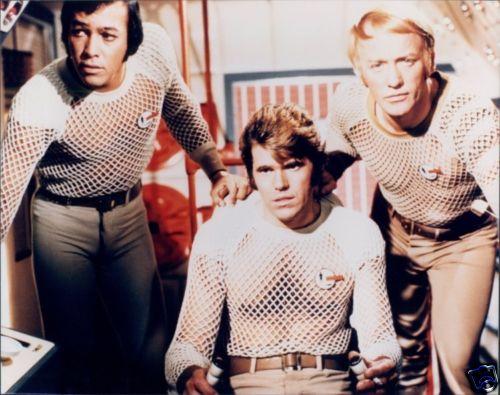
Oddly, everyone at SHADO headquarters, men and women both, wear see-through shirts, so there was a huge amount of beefcake for a science-fiction series.


At first the protagonist was former American astronaut Edward Straker (Ed Bishop).

In the second episode, lone wolf British test pilot Paul Foster (Michael Billington) witnesses a SHADO operation, and is given the choice of signing up or being killed.  Foster decided to join, and Michael Billington soon became the standout star, and a favorite of teen magazines.


In the third episode, Foster is brainwashed by the aliens into attempting to kill Straker.  Later Foster is captured by the aliens, and Straker has to come to the rescue.  The grudging love-hate relationship continued  through the series, and provided fodder for many slash fiction stories.

Only 26 episodes were aired, but there were two novels, comics, toys, action figures, a board game, and eventually a video game. And from 1975 to 1977, the same universe was used for Space: 1999, in which the Moonbase (and the moon with it) is swept away from the Earth's orbit for interstellar adventure.

Later Michael Billington played two-fisted heroes on many British tv series (The Onedin Line, Spearhead, The Collectors) and attended innumerable fan conventions.  He never married. He died in 2005, five days before his UFO costar Ed Bishop.

Aug 26, 2018

Battlestar Galactica: Star-Fighting Boyfriends

On Sunday nights in the fall of 1978, Boomer kids who were too young for All in the Family sat watching Battlestar Galactica, the beginning of a mythos that would last for three decades and rival Star Trek in scope and complexity.

The brief plot: in a distant part of the galaxy, the Twelve Colonies of Mankind have been destroyed by the evil Cylons.  A ragtag band of survivors, led by Commander Adama (Lorne Green) on the last surviving warship (the Battlestar Galactica), head out into space to seek the last human colony. . .Earth.

The beefcake was handled by the cute Star Wars uniforms. The bonding was handled by Commander Apollo (Richard Hatch, below) and Lieutenant Starbuck (Dirk Benedict, left).


In spite of their quests after girls, gay Boomer kids and the writers of slash fiction knew that they were romantic partners.


Teen magazines were content with gushing articles and semi-nude photos.

There were dozens of other characters. Ray Bolger, Fred Astaire, Randolph Mantooth, and Ed Beghley Jr. showed up.  Jonathan Harris of Lost in Space played Lucifer, leader of the Cylons (this was the heart of the Cold War, so good vs. evil were clearly drawn).


Ratings problems and howls of "plagiarism" from 20th Century Fox, owner of the Star Wars franchise, led to the cancellation of Galactica after just one season.  But it returned for Galactica 1980, set on Earth, with Kent McCord (left) and Barry Van Dyke (right) as the star-fighting romantic partners.

And in 2004-2009 as Battlestar Galactica, a re-imagined series with a female Starbuck.  And a prequel, Caprica (2010).

And feature films, comic books, a web series, over 20 novels (some written by Richard Hatch), video games, action figures, toys.

Just before the end of the 2004-2009 series, a couple of characters were outed, but not on screen, on a webisode. A bone thrown to gay fans, but more than they ever got from Star Trek. 

Nov 11, 2016

Four Flamboyant Guys Roaming the Galaxy: "Red Dwarf"


Red Dwarf is the second-funniest science fiction series of all time, after Hitchhiker's Guide to the Galaxy.  There have been 11 seasons since it premiered in 1988, plus a feature film and an avalanche of guidebooks, novelizations, and merchandise.

The premise: Dave Lister (Craig Charles), a lower-level employee on the interplanetary mining ship Red Dwarf, is put into stasis as punishment for bringing a cat on board.  But there's a nuclear accident, so the ship computer leaves him in stasis until it's safe to come out -- 3,000,000 years later.  He's now the last human being left in the universe, all alone except for three companions:

Arnold Rimmer (Chris Barrie), a holographic replica of his insufferably priggish bunkmate.


Cat (Danny John-Jules), a self-absorbed, fashion-obsessed humanoid cat (evolved from the one Lister brought on board).

The self-effacing, servile mechanoid Kryten (Robert Llewellyn).


Four distinct personalities, thrown together by chance, alone in the universe -- more or less.

As they zap through time and space, fight mind-controllng monsters, explore alternate dimensions, face mechanical and medical emergencies, they learn to work together as a team.

Each develops beyond his "programming,"  Lister into an unexpected leader, Kryten into a passive-aggressive counselor, the Cat into a skilled navigator, and Rimmer into a hero (sort of).

Aside from being riotously funny, there are more than enough gay subtexts in Red Dwarf :


1. Four guys zapping through time and space, rarely mentioning girls.
2. A significant beefcake factor.
3. The Cat's gay-coded flamboyance.
4. Kryton's gay-coded flamboyance.
5. The homoerotic subtext between Lister and Rimmer.
6. The homoerotic subtext between Lister and Cat.


All of the cast are gay allies.  Chris Barrie has played gay characters.  Danny John-Jules participated in the "Say My Name" project,  to raise awareness of black gay people in Britain.

 In 2012, Craig Charles appeared with his fellow Coronation Street stars at the Manchester Gay Pride Parade.


Related Posts Plugin for WordPress, Blogger...