For good or bad, I'm a child of the disco era. The songs of the Bee Gees bring back a rush of memories, especially those from their annus mirabilis, 1977-78:
When I brought Tyrone to the Harvest Dancewe were listening to "If I Can't Have You" on the car radio:
Don't know why I'm surviving every lonely day, when there's got to be no chance for me.
My life would end, and it doesn't matter how I cry.
My tears of love are a waste of time if I turn away
I Kissed a Boy Under the Mistletoe at my brother's Christmas party, then went upstairs and turned on KSTT radio to "How Deep is Your Love":
Cause we're living in a world of fools, breaking us down, when they all should let us be.
We belong to you and me.
When I figured It out, "Stayin' Alive" was playing in the background of everybody's life.
Well now, I get low and I get high, and if I can't get either, I really try.
Got the wings of heaven on my shoes -- I'm a dancin' man, and I just can't lose.
Objectively analyzed, the lyrics are simplistic and contradictory -- and heterosexist, loaded down with "girl! girl! girl!"
Yet no songs have ever been so meaningful.
The BeeGees consisted of three Australian brothers, Barry, Robin, and Maurice Gibb. They had been recording for two decades before they hit it big with the soundtrack to Saturday Night Fever, which launched the disco craze. They were apparently all heterosexual, but their music drew heavily from the gay-and-black underground scene.
Their younger brother Andy had an annus mirabilis of his own in 1977-78, with "Love Is Thicker than Water," "Shadow Dancing," "An Everlasting Love," and "Don't Throw It Away."
He became a teen idol, his bare hairy chest and bulge featured prominently in Tiger Beat, as well as the "nearly" gay interview magazine After Dark.
See also: Figuring It Out; The Eagles; and Rod and Al Stewart.
Beefcake, gay subtexts, and queer representation in tv and other pop culture from the 1950s to the present
Nov 27, 2014
Nov 25, 2014
Veronica's Closet: How Not to Play a Gay Character
In the 1990s, TV writers didn't know what to do with their gay characters.
They knew what gay men were: men who were really women. Men who were interested in show tunes and chick flicks and skin care products, who used their hands when they talked, who secretly wore dresses. And who might...possibly...date men.
But what to do with them?
Veronica's Closet (1997-2000) took a novel approach: how about a gay man who doesn't know he's gay? He'll have the show tunes and skin care products, but claim to be straight! Won't that be hilarious?
It wasn't hilarious at all.
The show aired after Seinfeld, and starred Kirstie Allie, formerly of Cheers, so it became popular.
Veronica ran a clothing company designed to increase women's chances of romance (modeled after Victoria's Secret).
Her staff included:
1. Olive (Kathy Najimy), whose job was undefined.
2. Underwear model turned publicist Perry (Dan Cortese, top photo).
3. Uptight marketing manager and token black guy Leo (Daryl Mitchell).
4. Secretary Josh (Wallace Langham).
Josh started out as feminine-coded, working as a secretary for a women's underwear company. And the feminine traits piled on, week after week. Not only show tunes and skin care products, but pink handkerchiefs, demitasse, a worry over getting fat, a female best friend, no interest in sports, a girly car, hints at drag. For heaven's sake, his middle name was Nicole!
Therefore he must be gay. The entire cast acted as if he was gay, asking his advice on skin care products and trying to fix him up with men When he protested that he was straight, they smiled knowingly.
"Wait," I wanted to ask, "Has Josh ever expressed the slightest interest in men?
"No, never," Veronica might answer.
"Has he ever expressed any interest in women?"
"Yes, often. He's been shown having sex with women. He had a girlfriend, nearly got married. But what does that have to do with it? He's feminine, so he's gay."
Near the end of the series, Josh finally gave and admitted that he was feminine...um, I mean gay.
He reluctantly gave up his heterosexual romances and began dating a guy, not because he was interested, but because that's what feminine...um, I mean gay men do, right?
Right?
The cast doesn't have a great record on gay rights. Kathy Najimy is bisexual. Kirstie Allie is not a gay ally
Wallace Langham, who played Josh, turned out to be rather homophobic also. In 2000 he beat up a gay tabloid reporter while using anti-gay slurs. He was sentenced to 450 hours of community service for LGBT charities.
They knew what gay men were: men who were really women. Men who were interested in show tunes and chick flicks and skin care products, who used their hands when they talked, who secretly wore dresses. And who might...possibly...date men.
But what to do with them?
Veronica's Closet (1997-2000) took a novel approach: how about a gay man who doesn't know he's gay? He'll have the show tunes and skin care products, but claim to be straight! Won't that be hilarious?
It wasn't hilarious at all.
The show aired after Seinfeld, and starred Kirstie Allie, formerly of Cheers, so it became popular.
Veronica ran a clothing company designed to increase women's chances of romance (modeled after Victoria's Secret).
Her staff included:
1. Olive (Kathy Najimy), whose job was undefined.
2. Underwear model turned publicist Perry (Dan Cortese, top photo).
3. Uptight marketing manager and token black guy Leo (Daryl Mitchell).
4. Secretary Josh (Wallace Langham).
Josh started out as feminine-coded, working as a secretary for a women's underwear company. And the feminine traits piled on, week after week. Not only show tunes and skin care products, but pink handkerchiefs, demitasse, a worry over getting fat, a female best friend, no interest in sports, a girly car, hints at drag. For heaven's sake, his middle name was Nicole!
Therefore he must be gay. The entire cast acted as if he was gay, asking his advice on skin care products and trying to fix him up with men When he protested that he was straight, they smiled knowingly.
"Wait," I wanted to ask, "Has Josh ever expressed the slightest interest in men?
"No, never," Veronica might answer.
"Has he ever expressed any interest in women?"
"Yes, often. He's been shown having sex with women. He had a girlfriend, nearly got married. But what does that have to do with it? He's feminine, so he's gay."
Near the end of the series, Josh finally gave and admitted that he was feminine...um, I mean gay.
He reluctantly gave up his heterosexual romances and began dating a guy, not because he was interested, but because that's what feminine...um, I mean gay men do, right?
Right?
The cast doesn't have a great record on gay rights. Kathy Najimy is bisexual. Kirstie Allie is not a gay ally
Wallace Langham, who played Josh, turned out to be rather homophobic also. In 2000 he beat up a gay tabloid reporter while using anti-gay slurs. He was sentenced to 450 hours of community service for LGBT charities.
Nov 9, 2014
Gary Daniels: Man-Mountain with Gay Subtexts
During the brawny Old West of the 1980s, when Ronald Reagan was squaring off against the Evil Empire and Jerry Falwell was squaring off against the gays, we needed lots of man-mountains:
Buffed shirtless guys who could storm through the jungles of Southeast Asia to rescue kidnapped buddies, get revenge on murdered wives or girlfriends, or take out entire enemy armies with their bare hands.
Unfortunately, after the first hundred buffed guys with martial arts training hit Hollywood, the market became highly competitive, and besides, 25-year old kickboxer Gary Daniels was British, unlikely to be cast in a movie promoting American Exceptionalism.
So he went to the Philippines instead. After a buddy-bonding Indiana Jones rip-off, The Secret of King Mahis Island (1988), he was cast as a man-mountain who ignores his wife and gets nude with his buddy prior to taking out the evil Vietnamese army in Final Reprisal (1988). Some rather explicit gay subtexts.
By the 1990s, Gary had managed to break into American film, playing kickboxer managers, villains, and opponents in the Big Match, fighting to rescue his kidnapped brother (in American Streetfighter), fighting to rescue his buddy (in Firepower), fighting to get revenge on his brother (Hawk's Vengeance).
Gary's characters had little time for women: the target audience of heterosexual male teenagers wanted to see muscles, fights, and explosions, and couldn't care less about a fade-out kiss. The result was a lot of gay subtexts.
During the 2000s, as Gary got older, he began playing more fully-clothed roles, as attorneys, detectives, and military officers who oversee the punching and kicking, but don't indulge personally. His most memorable recent role is The Expendables (2010), in which a group of aging man-mountains is hired to take out a Latin American dictator.
Two of them, played by Arnold Schwarzenegger and Jet Li, reveal that they are a gay couple in The Expendables 2 (2012). Or maybe they're just joking. Either way, they're acknowledging the homoerotics behind the man-mountain genre.
Buffed shirtless guys who could storm through the jungles of Southeast Asia to rescue kidnapped buddies, get revenge on murdered wives or girlfriends, or take out entire enemy armies with their bare hands.
Unfortunately, after the first hundred buffed guys with martial arts training hit Hollywood, the market became highly competitive, and besides, 25-year old kickboxer Gary Daniels was British, unlikely to be cast in a movie promoting American Exceptionalism.
So he went to the Philippines instead. After a buddy-bonding Indiana Jones rip-off, The Secret of King Mahis Island (1988), he was cast as a man-mountain who ignores his wife and gets nude with his buddy prior to taking out the evil Vietnamese army in Final Reprisal (1988). Some rather explicit gay subtexts.
By the 1990s, Gary had managed to break into American film, playing kickboxer managers, villains, and opponents in the Big Match, fighting to rescue his kidnapped brother (in American Streetfighter), fighting to rescue his buddy (in Firepower), fighting to get revenge on his brother (Hawk's Vengeance).
Gary's characters had little time for women: the target audience of heterosexual male teenagers wanted to see muscles, fights, and explosions, and couldn't care less about a fade-out kiss. The result was a lot of gay subtexts.
During the 2000s, as Gary got older, he began playing more fully-clothed roles, as attorneys, detectives, and military officers who oversee the punching and kicking, but don't indulge personally. His most memorable recent role is The Expendables (2010), in which a group of aging man-mountains is hired to take out a Latin American dictator.
Two of them, played by Arnold Schwarzenegger and Jet Li, reveal that they are a gay couple in The Expendables 2 (2012). Or maybe they're just joking. Either way, they're acknowledging the homoerotics behind the man-mountain genre.
Nov 3, 2014
Looking for Beefcake on the Swim Team
This isn't a picture of my high school swim team -- the yearbook photo wouldn't scan properly -- but two of the boys look exactly like my old high school classmates.
Back row right: looks exactly like Craig, who sat next to me in every class from third grade through junior high, participated in the famous streaking incident of 1974, and invited me to "get down" at his graduation party in 1978.
Front row center: looks exactly like David, who was dating my buddy Emily, except David was a bit more impressive in the locker room.
Is it any wonder that I went to all the swim meets?
Swimming was always a reliable source of beefcake. In the summer, you could go to Longview Park Pool to look at the never-ending parade of beefcake, men with hairy chests, jocks in red swimtrunks, heavily-muscled bodies glistening in the afternoon sun. When it got cold, you could get your beefcake quota by reading sports books about swimming (This also satisfied your parents, who were constantly trying to push you into liking sports.)

I collected Boy Scout instruction manuals on swimming, diving, water polo, and life saving, and guides to high school and college swim teams.
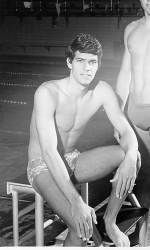
The only athlete I could name offhand was Mark Spitz, who won 7 gold medals in the 1972 Summer Olympics and had guest shots all over tv in 1973 and 1974. Most of the gay boys at Washington Junior High had this poster on their bedroom walls.
See also: Cruising in the Cub Scouts.
Back row right: looks exactly like Craig, who sat next to me in every class from third grade through junior high, participated in the famous streaking incident of 1974, and invited me to "get down" at his graduation party in 1978.
Front row center: looks exactly like David, who was dating my buddy Emily, except David was a bit more impressive in the locker room.
Is it any wonder that I went to all the swim meets?
Swimming was always a reliable source of beefcake. In the summer, you could go to Longview Park Pool to look at the never-ending parade of beefcake, men with hairy chests, jocks in red swimtrunks, heavily-muscled bodies glistening in the afternoon sun. When it got cold, you could get your beefcake quota by reading sports books about swimming (This also satisfied your parents, who were constantly trying to push you into liking sports.)
I collected Boy Scout instruction manuals on swimming, diving, water polo, and life saving, and guides to high school and college swim teams.
The only athlete I could name offhand was Mark Spitz, who won 7 gold medals in the 1972 Summer Olympics and had guest shots all over tv in 1973 and 1974. Most of the gay boys at Washington Junior High had this poster on their bedroom walls.
See also: Cruising in the Cub Scouts.
Subscribe to:
Posts (Atom)