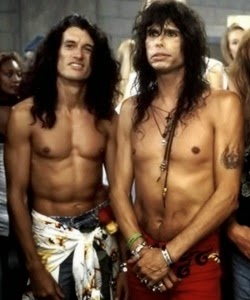
Julio Iglesias is a famous singer in Spain and Latin America, with dozens of gold and platinum albums.
I knew him primarily from a series of duets performed in the 1980s with an eclectic assortment of American stars:
"All of You" with Diana Ross
"The Air that I Breathe" with the Beach Boys
"To All the Girls I've Loved Before" with Willie Nelson
"My Love" with Stevie Wonder
They were all very heterosexist, but what did you expect of popular music in the 1980s?
Not much gay connection, although he was a guest star on an episode of The Golden Girls, and once he said: "If I was gay, I would be the best gay in history." I wonder what his criteria for gay excellence would be?
Well, maybe there's a gay connection in his sons.
The older, Julio Iglesias Jr. (born in 1973), got his start as a model, and now is an actor and singer. He appeared as Luis on the tv series Hacienda Heights, a bilingual telenovela about a Los Angeles family.
The younger, Enrique (born in 1975), has followed in his father's footsteps to become one of the biggest stars in Latin America.
He has been the subject of gay rumors, so he responded with a post on Facebook:
"I try to make good songs and that are fun. Either way, what is the problem with there being many gay singers? There are many gay people that must be respected … the truth is that most people are good and human."
It's nice to know that most people are good and human, gay or not, but not a lot of gay connection there.
Wait -- Julio Sr. is married to a cousin of famed actor Steve McQueen, making Julio Jr. and Enrique second cousins of his grandson, gay actor and model Steven R. McQueen.
There's always a gay cousin or uncle somewhere in the family tree.
Beefcake, gay subtexts, and queer representation in tv and other pop culture from the 1950s to the present
Feb 6, 2015
Feb 1, 2015
Homophobic Dog with a Blog: The Disney Channel's Worst Show
The Disney Channel used to be better than Nickelodeon in airing teencoms with gay subtexts, but the last couple of years, it's been slipping. Of the current crop, the only shows of much interest to gay kids are Austin & Allie (with Ross Lynch, who adds a gay subtext to everything) and Liv & Maddie (with Joey Bragg as the gay-vague older brother). I heard that Good Luck Charlie will be getting a "real" gay couple sometime this season. The other programs, like Jessie, are unremittingly heterosexist.
Take Dog with a Blog (2011-) -- please.
It's a standard "my secret" sitcom about a talking dog, Stan (voiced by Stephen Fuller), who uses the anonymity of the internet to write a blog about his family's adventures. The family, blended to provide conflict, consists of Mom and Dad, 13-year old Avery (G. Hannelius, a girl), 16-year old Tyler (Blake Michael, #8 on my list of Unexpected Disney Channel Teen Hunks), and the preteen Chloe.
Avery is the focus, so the recurring characters consist mostly of her friends, plus her evil nemesis, Karl Fink (LJ Benet), who suspects the secret.
Homophobia: Lots. Karl is a mincing, swishy, "quel domage!" homophobic stereotype.
Beefcake: none. Blake Michael, shown here partying with his buds, Eric Unger (Billy Unger's brother) and Mateus Ward (whose homophobic agent asked me to take down his post), is always fully clothed on camera.
Joe Larry Campbell plays Tyler's boss, The Hawk.
Bonding: maybe a little between Avery and her bff Lindsay. Other than that, Tyler keeps crushing on girls, Avery keeps crushing on guys.
Gay symbolism: Stan the Dog, the outsider masquerading as "normal," constantly in danger of discovery. Maybe a little.
Do you think the problem is co-creator Philip Stark, who was also responsible for the homophobic Dude Where's My Car (2000)?
Jan 30, 2015
Yokai: The Gay Goblins of Japan
Japanese movies and tv series often depict the hero fighting off a weird gibbering monster called a yokai.
The humans of Japan share their islands with hundreds of species of yokai, paranormal beings variously described as goblins, demons, and monsters.
Most yokai are indifferent to humans.
Like the gigantic terai oni, who stands upside down to wash his hands in rivers, and is only dangerous if he happens to step on you, or if you're caught in the stream when he takes out his giant penis to urinate.
But a few yokai hunt humans with nefarious, often erotic intent.
Multiple-tentacled yokai are eager to invade every orifice of any woman or man who falls into their grasp.
Every orifice.
There's a whole genre of pornography, shokushu goukan, dedicated to depicting the disgust, pain, and pleasure of the victim.
Turtle-shelled kappa lurk by the riverside to grab swimmers and invade orifices of their own, in the process pulling their victims to their deaths.
They probably believe that humans can breathe underwater.
Shiri me look like people bent over, except for the gigantic eye in their buttocks. You think they're running away, but they're actually running toward you.
Some Japanese authors even make up their own yokai. GeGeGe no Kitaro, a manga and anime series by Shigeru Mizuki, stars Kitaro, a yokai boy, son of a living eyeball, who is working for peace between the yokai and human tribes.
A 2007 film adaptation starred Eiji Wentz, who is the subject of gay rumors.
See also: Gay Manga of Japan; Japanese Tentacle Porn
The humans of Japan share their islands with hundreds of species of yokai, paranormal beings variously described as goblins, demons, and monsters.
Most yokai are indifferent to humans.
Like the gigantic terai oni, who stands upside down to wash his hands in rivers, and is only dangerous if he happens to step on you, or if you're caught in the stream when he takes out his giant penis to urinate.
Multiple-tentacled yokai are eager to invade every orifice of any woman or man who falls into their grasp.
Every orifice.
There's a whole genre of pornography, shokushu goukan, dedicated to depicting the disgust, pain, and pleasure of the victim.
Turtle-shelled kappa lurk by the riverside to grab swimmers and invade orifices of their own, in the process pulling their victims to their deaths.
They probably believe that humans can breathe underwater.
Shiri me look like people bent over, except for the gigantic eye in their buttocks. You think they're running away, but they're actually running toward you.
Some Japanese authors even make up their own yokai. GeGeGe no Kitaro, a manga and anime series by Shigeru Mizuki, stars Kitaro, a yokai boy, son of a living eyeball, who is working for peace between the yokai and human tribes.
A 2007 film adaptation starred Eiji Wentz, who is the subject of gay rumors.
See also: Gay Manga of Japan; Japanese Tentacle Porn
Jan 29, 2015
Dude Looks Like a Lady: Not as Homophobic as You Think
The hard-rock band Aerosmith, consisting of the extraordinarily ugly but extremely bulgeworthy Steven Tyler, Joe Perry, Tom Hamilton, and Joey Kramer, had a string of hits when I was in high school and college. Mostly about heterosexual sex, with slang, innuendo, double-entendres, and obfuscation to keep the censors away:
She just loves my big 10 inch...record of her favorite blues.
Goin' downtown, goin' down, goin' down, neath the city, eatin' ground round
Their most famous song, "Walk This Way" (1975) is surprisingly explicit, to those familiar with 1970s slang:
You ain't seen nothin' till you're down on a muffin, then you're sure to be a-changin' your ways
"Dude (Looks Like a Lady)" (1987) is often cited as the epitome of hard rock homophobia, a viciously anti-gay diatribe.
Except when I heard the song and watched the music video, it wasn't anti-gay or anti-transgender at all. Steven Tyler meets a woman, goes into an alley to have sex with her, and is surprised when: "She whipped out her gun and tried to blow me away."
But after his initial surprise, he doesn't attack, lash into a diatribe, or run away screaming. He decides to go through with it anyway: "Baby, let me follow you down -- do me, do me, do me, do me. What a foxy lady!"
Even with the "gun," the lady turned out to be "foxy."
I would not be so accommodating to a Lady who Looks Like a Dude.
Songwriter Desmond Child describes working on the song with Aerosmith. Joe Perry was worried that gay people would find it offensive, but Child said "I'm gay, and I'm not offended."
In fact, it was very accepting, especially during the conservative retrenchment of the 1980s:
Don't judge a book by its cover, or who you're going to love by your lover.
See also: My Girl Bill; and Subtext Songs of the 1980s.
She just loves my big 10 inch...record of her favorite blues.
Goin' downtown, goin' down, goin' down, neath the city, eatin' ground round
Their most famous song, "Walk This Way" (1975) is surprisingly explicit, to those familiar with 1970s slang:
You ain't seen nothin' till you're down on a muffin, then you're sure to be a-changin' your ways
"Dude (Looks Like a Lady)" (1987) is often cited as the epitome of hard rock homophobia, a viciously anti-gay diatribe.
Except when I heard the song and watched the music video, it wasn't anti-gay or anti-transgender at all. Steven Tyler meets a woman, goes into an alley to have sex with her, and is surprised when: "She whipped out her gun and tried to blow me away."
But after his initial surprise, he doesn't attack, lash into a diatribe, or run away screaming. He decides to go through with it anyway: "Baby, let me follow you down -- do me, do me, do me, do me. What a foxy lady!"Even with the "gun," the lady turned out to be "foxy."
I would not be so accommodating to a Lady who Looks Like a Dude.
Songwriter Desmond Child describes working on the song with Aerosmith. Joe Perry was worried that gay people would find it offensive, but Child said "I'm gay, and I'm not offended."
In fact, it was very accepting, especially during the conservative retrenchment of the 1980s:
Don't judge a book by its cover, or who you're going to love by your lover.
See also: My Girl Bill; and Subtext Songs of the 1980s.
Subscribe to:
Posts (Atom)