Jun 10, 2019

Rod Stewart: Gay Rumors, Heterosexual Songs

This song has been going through my head for two days:

It's late September and I really should be back at school
I know I keep you amused, but I feel I'm being used
You led me away from home, just to save you from being alone

You stole my heart, and that's what really hurts

"Maggie Mae" (1971) is about a college boy who hooks up with an older woman, and finds that she has taken control of his life.  I had a similar experience with my first boyfriend Fred -- an older man (well, 28) who convinced me to leave home, drop out of college, and follow him cross-country to Omaha. I lasted five miserable weeks.


Rod Stewart's songs are overwhelmingly infused with "girls! girls! girls!" heterosexism, but when you are growing up in a world where gay people are assumed not to exist, you find meaning where you can. 

"Twisting the Night Away" (1972)
Here's a fellow in blue jeans, who's dancing with an older queen
dolled up in her diamond rings, twistin' the night away
Man you ought to see her go, twistin' to the rock and roll
Here you'll find the young and the old twistin' the night away

I didn't realize, at age 11, what a "queen" was, but by the time I got to West Hollywood, I did.

"Tonight's the Night" (1975):

Come on angel my hearts on fire
Don't deny your man's desire
You'd be a fool to stop this tide
Spread your wings and let me come inside

I didn't realize, at age 14, that this was a graphic image of heterosexual sex. I thought he was trying to get someone to "open up" metaphorically, to find an emotional connection.  During my first year in high school, I was trying, with little success, to find something "real," a boy I could actually care about, amid the incessant "date girls!  have sex with girls!" rhetoric.

"You're in my Heart" (1977).

I didn't know what day it was 
When you walked into the room
I said hello unnoticed
You said goodbye too soon

During my junior year in high school, I was depressed because I had never experienced this jaw-dropping, forget-your-name attraction.  Well, I had, but I didn't recognize it, because I thought that boys could only ever be attracted to girls.

"If Loving You is Wrong, I Don't Want to Be Right" (1977)
Your mama and daddy say it's a shame
It's a downright disgrace
Long as I got you by my side
I don't care what your people say

The song is about a girl in love with a married man, but it could easily be applied to "the love that dare not speak its name."

Back in the 1970s, Rod Stewart had the androgynous air of a drag queen in training, and his highly publicized friendship with "bisexual" Elton John raised some rumors.  But closeted gay performers are usually homophobic, just to be on the safe side, and Stewart has always been gay-positive. 

His "Killing of Georgie" (1977), about a gay guy who leaves his small town for New York, and then is murdered (not in a homophobic hate crime), was the first pop song to talk about gay rights. In 2016, he noted that his youngest son Aiden, age five, liked dressing up like a lady. so he might be gay (most likely transgender, or just having fun).


Jun 9, 2019

Netflix's "Tales of the City": Not Your Grandfather's San Francisco

I thoroughy dislike the Tales of the City series of maudlin angst-ridden melodramatic novels, so watching the Netflix tv series wasn't near the top of my list.  But when I found out that the series was set in 2019, I was curious.  Mary Ann Singleton was in her mid-twenties when she moved to San Francisco in 1976, and got an apartment in the building of "feisty old broad" Anna Madrigal.  43 years later, Mary Ann would be in her 60s, and Anna Madrigal over 100.  How would they handle that?

So I sat down to watch two episodes.

They retconned all of the characters' ages and streamlined the melodramatic plot complications. Now Mary Ann (Laura Linney) moved to San Francisco in the 1990s, met Anna Madrigal and gay man Michael rather than a cast of thousands, married Brian, adopted a daughter, Shawna, and vanished in 1999 to pursue a career in tv journalism.  20 years later, she and her horrible estranged husband return for Anna's 90th birthday party.  Things have changed.

In the San Francisco of the 1970s (or I guess the 1990s), you were gay or straight, mostly straight.  Anna is a transwoman, but it was a deep secret, a big reveal far into the series.  Now San Francisco is a glittering, rainbow-flashing collage of nonchalant gender fluidity and pansexual queerness that make cisgender masculine-presenting gay men like Michael seem quaintly old-fashioned. 

And the old-guard residents of Barbary Lane are mostly there to provide advice and problems for the new generation.

The San Francisco of the novels was as white as a 1950s sitcom.  Now black people exist.   And East Asian, South Asian, Hispanic.  Actually, all of the new generation except Shawna are nonwhite post-racial "um...I guess my ancestors came from...IDK who cares?"

1. Shawna (Ellen Page), now 25 and working as a bartender in an eclectic queer bar, is so traumatized by her mother's disappearance that she can't commit to a relationship, but doesn't mind going out to the back alley for hookups with various gender-fluid people (Ida Best, her laid-back drag queen boss doesn't mind her leaving in mid-shift).  Eventually she starts dating the polyamorous couple Eli (Benjamin Thys) and Inka (Samantha Soule)

2. Wren (Michelle Buteau) is the neighbor/bff of Shawna's dad, Brian (Paul Gross, left, photo from when he was part of the new generation).

Paul is having trouble getting over Mary Ann (after 20 years?).  He has a Tinder full of women who are Mary Ann lookalikes, but he never swipes any of them, so Wren takes matters into her own hands.

3. Ben (Charlie Barnett of Russian Doll) is dating the much older Michael (Murray Bartlett), who no one ever calls Mouse.  He has to deal with the implications that he is a "boy toy," as well as the fact that Michael doesn't understand twentiesh culture.

Michael, meanwhile, finds in Ben a constant reminder of his own mortality.

I've dated a lot of guys 20-30 years younger than me, and never once did I get upset over the fact that they would probably outlive me.

4. Jake (nonbinary actor Garcia) has just transitioned, which bothers his partner Margot (May Hong) because now everyone mistakes them for a heterosexual couple, and what's the point of being queer if no one knows that you're queer? 

Margot also misses being in a lesbian relationship, while Jake, exploring an interest in guys, begins dating Flaco (Juan Castano).

5. Twins Ani (Ashley Park) and Raven (Christopher Larkin, left) are Instagram performance artists who change their identities regularly.

There are many other members of the new generation, some of whom are masculine-presenting, so beefcake is not a problem.  lots of bare chests and bare butts.  The sex scenes are mostly same-sex.

And the things I hate about the novels are mostly absent: no convoluted interconnections, no existential angst, no gloom-and-doom. At least in the new generation.  The old guard has secrets to be revealed.

Still, I'm not sure I find the new generation engaging enough to want to know more about their lives.  Maybe if there are more bare chests and butts.

My grade: B.

See also: Tales of the City, Gay San Francisco, Who Cares?

Jun 8, 2019

"Schooled": "Welcome Back, Kotter" for the 1990s

I got pulled into buying the $1.99 premiere episode of  Schooled (2019) with this shot of the abs of star Christian Gehring.

Turns out that it's a spin-off of The Goldbergs (2013-), the sitcom about future filmmaker Adam Goldberg's high school years in the 1980s.

Spin-offs usually take a wacky supporting character and push them into a starring role, then find out too late that wacky doesn't work for the central character.  So "Kiss mah grits" Flo was great on Alice, but bombed on Flo, and the bickering landlords on the top-rated Three's Company hit the bottom of the ratings barrel on The Ropers

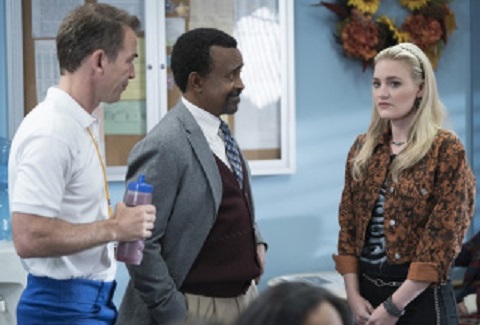
In this case, it's the wacky Lainey Lewis (A. J. Michaelka), Erica's school friend and eventually Barry's girlfriend.  Sometime during the 1990s, after a failed musical career, Lainey returns to Philadelphia and takes a job as a music teacher at William Penn Academy, "the same old place that she laughed about."

Shades of Welcome Back, Kotter, except Kotter actually had a teaching degree, and Lainey has no degree, no certification, no practicum, no nothng. She doesn't even know what a syllabus is.  But the Principal (Tim Meadows) and Coach Mellor (Bryan Callen), who knew her a a student, "believe" in her.

The music class is, naturally, full of slackers, losers, and wise guys, but Lainey "gets through to them" by switching from the "Do Wop" music on the syllabus to Grunge. So this is more like Glee without the gay kid?

But things go wrong when Lainey tries to expell Felicia (who happens to be the Principal's niece) for asking to go to the nurse's office (an act which would immediately get a real-life teacher fired, but here has no consequences).  But she finally bonds with Felicia.

Meanwhile, the ridiculously fit Coach Mellor, who actually doesn't have much of a physique, is having his own problems adjusting to the 1990s (wait -- wasn't he there all along?).  He hates the new Be Like Mike non-teamwork basketball style and short-short uniforms that show everything you got (well, I'd like to see those).

In a parallel to Lainey-Felicia, he butts heads with the showboating Matty (Hunter Doohan),the best athlete at the school, who quits the team in protest.  Not to worry, they bond, and the Coach suggests that he try out for football instead.

We finish with cameos by "the real Matty," Matt Ryan of the Atlanta Falcons football team,  who really  did attend the William Penn Charter School in Philadelphia, started as a basketball player before "the real Coach Mellor" convinced him to take football instead.

My head is exploding.  Are these all real people?  Are we going to get more interviews with famous graduates of William Penn Academy in future episodes?  I almost want to buy more episodes to see.

Gay References:  They will be performing Rent later on..

Gay Characters: None that I know of.

Beefcake.  Maybe I've been spoiled by Riverdale, but those team members are scrawny, and always fully clothed.

Lainey: Super annoying.

And where's Christian?

Back to Schooled:  It turns out that Matty appears only in the pilot.  The main students will be Ed (Israel Johson), Aaron (Dallas Edwards), Weasel (Gabe Gibbs), and Ronnie (Christian Gehring, finally).  There will also be another teacher, C.B> (Brett Dior, left), who will have a crush on Lainey.

Oh, and most of The Goldbergs will make cameos.

My grade:  D.  I'd rather watch Welcome Back, Kotter. Or Glee.  Or Riverdale.
Or The Goldbergs.

See also: The Goldbergs; 

Jun 1, 2019

Tales of the City: Gay Guys, San Francisco, Who Cares?

Year after year, people tell me "The Tales of the City books are stupendous!  Amazing!  Wonderful!  The best thing every written!"

"And they're historically vital!  Gay author Armistead Maupin originally published them in serial form in the San Francisco Chronicle, back when gay characters were unheard-of in mainstream literature!"

"And you lived in San Francisco! They will resonate strongly with your experiences!"

"And they're hilarious!  You've never laughed so much in your life!  You'll love them!"


So, again and again, I pick up the first volume, Tales of the City (1978).  Midwesterner Mary Anne Singleton comes to San Francisco on vacation, converses with her old college friend Mona Ramsey, and decides to stay.

This is not the least bit humorous.  It's dull, dull, dull!

She moves into 28 Barbary Lane, where her free-spirit landlady, Anna Madrigal, tells her, "My dear, I'm not opposed to anything," and gives her a marijuana joint as a housewarming gift.  Mary Anne is determined not to be shocked.

My life in San Francisco was nothing like this!

She goes shopping, sees two guys, and wonders if they might be gay.  She's determined not to be shocked, if they are.

Maupin eases into the revelation of their gayness.   I guess he had to be very, very careful, writing for heterosexuals in the 1970s.

I can't go on.  I'm so very, very, very bored.

But sooner or later someone will start praising the books again, and I'll try again.

I already know what happens next: Mary Ann befriends a gay man named Mouse.  He starts dating A-gay gynecologist Jon Fielding, who is dying, Mona Ramsey dates D'Orothea Wilson, and Mary Anne has an affair with Beauchamp Day. Anna Madrigal turns out to be a MTF transwoman, who has an affair with Beauchamp's father-in-law, who is dying.

Got all that?

 Through eight books and thirty years, Mary Ann, Mouse, and their huge group of friends encounter angst and tragedy as life hits them with unemployment, failed romances, homophobia, transphobia, death -- lots of death -- and AIDS -- lots of AIDS.

This by you is humor?

More recently, the characters have been getting way old -- like, they remember the 1960s old -- and starting to ruminate on their mortality.  Yes, they are going to die.  So am I.  Why would I want to read about it?

Why would anyone think it was funny?

The tv miniseries (1993, 1998, 2001) were a bit more palatable, maybe because they were not so episodic, and they got into the gay characters right away, instead of hinting around for weeks and weeks.


Besides, there were naked guys. (Pictured: Thomas Gibson as Beauchamp Day.)

I can't think of any other reason to care about Tales of the City 

See also: Netflix's 'Tales of the City': Not Your Grandfather's San Francisco


Related Posts Plugin for WordPress, Blogger...