Jul 24, 2020

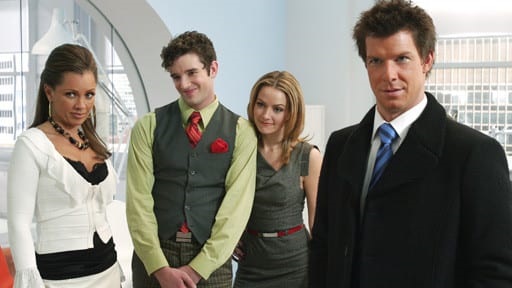
"Ugly Betty": The Gay, Transgender, and Racial Diversity Has Not Aged Well


I've been re-watching Ugly Betty (2006-2010), the soap opera/comedy adaption of the Colombian telenovela Betty la fea, about a Latinx girl of unconventional attractiveness (America Ferrara} who gpes to work in the svelte, "new now next" world of fashion magazine Mode.  The two worlds, working-class Queens and the upper East Side upper-crust, compete, collide, and merge in humorous or heartbreaking ways (this is a soap opera,after all).

Alhtough only 10 years has passed since the series ended, our  world is completely different, and Ugly Betty has not aged well.

1. The executive producer, some of the writers, and halfof the cast was Latinx.  The show won Alma awards for Hispanic representation.  But some of the depictions of Hispanic persons are cringeworthy today.  They're not all crass, gauche, loud, and flashy.

2. I find it a little annoying that Betty is supposed to be la fea, but she has to beat off the suitors.  In the first season, she has an on-off romance with a Queens boyfriend and Mode accountant Henry (Christopher Gorham, below), and gets several other suitors.

2. Women, especially women of color other than Betty, are scheming, manipulative, devious, underhanded, and treacherous. Mode creative director Wilhelmina wants to become editor-in-chief, a job for which she is exceptionally well qualified.  But magazine mogul Bradford installs his ne-er-do-well son Daniel (Eric Mabius, top photo), who knows nothing about fashion (except how to bed supermodels) and doesn't even want the job, except as a chance to prove to his father that he's not a screw-up. Wilhelmina is the villain, a veritable Wicked Witch of the West.

Other scheming women of color during Season 1 included: Sofia (Salma Hayak), who tricked Daniel into falling in love with her so she could write it up as the lead article in her magazine; and Constance (Octavia Spencer), the case worker of Betty's father Ignacio, who develops a wacky Fatal Attraction obsession with him.


3. Gay men are even worse.  In the first season, there were only two, both  flamboyant, flitting, fabulous fashion plates (plus a straight guy who pretended to be fabulous to get all of the wonderful benefits that gay people get, har har): Betty's nephew Justin, who doesn't actually come out until Season 4, in spite of his mother constantly saying how suppportive she is;and Wilhemina's "flying monkey" assistant Mark. She demeans, belittles, berates, and gay-bashes him every chance she gets, making it obvious that she ccnsiders him less than human.  She even "sells" him to a competing rich bitch.

4. The representation of transgender people is still worse.  Daniel's older brother Alex disappeared for two years and was assumed dead; then he returns as Alexis. It takes awhile,but eventually the other characters get used to she/her pronouns. But everyone, even Alexis, believes that she changed gender rather than confirming the gender identity she had all along: "I used to be a boy, but now I'm a girl." 

And "they cut it off," which is not at all what happens in sex confirmation surgery.

And back when he was a boy, Alex dated and had sex with girls, because, you know, everybody with a penis likes girls.  Now that she has "changed into girl," she dates boys. That's not how it works.  Your sexual orientation doesn't change along with your genitals. But heteronormativity and all that.

Did I mention that Alexis is even a bigger villain than Wilhelmina?

I still like the show, but it's amazing how much the world has changed in just 10 years.

See also: The Heterosexual Gay Kid of Ugly Betty

Jul 17, 2020

The Gay Enchanted Forest of Spooky the Tuff Little Ghost


When I was a kid in the 1960s, my favorite comics by far were the Harvey supernatural titles: ghosts, witches, and devils roaming an oddly-Medieval Enchanted Forest where same-sex desire was commonplace.

I preferred Casper, but in a pinch, I would read about Spooky the Tuff Little Ghost, a ghost boy with a Brooklyn accent, freckles, and a derby (or, as he pronounced it,  “doiby”).  (Not to be confused with Charlton's far inferior Timmy the Timid Ghost).

But while Casper was a 1960s nonconformist with a gay-coded softness and sensitivity, the hawkish Spooky had no aversion to booing.


 In Spooky’s wild region of the Enchanted Forest, ravenous bears, ogres, monsters, and evil wizards leapt out from behind every boulder, so booing was an essential form of self defense.  But for Spooky, it was an all-consuming passion.  He specialized in complex, artistic boos, creating statements similar to the happenings and guerilla theater of the 1960’s art scene: he might boo a horse and rider into trading places, so that the rider runs off with the horse on his back, or he might boo a lake out of its bed so precisely that the fish remain, swimming in mid-air.

In “Once upon a Scaresday," Spooky explains how he took up booing in the first place.  As a child, he was a coward and a sissy, always running away from danger.  One day he was walking in the hills beyond Spooktown with some friends, when cannibalistic monsters called Ghostcatchers attacked.  Spooky managed to run away, but his best friend Googy was captured and dragged off to be cooked and eaten.  Distraught with guilt and mourning his loss, Spooky asked his grandfather for advice, and the elderly ghost taught him how to defend himself by booing.  He proved to have a great gift for this ghostly martial art, and soon he was able to seek out the monsters and rescue his friend just as the cooking-fire was being lit.


A same-sex relationship originally motivated Spooky to boo, and a heterosexual relationship now compels him to stop.  Spooky and Poil (his pronunciation of Pearl) are quite an adult couple, dating, dining at each other’s homes, and even kissing on couches.  Pearl forbids him from booing.  She claims that it is immoral, but her real reason is class-based snobbery: she considers booing boorish and vulgar, a working-class pastime likely to offend her high-society ghost friends (but they usually turn out to be closet booing fans).


Spooky is constantly promising to refrain from booing, to keep Poil from brow-beating or even leaving him.  Many stories involved his frantic but quite clever schemes to continue booing after such a pledge, either for self defense or to assuage his addiction: he throws his voice, writes “boo” in the sand, spells it out with smoke signals.  But why would Spooky even agree to cease a useful, artistic, socially-praised, and strategically necessary activity, just because Poil disapproves?  Obviously she offers something more valuable than any of these things, more valuable than any love, but what?  I was mystified; I could imagine giving up a bad habit or even an innocuous hobby at the admonition of a friend, but a career, a passion, a veritable calling?

I knew it had something to do with the girls who jumped their ropes and played their singsong games in the shadow of the school.  At recess, we boys were herded far away to fields to play baseball and dodge ball, and if ever once we tried to play jump rope, or merely sit on the steps nearby to avoid the midday sun, a teacher would scream wildly at us to stay put.  What danger lurked there, against the cool bricks?  What threat did girls pose that could force Tommy Kirk to forsake his buddies at Midvale College, or Alec to forsake the wonders of the Earth’s Core, or Spooky to forsake his booing?

Jul 16, 2020

Manly P. Hall: Gay Psychic Murdered by His Lover


When I lived in Los Angeles, there was a University of Philosophical Research at 3910 Los Feliz, near the Silverlake gay neighborhood.  But it wasn't a university, and it didn't do any philosophical research, although it had a library of 50,000 volumes.  It was a mystical/occult organization founded by Manly P. Hall (1901-1990), who published The Secret Teachings of All Ages (1928).

I haven't read it.  It's a gigantic compendium of occult lore, thick, dense, and impenetrable, with chapters on "The Bembine Table of Isis," "The Hiramic Legend," "Hermetic Pharmacology," and "Fundamentals of Qabbalistic Cosmogony."  But it was immensely popular, on the shelf of everyone from H.P. Lovecraft to F. Scott Fitzgerald, and it has never gone out of print.

Hall became one of the biggest celebrities of the era.  In 1934 he founded the Philosophical Research Society, and stocked its library with thousands of rare occult volumes purchased for him by wealthy disciples, notably oil heiress Carolyn Lloyd.

He wrote many more books -- nearly 200 -- some with beefcake covers, like this rather buffed deity with a shining phallus creating the worlds.

He delivered over 7,000 lectures.

For all his erudition, Hall's philosophy was simple.  His Ten Basic Rules for Better Living include:
1. Stop worrying.
2. Don't try to dominate and control other people.
3. Learn to relax
4. Cultivate a sense of humor
5. Reign in your ambition.
6. Don't accumulate more than you need.
7. Believe in something bigger than yourself.
8. Never intentionally harm anyone.
9. Beware of anger.
10. Never blame others for your own mistakes.


Elvis Presley was a fan.  So was Ronald Reagan. He officiated at the wedding of horror movie great Bela Lugosi.

Disciples stood in line around the block on Los Feliz Avenue to hear his advice.  Astrologers, bodybuilders, magicians, actors, writers, philosophers.

A few -- the best and brightest, the most eager, the most muscular -- stayed on, to become his assistants.  Like future paranormal researcher Arthur Louis Joquel.

Hall was gay or bisexual.  He was married twice, but neither marriage was ever consummated.  His wives and disciples turned a blind eye to his interest in attractive male proteges, and quickly put a stop to any hint of scandal. Except for the last one.

In 1988, when Hall had become morbidly obese, almost unable to walk, and showed signs of dementia, he fell in with a salesman-turned-psychic named Daniel Fritz, who claimed to be a reincarnation of a prince from ancient Atlantis, and his son David, who regularly took spirit-journeys to Jupiter.

No different than the hundreds of other psychics, astrologers, occultists, and reincarnated princes that Hall had entertained over the years.  But his disciples suspected that these two were con artists.  

In August 1990 Hall rewrote his will to give Daniel his entire estate, worth some $52,000,000.  Six days later, he was dead.  Daniel and David were alone with the body for several hours.  Disciples believed that the two had murdered him.

An inquest found no evidence of foul play.  But the will was contested, and the estate reverted to Hall's widow.  Daniel and David moved on to other clients.

Jul 10, 2020

Strangers from Hell: When You Don't Know You're Dead

I don't usually watch Korean tv shows.  They'll never show a gay character, and there is an annoying emphasis on boy-girl romance.  But I watched Strangers from Hell because it had an intriguing premise: a rundown hotel from which there is No Exit.

Prologue: Two men walk down a narrow hallway, red-lit, draped in darkness.  Very dark color palette, hard to see anything. The young, attractive Jong-u (Im Si Wan) narrates: "I thought the world I lived in was hell, but this place is the real hell."

Wait -- is he lying in the room with blood on his face?  Is he dead?

Scene 1: Jong-u rides a bus across, I assume, Seoul, gets out his stuff.  .A guy accidentally crashes into him, then walks off without a word.  He exclaims "My goodness!"  Really weird translation of a common Korean expletive.

The Girl calls to make sure he's gotten there ok, ans says "You don't sound well."  Uh-oh, he's dead.

Scene 2: Jong-u looks at residences (like dormitories, with single rooms and shared baths).  A nice one costs 550,000 won ($417) per month.  "My goodness!  That's too expensive!"  The next costs 450,000 won.  A crappy one costs 270,000 won.  "My goodness!  Still too expensive!"

Scene 3:  Finally he walks up a long, steep hill and then a long, steep staircase to the Eden Residence, where a cheerful "My goodness!"-spouting lady offers him a room for only 240,000.  The building is going to be torn down for redevelopment, so only a few residents are left, long-term, crazy. 

She leads him down the dark, red-lit, decrepit hall, past three residents: Surly Guy snaps at him; Staring Guy stares; Giggling Guy giggles maniacally.  Plus it's a horrible, dingy room, with filty walls.   "It's cheap because a resident committed suicide." My Goodness says.

You know, the other room was only about $20 per month more.  Why take this one?  Unless you already took it, and you're forced to live your horrible death over and over.

Scene 4: Up on the roof. Jong-u calls The Girl and asks to hang out, but she's busy with her boss's birthday party.  My Goodness appears and tells him to be careful, some of the floors are decrepit.  Ya think?

Scene 5: Jong-u tries to sleep in his horrible room, where he can hear the screams, moans, and arguments of the other residents.  He gives up and starts to write a story about a man with an "odd gait" and a maniacal laugh, who carries a plastic bag full of....dead cats?  Gross!

Scene 6: We switch to the Cat Guy -- is this still a story Jong-u is writing?  He meets and is threatened by his superior, who carries a sinister suitcase.   "You have to be more quiet at night."

After stealing some iced coffee, Cat Guy goes into the Eden residents, where My Goodness nags him for killing so many cats.  Then he talks to Staring Guy about how, if someone dies in the residence, no one will care.

Scene 7: Jong-o wakes up in the morning, and decides to explore.  He hears a noise from the off-limits Fourth Floor, and is about to investigate, when Cat Guy interrupts him, carrying a gun. "My Goodness!" he exclaims.  But Cat Guy isn't planning to shoot him; he's going off to get shot.

Scene 8: Two cops are investigating all the plastic bags full of dead cats that keep popping up all over the neighborhood.   They're worried because the last time, the dead cats were followed by dead people.

Scene 9: The lady cop goes to the dentist.  I don't know why, except to give the dentist the opportunity to say "My Goodness, your cavity looks bad."

The dentist, played by Lee-dong Wook  (left), is important to the plot.  He gets second billing.

Scene 10: Jong-o is having a beer with Jae-ho, his new boss (it's just an unpaid internship)  Out on the street, he sees two guys fighting and flashes back to a fight of his own, when he was in the army (all Korean men serve for 1 to 2 years after their 18th birthday).  So, is this how he died?

Jong-o intervenes.   Afterwards, Jae-ho wants to continue their drinking, but Jong-u excuses himself and leaves.

Scene 11: Back at the residence, he meets Laconic Guy, another resident, who tells him that they're all in a long tunnel from which there is no escape (ya think?).

He goes down to take a shower, and is completely shocked by the sight of Cat Guy showering. Cat Guy actually doesn't have a bad physique.

He cooks dinner -- ramen.  Surly Guy warns him about the other residents. They're all crazy.  Who knows what they are capable of?

Later, everyone congregates in the hall.  Staring Guy stares, Cat Guy giggles, and Surly Guy yells.    Jong-u is most upset over Staring Guy, and yells at him.  Narrating, he says "I shouldn't have done that."  We see that Staring Guy is holding a meat cleaver behind his back.

Scene 12: Jong-u is trying to sleep amid the screams and giggles and scuffling.  Staring Guy stands in front of his door, trying to decide whether to kill him.  Surly Guy plays with a knife of his own.

Scene 13: Jong-u gets up in the night.  Staring Guy is asking "Do you want me to kill you now, or what?"  He goes to Staring Guy's room, and gets stabbed.  His life flashes before his eyes.

Wait -- he wakes up in bed.  It was a dream.  Or a flashback to his death, which he's reliving over and over.

Out in the hall, Surly Guy is arguing with Cat Guy.  But then Cat Guy comes walking down the hall.  Huh?

Surly Guy is just as confused as I am.

Laconic Guy comes out of his room, and calms everyone down.

The end.

Beefcake: Jong-o and Cat Guy showering.  Most of the actors are quite hunky.

Other Sights:  Some of Seoul.

Gay Characters:  Probably not.  But no one expresses any heterosexual interest.  It's not even clear whether The Girl is Jong-u's girlfriend or sister.

Weirdness:  I have no idea what's going on.

Will I Continue Watching:  Probably not.
Related Posts Plugin for WordPress, Blogger...