Showing posts with label Roddy McDowall. Show all posts

Aug 11, 2019

Dave Draper Doesn't Get the Girl

Dave Draper, "The Blond Bomber," was the go-to guy for movie bodybuilders during the 1960s, when most of the bulkers had moved to Italy to do sword-and-sandal flicks.


He never appeared in the gay-vague Physique Pictorial or similar physique magazines; in fact, some of his magazine covers are rather heterosexist, sandwiching him between two women, who are lusting after his biceps.  Inside, however, we see some homoerotic subtexts, as when fellow bodybuilder William Smith gazes at Dave's biceps.

After a minor role as a guy who takes his shirt off in Who's Been Sleeping in My Bed (1963), he capitalized on the sword-and-sandal crazy anyway, showing old Steve Reeve movies as Dave the Gladiator on local L.A. TV (1964-65).

In 1966 he landed a starring role in Lord Love a Duck, a comedy about a gay-vague Mephistophiles, Alan Musgrave (gay actor Roddy McDowall), who concocts wild schemes, including murder, to grant the wishes of his friend Barbara (Tuesday Weld).  Dave was one of her wishes, but not the man she married. Alan is supposed to find him intimidating, but instead approaches him with barely-restrained eye-bulging desire.


After more minor roles as guys who take their shirts off and scare people in Three on a Couch and Walk Don't Run, Dave starred in Don't Make Waves (1967), about New Yorker Carlo Cofield (Tony Curtis), who moves to Southern California to "Turn on!  Stay loose!  Make out!"  and romance a skydiving model named Malibu (Sharon Tate).  Dave played her boyfriend, Harry Holland, who also befriends Carlo.  There's a significant gay subtext, as in most of Tony Curtis's movies.


In 1967, Dave appeared as musclemen on episodes of The Monkees and The Beverly Hillbillies.  No significant gay subtexts, though it is interesting to watch the lesbian actress Nancy Kulp pretend that she is swooning over his physique.

Disillusioned at always been cast as bullies, objects of derision, and guys who don't get the girl, as if the bodybuilder was somehow inadequately masculine, Dave retired from acting to concentrate on bodybuilding and writing, and on managing World's Gym in Santa Cruz.  His personal website features many interesting articles on the history of bodybuilding, but doesn't mention gay people.

Apr 24, 2018

Henry Willson: The Man Who Invented Beefcake

During the Cold War of the 1950s, the Clark Gable-Cary Grant- Fernando Lamas model of  masculinity, the suave, sophisticated bon-vivants who sipped champaign at El Crocadero, fell into disfavor.  Movies began to display a new model of "youthful masculinity" featuring regular guys, small-town boys who sipped sodas at maltshops.   They had to be wholesome -- God-fearing, mother-respecting, patriotic -- yet sexual, overbrimming with erotic energy, aware (without stating it) that sometimes things happened in bedrooms.

They had to be stunningly handsome, of course, and muscular -- for the first time ever in the movies, they would rip their shirts off regularly, providing a beefcake spectacle that might draw audiences away from the still-prudish tv.

Walt Disney and his minions scoured the countryside to provide a stable of Adventure Boys for the teen and preteen audience -- James McArthur, Roger Mobley, David Stollery,  Tommy Kirk, Tim Considine, and many others.

For adult beefcake, the go-to guy was talent agent extraordinaire Henry Willson.

 Born in 1911, Willson began his career as a talent scout for the Zeppo Marx Agency, where he signed on future film great Lana Turner.  In 1943, he became the head of the talent division for David O. Selznick's Vanguard Pictures.  He and his assistants prowled gyms, modeling agencies, athletic events, and community theaters looking for prospects. Muscle Beach was a good bet, training ground to dozens of bodybuilder hopefuls drawn in by Earle E. Liederman's chatty columns in Muscle Power.

Since he was gay, Willson tended sign up men who were gay, or bisexual, or at least "gay for pay."   He spruced them up, arranged for acting lessons and gym memberships, and gave them strong, macho, all-American names:

Orton Whipple Hungerford III = Ty Hardin
Robert Mosely = Guy Madison
Francis Durgan = Rory Calhoun
Merle Johnson = Troy Donahue
Roy Harold Scherer = Rock Hudson

They present a straight facade to the world, of course, so Willson conspired with movie magazines and gossip columnists to send them on dates with female stars or link them romantically with in-the-know starlets.  Sometimes he even arranged "Hollywood marriages."  It seems that the "hiding in plain sight" was part of their appeal, adding a salacious twinge, "is he or isn't he"?


In 1953, Willson opened his own agency.  He didn't need to seek out prospects anymore; he was receiving 9,000 letters per week from high school football players and small-town thesbians anxious to make it big.  And some did -- if they were willing to make it on the casting couch first, or at least flirt a bit.  Almost every Hollywood hunk of the new beefcake model got his start as a Willson boy:

Doug McClure
James Darren
Chad Everett
Dack Rambo (left)

John Saxon
Nick Adams
Clint Walker (left)
John Derek
James Gavin

Willson didn't care for bodybuilders, except for Cal Bolder -- they had to find their representation elsewhere. And a few other hunks managed to find work without him.  But even if they weren't discovered by Willson, they often realized that connections are everything, and gay, bi, or straight, they became regulars at his weekly pool parties:

Ed Fury
Farley Granger
Van Williams
Robert Stack


Roddy McDowall
Steve Reeves
Tony Curtis
Aldo Ray
John Bromfield
Gary Conway
Gary Lockwood
Richard Long
Robert Wagner (left)

Disaster hit in 1955, when Willson made a deal with Confidential magazine to keep the rumors off Rock Hudson in exchange for a story about Tab Hunter's arrest at a gay party in 1950 (the actor and agent had a falling out).  The deal fell through, and Willson was effectively outed.  His established clients left -- most denied that they had ever met him -- and it became difficult to sign new clients.

During the 1960s, the fresh-faced, wholesome look became  "square," replaced by shaggy and androgynous,  and Willson's career ended.  Destitute, drinking heavily, forgotten by his former friends, he moved into a rest home for indigent Hollywood stars, and he died of cirrhosis of the liver in 1978.

But he left an amazing legacy, a 1950s world where "gay" was always just beneath the surface.

Oct 24, 2015

The Life of Riley: Bullying Boys into Girl-Craziness

Before World War II, teenage boys were expected to be concerned with the gang, or with one special pal, and think of girls as "poison."  Those boys who expressed an interest in girls prior to graduating from high school were ridiculed by their peers as pansies and Percies, evaluated by school psychologists, and subjected to tense heart-to-heart talks with their parents.

But after the War, the image of the adolescent masculinity shifted from "woman-hating" to "girl-crazy," and some of the long-running radio teenagers who had previously been concerned solely with paper routes and bad report cards suddenly began casting longing glances at their female schoolmates.  You can find the exact date: Chester Riley’s son Junior (Scotty Beckett) on  Life of Riley in January 1948; The Great Gildersleeve’s wisecracking nephew Leroy (Walter Tetley) in March 1949; and Ozzie and Harriet’s eldest son David Nelson in November 1951

Left and below: in 1948, MGM arranged for  Scotty Beckett (later Corky of Gasoline Alleyand his friend Roddy McDowall to go on a "see, they're not gay!" double date with Elizabeth Taylor and Jane Powell, but they seem to have ended up cuddling with each other.


The teenage boy had to be bullied, cajoled, and if necessary forced into girl-craziness; it could not be taken for granted.

In the January 1948 episode of The Life of Riley, for instance, blustering working-class family man  Chester (William Bendix) is horrified to discover that his fifteen-year old son, Junior, plans to bring a boy to the big New Year’s Eve dance.

He tries to explain about “the birds and bees,” sexual difference, but Junior insists that he already knows about “all that jazz.”


So Chester puts his foot down: there are “boy people” and “girl people,” he argues, and “boy people” should only take “girl people” to dances.  “Don’t you like girls?” he asks in a timid, hesitant voice, afraid of the possible answer.

When Junior admits that he likes girls “sometimes,” Chester takes charge, forcing the boy to break his same-sex date and telephone the boss’s daughter.  She is noncommital, so Chester forces him to call the offspring of another VIP (resulting, of course, in two dates for the dance, both impossible to break).  He is as hysterical in his insistence that Junior should like girls as fathers of the pre-War generation were hysterical in their insistence that their teenage sons should not.

Chester continued trying to "encourage" his son into girl-craziness when the show moved onto television, and Scotty Beckett was replaced by Lanny Reese (above) and even the obviously-grown up Wesley Morgan (left).

Nov 2, 2014

Roddy McDowall: Hiding in Plain Sight

Gay male actors born before Stonewall pretended to be heterosexual as a matter of survival.  They had "Hollywood marriages."  They brought heterosexual dates to events, and gave interviews about the type of woman they preferred.  Some, like George Takei and Richard Chamberlain, came out in old age, when their careers were over or almost over.  Some, like Charles Nelson Reilly and Paul Lynde, had such a fey stage presence that they figured it was obvious, no  need to come out. And some like Liberace, denied the "allegations" to their dying breath.

Roddy McDowall never denied anything, but he never said anything, either.  He "hid in plain sight," taking advantage of the homophobic myth that gay men don't exist, or if they do they're mincing, lisping pieces of fluff.

So, in this photo shoot, Roddy and fellow gay actor Tab Hunter cook weiners and cake in their underwear, and apparently no one in the 1960s had any idea.


Born in 1928, Roddy got his start as a child star, bringing wartime angst to the screen with boy-and-dog or boy-and-horse vehicles.  In his teens, he played Malcolm in Macbeth and David Balfour in an adaption of Robert Louis Stevenson's Kidnapped. 

He made the transition from child star to young adult seamlessly, playing prissy gay-vague characters, usually costarring with a more macho muscleman: Stuart Whitman in Shock Treatment (1964), Robert Redford in Inside Daisy Clover (1965), Dave Draper in Lord Love a Duck (1966).

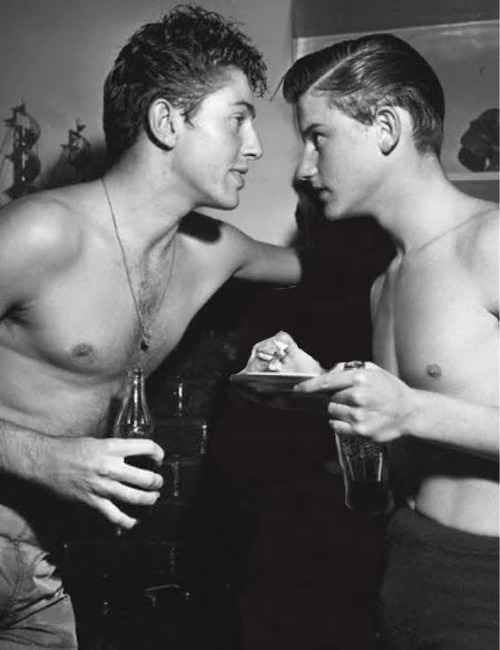
His friends were usually muscular, too, such as Scotty Beckett and fellow gay actor Farley Granger. (There was originally a girl between them, but she's been photoshopped out).


During the 1970s, Roddy started making movies again, mostly playing fey, easily-ruffled characters, sometimes comic relief, sometimes villains. Sci-fi, horror, adventure, black comedy: The Poseidon Adventure, The Legend of Hell House, Arnold, Embryo, The Flood!, The Cat from Outer Space, Double Trouble, The Evil Inside Me....  Sadly, he may be best remembered for the gay-vague Galen in the Planet of the Apes franchise.

Occasionally guest spots on tv series, but only two starring roles, on The Fantastic Journey and Tales of the Gold Monkey, which I remember fondly because I dated one of the cast members.

Most of his characters in 261 movie and tv roles were gay-coded, but none were gay.

That's something gay actors of the closet generation would never do.


The key was to not say anything, and occasionally pose for a photo shoot entitled "Calling All Girls."

He died in 1998.


Related Posts Plugin for WordPress, Blogger...