Showing posts with label pirates. Show all posts

Dec 28, 2025

Francois Göske : Searching for gay subtexts amid the constant drone of "girls! girls! girls!" At least he shows his junk


Robert Louis Stevenson's books are sacred, memories of childhoods past where boys conjured up lavish adventures with each other.  Especially Treasure Island, written specifically upon a request from his stepson Lloyd Osbourne that there be "no girls in it."  And there aren't, except for Jim Hawkins' mother.


So I was quite disappointed with the German miniseries (2007), in which Jim Hawkins (18-year old Francois Göske) not only does stuff with a lady of the evening, he falls in love with a female stowaway on the ship, Sheila (Diane Willems)!

Ok, I thought, but maybe Göske's other work will redeem him.  Some gay characters, or some substantial gay subtexts?

His first starring role was in a 2003 remake of the children's classic Das Fliegende Klassenzimmer (The Flying Classroom), set in a boys' school.  Only this one had girls -- and he gets a girlfriend.


In French for Beginners (2006), Goeske goes to France as part of a student exchange program.  It looks like he has a gay subtext buddy-bond with Lennard Bertzbach, but actually they are partners in crime, dedicated to winning the Girl of His Dreams. 

 A reviewer  suggests that this "charming" movie be used in French language classes.  It's not charming when you spent your childhood with the "what girl do you like?  What girl?  What girl?" interrogation.

Grimm's Finest Fairy Tales: The Farmer's Daughter (2008).  I'm not familiar with that particular fairy tale, but I imagine it involves Goeske kissing some girls.


Summertime Blues (2009), based on the juvenile novel by Julia Clarke: Goeske goes to the countryside with his mother, and meets the Girl of His Dreams.

Dornroschen (2009): The fairy tale of Sleeping  Beauty.  Guess who wakes her with a kiss?

More after the break

Nov 25, 2025

The Swashbuckling Boyfriends of November

November is my favorite month.  The colors are soft and muted, the sky is not too bright, the air is cool but not cold, it's festive but not overwhelming like December, and it contains my birthday and Thanksgiving, the two holidays that provide the most pleasure and least guilt.

Besides, when I was a kid, November and December were the only months where I could read without getting yelled at.

Mom and Dad disapproved of reading -- it was a waste of time, it would strain my brain, it was antisocial -- I should be out playing sports, or at least watching tv with the family.  Science fiction and fantasy was especially suspect, likely to turn me into an atheist, or, much worse, a Catholic.  So I always hid books, or read at my friends' house, or said they were for school.

But in November,they actually were for school.  Teachers always assigned us swashbuckling adventure novels to read over Thanksgiving and Christmas vacation!

It wasn't my fault -- blame my teacher.  Sorry, no time to play basketball in the driveway, or touch football in the schoolyard -- I had to get through this book.

Four of the books we were assigned were particularly memorable.  They had gay subtexts as well as a heteronormative primary plot.

1. The Count of Monte Cristo, by Alexander Dumas (1844).  Edmond Dantes escapes from his unjust imprisonment in the Chateau d'If, and gets vengeance on the people who betrayed him.  He gets a girlfriend, but also forms several passionate male friendships, notably with Peppino, a boy who was also betrayed and becomes his...um...."servant."  Henry Cavill, left, is one of the more muscular Dantes in film.


2. The Three Musketeers, by Alexander Dumas (1844). A young man named d'Artagnan wants to become a Musketeer, one of the king's bodyguards. The three current Musketeers reject him, but then find him worthy.  He gets a girlfriend, but rejects her; his most passionate relationships come with men. (Chris O'Donnell, left, is one of many hunky d'Artagnans).

3. Treasure Island, by Robert Louis Stevenson (1883). A boy helps pirates find buried treasure, with nary a woman in sight.

4. The Prisoner of Zenda, by Anthony Hope (1894). An Englishman on holiday in Ruritania bears a striking resemblance to King Rudolph, who has disappeared, and agrees to impersonate him.  He falls in love with the King's fiancee, but has to leave her.  The king and the commoner share many a touching moment.

5. The Scarlet Pimpernel, by the Baroness Orczy (1905).  A precursor of Zorro, Batman, and all of the other superheroes with a milktoast alter ego, Sir Percy Blakeney pretended to be gay -- weak, shrill, feminine -- but he was really a hetero hero, saving French aristocrats from the guillotine during the Reign of Terror.  He has a girlfriend, whom he marries, but he also spends time rescuing male aristocrats, notably the hunky Sir Andrew.

6. Captain Blood, by Raphael Sabatini (1922).  Dr. Peter Blood, an Irish physician (who would want to go to a doctor called Blood?), is wrongly convicted of treason and sold into slavery in the Caribbean.  He and his friend Jeremy Pitt commandeer a ship and become pirates. (Ross Alexander, top photo, played Jeremy Pitt in the 1935 movie).

All of these novels have been filmed many times, usually with a hetero-romance tacked on to provide a "fade out kiss" ending.  But I didn't know that during those long, cool November afternoons.


Apr 19, 2023

"One Piece": Buddy Bonding During a Quest to Own Everything in the World


 One Piece, a Japanese anime series on Netflix with a 95% "similarity" rating.   The only one-pieces I've heard of are ballet leotards.  Maybe it's set in a ballet school, with muscles and bulges.  

Prologue:  No such luck.  This is about pirates. Back story: years ago, the King of Pirates buried a treasure, "everything the world has to offer," so now thousands of pirate ships are scouring the oceans, looking for it.  Um...those would be scavengers.

Scene 1:  Some sailors see a barrel floating in the ocean, and pull it aboard, even though their shipmates are  screaming with rage and yelling "You suck!"  I can't imagine what their beef is.  

Meanwhile, at a fancy ball on a cruise ship  -- the same ship? -- redhead girl is asked to dance.  

Suddenly pirates attack!  Everyone at the fancy ball panics, except for the redhead girl, who just smiles.


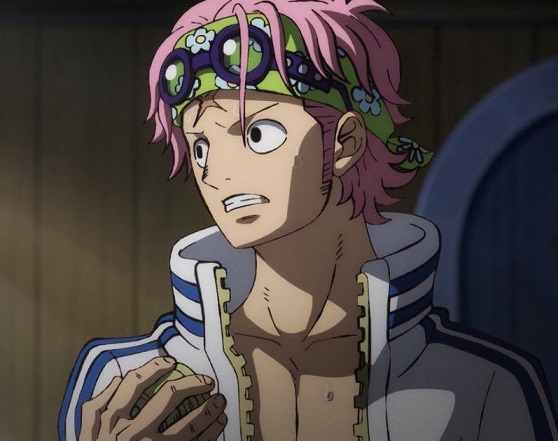
The pirate leader, Iron Club Alvida, forces the crew to say that she's the most beautiful woman on the ocean.  They all board rhe cruise ship except for Coby, a frightened pink-haired boy.  She assaults him.

This is not what Coby looks like in this episode.  He must grow up.

Scene 2: The pirates have entered the ball room: "We won't take yer lives, but we'll take yer valuables." (That's what the subtitles say.)  

Coby runs into the kitchen, and finds the barrel that the sailors pulled out of the ocean earlier (the one that made their shipmates furious).  The pirates follow and break it open: it contains a boy!  They attack, but he easily subdues them, and introduces himself to Coby as Monkey D. Luffy.  Maybe they'll have a gay subtext buddy-bond.

Meanwhile the redhead girl puts on a pirate uniform and swings over to the pirate ship.  She kicks a guard in the balls, and smiles for about ten seconds.  

Scene 3: Luffy is hungry, so he raids the kitchen.  He explains that his ship got swallowed by the maelstrom in Scene 1, and he escaped by sealing himself in a barrel. Apparently he's a paranormal being, maybe a trickster god.   Coby tells us his back story: he was out fishing one day, when he was shanghaied by the pirate queen and forced to work as a chore boy.

Luffy: "Why didn't you just run away?  You're dumb and stupid, and a wimp.  I hate you!"  So much for the gay subtext.

Meanwhile, the redhead girl is investigating the pirate ship.


More plot dump: Luffy is planning to become King of the Pirates, a title given to the person who "finds everything in this world."  That's a lot of booty.  No, wait, these subtitles must be off.  He's not looking for everything in the world, just a single object called the One-Piece. Sort of like the One Ring that gives you infinite power, and allows you to take over?

Coby has a goal, too: to join the navy, and catch bad guys like pirates.  Uh-oh, conflict!

Scene 4:  Having eaten, Luffy needs a new ship: "I wonder if they would give me this one, if I asked nicely."  But at that moment Alvida the Pirate Queen arrives.  He disparages her beauty, which makes her furious. He grabs Coby and flies to the upper deck.  There he subdues some regular pirates by stretching out his arm and boomeranging back.  

When Alvida approaches again, Coby stands up to her, disparaging her beauty and stating that he's going to join the navy, while Trickster God laughs.  She attacks, but Luffy deflects her blows onto himself, and of course he can't be hurt.  He punches her into the stratosphere.

Meanwhile, the redhead girl is leaving with the pirate booty.

Scene 5:  The navy arrives!  Coby and Luffy grab a small boat and leave to avoid capture.  Couldn't he just clobber them all?  

Luffy still needs a crew.  He suggests recruiting the pirate-hunter Zoro, who is incarcerated at a navy base. Coby is opposed to the idea: Zoro is a bad guy.  They argue.

Cut to the navy base, on a small island.  Zoro is tied to a stake in the courtyard.  He grimaces.  The end.


Beefcake:
  No. But in the One-Piece movie, also on Netflix, all of the male characters are semi-shirtless, with spectacular physiques.  Maybe I'll review that next.

Gay Characters: Coby and Luffy have a gay-subtext buddy-bond, right now, but the redhead girl will no doubt be joining them, and become the object of  heterosexual desire for one or both.

Culture Clash:  Why were the sailors so upset over pulling a barrel out of the ocean?  

Why does Luffy insult Coby and say that he hates him, when he obviously likes him?  

 Why is a person who owns everything in the world called the King of the Pirates instead of The Emperor or the Supreme Leader?  

Why would a trickster god have to work hard to own everything in the world?  Doesn't he control it already?

Maybe these things make sense to Japanese viewers, or maybe they're explained in later episodes.

Will I Continue to Watch: Holy cow, there are over 1,000 episodes!  One a day for the next three years!  I don't think so.

See also: Three One-Piece Movies in One Sitting

Jun 22, 2013

Tim Tyler's Luck: Gay Boy and Pirate in the Jungle

The results of the poll are in, and there were lots of votes for 1940s and before, but not many for the 1990s and 2000s.  That doesn't really match my blog traffick:

Mae West, gay icon of the 1930s -- 33 hits
Zoey 101, Disney channel teencom of the 1990s --  330 hits

But ok, we can start with Tim Tyler's Luck.


It began in 1928 as a humorous comic strip about a young teenager living in an orphanage, where he was burdened by bad luck.  The gag-a-day humor ended when he met an older boy, Spud, and they decided to set out on the road together.  Eventually they grew into young adults and settled in Africa, where they spent many decades hunting down poachers, finding lost civilizations, being captured by cannibals, and squashing tribal rebellions, all the while ignoring the occasional savage princess or girl reporter.  They endured through 1996, the last of the old-style teenage homoromances hidden away in the comics sections of a dwindling number of small-town newspapers.    

In the movie serial version of Tim Tyler’s Luck (1937), Frankie Thomas plays Tim Tyler, but his partner Spud (Billy Benedict), is virtually absent, appearing only in the first chapter.  Instead, Tim travels through Darkest Africa alone.  He is heavily feminized by the camera, jaunting through the bush with a sweater tied around his neck as if he just stepped off a tennis court.  He is rescued more often than rescuing, participating in the vague euphemisms for sexual assault usually reserved for damsels in distress: he is carried off, kicking and screaming, twice.

When he strips down to his underwear to swim in a lagoon, a movie convention usually intended to divest young ladies of their clothes, a crocodile attacks, but lest the homoerotic implication become too obvious, a friendly panther, not Tarzan, rushes to the rescue.


There's a girl, but no hetero-romance.  Instead, the gay subtext comes when a bearded French-accented pirate, Lazarre (Earle Douglas) carries Tim off into the bush, screaming and arms-flailing like the young ladies who are always being abducted out of their bedchambers in these serials.  Tim talks Lazarre out of his dastardly plans and rehabilitates him into an ally.  For the rest of the serial, Lazarre provides comic relief with pretensions of cowardice while risking his life to save Tim over and over (the boy needs a lot of saving).

One wonders why director Ford Beebe didn’t let Spud tag along on the adventure and take charge of the comic relief instead of Lazarre.  Allowing  Tim to meet and rehabilitate the pirate certainly adds to the dramatic potential of the series; however, it also inadvertently reflects the sudden intensity of love at first sight.

The bond between the brash, working-class pirate and the fey sophisticate tennis player replicates the tough-sissy gender polarization of Freddie Bartholomew and Jimmy Lydon in Tom Brown's School Days,  but with a more overt erotic subtext.  Tim and Lazarre’s scenes are peppered with full-body hugs and sly innuendos: “We can’t leave until daybreak.  You will stay here with me tonight.”   And they do not participate in the heteronormative conclusion: evidently they plan to stay together forever.

Related Posts Plugin for WordPress, Blogger...