Aug 29, 2023

Duke Van Patten's Beefcake and Romance Photos

Duke Van Patten (the one on the left) was recommended to me as a Facebook friend because we have one "mutual friend," Christopher Atkins.

Could he be related to the famous Van Patten brood of 1970s hunks?

Maybe, but before I click on "Yes! Add me!" I always check to see if the prospect is gay.

I've never met a guy named Duke, but that's probably not his fault.

He's an actor living in New York.  Otherwise his "likes" are empty: no music, no tv shows, no sports, friends other than Christopher invisible.

Not much to go on.

A lot of photos of Duke with guys.  This one may be joke.  He comments "I love snapchat captions."


But not this one under the Christmas tree.


Or this one.  They're engaging in the macho sport of fishing, but look -- seven guys, no girls.  My kind of vacation!


There are about a thousand pictures posted of Duke in a boy-boy pair.  Or in this case, a trio.


But what am I to make of this meme? Granted, there's a nice chest and biceps, and the girl is far in the background, but she's still a girl.

Ok, time to check Duke's other social media.


Instagram: 2 pictures of Duke in a group that includes girls, and 85,000 of Duke with guys, including this take on the "On top of the world!" scene from Titanic.  Comment; "10% of our brains?  I think we use only 10% of our hearts."

Twitter: He watches a lot of movies, he saw Angels in America in London, his dream dinner guest is Aslan, and he states "I'm glad I'm not a 12-year old girl anymore."


One more place to check.  If he's an actor, maybe he's on IMDB.

Hey, he's the son of Vince Van Patten, the 1970s movie hunk and tennis player, part of a whole show biz dynasty.

Five on-screen credits: two walk-ons, The Adventures of Velvet Prozac (sounds campy), The Guest House (about a guy with a gay stalker), and The Real Housewives of Beverly Hills (playing himself)

I'm convinced.  Sign me up.  I don't have any friends left in New York -- maybe he'll invite me for a visit. 

I could tell him my Vince Van Patten hookup story.

See also: The Van Patten Brothers.

Cameron Mathison: Gay Content and Abs

Have you ever heard of Cameron Mathison?

Me, neither.

When I saw this black-and-white photo of the muscleman with an old-fashioned swimsuit and hairstyle, I figured he must be a 1950s beefcake star, like Troy Donahue or Rock Hudson, maybe one of Henry Willson's stable of gay and gay-friendly actors hired for their physique rather than for their background in The Taming of the Shrew.

But I thought I had covered almost all of them, even the most obscure.

Turns out this guy was born in 1969: this is a faux-retro photo from the 1990s.


He grew up in Canada, and graduate from McGill University with a degree in engineering.  After appearing in a few movies, he landed a plum role as con man Ryan Lavery on the soap All My Children.  He appeared from 1998 to 2011, with a year off.

At the same time he was a correspondent for Good Morning, America, working on the Oscars, the Golden Globes, and other events, and interviewing celebrities from Mario Lopez to Wolfgang Puck.


In 2015 he began starring in a series of movies based on the Murder, She Baked novels, as Mike Kingston, boyfriend of the small-town baker turned sleuth.

Any gay content?  Oh, I don't know.  Look at those abs.


How have I not heard of this guy before?

Ok, ok, he plays a gay character in 54 (1998), with Ryan Philippe (with a gay kiss edited out), and Getty Images has some pictures of him at the Gay and Lesbian Film Festival in L.A. in 2011.

That's enough gay content for me.


By the way, he has a brother, Scott.  I want to know more about him, too.


Aug 28, 2023

Krazy Kat: The First Gay Comic Character


From 1913 to 1944, newspaper readers could read a sparely drawn comic strip, an anomaly in the era of lush art deco masterpieces like Little Nemo, in which a small, squiggly cat named Krazy professes undying romantic love for the mouse Ignatz, who responds by lobbing a brick at Krazy's head.  But the cat is not dissuaded, accepting even violence as a signifier of desire. And, in fact, Ignatz often gives in and grudgingly accepts Krazy's affection.

 Meanwhile Officer Pup hangs around to throw Ignatz in jail or pontificate on the evil of brick-throwing.

The general public wasn't impressed, but the elites loved it, exuding comparisons to Charlie Chaplin and German expressionism. Gilbert Seldes’ The Seven Lively Arts (1924) devoted a chapter to the strip, and today most histories of the comic strip include warmly appreciative paragraphs.  Literary figures as diverse as Jack Kerouac and Umberto Eco have praised it.  It has influenced every comic strip from Peanuts to Pearls Before Swine. 

But heterosexuals try desperately to avoid admitting that Krazy Kat is gay.

The evidence is incontrovertible.  Cartoonist George Herriman always refers to Krazy Kat and Ignatz Mouse with the pronouns "he," "him," and "his," not to mention "Mr. Kat" and "Mr. Mouse."  I haven't read all 1500 strips, but I've read several hundred, and never once is Krazy Kat referred to with any feminine pronouns.  Krazy Kat is most definitely a male, experiencing same-sex desire.  He's gay.

Yet Gilbert Selden ("The Seven Lively Arts") and Robert Harvey ("The Art of the Comic Book") insist that Krazy's gender is indeterminate or ambiguous.

Gene Deitch ("The Comics Journal") calls Krazy a "he/she."

Martin Burgess ("The Comics Journal") says that Krazy is "always changing genders."

Miles Orville suggests that there is some ambiguity, but adds “for the sake of consistency, I am going to refer to Krazy as ‘she.’”

Poet E.E. Cummings, cartoonist Bill Watterson, and encyclopedist Ron Goulart have no qualms it: Krazy is a girl. Period.

A classic example of refusing to recognize same-sex desire even when it is hitting you in the head like a well-thrown brick.

When cornered, even cartoonist George Herriman backed off.  He was questioned about Krazy's gender, but not with homophobic disgust -- with honest confusion, in those days before the general public knew that gay people existed.  Wow could a male possibly desire another male?  It made no sense.

He responded that "The Kat can't be a he or a she.  The Kat's a spirit -- a pixie -- free to butt into anything.  Don't you think so?"

No.

No evidence that Herriman was gay, but he was hiding, of mixed race in the all-white world of newspaper cartooning.  He explained his dusky looks by claiming to be half Greek, and always wore a hat to hide his kinky hair.  He knew all about masks.

See also: Pogo, the Gay Possum of Okefenokee Swamp


Aug 27, 2023

The Clones of "Saved by the Bell"


During the 1990s, as advertisers were squabbling over the affluent teen market and cable stations were struggling to fill slots, Saved by the Bell-like teencoms appeared regularly: Welcome Freshmen (1991-92),  California Dreams (1992-97), Running the Halls (1993), Saved by the Bell: The New Class (1993-2000), Hang Time (1995-2000), Breaker High (1997-98), USA High (1997-99), City Guys (1997-2001).

The formula was easy: take six to eight beautiful people, three or four boys (schemer, hunk, nerd, and ethnic minority), three or four girls (cheerleader, feminist, princess, and ethnic minority).  Give all of the boys some tongue-lagging, eye-exploding girl-craziness, and all of the girls an obsession over boys.  Give them three sets: high school hallway, locker room, and teen hangout.  Add a clueless principal and an occasional parent, and voila!  The scripts write themselves (or actually, they can be recycled from  40-year old episodes of The Many Loves of Dobie Gillis).


In spite of the dull repetitiveness of the plots, gay teens might find them worth a look.

1. The shirtless, swimsuit, and speedo shots were constant, and the muscles often spectacular.  Even those teens who weren't man-mountains got their turn in the wrestling singlet.


Or found some other reason to take off their clothes.


2. Many of the high school hunks came in pairs, polarized into white/nonwhite or nerd/jock.  Breaker High was notable for having two homoromantic pairs: the nerd  Sean (Ryan Gosling) was paired with the schemer Jimmy (Tyler Labine); and the jock Max (Scott Vicaryous) was paired with the ethnic minority Alex (Kyle Alisharam).

These pairs often enjoyed emotional bonds much more intense than those of their knee-jerk heterosexual romances.  Plots often involved threats to their relationships.  For instance, on Breaker High, Alex and Max break up, and Jimmy jumps at the chance to befriend the hot jock.  But then he realizes where his true affections lie and returns to Sean.

But at the same time, they constantly patroled the boundaries of their relationship, evoking and rejecting the possibility of homoromance in joke after joke, episode after episode.  The studio audience usually responded with hysterical laughter: they knew exactly what was not being mentioned.

Beefcake, buddy-bonding, and borderline homophobia.  What else could a gay teen want from a Saturday morning teencom?


I Saw John Amos Naked


This post has been revised as John Amos: Kunta Kinte, Gordy the Weatherman, James Evans, a gay husband, and my gym buddy

Aug 26, 2023

Eric Roberts, Gay and Nearly Nude


Before Eric Roberts played Eli's friend Junior on Season 2 of The Righteous Gemstones, he had a long career -- 667 acting credits on the IMDB -- as serious actor and beefcake star, beginning at age 22 with King of the Gypsies (1978).


Eric stripped to his underwear in Star 80 (1993), as a guy who murders his wife, a model who appeared in Playboy.   

In 1996, when it was dangerous for an actor to play a gay character, Eric starred in It's My Party, as a gay guy with AIDS who decides to host a party for family and friends, then end his life.  Well, in those days gay men in movies were either dying of AIDS or coming out into a world where everyone is homophobic and there is no LGBT subculture.  As far as I can tell, this was his only gay role.


But he has taken off his clothes on screen many times since.  No frontals, but there's a butt shot on Gemstone Pride


The Kiss Heard 'Round the World: A Kelvin/Keefe Adventure

A Righteous Gemstones story: The day of Kelvin and Keefe's canonical kiss, as seen by BJ, Amber, Gideon, Judy, Eli, Keefe, and Jesse.
 

10:20 am: BJ

BJ watched Judy primping at her dressing room vanity. He grinned: it was so ordinary, but he wanted ordinary. After their marital problems, Judy and Kelvin both quitting the church, the kidnapping, and the rescue, it was nice to be just plain dressing for the morning service again.

Judy led him out into the south corridor and kissed him. He saw that Jesse and Amber were also kissing goodbye. But Kelvin and Keefe just pressed their foreheads together. Ugh! That was ordinary, too. How many times had Keefe complained about Kelvin's fear of being open in public? Well, he didn't really complain -- he was so devoted that anything Kelvin did was fine with him. But BJ could tell that he was suffering over being treated as a good buddy. "The kidnapping and rescue didn't change anything!" he thought."If that doesn't do it, what will?"

Link to the full story.

Aug 25, 2023

Charles in Charge: The First Teencom

Fresh from his tenure on Happy Days, Scott Baio made a dent in the "servant saves dysfunctional family" genre with Charles in Charge (1984-85), about a college student who works as a male nanny, a surprisingly gender-bending role for 1984.

Willie Aames, who had starred with Scott in the teen sex comedy Zapped! (1982), would play his girl-crazy best friend Buddy.


Charles' rather disturbed charges would include painfully shy teenager Lila (15-year old April Lerman), tween mad scientist Douglas (14-year old Jonathan Ward), and preteen juvenile delinquent Jason (Michael Pearlman).


Charles himself would be rather nerdy, fond of suspenders, ties, and shirts buttoned all the way up.  To preclude any gay suspicions, he would have a steady girlfriend, Gwendolyn (Jennifer Runyon), and Buddy would be indefatigably girl-crazy.

Charles in Charge premiered on October 3, 1984 in a block with John Stamos' teen-oriented sitcom Dreams. There were a few things to like about it, like Jason's blatant crush on Charles.  But the teens who were expecting a hot teen idol stayed away, and the adults were busy watching The Fall Guy and Highway to Heaven, so the show tanked after 22 episodes.


A retooled Charles in Charge appeared in first-run syndication on January 3rd, 1987.   Lots of retooling:

1. The theme song was revamped to sound sexy and risque ("I want...ooh...I want Charles in charge of me!").

2. Charles was now a collegiate hunk, with an updated wardrobe, when he wasn't wandering around the house in a towel (or a hot dog suit).  A Charles-of-all-trades, he supplemented his nanny income by working as a teaching assistant at the college, and at the local pizza parlor hangout.

3. Buddy's girl-craziness likewise faded away; he became a dimwit instead.

4. There were strong adult characters, grumpy Walter Powell (James T. Callahan) and Charles' mother Lilian (Ellen Travolta).

5. And Charles' new charges, the Pembrokes, were not at all dysfunctional: glamorous future model Jamie (14-year old Nicole Eggert), bookish future writer Sarah (13-year old Josie Davis), and preteen athlete Adam (12-year old Alexander Polinsky).  Justin Whalen played Cousin Anthony.

This time teen viewers took notice, and Charles quickly becoming the #1 syndicated program on the air (Mama's Family was a close second).  It lasted until 1990, and inspired a whole genre of beefcake-heavy 1990s teencoms.

Of the three kids in the first incarnation of Charles, only Jonathan Ward had a significant acting career as a teenagerHe starred in the "boys alone" drama White Water Summer with Sean Astin (1987) and in the E.T. ripoff Mac and Me (1988), plus his own "my secret" teencom, The New Adventures of Beans Baxter (1987).  In 1994, he wrote and starred in a Discovery Channel documentary, Understanding Sex. 

Of the three kids in the second incarnation, both Nicole Eggert and Josie Davis went on to successful acting careers.  Alexander Polinsky does voice-over work and is involved behind-the-scenes in model construction.

Aug 21, 2023

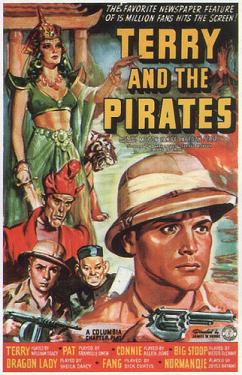
Terry and the Pirates


Terry and the Pirates (1934-1973) presented the most overt adult-teen homoromance in the comic strips.  When fourteen-year old Terry Lane first set out to search for his missing grandfather, accompanied by soldier of fortune Pat Ryan, he was a wide-eyed innocent who seemed to belong in a humor strip, quite out of place among the jungles, copra plantations, and seedy port cities of the South China Sea, where everybody had an angle, a price, and a lot of secrets.  He was even drawn differently from the other characters, with a round face and soft, curvy lines amid Milt Caniff’s trademark square-jawed, angular men and women.  Caniff often used humorously drawn outsider characters, like the pug-cute Dickie Dare and the eyeglassed, golly-gee-spurting Wash Tubbs, to link the preternatural world of adventure with the comfortable, familiar world back home.  But Terry was neither boy, like Dickie Dare, nor man, like Wash Tubbs.  He was a teenager, and he was growing up.


Most comic strip characters either do not age, or they jump from child to adult instantly, but Terry aged normally, celebrating his fifteenth birthday in 1935, his sixteenth in 1936, and so on.  As he approached manhood, his relationship with Pat Ryan became considerably more intimate than those of the other pairs, the homoromantic slipping inexorably into the homoerotic.  Terry and Pat were sometimes shown sharing a single bed, or showering together, or naked together.  In a 1936 strip, the sixteen-year old Terry has just bathed, and he is toweling off.  The towel shields his backside from readers, but his frontsize is fully exposed to Pat, who is gazing with obvious appreciation.


Buck Rogers, Flash Gordon, and Don Winslow spent half of their time brawling with men and the other half kissing women, but as long as Terry is not yet a man, Pat Ryan actively avoids the tall, slinky femmes fatale who keep wrapping their arms around him.  . When jewelry fence–kept girl Burma throws herself at Pat for three weeks’ worth of strips, he consistently rejects her, consenting to a kiss only after she calls him “Yellow!”, denigrating his masculinity, eight times in three panels.  Then, after the kiss, he refuses to accept her purring “darlings.”

Pat’s masculinity is, indeed, open to question, in spite of his square-jawed stoicism and expertise at fisticuffs.  He is denigrated by worse terms than “yellow,” including “sissy” and “pansy,” but only by women, so he won’t have to fight back.  Late in 1936, when they are all shipwrecked on another island, Burma throws herself at the colonial administrator (although she is supposedly as hard as nails, she falls for every man she sees).  The solicitous Pat gives the adminstrator’s wife make-up and hairstyle tips so she can beat off the competition.  One expects that, if World War II had not broken out, Pat could have easily returned to America and opened a hair salon.

The sixteen and seventeen-year old Terry is often positioned structurally as a parallel to whatever tall, slinky woman is lusting after with Pat this time.  The lady strips down to her underwear, and in the next scene Terry strips down to his underwear.  Pat is knocked unconscious, and the lady gingerly holds him in her arms.  The next time Pat is knocked unconscious, Terry gingerly holds him in his arms, in precisely the same position.

Columbia’s adaption, released on May 5th, 1940, is one of the era’s few intentionally humorous movie serials (it was directed by James W. Horne, who did the Laurel and Hardy shorts).  Terry was played as a squealing teenager by 22-year old William Tracy, a rather stout, likeable blond.  Pat Ryan, the soldier-of-fortune bodyguard, was miscast with Granville Owen, adequately tall and muscular but only five years older than William Tracy – he had just finished playing a college student in Start Cheering (1938), and he would go on to play the eternally teenage Li’l Abner in the adaptation of the Al Capp comic strip (1940).

The two are by far the most physically expressive of homoromantic partners in movie serials, one with hand always firmly placed on the other’s arm, shoulder, or back, except when they are walking with their arms wrapped around each other’s waists. Terry screams and flails like a damsel in distress when he is terrorized by crocodiles, headhunters, and villains lobbing hand-grenades, and after Pat swoops down like Tarzan to save him, they embrace, Terry’s face pressed against Pat’s chest.  

In an early chapter, they are bedded down for the night when a gorilla breaks into Terry’s room and tries to carry him away.  Pat rushes to the rescue, getting his shirt ripped off in the process.  Afterwards Terry stares appreciatively at Pat’s bulging muscles and hints “I’d feel a lot better if I slept with you tonight.” Pat agrees.

Aug 20, 2023

Boxers and Boyfriends: Joe Palooka

The most famous fictional boxer of the 20th century was probably Joe Palooka in the long-running comic strip (1930-1984).   Tall and immensely strong but gentle, Joe Palooka was the creation of Ham Fisher, who observed lots of young Polish immigrant boys hanging around boxing arenas, hoping that their muscles would bring them fame and fortune.


In his heyday, Joe was appearing on the radio, in movies (starring Joe Kirkwood, left), in big-little books, and in comic books.

You could buy Joe Palooka toys, gum, lunch boxes, board games, and a cut-out mask on Wheaties cereal.  


 In 1948, the town of Bedford, Indiana  (near Bloomington) erected a statue in his honor.  It was moved to nearby Oolitic in 1984.

Joe was originally "a woman-hater" and "allergic to girls," although cheese heiress Ann Howe kept trying to snare him, like Daisy Mae in Li'l Abner.  In the 1930s, lack of heterosexual interest did not signify gay identity; although gay readers found ample subtexts. Joe was a "man's man," enjoyed buddy-bonds with his sparring partner, massively-muscular Humphrey Pennyworth.

The two adopted a mute orphan named Little Max, who became popular enough to get his own series of toys and comic book title.


As boxing declined in popularity,  Joe moved beyond the ring to fight gangsters, Nazis, spies, and mad scientists.  During the 1950s he became an all-purpose trouble-shooter, traveling the world to right whatever wrongs needed a muscular remedy.  He got a tv series in 1954.  Harve published a Joe Palooka comic book through 1955.

Since changing attitudes required even heroes to express hetero-horniness, Joe eventually married Ann How.  And Humphrey became short and round, a comic relief character.


The comic strip lingered in a dwindling number of small-town newspapers until 1984.  By that time,  everyone had forgotten about Joe Palooka. (Except for Ham Fisher's home town of Wilkes-Barre, Pennsylvania, which renamed a nearby mountain after him).

And the 1980s college boys scouring the discount bins at the Comics Cave for beefcake covers.

And the elderly gay men who remembered glimpsing homoromantic potential in their childhood, when they opened the comics page to read about L'il Abner, Flash Gordon, Prince Valiant, and Joe Palooka.


Aug 13, 2023

Prince Valiant

During the 1960s, the Rock Island Argus printed mostly depressing 50-year old comic strips with jokes about husbands hating their wives or friends betraying each other, with little bonding (Out Our Way was an exception) and very little beefcake. Alley Oop and Prince Valiant were exceptions -- 50 years old, but muscle-heavy.

Prince Valiant was a color strip that appeared only on weekends.  Like Gasoline Alley, it featured characters aging in real life, but it was unique in having no speech balloons; text appeared at the bottom of each panel, making the strip seem more like an illustrated novel than a comic.


When it first appeared in 1938, Val was a young prince from Thule (modern day Norway) who traveled to Britain to become one of King Arthur's knights. Later he returned to Thule to help his father regain his throne, then traveled across Europe and Asia, fighting Goths and Huns, visiting the Holy Land (long before the Crusades).  By the 1960s, the middle-aged Val had settled in North America.

Generally Medieval fantasies (and real epics like The Song of Roland) offer little beefcake; knights wear shining armor, and their northern climate doesn't permit much skinny-dipping.


Sigfried in The Nibelungenlied gets naked, and Sir George in The Magic Sword (1962),  and Lancelot (Nicholas Clay) in Excalibur (1981) take their shirts off, and that's about it.  But in Prince Valiant,  Val was shirtless more often than not.  His muscular physique was drawn in full color and in loving detail.


Unfortunately, through the 1960s, Val retained a 1930s page boy haircut, red lips, rosy cheeks, and long lashes, giving him a rather feminine appearance that didn't lend itself to romantic fantasies.  The name "Val" didn't help much.

And there was little buddy-bonding.  During the 1930s, Val sparred with rival prince Arn of Ord, but they became little more than grudging friends.  In fact, the main plotlines involved the fade out kiss.  First Val and Arn competed for the hand of the fair maid Ilene.  Then she died in a shipwreck, Arn was dropped from the strip, and Val turned his attentions to the fair maid Aleta.

They married, and in 1947 their son Arn was born (the first European baby born in North America).   Eventually they had three more children. When I started reading the strip in the 1960s, Arn was a mischievous teenager, but soon he, too, married.

 Hal Foster, the original cartoonist, also drew Tarzan for many years.   He died in 1982, but the strip is still going strong.


Aug 11, 2023

Yogi Bear and Boo Boo


A few years ago I published a scholarly article outlining the homodomestic relationship between Yogi Bear and Boo Boo. And Ruff and Reddy.  And Spongebob and Patrick.

People immediately started screaming at me.  Even today, every few weeks someone finds the article and starts screaming again:
"It's a kid's cartoon!"
"You're reading too much into it!"
"The cartoonists never intended them to be gay!"
"Can't two guys be friends without everyone thinking they're gay?"
"How can they be gay, when they aren't Wearing a Sign?"

Except I never said that the Yogi Bear and Boo Boo were "really" gay, whatever that might mean for beings with no bodies or minds, who don't exist at all outside of some images painted on celluloid.  Or that the producers meant them to be gay.  I said that their partnership provided a model with which gay kids could identify and validate their own same-sex desires.

A lot of the things I know about the world -- avalanches, duels, Napoleon, gangsters, daffodils, Shakespeare, karate, King Arthur, submarines, Egyptian hieroglyphics -- I probably first heard from the block of cartoons that Hanna Barbera broadcast on prime time in the late 1950s, and aired through the 1960s on Saturday mornings and on late-afternoon kids' programs like Captain Ernie's Cartoon Showboat.


The characters belong to my earliest, preliterate, preverbal memories:

Huckleberry Hound
Lippy the Lion and Hardy Har Har
Pixie and Dixie
Quick Draw McGraw and Baba Looey
Ruff and Reddy
Snagglepuss
Wally Gator
Yogi Bear and Boo Boo


Note that they usually came in pairs who lived together, traveled together, and worked together to defeat the bad guy who wanted to eat or confine them.  I know now that they were reflections of the movie-comedy teams of the 1940s and 1950s, like Abbott and Costello, Hope and Crosby, and Martin and Lewis.

I didn't know then.

I knew only that every adult man in the real world had a wife, and every teenage boy had a girlfriend whom he hoped one day to marry.  I saw no men, heard of no men -- none at all  -- who lived together, who built a life together, who didn't need or want wives. But at "cartoon time," in plain view, there was Yogi Bear and Boo Boo, Pixie and Dixie, Quick Draw and Baba Looey.

See also: The Three Stooges and The Flintstones.


Aug 10, 2023

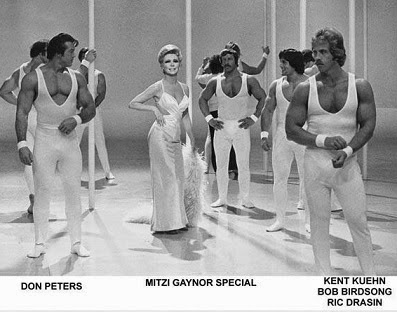
March 24, 1975: Mitzi and a Hundred Guys

March 24, 1975.  The Monday before Easter.  I check the TV Guide and find a special, Mitzi and a Hundred Guys.  

I don't know who Mitzi is, but anything with a hundred guys is going on my DVR List.

Just kidding -- in those days you watched it in real time or not at all.  So I plop myself in front of the tv.  My parents are surprised that I want to see something with "singing and dancing" in it; usually I hate variety shows.

There's a lot of singing and dancing, interspliced with comedy skits like Carol Burnett.   But the hundred guys make up for the tedium.

They include  included practically every male tv star,  plus some movie and radio stars.  I divide them into:

 Hot guys that I know.

Hot guys that I don't (such as Rich Little, left).

 Ugly guys that I know.

Ugly guys that I don't.

But the highlight is Mitzi crooning the Irving Berlin torch song "Always" while bodybuilders in jock straps surround her.

At least, I remember jock straps.  But, thanks to the internet, I see that they were wearing white pants.  And I can identify them.


1, Don Peters (1931-2001), a five-time Mr. America winner who also posed for the gay-porn photos of Bruce of L.A.


2. Kent Kuehn, a three-time Mr. America who appeared with Arnold Schwarzenegger in Stay Hungry (1975), the film that popularized bodybuilding.


3. Bob Birdsong (b. 1948), who appeared in two gay porn films, California Supermen (1972) and Loadstar (1973) before winning the 1975 Mr. Universe title. He later "found Jesus," got a "beautiful wife" and started a ministry.


4. Ric Drasin (b. 1944, recent photp), a bodybuilder, professional wrestler, and actor, with credits ranging from Ben (1972) and Sextette (1978) to The Shield (2004).  He is also a spokesman for Gold's Gym and a wrestling instructor.
Related Posts Plugin for WordPress, Blogger...