Showing posts with label domestic. Show all posts

Mar 6, 2025

Woody Woodpecker: being a wood-pecker was not gay enough

During a televised interview with Walter Lantz sometime in the 1980s, the fawning reporter said "Woody Woodpecker is my favorite cartoon character, and most people I've talked to agree. Why is that?"

Talk about hard-hitting investigative journalism!

I roiled.  Woody Woodpecker is no one's favorite cartoon character.  He's right up there with Scrappy-Doo as the most hated cartoon characters of all time.

Lantz rolled out the anarchic bird in 1940, as a foil for his established character Andy Panda.  He was an ugly, unpredictable psychopath, causig mayhem for its own sake (as opposed to Bugs Bunny, who fights back against aggressors).  Apparently he was popular enough to rate his own song, mostly about his heterosexual prowess:

Though he can't sing a note, there's a frog in his throat
All his top notes come out blurred
He's the ladies' first choice, with a laugh in his voice...and then that annoying ha-ha-ha-HA-ha.


The theatrical cartoons were repeated on tv on the syndicated Woody Woodpecker Show (1958-66, and repeated through the 1970s).  I never watched.  Too scary.

From 1963 to 1978, Woody Woodpecker was a bottom-of-the-rack selection of Gold Key Comics). In the comics, he was domesticated, a single father living in 1960s suburbia (although still talking like it was the 1940s).  He was raising his niece and nephew, Knothead and Splinter, a boy and a girl, guiding them through crises involving bullies, paper routes, and science projects.

There were also globetrotting adventure stories:

The Great Riverboat Race
Ghost of Gold Creek Gulch
Sub-Marooned in Neptunia

Wait -- the hair-dragging -- does that caveman want Woody as his mate?

These were similar to what you would find in the Bugs Bunny and Porky Pig comics a little higher up in the rack, or Donald Duck and Uncle Scrooge comics at the very top, but with some significant, deal-breaker differences.

1. Woody lived in a human world, with only occasional animal characters. 


2. No buddy bonding, like Bugs and Porky or Donald and Uncle Scrooge had had on their adventures.  Heck, even the other main Lantz character, Andy Panda, had a boyfriend, Charlie Chicken, with a sort of id-superego, rushing headlong into danger/worrying if he left the stove on sort of dynamic.

3. Bugs, Porky, and Donald had girlfriends as foils only, and Donald Duck was not interested (in the adventure stories), but Woody was obviously daft over dames, throwing himself into a bosomy woman's lap every five seconds.

4. The art was pedestrian, and the stories cliched.


Years later, I learned the slang meaning of "wood," which transformed "woodpecker" into a dirty word.  I don't think it's enough to redeem Woody Woodpecker.

See also: Bugs Bunny Meets the Drag King


Sep 10, 2023

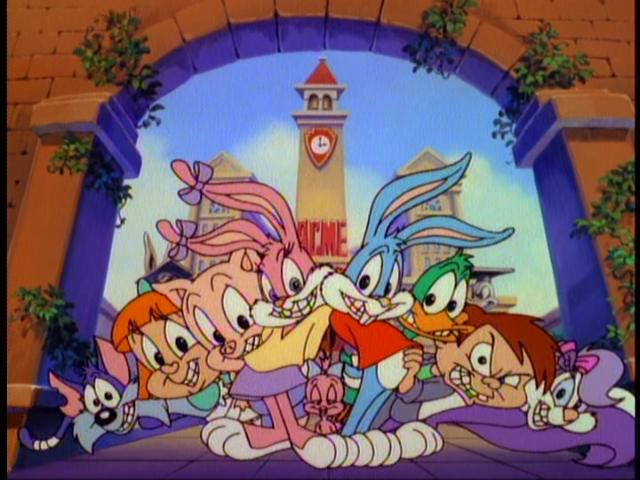
Tiny Toon Adventures: Not what you think


Everyone misunderstands Tiny Toon Adventures.  

They weren't kid versions of classic Warner Brothers characters -- Bugs Bunny, Porky Pig, and so on.  

They weren't the offspring of the classic Warner Brothers characters.  

And they weren't tiny -- they were adolescents, aged 13-15.  They lived with their parents while attending  Acme Looniversity, where the classic characters taught them the art of being toons.

After years of decline -- no new cartoons, old ones chopped to bits to eliminate the violence  -- Warner Brothers was trying to modernize for a new generation of fans.  So the Tiny Toons began appearing in after-school time slots, first in syndication (1990-1992), and then on the Fox network (1992-1995).


  They drew on the personalities of the classic characters, but their adventures were strictly modern, involving video games, cell phones, and lots of sly references to 1990s pop culture, from Lifestyles of the Rich and Famous to Roseanne Barr.

There were no domestic partnerships, as in the Hanna Barbara cartoons of a generation before. Instead, the characters displayed the heterosexism of the major teen sitcoms of the era (Sabrina the Teenage Witch, Boy Meets World, California Dreams), with lots of dating and romance. But there were plenty of subtexts.

Plucky, an egotistical duck, and Hamton, a shy, sensible pig, are partnered for a number of adventures, including parodies of Batman and Star Trekand sometimes are shown living together.  They break up, seek out other "best friends," realize how much they care for each other, and reconcile.

The human character Elmyra usually lacks heterosexual interest -- she is busy hugging and squeezing "cute little animals" to death.  But in one episode, she falls in love with a new girl named Rhonda Queen, and goes to absurd lengths to try to win her affection.

The character of Gogo Dodo also lacks heterosexual interest, and brings a vacuum cleaner to the school dance.

The gay kids in the audience had a lot to identify with.  A lot more than with the horrid Animaniacs, which regrettably replaced Tiny Toon Adventures in 1993.

See also: Animaniacs

Aug 11, 2023

Yogi Bear and Boo Boo


A few years ago I published a scholarly article outlining the homodomestic relationship between Yogi Bear and Boo Boo. And Ruff and Reddy.  And Spongebob and Patrick.

People immediately started screaming at me.  Even today, every few weeks someone finds the article and starts screaming again:
"It's a kid's cartoon!"
"You're reading too much into it!"
"The cartoonists never intended them to be gay!"
"Can't two guys be friends without everyone thinking they're gay?"
"How can they be gay, when they aren't Wearing a Sign?"

Except I never said that the Yogi Bear and Boo Boo were "really" gay, whatever that might mean for beings with no bodies or minds, who don't exist at all outside of some images painted on celluloid.  Or that the producers meant them to be gay.  I said that their partnership provided a model with which gay kids could identify and validate their own same-sex desires.

A lot of the things I know about the world -- avalanches, duels, Napoleon, gangsters, daffodils, Shakespeare, karate, King Arthur, submarines, Egyptian hieroglyphics -- I probably first heard from the block of cartoons that Hanna Barbera broadcast on prime time in the late 1950s, and aired through the 1960s on Saturday mornings and on late-afternoon kids' programs like Captain Ernie's Cartoon Showboat.


The characters belong to my earliest, preliterate, preverbal memories:

Huckleberry Hound
Lippy the Lion and Hardy Har Har
Pixie and Dixie
Quick Draw McGraw and Baba Looey
Ruff and Reddy
Snagglepuss
Wally Gator
Yogi Bear and Boo Boo


Note that they usually came in pairs who lived together, traveled together, and worked together to defeat the bad guy who wanted to eat or confine them.  I know now that they were reflections of the movie-comedy teams of the 1940s and 1950s, like Abbott and Costello, Hope and Crosby, and Martin and Lewis.

I didn't know then.

I knew only that every adult man in the real world had a wife, and every teenage boy had a girlfriend whom he hoped one day to marry.  I saw no men, heard of no men -- none at all  -- who lived together, who built a life together, who didn't need or want wives. But at "cartoon time," in plain view, there was Yogi Bear and Boo Boo, Pixie and Dixie, Quick Draw and Baba Looey.

See also: The Three Stooges and The Flintstones.


May 6, 2023

Robinson Crusoe on Mars

Ask any male boomer when he realized that he was gay, and he’ll most likely say when he saw Robinson Crusoe on Mars (1964). I saw it in the spring of 1968, on the family’s brand new color tv set.


The plot is obviously a version of Robinson Crusoe: after crash landing on the frigid Red Planet, astronaut Kit Draper (Paul Mantee) builds a cave habitat so warm he can walk around shirtless or in a tight-black t-shirt, displaying an amazingly buff, hairy chest.


He has food, water, and a pet monkey, but he is intensely lonely. Then an alien mining company establishes a beachhead nearby, and he helps himself to one of their slaves. “I prayed for a companion,” Kit exclaims, “And I finally got one!” 

Somewhat Aztec in appearance, “Friday” (Victor Lundin) is so accustomed to the Martian cold that he can comfortably walk around in nothing but a kilt, displaying a massive, sculpted body, with golden skin, thick arms and shoulders, and a smooth, hard chest.

The two men are extremely physical in their interaction. Shortly after they meet, Kit takes Friday’s hand and places it on his own knee, an image that is intensely intimate and sensual. Kit is buried in a shower of space debris and nearly suffocates, and Friday rescues him. As they walk away, Kit wraps his arm around Friday’s waist.  At the end of the movie, they are rescued, and go back to Earth together, permanent partners.

Who would produce such a film, about two men who love each other and build a home together, in the dark homophobic days of 1964?

This was Paul Mantee’s first credited acting role; he went on to make dozens of two-fisted movies, sometimes with “man” in the title to emphasize the intended audience, such as A Man Called Dagger (1967) and That Man Bolt (1973), and he then settled down to write novels about heterosexual Italian-American adolescents.  And he obviously stayed in shape.

Victor Lundin played a series of Klingons, Indians, savages, and bad guys, and cut some country-western records. Today, on his website, he sells a cd with a song about how much he likes girl-watching.


Neither of the writers seem obvious gay allies, but when we look at the director, Byron Haskin, we find movie after movie set in steaming jungles, where men wear next to nothing and fall into each other’s arms a lot: Man Eater of Kumaon (1948), Tarzan’s Peril (1951), His Majesty O’Keefe (1953), Little Savage (1959). That explains the beefcake; what explains the bonding?


Mar 13, 2021

The Odd Couple


The Odd Couple (1970-75) seems like an odd addition to the teen-friendly Friday night lineup that also included The Partridge Family, The Brady Bunch, and Room 222.  No teens, no teen idol songs, just two middle aged men, the slovenly Oscar Madison (Jack Klugman) and the fastidious Felix Ungar (Tony Randall) as bickering heterosexual roommates in a New York apartment.

Ostensibly they are thrust together out of necessity after failed heterosexual unions: Felix is kicked out of his house because his wife, Gloria, finds him too fastidious, so he takes refuge with his divorced friend.  But surely being a “neat freak” is insufficient cause for divorce.  Nor does the sudden disruption of his life explain why Felix continues to live with Oscar for five years; a middle-aged heterosexual man with a sizeable business income (Felix is a professional photographer) may move in with a buddy for a few weeks in an emergency, but he would certainly want his own apartment as soon as possible.  If Felix is understood as “gay,” however, it makes perfect sense.

Tony Randall would most likely favor a gay reading of his character: in the 1950’s and 1960’s he specialized in gay-stereotyped roles, sensitive, effete, artistic, snobbish, persnickety, and doting on macho best friends; in Send Me No Flowers (1964), his character all but jumps into bed with the hunky Rock Hudson.   After The Odd Couple, he planned to make television history by playing the first openly gay character with a starring role in prime time, but network censors insisted on closeting Love, Sidney.

Randall notes that they did attempt to mention gay people a few times in The Odd Couple.  Felix finds an article that Oscar is writing about gay liberation, assumes that he is gay, and muses, “If it was going to be anyone,  you’d think it would be me.” Oscar and Felix accidentally book themselves onto a gay airplane flight, and fit right in with the other couples.   But all such references were summarily nixed by the network censors. The producers got so fed up that they filmed clips of Oscar and Felix kissing, and sent them in just to get the censors mad.

The network was so squeamish about potential “misinterpretations” of the couple that in the first season they made the middle-aged men, one still aching from a breakup, flirt with women as aggressively as college fratboys.  In the first episode, “The Laundry Orgy” (September 1970), Felix and Oscar scheme to end their weekly poker game early so they can go out on a date with the giggling British-mod Pigeon Sisters, who seem to have popped in directly from a stag film.  Aside from the best-buddy dynamic, the fact that they can only conceive of a date with women when both of them go together, the plot is remarkably heterosexist, with poker-playing buddies mere hindrances on the road to heterosexual toddy.

As the show progressed, the poker pals and the Pigeon Sisters were dropped, and the tension about the duo’s conflicting personal habits faded into the background.  Eventually their definition as an “odd couple” depended less upon the neat/sloppy interaction than upon appearance together in all public and private events, so obviously romantic partners that their occasional heterosexual dates and separate bedrooms seemed irrelevant.  In “The Princess” (September 1972), Felix is hired to photograph the Princess of Luxembourg (Jean Simmons).  Oscar and the Princess share a mutual attraction, but the walls of royal security make him despair of ever seeing her again.  Then Felix receives an invitation to attend a royal ball, and gets an idea: “It says here that I can bring a guest.  Oscar – you’ll be my date!”  So Oscar and Felix, resplendent in tuxedos, mingle among the palace elite as same-sex partners without the least embarrassment.  The Princess seems taken aback by this demonstration that the two are lovers, but only because she is herself interested in Oscar.

After the initial giggling Pigeon Sister phase, Oscar and Felix develop an extraordinary interest in children.  They tutor a teenage jock, act as big brothers to a reform school boy, adopt a homeless boy,  restore a lost infant to its mother, help Oscar’s homeless niece deliver her baby, and coach pee wee football. This domesticity helped The Odd Couple move beyond the sophomoric humor of Neil Simon’s hetero-sex farce, and sealed the duo’s popularity among adolescents.

Of 114 episodes, only fourteen concern Oscar or Felix seeking heterosexual romance, and eleven involve nurturing children or adolescents.  Most of the remaining episodes show the couple acting as domestic partners: going on cruises and retreats together, relating anecdotes about how they first met, or helping friends sort through their romances.  The romantic implication of their relationship is never far from the surface.  For instance,  in “Being Divorced Means Never Having to Say I Do” (December 1971), Oscar’s ex-wife Blanche announces that she is getting remarried.  Oscar is delighted at the prospective liberation from alimony payments, but Felix objects (literally, during the ceremony!).  He protests that Blanche is obviously not in love with her fiancé.

Oscar: [Sarcastically.]  What is love, Dear Abby?

Felix: Love is that feeling between two people, a man and a woman. [Pause.] It doesn’t have to be a man and a woman. [Pause.] It could be a man and a dog, or a dog and a cat, or a. . .a bunny. [Pause]. Love is that intense, vital, passionate feeling one person has for another.


As Felix attempts to describe the romantic love that would justify a permanent monogamous commitment rather than a simple friendship, it is curious that he doesn’t make love exclusively heterosexual, as so many people still do today.  His pause after “it doesn’t have to be a man and a woman” followed by an incoherent ramble about pets suggests that he has thought of another form of romantic love, one that he dares not speak aloud.  Oscar agrees that he has a “intense, vital, passionate” feeling for Felix, but it is certainly not hate, and it is too passionate to be simple friendship.

The theme song had lyrics, never aired, that emphasize what gay viewers knew all along, that the two were literally in love, sharing a passion deep enough to withstand their conflicting personalities, their trivial pursuit of women, and the stares of passersby:

No matter where they go, they are known as the couple.
They’re never seen alone, so they’re known as the couple.
Their habits, I confess, none can guess with the couple. . .
Don’t you find, when love is blind, it’s kind of odd?

Oct 5, 2020

Summer 1971: Donald Duck's Double Life


When I was a kid in the 1960s, my favorite comics were the Harveys (CasperRichie Rich), followed by Gold Key jungle heroes (Tarzan, Korak, Brothers of the Spear), and then Archie, and maybe some Marvel and DC if I could get them.  Disney's Donald Duck was not as low on the list as Bugs Bunny, but it was down near the bottom.
The problem was that Donald led a double life.  I liked the stories where he was an adventurer, brave, resourceful and intelligent, setting out with his rich Uncle Scrooge to explore lost Atlantis, the Yucatan, Tibet, Antarctica, or the Seven Cities of Cibola, in plotlines as macho as Treasure Island, as passionate as Time Tunnel.  It was a man-only world, with no damsels in distress to be rescued and no girls waiting back home at the story’s end.

In fact, no one expressed any heterosexual interest at all, though the nephews sometimes swooned over male crooners and teen idols.  (During the 1990s, Don Rosa retconned the characters to give Uncle Scrooge a long-ago romance with dance-hall girl Glittering Goldie).

But in other stories, Donald transmutated like a zombie into a single father living in the town of Duckburg, where he was saddled with a series of dismal jobs: janitor, gas station attendant, door-to-door salesman, delivery boy. And  he had a girlfriend, Daisy Duck, who was constantly natting her disapproval of  every single one of his interests, hobbies, goals, and dreams (precisely like Poil's disapproval of Spooky's passion for scaring).

The two could not be more different. Donald exuded toughness and aggression, Daisy was dainty to the point of idiocy. Donald bellowed at baseball games, Daisy drank tea at the Tuesday Afternoon Ladies’ League. Donald puttered around in junkyards, Daisy puttered about in her petunia bed.


It was disgusting! Donald had not only abandoned his life of swashbuckling adventure, he could not even enjoy the simple pleasures of boxing matches and working on cars. Instead, he sat bored on a frilly white chair at the Bon Ton, while Daisy tried on hats. Why would he do it? If they shared no common interests whatsoever, why would he even want to hang out with her?

In "The Double Date," Daisy and Donald go on a double date with Clara Cluck and Rockhead Rooster.  Donald and Rockhead exhibit an instant, eye-bulging attraction to each other, and become so engrossed in discussions of cars and sports that they ignore the girls.  They even dance together at a party.  Daisy and Clara agree that "They shouldn't see each other again."

One rainy afternoon in the summer of 1971, when we were sitting on the floor in Bill's family room, reading comic books, I brought up my concerns.  "I don't get it.  Donald Duck has a lot more fun on his adventures with Uncle Scrooge, and he doesn't anything that Daisy likes.  Why does he hang out with her?  What's the big deal?”

Bill's older brother Mike happened to be passing through on his way out, wearing a raincoat and tossing his keychain in the air. He pulled the comic from my hands and leafed through it, murmuring “Hmm…very eenterest-ing,” like the Nazi spy on Laugh-In. Then he returned it with a grin. “Een mine professional opinion, Uncle Scrooge ees a boy, und Daisy Duck ees a girl.”


“So what?” I asked.

Mike  laughed, and reached down to tousle my hair. “So what!” he exclaimed in his normal voice. “Just wait ‘til you discover girls. Then you won’t ask ‘so what’? You’ll say ‘gimme her number!’”  And he was gone. I heard him repeat “so what!”, chortling to himself, as he clomped through the kitchen and out the back door.

Suddenly chilled, I scooted over to sit next to Bill, our backs against the couch.  He smiled, and we sat together, quietly.

Abandon the Seven Cities of Cibola to drink tea from fragile cups and discuss poetry! The idea was absurd!

See also: Heterosexualizing my Childhood Hero

Jul 10, 2020

Pinky and the Brain: The same thing we do every night


The WB Network's Pinky and the Brain (1993-1999), a spin-off of the execrable Animaniacs, was about two intelligent lab rats who shared a cage and collaborated on schemes to take over the world.  At first they were coded as coworkers and bunk mates, not as romantic partners. Both had outside love affairs; Pinky was especially promiscuous, falling in love with a horse, a sea lion, and children's book heroine Pippy Longstocking.

However, there were gay "jokes" from the beginning. In a running gag, Brain has a sudden insight and asks Pinky "Are you pondering what I'm pondering?" Pinky replies with a nonsequiter that can often be read as sexual, or at least dirty, such as "I think so, Brain, but how can we get seven dwarves to shave their legs?" or "I think so, Brain, but isn't a cucumber that small called a gherkin?"

Of seventy-five recorded "pondering" responses, thirteen concern transvestism or fetish costumes — "I think so, Brain, but this time you wear the tutu" — and twelve evoke sexual double entendres — "I think so, Brain, but apply North Pole to what?"

The tag line of each episode, after the most recent plan for world domination has failed, similarly allows for a homoerotic reading:
  Brain: Let us go back to the lab and prepare for tomorrow night.
  Pinky: Why, Brain? What are we going to do tomorrow night?
  Brain: The same thing we do every night, Pinky. [Pause, while we ponder just what it is that they do every night] Try to take over the world.

When Pinky and the Brain moved to prime time in 1995, plotlines became more complex, with movie and television parodies and recreations of the basic scenario in various historic periods. The writers also added what Warner Brother's head of programming referred to as "family and romantic element."  Potential heterosexual partners did appear occasionally, and Brain was somewhat swayable, but Pinky steadfastly chose the Brain over any other love.

Most of the romantic elements, however, involved the duo's attraction to each other, which Pinky celebrated and the Brain grudgingly admitted. In "Just Say Narf", Pinky sings and flirts with a despondent Brain: he bats his eyes seductively, lays his head cozily in Brain's lap, and twirls him about in a waltz before Brain finally cheers up.

Even when the Brain takes up smoking, Pinky's attraction does not diminish: "Hello there, stinky smelly smoky boy," he says with a leer, "Do you have a monkey in your pants?" He "means" to say "Do you have a monkey on your back?", a metaphor for addiction. When he says "pants" instead, the "mistake" produces a striking metaphor that is not not sexual.

Pinky and the Brain share more than physical attraction, however; they begin to represent themselves as a closeted gay couple. A prospective employer asks Brain, "Are you married?" After a brief, awkward pause, he responds "No. I do have a ... roommate." Considering various responses and then deciding on "roommate" is — or was — a familiar strategy for hiding same-sex partners from potential homophobes. Brain gets the job and enters corporate culture as a closeted gay man — or mouse — clumsily rejecting a female suitor and inventing a lame explanation for the picture of Pinky on his desk.

When Brain's parents visit, Brain again introduces Pinky as "my ... um ... roommate." The liberated 1990's parents are not fooled, however; while constantly criticizing Brain for his poor housekeeping, poor cooking, and unrealistic career goals, they never nag him to "meet a nice girl" and get married; obviously they are aware that he already has a partner. At the end of the episode, Mom and Dad invite the two to visit as a couple at Thanksgiving.

No other cartoon of the 1990's portrayed same-sex relationships so overtly.

See also: Animaniacs

Mar 9, 2019

"Danger Island": Jan-Michael Vincent's First Boyfriends


The Banana Splits Adventure Hour (1968-70), was a Saturday morning anthology series starring an animatronic rock band, with psychedelic blackouts, corny jokes, very bad songs, and cheesy cartoons.  But the live-action segment, Danger Island, offered a glimpse of a 1960s gay couple.

Archaeologist Professor Hayden (Frank Aletter, who starred in It's About Time), his daughter Leslie (Ronne Troup), and their young, tanned, and remarkably toned assistant, Link (Jan-Michael Vincent, who would go on to star in Big Wednesday) are searching for a lost city in the uncharted South Seas. Suddenly pirates attack. 

Link is knocked overboard, and sees the ship explode, so he assumes that his friends are dead; he therefore swims for the nearest island, fighting a shark en route. Crawling onto the shore, half-naked and half-drowned, he encounters a pair of long-time castaways.  

The tall, muscular African-American Morgan (Rockne Tarkington) wears a brown vest that accentuates his biceps.  His boyfriend, the short, slim Pacific Islander Chongo (professional stuntman Kahana), who is mute and somewhat addled, wears a yellow vest that looks like it was meant for a girl.

The couple invite Link back to their cave-home, where Chongo fusses over him like a drag queen auntie, making him try on one inappropriately risqué costume after another and in the process “accidentally” fondling his hard chest and shoulders.

Link settles on skintight white pants and a blue sailor shirt (but not to worry, it’s always being torn open or ripped off). Meanwhile, Morgan advises him of the severity of their situation: Danger Island is overrun by wild animals, savages, and pirates, all with different specialties of murder and mayhem (thus its name). 


Eventually Professor Hayden and Leslie, not dead after all, join the party, and they spend many cliffhangers looking for the lost city and fighting the promised wild animals, savages, and pirates (who drool enthusiastically over hardbodied Link). 

 In the last episode, they have thwarted every villain and acquired a boat, and they prepare to head back to civilization. But Morgan and Chongo decline rescue: “We’ve been living this way too long,” Morgan explains, his arm cozily around his partner’s waist. “We wouldn’t know how to live civilized.” 

They say goodbye and walk off arm in arm. I cannot imagine what the actors thought they were portraying in this scene. I can only advise Morgan and Chongo that they could live “this way” quite happily in Greenwich Village or the Castro, with the first heady days of gay liberation immanent.

Sep 8, 2015

The Wonderful Flight to the Mushroom Planet

When I first moved to L.A. in 1985, I met 40-year old David Cameron, a lawyer involved with historic preservation and gay politics -- and a connection to my earliest childhood.

When he was nine years old, he asked his mother to write a story for him and his best friend, Chuck Fabian, about a "little planet just their size."

The result was The Wonderful Flight to the Mushroom Planet (1954), one of the first books I read on my own (another was The Spaceship Under the Apple Tree), a fascinating evocation of the world of a gay child whose gayness is known but not yet consciously acknowledged.

David becomes David Topman, "tall and quick, with freckles and sun-bleached brown hair that flopped over his eyebrows."  Chuck became Chuck Masterson (the gay S&M references obviously unintentional), "shorter and squarer with brown skin and dark hair."

Their call to adventure is a newspaper ad for boys to build a space ship.  They build one, and deliver it to an odd little man named Mr. Bass, who lives in an observatory on the outskirts of town. Soon all three are en route to his home planet, Basidium, which orbits the Earth at a distance of 50,000 miles (a lot closer than the Moon), for some clever critiques of modern bureaucracy and a crisis to resolve.

When I was very young, I found in Mushroom Planet "a good place," a precursor to Earthfasts,  The Tripods, or The Lord of the Rings.


1. Everyone insisted on misunderstanding the boys I liked, calling them "buddies" rather than boyfriends.  But in Mushroom Planet, no one mistakes David and Chuck for buddies.  They are most obviously partners, with a bond that is unstated but as strong as any true love. There is no question but that they will be together forever.

2. Everyone insisted on misunderstanding my friendships with girls, calling them "girlfriends" rather than buddies.  But in Mushroom Planet, no girls are gazed at, thought of, or even mentioned, except for the boys' mothers.  The planet Basidium is occupied entirely by little men (later we discover that they reproduce through spores, like mushrooms).

I didn't realize at the time that there were sequels: Stowaway to the Mushroom Planet, Mr. Bass's Planetoid, A Mystery for Mr. Bass, Time and Mr. Bass.  The boys grow older, and the plotlines more elaborate and mature.  But through it all, Basidium remains a good place.


Jan 24, 2013

Born to Fight/Devil Diamond

During the 1930s, boxing was America's sport.  Millions of people watched matches or tuned in by radio.  Champions like Jack Dempsey, Joe Louis, Max Schmeling, and Max Baer became superstars.  In the comics, Joe Palooka was more popular than Flash Gordon or Little Orphan Annie.  And there were dozens of films about fictional boxers and the men who loved them.

Born to Fight (1936) stars Kane Richmond as boxer Tom "Bomber" Brown, who goes on the lam after clobbering a gangster and falls in love with the homeless adolescent Baby Face (19-year old Frankie Darro).  They set up housekeeping -- Bomber cooks breakfast for Baby Face, asks "How did you sleep?" in the morning.  When they determine that Baby Face could make a good living as a boxer (after all, he already has the name for it),  Bomber starts taking 12-hour shifts at the gas station to pay for his training.

The two are amazingly expressive: they walk off with their arms around each other's waists, enfold each other in full-body hugs, sit pressed together on a bench, drawing their faces so close that they seem preparing to kiss.

Several years pass, while we see the standard boxing and backstage plot of fame and hubris, and they break up.  Then they realize how much they care for each other and reconcile with teary-eyed abandon. Homoromance is triumphant.


Devil Diamond (1937) reverses the plot, giving the teenager an unrequited crush on the man.  This time gangsters offer the boxing training to the adolescent Lee (Frankie Darro).  Living at a boarding house during his “training.” Lee becomes quite taken with fellow boarder Jerry Carter (Kane Richmond), a government agent working undercover, and though Jerry is not sure at first if Lee is accomplice, pigeon, or gunsel, he soon warms up to the boy and reveals his true identity.

Now sharing a secret life, the two spend many scenes heart-to-hearting and going on long walks together.  When Jerry begins courting a girl, Lee roils with jealousy.  What does he need a “dame” for?  Why can’t it be just the two of them?  One night Jerry fails to appear at the boarding house at his usual time, and Lee stays up late waiting, along with Yvonne (Rosita Baker), the landlady’s daughter.  Finally Jerry shows up:

Lee: [Anxiously] Where you been?  I’ve been looking for you.
Jerry: Out for a walk.  Want anything special?
Lee: [Hesitates.]  No. . .I just wanted to say hello.
Jerry: Okay – hello. [Goes upstairs.]
Yvonne: [Frustrated.] Is that all you wanted to say to Jerry?  Hello?

A moment later, Lee musters up his courage and scoots up the stairs after him, but even when they are alone together, he is altogether afraid to say whatever needs to be said.  He stares and stumbles, and mutters incoherently about wanting to become a junior g-man, until Jerry gets frustrated and asks him to leave.

Lee’s inability to express his interest in Jerry is counterbalanced by his very vocal disinterest in Yvonne: he rebuffs her with snide asides, tells her in no uncertain terms to “scram,” accepts a date with her only when Jerry offers to double.

The movie ends with the bad guys subdued and Jerry in a clinch with his girl, while Lee looks on in rather obvious distress.  There has been no physical intimacy, no exclusivity, no promise of permanence; the passion has been all one-sided.  Yvonne swoops in to kiss him on the cheek, and he grimaces as we fade out to dreams deferred.

Oct 2, 2012

Matt Dillon


Androgyny was in during the  late 1970s and  early 1980s -- there was Peter Barton, Michael Gray, John Stamos -- but no one encapsulated raw androgynous erotic energy more than Matt Dillon.  Born in 1964, Matt got his start playing a surly high schooler in Over the Edge (1979).


Edgy roles followed.  He became famous, in a sleazy, controversial way, for Little Darlings (1980), in which he helps some underaged summer-camp girls lose their virginity.  But much more often, the main relationship in his movies was with a brother --  Jim Metzler in Tex (1982), Mickey Rourke in Rumble Fish (1983) -- or a buddy, as in the The Outsiders (1983) and The Flamingo Kid (1984).  Sometimes the buddy-bonding was even domestic.


Never a teen magazine fave rave, but a favorite of gay teens, Matt bulked up, filled out, and moved seamlessly from the world of serious films about troubled teenagers to serious films about troubled adults: a professional gambler, a heroin addict, an ordinary guy caught up in a murder plot, a neo-noir antihero.


And non-troubled adults.  In the comedy In and Out (1997), Matt plays a movie star who accidentally "outs" his old high school teacher (Kevin Kline) during an Oscar award speech -- except his teacher isn' really gay.  Except he is.


Matt remains a reliable presence in Hollywood, nonchalantly recognizing his gay fans, and regularly starring in movies that they enjoy seeing, well-written, well-acted, and with just as much buddy-bonding as boy-meets-girl fade-out kisses.
Related Posts Plugin for WordPress, Blogger...