Showing posts with label comedy team. Show all posts

Sep 5, 2019

Teen Angels

A year before they caused a counterculture-establishment standoff with their Smothers Brothers Comedy Hour (1967-70), comic duo Tommy  and Dick Smothers starred in an "I've got a secret" sitcom, The Smothers Brothers Show (1965-66).

Dick, the "straight man," plays a young, hip, self-absorbed bachelor in the Bill Bixby mold.  The paranormal event that jolts him out of his heterosexist stupor is not a crashed spaceship, but a knock on the door: his irreverent, anarchic, "queer" brother Tommy, lost at sea two years ago, has returned as "an apprentice angel," assigned to oversee Dick's life and do good deeds.

The plots involved Tommy's good deeds -- reforming gangsters and juvenile delinquents, helping the homeless, helping a musician change his tune -- and Dick's fruitless attempts to continue his skirt-chasing in instead of accepting a supernatural, well-night omnipotent same-sex bond.

I don't remember much about the series -- I was very, very young at the time -- but I remember Tommy's marvelous nonchalance about gender transgressions. To liven up a nursing home, he puts on old-lady drag and cavorts with the old men.


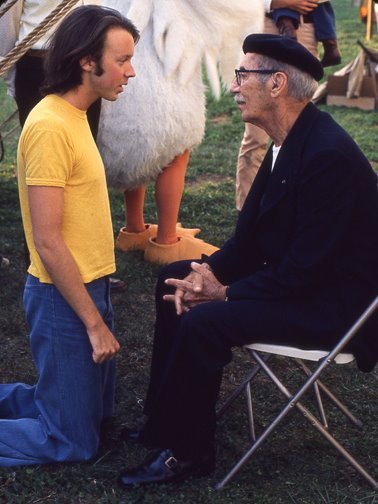
Fast forward thirty years, and the premise was recast in Teen Angel (1997-98), starring Corbin Allred  (left) as Steve, a young, hip, self-absorbed high schooler in the Michael Cade mold.  Again, a knock on the door: his irreverent, anarchic, "queer' best friend Marty(Mike Damus), who died last year after eating a spoiled hamburger, has returned as "an apprentice angel," assigned to oversee Steve's life and do good deeds.

The plots involved Marty's good deeds -- mostly helping Steve pass tests, get on the wrestling team, get the lead in the school play, and so on.  The sibling relationship gone, Marty and Steve become a more obvious romantic couple; though they both display heterosexual interests, they are obviously devoted to each other.


Again, Marty displays a marvelous nonchalance about gender transgressions.  When Steve likes a  cheerleader named Jessica, Marty senses that she will reject him, so he morphs into Jessica to go on the date.

What can we learn about the social changes between 1965 and 1997:
1. MORE heterosexism.  More tongue-lolling, leering, moaning insistence that boys and girls together are the meaning of life.
2. MORE subtext. More touching, more tenderness, more caring.
3. Humorous gender transgressions are ok, but you still aren't allowed to be gay.

Jan 19, 2019

Firesign Theatre: We're All Bozos on This Bus

The youth counterculture of the 1960s listened to Boomererson Airplane, Donovan, -- and the Firesign Theatre.

They were a comedy troupe consisting of  Phil Austin, Peter Bergman, David Ossman, and Philip Proctor. Beginning in 1966, they performed parodies of mass media on L.A. radio --  tv commercials, soap operas, film noir -- switching from sketch to sketch randomly, with a surrealism that presaged Monty Python's Flying Circus.  

Soon they were releasing comedy albums, with seemingly nonsensical titles that actually take on meaning as the story progresses:
Waiting for the Electrician, or Someone Like Him
How Can You Be in Two Places at Once, if You're Not Anywhere at All?
Don't Crush that Dwarf, Hand Me the Pliers
I Think We're All Bozos on this Bus
Everything You Know is Wrong


Roller Maidens from Outer Space (1974) is Phil Austin's solo album.

No gay characters per se, but they skewered everything, including heterosexual romance, the heterosexual nuclear family, even American exceptionalism:

This land is full of mountains, this land is full of mud.
This land is full of everything, for me and Elmer Fudd.

And the fluidity of desire was included gleefully, un-selfconsciously:

Ralph: Look at the muscles on that dude!  He's got muscles in his ears!
Babe: That's Steve Reeves.
Ralph: No.
Babe: There he is!  That's Steve Reeves!
Ralph: No, that's Agnes Moorhead.

But their most important contribution to gay boomer kids was the parody itself.  When Peter Bergman died in 2010, one of the tributes on the Firesign website message board said:


"It was hard being a gay kid a backwater part of the country,  and Firesign made me realize that the world is nuts -- that we are all bozos on this bus -- and I was not the only person who perceived it."

In the album Radio Live Now (2001), the troupe decided to make long-term characters Hal and Ray, news anchor partners, a gay couple. Phil Proctor explains: "we were kind of implying that they were committed to one another for life, and they were living together, and treating all that with complete respect, as a normal aspect of the end of the century in American society."

Nov 26, 2018

Gilligan's Island


Gilligan's Island (1964-67), the tale of seven nitwits who set out from Honolulu for a “three hour tour” and end up stranded on a desert island is famous for its ineptness and naiveté, but actually it was no more inept or naive than most other 1960s escapist sitcoms, and it had a lot for gay kids to like.

1. Beefcake First mate Gillian (Bob Denver, below) was slim, smooth, and occasionally shirtless.

Lithe, hard bodied Denny Miller, a 1959 Tarzan (left), appeared twice, as a "jungle man" and as as a surfer who rode a wild wave all the way in from Honolulu.


 In February 1965, Kurt Russell appeared as a jungle boy, wearing only a loincloth (he counts as beefcake when you're five years old)

Even the Professor (Russell Johnson, whose son David was a fixture in West Hollywood) take off his shirt a couple of times.

2. Utter lack of heterosexual interest.

There was lots of heterosexism, of course.  When the Professor wonders why headhunters would abduct only the girls, Gilligan quips “Because they’re boys!”  When Mrs. Howell becomes the recipient of anonymous love letters, they interrogate all of the male castaways. They are innocent.  "But that's impossible!" she exclaims.  "That's everyone on the island!"  It never occurs to her for a moment that either Ginger or Mary Anne might be interested in her. 

The Skipper occasionally bats his eyes at Ginger or Mary Anne, but the other two single men, Gilligan and the Professor, never display the least interest in girls.  (Incidentally, Russell Johnson's son was very active in gay politics in Los Angeles.  Since his death from AIDS in 1994, the elder Johnson has devoted himself full-time to fundraising for AIDS research.)


3. Same-sex bonding.  When Gilligan and the Skipper fantasize about being rescued, they mention hamburgers and milkshakes, but never girls or “settling down.” Perhaps they've already settled down: they’ve been together since the War (probably the Korean War, over a decade ago), without even a perfunctory search for girlfriends or wives. 

Presumably Bob Denver, who had previously played "allergic to girls" on The Many Loves of Dobie Gillis played Gilligan as a man-child with “arrested development,” excused from demonstrating heterosexual desire because he hasn’t “discovered” girls yet,

But occasionally we see a hint of an alternative explanation:. In “High Man on Totem Pole” (February 1967), a new batch of headhunters captures the Professor, the Skipper, and Mr. Howell. The girls are disconsolate:

Ginger: All of the men are gone!

Gilligan: I’m still here!

Ginger: [Dryly.] I said, all of the men.

But what sort of man is not really a man?

 In the last original episode of the series, “Gilligan the Goddess” (April 1967), savage tribesmen visit the island in search of a “white goddess” to throw into a volcano. Gilligan pretends to be a girl, donning a wig and a sixties mod dress, so he will be selected (the plan is to go to the other island and call Hawaii for rescue).

 Blustering King Killiwani (Stanley Adams) demonstrates an interest in Gilligan even when he is male, ignoring the other castaways while forcing him to dance, but when Gilligan becomes “Gilliana,” he becmes downright grabby. Unwilling to reveal the truth and ruin the rescue plan, but also unwilling to let Killiwani commit date rape, the castaways try to distract him with food and entertainment.

Mrs. Howell: Anybody for passion fruit?

Gilligan: No passion fruit! I think I’ll have a banana. [He grabs one and peels it, then feeds a piece to Killiwani.]

Girls: And now for your pleasure we present the great magician, Thurston Howell the Third!

Gilligan: [Applauds.] He’s great. He knows a thousand tricks, and I want to see them all.

Killiwani: [Places hand on Gilligan’s knee.] You the only trick I interested in!

Gilligan rejects the passion fruit because he is skittish about getting passionate, of course, but his choice of a phallic symbol-banana instead suggests another dimension, especially when he feeds it to Killiwani. His gesture is natural, almost unconscious, and surprisingly intimate; he behaves as if he really in a romantic relationship. (We should note that he objects to the ruse because he doesn’t want to dress like a girl, not because he dislikes Killiwani’s attention.)

Maybe  same-sex desire was  not beyond all imagining, even in 1967.

Aug 3, 2018

Not the Marrying Kind: Gay Burns and Allen


Television was introduced in 1949, just in time for the formative years of the first Boomers (the generation officially started in 1945). Radio performers scrambled to make the transition. Some made it, most didn't.  Burns and Allen, a "married couple" sitcom starring comedians George Burns and Gracie Allen, made it. After 20 years on radio, they transitioned to television in 1950 and stayed on until 1958, stopped only by Gracie's death.

They're shown here with guest star Steve Reeves.

I recently listened to an episode from the end of the radio run, in 1949.

The homophobic silence of Dark Age America was starting to break -- very, very slightly -- as radio sought to compete with television by introducing "racy" content -- hints and innuendos about sex in general, and same-sex desire in particular.  So there are gay jokes.

The plot is about George and Gracie, playing themselves, trying to find a wife for painfully shy next door neighbor, musician Meredith Willson (who penned The Music Man).

 They co-opt singer Eddie Cantor (who was subject to some gay rumors of his own).   He wants to marry off some of his daughters.

So Gracie invites Eddie Canter over, and announces to Meredith, "We've found someone for you to marry!"

After a pause, Meredith says:  "Gee, I had my heart set on a woman."


Later Eddie explains to his potential son-in-law how a wedding works:

"The minister says 'I now pronounce you man and wife, and then you kiss."

"Even if you've just met?" Meredith asks, thinking that he means kissing the minister.

Meredith (or at least the character he is playing) is too shy to talk to women, let alone marry one.  He complains: "I can't get married if a woman is [at the wedding]."

Again and again, joke after joke brings up the idea that Meredith is considering marrying a man.

What's going on?

If same-sex desire is really beyond the boundaries of what can be known, then the characters are playing with an absurdity, a play on words like Abbott & Costello's "Who's on First" routine.

But same-sex desire was known, even in 1949. The Kinsey Report, Sexual Behavior in the Human Male (1948) revealed its existence to millions.  George Burns and Gracie Allen knew gay people, worked with gay people in Hollywood.

Their television series often implied that teenage son Ronnie Burns (or at least the character he played) preferred the company of men.

Maybe that's why Meredith Wilson's character trips easily over the boundary between "confirmed bachelor" and "gay."

At the end of the episode, everyone agrees that he "should never get married." At least not to a woman.

Even in the darkest of the Dark Ages, there were still hints and innuendos.

(In real life, Meredith Wilson was married three times.  To women.)

See also: Eddie Cantor: The Craziest Reason for Gay Rumors


Aug 2, 2018

The Marx Brothers

I first saw the Marx Brothers at a Film Festival during the Summer of 1978 (along with Animal House, Grease, and The Rocky Horror Picture Show: it was a memorable summer).  The anarchic comedians came from Vaudeville, moved onto Broadway, and started spinning their bits into movie comedy with Cocoanuts (1929).  Three of the greatest comedies of all time followed: Animal Crackers (1930), Monkey Business (1931), and Horse Feathers (1933).  Then they made some movies that were merely great.

Zeppo, the youngest, played the "handsome leading man" for a treacly romantic plot.

Groucho engaged in long cons, often involving wooing wealthy dowager Margaret Dumont.


Chico (right)  played an Italian-accented musical virtuoso planning cons of his own.

Harpo played his mute, addled sidekick, who liked to chase women while honking a horn. He also handed  random people his leg.

Wait -- Zeppo falling in love with a woman, Groucho wooing a woman, Harpo chasing women.  Granted, the wordplay came fast and furious, pretensions were deflated, social institutions were mocked -- but wasn't it still heterosexist?

Not at all. You can queer a Marx Brothers movie as easily as Making Love.


1.  You don't expect a lot of beefcake in movies from the 1930s, but there was some. Mostly from incidental players.


In this still from Duck Soup, Zeppo looks pleasantly muscular for the 1930s, and Chico positively buffed.

2. In the heart of the Pansy Craze, there are no pansy jokes  No screaming queens, no effeminate waiters, none of the overt homophobia evident in other movie comedies of the era.

3. Zeppo's hetero-romance is ludicrously over-the-top; it is one of the social institutions that the Marx Brothers are mocking.

Groucho woos Margaret Dumont for her money; elsewhere, his jabs and hints hit men and women both.  "Tell me, what do you think of the traffic problem? What do you think of the marriage problem? What do you think of at night when you go to bed, you beast!"

Harpo hands his leg to women and men both.

Chico doesn't seem particularly interested in women.

All of the Marx Brothers demonstrate an easygoing nonchalance about same-sex desire that is remarkable for the period.

4. In real life, Groucho stated that he was "straight but curved around the edges."

My friend Randall claimed to have been with him at a party in Hollywood in 1958.


Near the end of his life, the 80-year old Groucho fell in love with 30-year old Bud Cort -- who starred in Harold and Maude (1971), about a romance between a teenage boy and an elderly woman.  Bud moved into Groucho's mansion, where the question of whether they became physically intimate is nobody else's business.  "I loved him, and he loved me.  He was my fairy godfather." 

See also: Dick Sargent, Cary Grant, and Groucho Marx in the Same Bed.

Aug 21, 2017

Jerry Lewis Falls in Love

In 2007, comedian Jerry Lewis called someone a "fag" during his telethon, and apologized the next day for his "bad choice of words."  In 2008, he referred to cricket as a "f-- game" during an interview on Australian tv, but refused to apologize.

Ok, he was homophobic.  But no more homophobic than other people born in 1926: Paul Lynde, Aldo Ray, Tom Tryon, Allen Ginsberg, Cloris Leachman, Charlotte Rae. . .never mind.

[I'm being sarcastic, of course.  This is a list of people who were born that year who were gay or gay-friendly, which supports my argument that you can't excuse his homophobia due to his age.]

But in his early days, Jerry Lewis was gay.  Or rather, he played gay.

In 1946, the young Borscht Belt comedian Jerry Lewis and the nightclub singer Dean Martin started a comedy act.  It spun into a radio program (1949-53), numerous television appearances, and a series of 16 movies, beginning with with My Friend Irma (1946) and ending with Hollywood or Bust (1956).

From the 1920s through the 1960s, many comedians came in pairs:  Laurel and Hardy, Abbott and Costello, The Smothers Brothers, Gilligan and the Skipper.  They were a relic of Vaudeville, where a "straight man" would set up the joke and a "stooge" would deliver the punchline.

In comedy duos, the straight man (Hardy, Abbott, the Skipper, Dean Martin) strived for respectability: a job, a house, a wife.  He wanted to do things "right," conform to the rules of heterosexist normalcy.  The stooge (Laurel, Costello, Gilligan, Jerry Lewis) was a court jester, like Harlequin of the Commedia dell'Arte or Skip in the Little Nemo comic strip. He stymied the straight man's plans, skewered his pretensions, brought anarchy, rebellion, and freedom.  He was usually not interested in women.

Most comedy duos eliminated the potential for gay subtext by pretending to hate each other, but Dean and Jerry obviously cared for each other.  Jerry went even farther, however, hinting to the oblivious Dean that he was in love.  And sometimes going beyond hints.

Dean: I want to read this fan letter.
Jerry: You don't need to read it to me.  I know what it says. "Dear Mr Martin, you're wonderful, I adore your voice, I dream of you, I sleep with your picture under my pillow."
Dean: How did you know?
Jerry: That's how I feel,  too.


Jerry was also extremely physical, always hugging, holding, and trying to kiss Dean, who accepted the displays of affection with some embarrasment.  In My Friend Irma Goes West, Dean is rubbing Jerry's chest in a circular motion; Jerry says that it feels good, but he would prefer "bigger circles."  Where, precisely, does he want Dean's hand to be?

In their movies and nightclub acts, Dean played the self-absorbed, not-always-faithful "husband," and Jerry the devoted but sneaky "wife."  Dean went off to carouse with his card-playing buddies, while Jerry waited at home with dinner in the oven.  Sometimes Dean hooked up with women, but Jerry always found a way to sabotage the relationship.

If it was all part of the act, what was it for?  What joy did Dean and Jerry expect homophobic 1950s audiences to find in watching unrequited same-sex love?


The pair had a nasty breakup in 1956, and rarely spoke to each other again, except at the funeral of Dean's son, Dean Paul Martin.    Dean Martin went on to the famous homoerotic Rat Pack.

But Jerry occasionally commented on their relationship: "It was like a romance"; "We were closer than brothers"; and, in an interview I remember from the early 1970s, "It makes you wonder if there is something to homosexuality."

See also: The Gay Adventures of Jerry Lewis.


Aug 20, 2017

The Gay Adventures of Jerry Lewis

When I was growing up, every summer and sometimes at Christmastime, we drove 300 miles from Rock Island, Illinois to Garrett, Indiana, to visit my parents' family.  We usually stayed with my Aunt Nora, whose kids were nearly grown-up: when I was 10, Cousin Ed was 21, Cousin Eva 19, and Cousin Joe, the only one still living at home, 17 (he's the one who I saw naked).

It was fun staying with Aunt Nora.  Their house was only two blocks from the Limberlost Library, where Cousin Joe let us check out books on his card.  It was three blocks from Sylvan Lake, where we could go swimming and fishing in the summer.

And in the winter, there was another treasure: an attic full of comic books from the 1950s!

Donald Ducks! Ancient chubby Caspers!  Archie going to sock hops! Pre-code horror!


And Jerry Lewis.

At the time I didn't know that Jerry Lewis was a real person, a comedian whose shtick involved blatant gay subtexts.


I just thought that he was a comic book character, a big-jawed, rather dopey, but cute young man who was not interested in women, as many cover gags demonstrated (here a woman is amazed because he took her through a Tunnel of Love without attempting a kiss.)


 However, he had a long-term partner named Dean Martin.

The Adventures of Dean Martin and Jerry Lewis title (1952-1957) had the pair traveling around the world, to China, the Middle East, Mexico, sub-Saharan Africa, or Ruritanian countries of Europe, where they became immeshed in intrigues involving spies, bandits, evil cultists, or cannibals, allowing the easily-frightened Jerry to leap into Dean's arms.

Dean often got girls along the way, but Jerry did not.


In the few issues that displayed him shirtless, he had a pleasantly solid physique.

(Yes, that's Batman and Robin as guest superheroes.)

In 1957, shortly after the real-life comedy duo split up, Dean Martin vanished from the comic books, and The Adventures of Jerry Lewis continued for another 84 issues, finally folding in 1971.


Now Jerry was a single parent raising his sarcastic preteen nephew, Renfrew, and still not interested in women, though often they tried to seduce him.  The duo had humorous paranormal adventures with ghosts, witches, werewolves, monsters, mad scientists, and so on.

Eventually Jerry became the headmaster of a school for kids who are "different."

Some nice gay symbolism in my Aunt Nora's attic during the long, dull days after Christmas.

See also: Jerry Lewis Falls in Love.

Aug 14, 2016

Laurel and Hardy: 1930s Gay Couple

One Christmastime in junior high, around 1973 or 1974, I happen to be walking through the room while Grandma Davis and her friend are watching an old black and white movie on tv.  Two guys, one fat and one skinny, are getting into a slapstick scrape.

"They don't make movies like that nowadays," Grandma Davis exclaims.

"Nowadays all you see is sex, sex, sex," her friend complains. "Thankfully the boys weren't interested in women."

My ears perk up.  Not interested in women?  Maybe they were interested in each other?

I sit down, but the movie is nearly over.  "Who were they?"  I ask.

"Why, what do they teach in those hippie schools of yours?"  Grandma Davis  asked.  "It was Laurel and Hardy, the greatest comedy team in history!"

Later, in the Washington Junior High library, I read about the bumbling man-child Stan Laurel and the fat blustering Oliver Hardy (reminiscent of Gilligan and the Skipper on Gilligan's Island), who starred together in over 70 shorts and 23 feature films from the 1920s to the 1950s.  But many of their films involved wives, and both were married to women in real life.

Grandma's friend was wrong.

Years later, in Bloomington, around 1983 or 1984, I turn on the tv one dull Saturday afternoon, hoping for an old beefcake movie.  Instead, I see two women wearing men's suits.  One is talking on the telephone to Oliver Hardy.  "I'd love for you to meet my husband," she says, glancing at her partner, who smiles.

WTF?

Did I just see a lesbian couple in a 1930s movie?

 Apparently not.  The movie was Sons of the Desert (1933), with Laurel and Hardy as a couple of henpecked husbands who sneak away to go to a lodge convention in Chicago.  Their wives have become wise to the deception, and are planning a comeuppance.  Not lesbians.

But the gay subtexts come fast and furious in the Laurel and Hardy world.

The two often have wives, but only as obstacles to be overcome in their quest to be together.

They often flirt -- literally flirt -- with police officers, boxers, and sundry macho figures.

They often don drag, or act the 1930s "pansy."  And they are devoted to each other, with an obviously physical relationship.


In The Celluloid Closet (1978), Vito Russo discusses the 1932 short Their First Mistake.  As usual, the wives are jealous.  In this case, it's just Ollie's wife, who forbids him from seeing Stan.  So Ollie gives her a baby (somehow) to distract her.  But the plan backfires, and she files for divorce, naming Stan as the "other woman."  The movie ends with Stan and Ollie as a domestic couple raising the child themselves.

Can you get more overt than that?


Sep 5, 2015

Watching Monty Python's Flying Circus

When PBS came to Rock Island in the 1970s, it brought us a full-fledged British invasion. Sitcoms (Father Dear Father, Good Neighbors), science fiction (The Prisoner, The Hitchhiker's Guide to the Galaxy), costume drama (Upstairs Downstairs) -- and since they were on PBS, they were all educational, approved even by teachers who derided all other tv as "mindless trash."

Monty Python's Flying Circus (1969-74) was the most bizarre of the lot.  Ostensibly a comedy-sketch show with a regular troupe of performers, like Saturday Night Live, it had sketches that bled into other sketches, or stopped halfway through, weird semi-animated characters commenting on the action, visual puns, in-jokes, moments of sudden chaos.  In Britain, there were antecedents in The Goon Show  and This Was the Week That Was, but in America we had never seen anything like it.

And we loved it.  We repeated catch phrases over and over (I still use "Nudge nudge, wink wink, say no more!").

We discussed the inner significance of sketches with the zeal of literature scholars.

We sang "The Lumberjack Song" and "Spam!"

We went to the movies, Monty Python and the Holy Grail (1975) and Monty Python's Life of Brian (1979).

In retrospect, we didn't like Monty Python very often.  Many sketches were incomprehensible, too bizarre, too busy savaging British programming conventions that we had never heard of.  And why are men in drag portraying elderly women with Yorkshire accents by definition hilarious?

But some of the sketches were -- and still are --anarchic gems.

Dead Parrot ("This is an ex-parrot!")

Hungarian Translation ("My hovercraft is full of eels.")

Nudge Nudge Wink Wink ("Is your wife...into photographs?")

Spam ("No one expects the Spanish Inquisition!")

There was a fair amount of nudity, many more exposed chests and abs than you would ever see on American tv.  Eric Idle (left) was particularly likely to be displayed in the altogether.

And, surprisingly for the 1970s, there were no swishy stereotyped gay characters, After Graham Chapman came out to the other troupe members in 1967, they were careful to avoid overt stereotyping of gay men, although their distaste for transvestism is often apparent.

In fact, a number of sketches skewered homophobia, as when one character suspects that another is a "poof," and casually shoots him.  Or a "Prejudice Game," in which anti-gay prejudice is placed on equal footing with racial and religious prejudice -- revolutionary in the 1970s.

See also: Saturday Night Live.

Aug 6, 2014

Perfect Strangers: Gay Couple Turns Straight

For many years, tv has disguised gay couples as heterosexuals with some other reason for being together -- they work in the same office, or share an apartment, or are brothers.  So censors, skittish network executives, and shrieking homophobic audiences remain clueless, but if you're "in the know," the gay subtext is obvious.

Bronson Pinchot was well known for playing Tom Cruise's buddy in Risky Business (1983) and several swishy gay guys when he was cast in the gay-vague buddy sitcom Perfect Strangers (1986-1993).  He played Balki Bartokomous, an exuberant free-spirit from the faux-Greek country of Mypos, who descends upon his distant cousin Larry (Mark Linn-Baker) in Chicago.

It's supposed to be a brief visit, but the two end up falling in love, and Balki stays on.  He gets a job in the department store where Larry works, and decides to become an American citizen.  Eventually Larry becomes a photojournalist, and Balki a cartoonist.

I watched sometimes during the first and second seasons, when Perfect Strangers led into Head of the Class and Night Court, and the plotlines involved Larry negotiating his relationship with Balki: how do you handle being in love with someone who doesn't understand the details of modern American life, like how to open a checking account or go to the supermarket?

And Balki negotiating his relationship out with Larry: he's cute but so shy and reserved.  How can I draw him out of his shell?


Apparently the network had a problem: the guys were too obviously a gay couple.  So during the second season plotlines increasingly involved dating girls, culminating in steady girlfriends Jennifer and Mary Anne (Melanie Wilson, Rebeca Arthur).

Or maybe it was a screen.  Could they be sitting farther apart on that couch?

I remember the exact episode when I stopped watching: during the third season, February 3rd, 1988: Balki serves a Myposian dish, "bibi babkas," to Larry and their girlfriends.

"This is the end.  The show is doomed."

It actually continued through eight seasons, with the pair becoming more and more obviously heterosexual every day.  Larry eventually married Jennifer, and Balki married Mary Anne, although they continued to live together.

And they still couldn't keep their hands off each other.  Even off stage.

In the series finale, on August 6, 1993, both became fathers.  The heterosexist mandate was triumphant.  Sort of.


Bronson Pinchot, who apparently had a respectable physique, has since retired from acting.  Now he renovates Victorian houses in small-town Harford, Pennsylvania.

Mark Linn-Baker continues to act.  His tweets mostly involve his workout routine.

Jul 24, 2014

Cheech and Chong: The Original Stoner Couple

Comedy duo Cheech Marin and Tommy Chong were the original stoners: their comedy albums were about the "hilarious" things people say while high, and their movies were about the "hilarious" hijinks people get into during their quest for drugs.

I was an undergraduate at Augustana (1978-82) during the Cheech and Chong heyday. My brother had all of their albums.  Augie guys couldn't stop quoting from their movies, Up in Smoke (1978), Cheech and Chong's Next Movie (1980), and Nice Dreams (1981). 


Two more followed -- Still Smokin' (1983) and The Corsican Brothers (1986) -- but the War on Drugs had made drug use suspect -- even lovable stoner drug use -- and the duo soon split up.

I never made it through any of their movies.  They were predicated on gay panic and homophobic stereotypes.  Check out Cheech's near-assault by two swishy gay predators in Still Smokin' -- it's nearly enough to outrank Chuck and Buck as the most homophobic movie of all time.

But to be fair, it's hard to find a comedy during the period that didn't include gay panic jokes and homophobic stereotypes.

And you have to admit, these guys were hot.  Cheech Marin, especially, knew how to flex a bicep.  He -- or his stunt double -- even has a frontal nude scene in Nice Dreams.

Have they redeemed themselves since the 1980s?


Cheech has had a long career in movies and tv series, playing mostly stereotypic Hispanic characters.  I liked Born in East L.A. (1987), about a Mexican-American guy who is mistaken for an illegal alien and deported.  Although he falls in love with a woman, he bonds with several guys along the way.

And The Shrimp on the Barbie (1990), about a Mexican immigrant in Australia who is hired by a heiress to pretend to be her boyfriend and -- get this -- does not fall in love with her!  At least, I don't remember any hetero-romance.


Cheech also starred in Nash Bridges (1996-2001), as Inspector Joe Dominguez, sidekick to Bridges, who was played by the gay-positive Don Johnson.  They had a gay secretary, Pepe (Patrick Fischler), and if I recall properly, they went undercover as a gay couple in one episode.

He played a gay character in an episode of The George Lopez Show: George believes that he has found his father, and shows up at the home of Lalo (Cheech), who is gay, and living with his partner, Charles (John Michael Higgins).

Tommy Chong hasn't done quite as much.  He is best known as the aging stoner Leo on That 70s Show.

Recently the two have reunited for some video shorts, and for the animated feature Cheech and Chong: The Animated Movie (2013).  Their mascot is a crab (pubic hair lice) named Buster (the same joke was used in the gay comic Poppers back in the 1980s).

Mar 31, 2014

The Three Stooges: Gay Symbolism on "Cartoon Showboat"

When I was a kid in the 1960s, every day after school I rushed home or to my boyfriend Bill's house to watch Captain Ernie's Cartoon Showboat.  Captain Ernie (later weatherman Ernie Mims) showed old Bugs Bunny and Popeye cartoons, and with the proviso "Don't try this at home," The Three Stooges.

I didn't realize that the comedy shorts were originally shown in theaters 30 or more years before, or that the three "stooges" belonged to a long tradition of comedy teams.  I found them bizarre, somewhat disgusting,  and fascinating.

What was this world of boarding houses, boxing rings, hobos riding the rails, jitterbug music, and machine-gun toting gangsters?

Why did Moe, Larry, and Curly/Shemp have different jobs and living situations in every episode?


Why was their theme song Three Blind Mice?

Why was third member of the trio so changeable, sometimes Curly, sometimes Shemp?

The role of the Third Stooge was sometimes filled by two flamboyantly gay-coded actors, Joe Besser in the shorts and Joe DeRita in the movies (seen here with Samson Burke in The Three Stooges Meet Hercules).  But they never appeared on Cartoon Showboat.


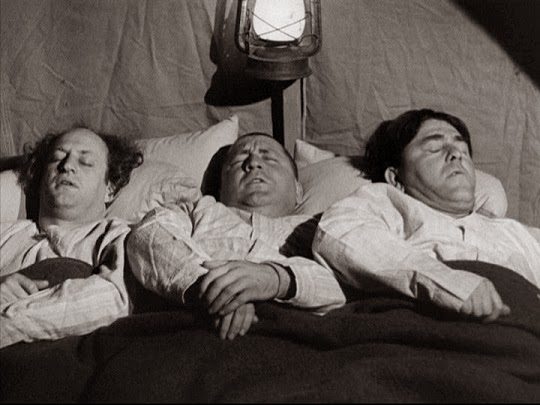
And the most important question: why did the men live together (and sleep together)?  Where were their wives?

All of the adult men I knew, or had seen on tv, or had ever heard of, had wives.  My parents and other relatives constantly talked about the far-off day when I would be "grown up" and "married," as if the two states were identical.

Yet these three men were obviously grown up, and obviously not married.  Men building a life together, not needing or wanting wives (I missed or ignored the scenes where they flirt with women).

I didn't think there was any  romance between them, not even friendship -- Moe was painfully abusive to the others, and they treated him with open contempt.

But, as with the Hanna Barbara cartoons of my earliest childhood (Yogi Bear, The Flintstones), the domesticity itself was evocative.

There was a recast, The Three Stooges, in 2012, with Chris Diamantoupoulos  (top photo) as a rather muscular Moe.  Again, they don't get girlfriends or wives; the hetero-romantic plot is given to a new character.

See also: Samson Burke.

Related Posts Plugin for WordPress, Blogger...