Speaking of buddy-bonding tv, Route 66 (1960-64) was before my time and never rerun, so I've only seen a few clips on youtube, but older Boomers tell me that it was one of the gay-friendly lights of the early 1960s.
It starred clean-cut Yale undergrad Tod (29 year old Martin Milner, who had just appeared in a loincloth in the risque Private Lives of Adam and Eve). Tod -- not Todd -- and his boyfriend traveled around in a blue 1960 Chevy Corvette "in search of America," like Jack Kerouac before them.
His first boyfriend, Buz (not Buzz -- evidently the producers didn't care for last letters), was a streetwise former juvenile delinquent from Hell's Kitchen, played by 32-year old George Maharis. A 1973 Playgirl centerfold, Maharis was gay in real life.
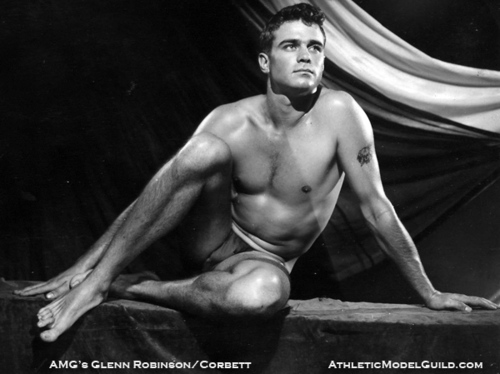
After 2 1/2 seasons, Maharis dropped out, citing the grueling schedule and a bout of hepatitis, Tod quickly found a new boyfriend, haunted ex-GI Lincoln (30-year old Glenn Corbett, recently of It's a Man's World). A former Physique Pictorial model, Corbett was bisexual in real life.
They didn't stick to Route 66; they crossed the U.S. and Canada several times, surfing in Southern California, working on a lobster boat in Maine and a ranch in Wyoming, going to Mardi Gras in New Orleans, vacationing in Toronto. As usual in road series, they got involved in the private dramas of people they met along the way.
The buddy-bonding seems rather intense, and virtually none of the episodes involved getting girlfriends. However, there were little else for gay kids to watch:
1. Very few rescues (usually they were taken hostage together).
2. Insufficient beefcake, considering the number of bodybuilders in the cast (these pictures are from other projects).
3. And the series ended with Tod getting married, his youthful spirit -- and his same-sex romance -- giving way to heterosexual destiny.
But sometimes just an intense friendship is enough.
After Route 66, Martin Milner starred in the beefcake-heavy Gidget, Adam-12 and Swiss Family Robinson (with Willie Aames). Glenn Corbett starred in The Secret of Boyne Castle and a few Westerns before moving behind the scenes. George Maharis had guest spots on many tv programs, performed in nightclubs, and pursued a second career as a painter.
Beefcake, gay subtexts, and queer representation in tv and other pop culture from the 1950s to the present
Dec 16, 2015
Jason Gedrick
Born in 1965, Jason Gedrick broke into show business with The Heavenly Kid (1985), a comedy in which the nerd (Jason) wins The Girl with a little help from a dead teenager from the 1950s (Lewis Smith). In the process, he bonds with the teen angel (and exhibits the usual 1980s homophobia), and shows off an implausibly buffed physique.
The actioner Iron Eagle followed (1986): avid video-gamer Doug (Jason) rescues his dad from Islamic terrorists, with a little help from an older pilot (Louis Gossett Jr.), who is distraught over the many kids that he has seen die over the years, and isn't about to watch Doug die, too. More buddy bonding.
Teen magazines paid some attention to him, displaying his dark, sultry pout and lean muscles.
Gay teens in the 1980s saw a pattern developing: his characters always had girlfriends but found meaning with guys.
The pattern continued in Rooftops (1989): a homeless teen named T, who lives on rooftops, has a girlfriend, but is also in love with a boy. When his boyfriend is killed by drug dealers, T vows to use his dance-combat skills to clean up the neighborhood.

The pattern continued in Backdraft (1991), with Kurt Russell, and Crossing the Bridge (1992), with Josh Charles.
And we saw more of Jason's body in the nude shower scene.
I lost track of Jason in the 1990s. He apparently moved into television, playing a college boy in Class of 96 (1993), a Hollywood star accused of killing a teenage girl in Murder One (1995-96), and an ex-con trying to go straight in EZ Streets (1996-97), plus significant roles Desperate Housewives, Luck, Necessary Roughness, and Dexter. I haven't seen any of them.
But in 2007, for old time's sake, I saw Jason in Kings of South Beach (2007). He plays Chris Troiano, a New Yorker who moves to Miami to escape the Mafia and start a new life. He opens a nightclub and takes bouncer Andy (Donnie Wahlberg) under his wing.
Andy is actually an undercover cop who must choose between his love for Chris and his job.
There is a palpable chemistry between Andy and Chris which almost moves from subtext to text.
Labels:
1980s,
1990s,
cops,
dance,
nerd,
sex comedy,
teen angel
Dec 6, 2015
Shock-headed Peter: Castration and Gay Panic in a German Children's Story
![]() |
Its logo was a boy with wild blond hair and long sharp nails like Edward Scissorhands.
Nearby there was a statue of the same boy, along with some other children.
"You've never heard of Struwwelpeter?" Doc asked. "He's a national hero, like Bart Simpson in America!"

Turns out that all German schoolchildren read Der Struwwelpeter, written and illustrated by Heinrich Hoffmann (1809-1894), about children who misbehave and get their comeuppance -- usually a violent retribution.
A girl who plays with matches burns to death.
Kaspar, who won't eat his soup, wastes away and dies.
Hans, whose "head is always in the clouds," falls into a river.
Robert, who goes outside in a storm, blows away.
Hoffmann was a psychiatrist, though he lived before Freud's discovery of the unconscious, and many of his stories have been analyzed for their psychosexual undertones
The most obvious gay connection is in the story of Konrad, der Daumenlutscher (the Thumb-Sucker).
Though his mother warns him to not suck his thumb, Konrad persists in the bad habit. Then he encounters the Tailor with the Scissors (in modern versions, the monstrous Scissor-Man), who cuts both of his thumbs off.
Oral fixation, symbolic castration, gay anxiety, and a 19th-century Freddie Kruger!
The stories have been translated into several languages. They were adapted into a 1955 movie (available on youtube), an operetta (1992) and a musical (1998).
In 2010, Richard Mansfield filmed an explicitly homoerotic shadow-puppet version, of the Daumenlutscher story, "Suck-a-Thumb." It made the rounds of the gay film festivals.
In an even more explicitly gay sequel, Konrad is sent to a psychiatric hospital for a brutal "cure."
Don't worry, that's a door handle, not what you're thinking.
Dec 4, 2015
The Wiz: Gay Manhattan in the 1970s
Dorothy is a 24-year old kindergarten teacher living with her Aunt Em and Uncle Henry in 1978 Harlem, New York. They were happy to raise her, but now they're dropping broad hints: "You're grown up, practically middle aged. Move out!"
But Dorothy is paralyzed by fear. She's never been south of 125th Street, which means that she's never been to the Museum of Modern Art, about a mile away, or the Empire State Building, or to the gay village of Chelsea. Like everyone in America in the 1970s, she has heard horrible things about Manhattan: skyrocketing crime, economic decline, a failing infrastructure. It's a cesspool of corruption, misery, and perversion. There are gay people there.
Then she follows her dog Toto out into a snowstorm, and gets lost in Manhattan -- which she calls Oz.
She encounters raw racism -- taxis invariably refuse to take her fare -- and many of the urban evils that 1970s critics bemoaned: graffiti, prostitutes, gangs, drugs, gay people.
But she still visits sites that are both beautiful and powerful -- the New York Public Library, the World Trade Center, Cony Island, and the glittering emerald fantasy of Park Avenue.
She makes more friends than she ever had before in her life: a Tin Man, a Scarecrow (played by Michael Jackson), a Lion.
And she is surrounded by beefcake. Cute "numbers runners." Munckins frozen in graffiti. Sweat-shop workers who escape their masks and uniforms to reveal muscular bodies, naked except for jockstraps. Many, if not most, are gay-coded.
In the end she defeats the evil Evilene, debunks the shyster Wizard, and goes back home to Harlem.
But she is no longer afraid. She knows now that for all its dangers, squalor, and decay, Manhattan is a beautiful, magical place, where you can find friends, where difference is accepted, where you can be free to be who you are. Where being gay is ok.
The Wiz is not a great movie. It's way too long, the acting is awful, and paralyzing fear is not the best attribute for a heroine -- Dorothy has none of the resourcefulness of her counterpart in the Baum books, none of the courage of the Judy Garland version. One gets the impression that she should be talking to a therapist rather than going on a heroic quest.
And the gay symbolism.
When I saw The Wiz in the fall of 1978, during my freshman year in college, I had visited 17 U.S. states and 5 foreign countries, but still, my world felt as constrained as Dorothy's. Faced with constant heterosexist pronouncements about my future wife and kids, I felt, like Michael Jackson's Scarecrow, that:
You can't win, you can't break even
And you can't get out of the game
The Wiz suggested that home might be a "good place" after all. All you needed was a copy of the Gayellow Pages.
Subscribe to:
Posts (Atom)