Showing posts with label Bugs Bunny. Show all posts

Jun 7, 2026

Gay couples from your grandfather's comics: Mutt and Jeff, Alphonse and Gaston, LIttle Nemo and Flip, Chip and Dale....


Comic book historians call the period from 1890 to 1930 a golden age, with The Yellow Kid, The Katzenjammer Kids, Moon Mullins, Barney Google, Krazy Kat, Little Nemo, and so on.  I've read selections: they haven't aged well.  Even when I can understand the slang, the jokes don't make much sense.  They seem to be mostly about people hitting each other.

But there are a lot of gay subtext couples.  Did readers in 1926 wonder what Mutt and Jeff are planning, or was it obvious that they are on their honeymoon?  


Did they wonder why Flip, nephew of the Dawn Guard, was so obsesseed with preventing Little Nemo from reaching the Princess?   Did they wonder about his cigar?  (Left: Flip tries to seduce Jimmy in the Return to Slumberland graphic novel).


And what about Alphonse and Gaston?


The invention of prolific cartoonist Frederick Burr Opper, the two Frenchmen, one tall and one short, first appeared in The New York Journal in 1901, and continued intermittently until 1937.

 Jokes involved them being urbane, sophisticated, and foppish, traits antithetical to the big-shouldered Yankee masculinity of the era.

And over-polite, each graciously refusing to leave before the other as the building burns down or the bull charges at them.


More after the break

Nov 4, 2025

"Hollywood Steps Out": Queer Looney Tunes in 1941


When I was a kid in Rock Island, Captain Ernie's Cartoon Showboat on weekday afternoons displayed a lot of old Looney Tunes cartoons.  No matter that they were originally for adults, and full of references to 1940s culture that went over our heads -- if it starred Bugs Bunny, we were interested.

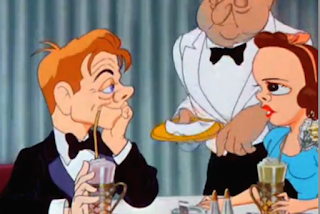
Except not all of the Looney Tunes featured Looney Tunes stars.  There were parodies of travelogues, advertising, and short subjects. I found one particularly memorable: "Hollywood Steps Out" (1941), with caricatures of contemporary Hollywood stars dining and dancing at Ciro's Nightclub.  I had never heard of any of them.  I know who many of them are now, of course: Clark Gable, Cary Grant, Oliver Hardy, Mickey Rooney, Henry Fonda, Groucho Marx.  I've even heard of Jerry Colonna and Kay Kyser.  But to give you the idea of what it was like going in cold:


Establishing shot of Ciro's Nightclub in Hollywood, where dinners start at $50.00 ($940 in today's currency).

1. Soulful Eyes exclaims "What a place!"  Elderly Blond Woman sells him a cigarette, and lights the match with her shoe.

2. Guy with Big Lips talks to a Developmentally Challenged Girl, who responds with a series of "oomphs."  Apparently she can't speak.  Disturbing!

3. Johnny Weissmuller takes off his coat, revealing his muscular physique.  I knew who he was -- Tarzan (top photo). Wow, beefcake!

4. Three Gangsters talk about how risky a job is.  But it turns out to be pitching pennies. 

5. Crazy Guy with Frizzy Hair gives the Elderly Blond Woman a hot foot, but she doesn't respond.

6.  Big Ears swerves his head to gaze at a Lady in Red passing, with a fan over her face.

7. Pipe Smoker takes the stage.  As he introduces the first act, he's interrupted by a horse and jockey, who apparently want to have sex with him, but he shooes them away.  

8. Feminine Old Guy swishes as he conducts the music.  Swishy -- gay hint!


9. Jimmy gets cruised by a woman, who wants to dance with him.  He refuses, and finally runs away, leaving a sign "Mr. Smith Goes to Washington."  Not interested in girls -- gay hint!

10. Big Ears from #6 dances across the floor, following the Lady in Red. Some other people are dancing, including an ice skater and Frankenstein.  The Three Stooges slap each other.  Fat Man dances with two women at once. A man with big feet dances.  


11. Andy and his date are getting milkshakes.  He's shocked that they cost $50, and asks his father at the next table for a loan. But Dad doesn't have any money, either, so they both end up washing dishes.

12. Big Ears is still following the Lady in Red, while Pipe Smoker from #7 takes the stage again.  The horse and jockey flirt with him again.  Then a woman dances, naked except for a giant bubble held in front of her (gross!).  A Guy in a Cap and Gown gazes in lust, and yells "Students!"  A table full of men wolf-whistle (Gross!  This isn't fun anymore!).

13. She dances for a long time, while a man comments: "I haven't seen such a beautiful bubble since I was a child." Henry drools, but is called away by his mother. Googly-Eyes says obsessively "Gee!  Gee! Gee!"   A man looks through binoculars and says "Guess who?"  Crazy Guy hits the bubble with a sling shot, and it pops, revealing that she is wearing a barrel.


14. Big Ears finally catches the Lady in Red, and turns her around.  

She turns out to be a guy in drag! 

During my childhood, before I was aware that gay people (or drag queens) existed, I was confused by the revelation.  Why was this man dressed as a lady?  Why had he been flirting with Big Ears all night?  Did he want to hug and kiss? But...boys didn't hug and kiss boys. Did they?

A glimmer of gay potential on Captain Ernie's Cartoon Showboat

See also: Mickey Rooney: Gay-Vague Teen Hunk of the 1940s

Cary Grant: Hints and Closets in the 1930s

Who is Bradley Cooper, and why is he "ultra-famous"? With his gay/sort of bi characters , backside, and d*ck

The Marx Brothers: Bisexual Groucho and hunky Chico


Mar 6, 2025

Woody Woodpecker: being a wood-pecker was not gay enough

During a televised interview with Walter Lantz sometime in the 1980s, the fawning reporter said "Woody Woodpecker is my favorite cartoon character, and most people I've talked to agree. Why is that?"

Talk about hard-hitting investigative journalism!

I roiled.  Woody Woodpecker is no one's favorite cartoon character.  He's right up there with Scrappy-Doo as the most hated cartoon characters of all time.

Lantz rolled out the anarchic bird in 1940, as a foil for his established character Andy Panda.  He was an ugly, unpredictable psychopath, causig mayhem for its own sake (as opposed to Bugs Bunny, who fights back against aggressors).  Apparently he was popular enough to rate his own song, mostly about his heterosexual prowess:

Though he can't sing a note, there's a frog in his throat
All his top notes come out blurred
He's the ladies' first choice, with a laugh in his voice...and then that annoying ha-ha-ha-HA-ha.


The theatrical cartoons were repeated on tv on the syndicated Woody Woodpecker Show (1958-66, and repeated through the 1970s).  I never watched.  Too scary.

From 1963 to 1978, Woody Woodpecker was a bottom-of-the-rack selection of Gold Key Comics). In the comics, he was domesticated, a single father living in 1960s suburbia (although still talking like it was the 1940s).  He was raising his niece and nephew, Knothead and Splinter, a boy and a girl, guiding them through crises involving bullies, paper routes, and science projects.

There were also globetrotting adventure stories:

The Great Riverboat Race
Ghost of Gold Creek Gulch
Sub-Marooned in Neptunia

Wait -- the hair-dragging -- does that caveman want Woody as his mate?

These were similar to what you would find in the Bugs Bunny and Porky Pig comics a little higher up in the rack, or Donald Duck and Uncle Scrooge comics at the very top, but with some significant, deal-breaker differences.

1. Woody lived in a human world, with only occasional animal characters. 


2. No buddy bonding, like Bugs and Porky or Donald and Uncle Scrooge had had on their adventures.  Heck, even the other main Lantz character, Andy Panda, had a boyfriend, Charlie Chicken, with a sort of id-superego, rushing headlong into danger/worrying if he left the stove on sort of dynamic.

3. Bugs, Porky, and Donald had girlfriends as foils only, and Donald Duck was not interested (in the adventure stories), but Woody was obviously daft over dames, throwing himself into a bosomy woman's lap every five seconds.

4. The art was pedestrian, and the stories cliched.


Years later, I learned the slang meaning of "wood," which transformed "woodpecker" into a dirty word.  I don't think it's enough to redeem Woody Woodpecker.

See also: Bugs Bunny Meets the Drag King


Sep 10, 2023

Tiny Toons University: The toons go to college, learn drag techniques from Bugs Bunny


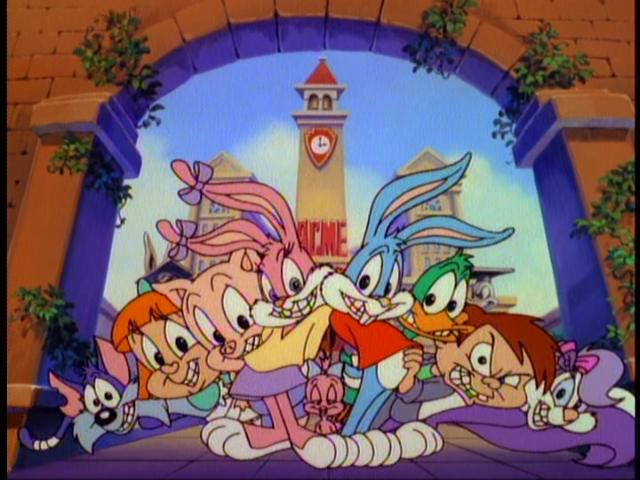
I was a fan of Tiny Toon Adventures (1990-92), featuring young toons with personalities similar to the established characters -- Babs and Buster Bunny (Bugs Bunny), Hampton (Porky Pig), Plucky (Daffy Duck), Sweetie (Tweety), Montana Max (Yosemite Sam).  They attended Acme Looniversity, where they  took on various pop culture icons, like the established characters did in the 1940s, parodied popular songs, and had tween adventures.  That was the problem -- they were in junior high.  Why were they attending a university?

The new Tiny Toons Looniversity (2023)  corrects that problem by making the toons young adults, so they have their own apartments and coffe shop hangouts -- and they attend an actual university.  They all look the same as their predecessors, except for Sweetie Bird, who has become an angry, leather-clad social justice warrior.  I wanted to check for LGBTQ inclusion, so I reviewed the episode "Save the Loo Bru."  Loo refers to Acme Looniversity, not the toilet, and Bru to their coffee shop hangout (shouldn't it be a brew-pub?).

Scene 1: Professor Bugs comes to class in drag.  He explains that "looking fabulous is its own reward," but drag can also be used to defeat a nemesis.  "So, how will we knw when we meet our nemesis?" "They're jerks."

Scene 2: At the Loo Bru, the gang discusses the lecture.  "I can't wait to have a nemesis!" Buster exclaims.  Suddenly Barista Dizzy tells them that the Loo Bru is closing: evil nemesis Montana Max has bought it, and plans to tear it down. 

Scene 3: They consult university president Granny.  She can't do anything: students are permitted to buy any looniversity property, and Max is a student: he just transferred in on an athletic scholarship.

Buster realizes that Max is his nemesis, and vows to ruin him.

Scene 4: Barista Dizzy is not only out of a job: his apartment is upstairs, so when they tear down the building, he'll be homeless.  Babs and Sweetie invite him to move into their place.

Cut to Dizzy moving his (literal) junk in, treating a chair as a toilet, swallowing their refrigerator, and so on. 


Scene 5
: Buster becomes the drag queen Ruth Less. His roommates Hampton and Plucky find him "shockingly attractive." As a conniving businesswoman, he'll gain Max's trust and destroy his business from within. 

Scene 6: A restaurant, La Re Lais de Mechant (the evil relays). Drag Buster bursts in and criticizes everything. Max is smitten: "What a cruel, demeaning, angry woman!" 

They dine together.  Max tells her about an investment opportunity, his 7-story Drink Empire "built on the corpse of a beloved campus coffee shop." 

Scene 7: Dizzy plays his drums in the middle of the night.  Babs and Sweetie agree that he has to go.

Cut to Babs bursting into Buster's dorm room. "Have you saved the Loo Bru yet?"  She sees Buster in drag.  "This is what it's like to have an identical twin." 

With Plucky playing her lawyer and Hampton her butler, Drag Buster will convince Max to give him complete control of the Loo Bru.

Scene 8: Drag Buster and her underlings visits Max at home. They go into his study to "talk business," but he has the fireplace going, and he serves hot chocolate.   Buster's makeup starts to fade, and finally falls off.

"You're not a brutal business bunny!" Max exclaims.  "You're that bunny from the Loo Bru."  He sics his henchmen on them, but he's still upset that things didn't work out.


Scene 9:
Ok, so the seduction didn't work.  Any other ideas?  Yes -- Hampton notices that Max's athletic trophies and newspaper articles are all fake.  He was admitted to the looniversity under false pretenses!  He's out!  Which means he can no longer buy the Loo Bru.

They break the news on demolition day.  By the way, Max is still attracted to Buster as a boy: "My love!" he exclaims, before remembering that they are arch-enemies. 

Scene 10: Professor Bugs congratulates Buster on defeating his nemesis. (Will this be on the final?)  Actually, Buster admits, Hampton figured it out.  The drag seduction didn't work.   "You'll get better with practice," Bugs assures him. 


Scene 11
: Bugs and Buster performing in drag at the Loo Bru.  Everyone cheers.  Max bought a ticket to the show, but bouncer Dizzy won't let him in.  

Beefcake: Max pretends to be a muscleman.

Heterosexism: Nobody in this episode expresses heterosexual interest except Max.

Gay Characters: Sweetie complains that there aren't enough women on campus.  Not enough potential girlfriends?  Max is attracted to Buster in drag and out. 

My Grade:  Fine for nostalgia purpose, and good if subtle LGBTQ inclusion. I'd have to watch other episodes to be sure, but it looks like a B+.

Tiny Toon Adventures: Not what you think


Everyone misunderstands Tiny Toon Adventures.  

They weren't kid versions of classic Warner Brothers characters -- Bugs Bunny, Porky Pig, and so on.  

They weren't the offspring of the classic Warner Brothers characters.  

And they weren't tiny -- they were adolescents, aged 13-15.  They lived with their parents while attending  Acme Looniversity, where the classic characters taught them the art of being toons.

After years of decline -- no new cartoons, old ones chopped to bits to eliminate the violence  -- Warner Brothers was trying to modernize for a new generation of fans.  So the Tiny Toons began appearing in after-school time slots, first in syndication (1990-1992), and then on the Fox network (1992-1995).


  They drew on the personalities of the classic characters, but their adventures were strictly modern, involving video games, cell phones, and lots of sly references to 1990s pop culture, from Lifestyles of the Rich and Famous to Roseanne Barr.

There were no domestic partnerships, as in the Hanna Barbara cartoons of a generation before. Instead, the characters displayed the heterosexism of the major teen sitcoms of the era (Sabrina the Teenage Witch, Boy Meets World, California Dreams), with lots of dating and romance. But there were plenty of subtexts.

Plucky, an egotistical duck, and Hamton, a shy, sensible pig, are partnered for a number of adventures, including parodies of Batman and Star Trekand sometimes are shown living together.  They break up, seek out other "best friends," realize how much they care for each other, and reconcile.

The human character Elmyra usually lacks heterosexual interest -- she is busy hugging and squeezing "cute little animals" to death.  But in one episode, she falls in love with a new girl named Rhonda Queen, and goes to absurd lengths to try to win her affection.

The character of Gogo Dodo also lacks heterosexual interest, and brings a vacuum cleaner to the school dance.

The gay kids in the audience had a lot to identify with.  A lot more than with the horrid Animaniacs, which regrettably replaced Tiny Toon Adventures in 1993.

See also: Animaniacs

May 11, 2021

Pepe Le Pew, the Bisexual Looney Toons Skunk

We know about Bugs Bunny's forays into drag in the old Looney Toon shorts, but what about Pepe LePew?

The faux-French accented skunk was named after the Pepe Le Moko character (Charles Boyer) in Algiers (1938), who reportedly signaled his amorous intent to Hedy Lamar with the request  "Come wiz me to ze Casbah" (although the line never appears in the movie).


Charles Boyer (1899-1978) was bisexual, by the way.

In Chuck Jones' hands, Pepe LePew became an amorous but odiferous skunk who mistakes a cat with a white paint stripe for another skunk and falls madly in love.  His "odor de pew" and aggressive manner -- which today would signify sexual harassment, if not a a ful-fledged sexual assault -- compel his intended to flee, so he's off on a wild pursuit.

It's usually a female cat, but in 4 of his 17 cartoon appearances between 1945 and 1962, it's a male.

In Odor-Able Kitty (1945), it's a male cat.  Pepe is not dissuaded.

In Scent-imental Over You (1947), it's a male dog.

In Scentimental Romeo (1951), Pepe follows the female cat into a Tunnel of Love, where he makes out with a human male by mistake.

In Dog Pounded (1954), Pepe pursues fellow Looney Toons star Sylvester.

That's 23%.  Pepe is definitely bisexual.

In his later appearances, Pepe has occasionally noted an indifference to the gender of his romantic partners:

On an episode of The Sylvester and Tweety Mysteries (1995-2000), Sylvester gets a white stripe down his back again, and is amorously pursued by a male skunk, who explains that he is Pepe's fourth cousin: "What can I say?  It runs in the family."


Sylvester and the female cat Penelope both get white-striped in the direct-to-video Tweety's High Flying Adventure (2000).  Pepe pursues them both.

Sylvester tries to explain that he is an inappropriate partner, not because of his gender, because of his species:

 "You've got it all wrong. I'm not a skunk!"

Pepe responds: "Love can never be wrong."

Feb 6, 2013

Bugs and Daffy: the Gay Warner Brothers


When I was a kid in the 1960s, I didn't realize that the Warner Brothers cartoons that I was watching on Captain Ernie's Cartoon Showboat were actually produced for theatrical release 30 years before.  But I did notice some substantial differences between them and the Hanna Barbara cartoons that I saw on Saturday mornings, not to mention the Warner Brothers comic books.

There were no same-sex partners like Yogi Bear and Boo Boo, no stable backstories or situations at all. Bugs Bunny might become the antagonist of Yosemite Sam, Elmer Fudd, or Daffy Duck.  Porky Pig may be paired with Bugs, Daffy, or Sylvester (who could talk or not).

The ambiguity in personalities and relationships led away from homodomestic partnerships to more overt gay subtexts.  Pepe LePew tries to romance a male cat in "For Scent-imental Reasons (1949).  Porky Pig and Daffy Duck share a hotel room in "Pig’s Feat" (1943) When they prepare to leave, they are presented with a bill which includes a service charge for removing “love spots."


Much has been made of Warner Brothers’ characters’ forays into drag.  Sam Abel, for instance, believed that the drag routines of Bugs Bunny and others were "ways of addressing problems of masculine domination" and question gender roles.  But Bugs often kisses a male antagonist full on the lips while they are both men, conventionally dressed.  And he is not alone in the practice:In “The Hair Brained Hypnotist,” Elmer is hypnotized into thinking he is a rabbit, and he kisses Bugs three times.  In “Tortoise Beats Hair,” an early Bugs is kissed by five tortoises simultaneously. We must answer two questions about this practice: what is its purpose in the plot, and why is it funny.

At first glimpse, it seems that the kiss is a form of humiliation: Bugs may kiss Elmer after dropping his pants or turning his gun inside out.  But on other occasions, it seems to be an annoyance. No live-action underdogs engage in this practice.

And in other instances one can't find any rational explanation.  When Bugs wins an Academy Award, he kisses his Oscar statue and says he'll take it to bed with him.  The Oscar says “Do you mean it?” and sashays, pansy-style, while Bugs stares, stunned either by the spectacle of a talking statue or by the same-sex proposition.

Many of the throwaway jokes involve gay sexual innuendo.  A dog pretends that a female-cat hand puppet is a real cat, and while a male cat is making out with the puppet, he reaches down and squeezes the dog’s bulbous nose, in the place where the crotch would be.  “Something new has been added!” he exclaims, a la Jerry Colonna.

In “The Big Snooze,” Elmer decides to tear up his contract and quit the cartoon business. Bug enters Elmer’s dream, strips him naked, ties him to a railroad track, and then puts him in drag.  A group of zoot-suited wolves chase him off a cliff.  He awakens and decides to not quit after all, whereupon Bugs exclaims, a la Beulah, “I love dat man!”

In “Duck Soup to Nuts,” Daffy peers into Porky’s gun and sees a pinup girl.  When Porky looks, he sees Daffy.

Later Daffy puts Porky in drag and turns into a lecherous wolf to chase him.  Then he begs Porky not to shoot him because he has a wife and kids, whom he kisses. But they turn out to be his buddies.

Thee jokes and innuendos suggest an awareness of same-sex potential and even an openness that one doesn't see in the live-action vehicles of the 1940s, and is rare in cartoons today.
Related Posts Plugin for WordPress, Blogger...