Showing posts with label Warner Brothers. Show all posts

Jul 10, 2026

Bugs and Porky meet a Drag King: Warner Brothers Comics


When I was a kid, my favorite comic titles were Harvey (gay-vague Casper the Friendly Ghost), Disney (Donald Duck as macho adventurer), and the Gold Key jungle adventures.  If I had allowance money leftover, Little Lulu and Archie comics were ok.

Comics featuring Warner Brothers cartoon characters Daffy Duck, Porky Pig, and Bugs Bunny were low on my list.  Not as low as Charleton Comics, but low.


The art was amateurish, with minimal backgrounds, or just blank space.  This is one of the best covers,depicting Bugs opening a door leading to another planet, where a cowboy-rabbit is racing across the desert on a camel.

And instead of the anarchic outsiders of the cartoons, the characters were stable, stolid suburbanites, with houses and jobs and girlfriends. Porky was a single dad, raising his nephew, Cicero, like a Donald Duck knockoff.

But sometimes Bugs teamed up with Porky Pig or Yosemite Sam for adventure stories.  Maybe they stumbled upon a haunted inn.  Or they answered a job ad for "undersea explorers"  Or a telegram arrived about "trouble at the ranch."  Buddy-bonding, captures, and nick-of-time rescues followed.


A continuing series had Bugs and Porky working as Indiana Jones-style adventurer-archaeologists, investigating the myth of Pegasus or discovering a lost civilization hidden under the ice of Antartica.  With no girlfriends in sight, and no damsels in distress to be won.

Unfortunately, you couldn't find the adventure stories by looking at the covers -- almost all of them displayed one-shot gags.  Who could guess that this cover art, featuring Cicero using a pogo stick to steal a lick of Porky's ice cream, hid a story about the guys finding a mysterious artifact that leads them to lost Atlantis?  

And the clerks at the drug store frowned on looking inside.  You had to just buy the issue and take your chances.


More after the break

Jun 7, 2026

Gay couples from your grandfather's comics: Mutt and Jeff, Alphonse and Gaston, LIttle Nemo and Flip, Chip and Dale....


Comic book historians call the period from 1890 to 1930 a golden age, with The Yellow Kid, The Katzenjammer Kids, Moon Mullins, Barney Google, Krazy Kat, Little Nemo, and so on.  I've read selections: they haven't aged well.  Even when I can understand the slang, the jokes don't make much sense.  They seem to be mostly about people hitting each other.

But there are a lot of gay subtext couples.  Did readers in 1926 wonder what Mutt and Jeff are planning, or was it obvious that they are on their honeymoon?  


Did they wonder why Flip, nephew of the Dawn Guard, was so obsesseed with preventing Little Nemo from reaching the Princess?   Did they wonder about his cigar?  (Left: Flip tries to seduce Jimmy in the Return to Slumberland graphic novel).


And what about Alphonse and Gaston?


The invention of prolific cartoonist Frederick Burr Opper, the two Frenchmen, one tall and one short, first appeared in The New York Journal in 1901, and continued intermittently until 1937.

 Jokes involved them being urbane, sophisticated, and foppish, traits antithetical to the big-shouldered Yankee masculinity of the era.

And over-polite, each graciously refusing to leave before the other as the building burns down or the bull charges at them.


More after the break

Sep 10, 2023

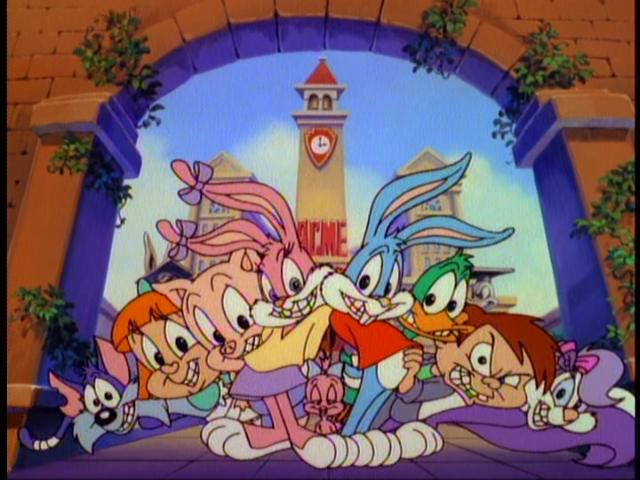
Tiny Toon Adventures: Not what you think


Everyone misunderstands Tiny Toon Adventures.  

They weren't kid versions of classic Warner Brothers characters -- Bugs Bunny, Porky Pig, and so on.  

They weren't the offspring of the classic Warner Brothers characters.  

And they weren't tiny -- they were adolescents, aged 13-15.  They lived with their parents while attending  Acme Looniversity, where the classic characters taught them the art of being toons.

After years of decline -- no new cartoons, old ones chopped to bits to eliminate the violence  -- Warner Brothers was trying to modernize for a new generation of fans.  So the Tiny Toons began appearing in after-school time slots, first in syndication (1990-1992), and then on the Fox network (1992-1995).


  They drew on the personalities of the classic characters, but their adventures were strictly modern, involving video games, cell phones, and lots of sly references to 1990s pop culture, from Lifestyles of the Rich and Famous to Roseanne Barr.

There were no domestic partnerships, as in the Hanna Barbara cartoons of a generation before. Instead, the characters displayed the heterosexism of the major teen sitcoms of the era (Sabrina the Teenage Witch, Boy Meets World, California Dreams), with lots of dating and romance. But there were plenty of subtexts.

Plucky, an egotistical duck, and Hamton, a shy, sensible pig, are partnered for a number of adventures, including parodies of Batman and Star Trekand sometimes are shown living together.  They break up, seek out other "best friends," realize how much they care for each other, and reconcile.

The human character Elmyra usually lacks heterosexual interest -- she is busy hugging and squeezing "cute little animals" to death.  But in one episode, she falls in love with a new girl named Rhonda Queen, and goes to absurd lengths to try to win her affection.

The character of Gogo Dodo also lacks heterosexual interest, and brings a vacuum cleaner to the school dance.

The gay kids in the audience had a lot to identify with.  A lot more than with the horrid Animaniacs, which regrettably replaced Tiny Toon Adventures in 1993.

See also: Animaniacs

May 11, 2021

Pepe Le Pew, the Bisexual Looney Toons Skunk

We know about Bugs Bunny's forays into drag in the old Looney Toon shorts, but what about Pepe LePew?

The faux-French accented skunk was named after the Pepe Le Moko character (Charles Boyer) in Algiers (1938), who reportedly signaled his amorous intent to Hedy Lamar with the request  "Come wiz me to ze Casbah" (although the line never appears in the movie).


Charles Boyer (1899-1978) was bisexual, by the way.

In Chuck Jones' hands, Pepe LePew became an amorous but odiferous skunk who mistakes a cat with a white paint stripe for another skunk and falls madly in love.  His "odor de pew" and aggressive manner -- which today would signify sexual harassment, if not a a ful-fledged sexual assault -- compel his intended to flee, so he's off on a wild pursuit.

It's usually a female cat, but in 4 of his 17 cartoon appearances between 1945 and 1962, it's a male.

In Odor-Able Kitty (1945), it's a male cat.  Pepe is not dissuaded.

In Scent-imental Over You (1947), it's a male dog.

In Scentimental Romeo (1951), Pepe follows the female cat into a Tunnel of Love, where he makes out with a human male by mistake.

In Dog Pounded (1954), Pepe pursues fellow Looney Toons star Sylvester.

That's 23%.  Pepe is definitely bisexual.

In his later appearances, Pepe has occasionally noted an indifference to the gender of his romantic partners:

On an episode of The Sylvester and Tweety Mysteries (1995-2000), Sylvester gets a white stripe down his back again, and is amorously pursued by a male skunk, who explains that he is Pepe's fourth cousin: "What can I say?  It runs in the family."


Sylvester and the female cat Penelope both get white-striped in the direct-to-video Tweety's High Flying Adventure (2000).  Pepe pursues them both.

Sylvester tries to explain that he is an inappropriate partner, not because of his gender, because of his species:

 "You've got it all wrong. I'm not a skunk!"

Pepe responds: "Love can never be wrong."

May 9, 2021

Animaniacs: Heterosexist to the Max

In a 1992 episode of Tiny Toon Adventures, Buster and Babs help some outdated black-and-white cartoon characters from the 1930s, who become so popular that Tiny Toons is cancelled to make room for their new show.

Precognitive or not, Tiny Toons was cancelled that spring to make room for Animaniacs (1993-1998).

The frame story: three black-and-white characters, Yacko, Wacko, and Dot, were too zany for 1930s audiences, so they were locked in the water tower at Warner Brothers Studios.

 Fifty years later, they escaped to unleash their zaniness on the world.

Wait -- children were locked in a water-tower prison?

The discomfort continued with the show itself.

First, Tiny Toons had ample gay subtexts, but Wacko and Yacko were preteen horndogs, aggressively heterosexual, sexually aware, and probably sexually active.  When a woman with big breasts comes on state, they all but have orgasms on the spot.  They leap into the arms of the big-breasted nurse so often that their leering "Hello, nurse!" became a catchphrase.

Dot disapproves of the activity, but when a handsome man approaches, she throws herself at him in a fit of heterosexual mania.

Their cartoons were horrible, but the subsidiary features were even worse.

1. Slappy Squirrel, an aging, raunchy cartoon character from the 1930s, and her grandson.
2. The Goodfeathers, gangster pigeons
3. Rita and Runt, a showtune-singing cat and stupid dog.
4. Some others that I don't remember.


The only feature with redeeming value was Pinky and the Brain, about two lab rats who plotted to take over the world. They at least had a gay subtext.  But in 1993 they were spun off into their own show, leaving Animaniacs to promote childhood heteronormativity for another five years.

See also: Pinky and the Brain


Jul 10, 2020

Pinky and the Brain: The same thing we do every night


The WB Network's Pinky and the Brain (1993-1999), a spin-off of the execrable Animaniacs, was about two intelligent lab rats who shared a cage and collaborated on schemes to take over the world.  At first they were coded as coworkers and bunk mates, not as romantic partners. Both had outside love affairs; Pinky was especially promiscuous, falling in love with a horse, a sea lion, and children's book heroine Pippy Longstocking.

However, there were gay "jokes" from the beginning. In a running gag, Brain has a sudden insight and asks Pinky "Are you pondering what I'm pondering?" Pinky replies with a nonsequiter that can often be read as sexual, or at least dirty, such as "I think so, Brain, but how can we get seven dwarves to shave their legs?" or "I think so, Brain, but isn't a cucumber that small called a gherkin?"

Of seventy-five recorded "pondering" responses, thirteen concern transvestism or fetish costumes — "I think so, Brain, but this time you wear the tutu" — and twelve evoke sexual double entendres — "I think so, Brain, but apply North Pole to what?"

The tag line of each episode, after the most recent plan for world domination has failed, similarly allows for a homoerotic reading:
  Brain: Let us go back to the lab and prepare for tomorrow night.
  Pinky: Why, Brain? What are we going to do tomorrow night?
  Brain: The same thing we do every night, Pinky. [Pause, while we ponder just what it is that they do every night] Try to take over the world.

When Pinky and the Brain moved to prime time in 1995, plotlines became more complex, with movie and television parodies and recreations of the basic scenario in various historic periods. The writers also added what Warner Brother's head of programming referred to as "family and romantic element."  Potential heterosexual partners did appear occasionally, and Brain was somewhat swayable, but Pinky steadfastly chose the Brain over any other love.

Most of the romantic elements, however, involved the duo's attraction to each other, which Pinky celebrated and the Brain grudgingly admitted. In "Just Say Narf", Pinky sings and flirts with a despondent Brain: he bats his eyes seductively, lays his head cozily in Brain's lap, and twirls him about in a waltz before Brain finally cheers up.

Even when the Brain takes up smoking, Pinky's attraction does not diminish: "Hello there, stinky smelly smoky boy," he says with a leer, "Do you have a monkey in your pants?" He "means" to say "Do you have a monkey on your back?", a metaphor for addiction. When he says "pants" instead, the "mistake" produces a striking metaphor that is not not sexual.

Pinky and the Brain share more than physical attraction, however; they begin to represent themselves as a closeted gay couple. A prospective employer asks Brain, "Are you married?" After a brief, awkward pause, he responds "No. I do have a ... roommate." Considering various responses and then deciding on "roommate" is — or was — a familiar strategy for hiding same-sex partners from potential homophobes. Brain gets the job and enters corporate culture as a closeted gay man — or mouse — clumsily rejecting a female suitor and inventing a lame explanation for the picture of Pinky on his desk.

When Brain's parents visit, Brain again introduces Pinky as "my ... um ... roommate." The liberated 1990's parents are not fooled, however; while constantly criticizing Brain for his poor housekeeping, poor cooking, and unrealistic career goals, they never nag him to "meet a nice girl" and get married; obviously they are aware that he already has a partner. At the end of the episode, Mom and Dad invite the two to visit as a couple at Thanksgiving.

No other cartoon of the 1990's portrayed same-sex relationships so overtly.

See also: Animaniacs

Mar 18, 2018

All the Four Color Beefcake Ever Printed

The Four-Color series was the mainstay of Dell Comics, begun in 1939 and lasting through 1962, with over 1300 issues, often two or three per month.  There were no ongoing characters: each book was standalone.

Artists mined the stables of Walt Disney and Warner Brothers for comic inspiration:
"Porky Pig and the Grand Canyon Giant"
"Donald Duck and the Pixilated Parrot"


They adapted radio and tv series:
"Tom Corbett, Space Cadet"

Some of the early 1960s cartoons:
"Rocky and His Friends" (TV cartoon)
"Yogi Bear Joins the Marines" (predating Gomer Pyle)
"Yogi Bear Visits the U.N." (seriously?)

Some of the tv adaptions were head-scratchers, not at all popular with kids:
"77 Sunset Strip," about swinging bachelor detectives.
"I Love Lucy"
"The Life of Riley"


They adapted movies, some from years before:
"Francis the Talking Mule"
"Jungle Jim"
"Rio Bravo"

And comic strips, some from a generation before:
"Krazy Kat"

Some that I have never heard of:
"Will-Yum"

Plus miscellaneous features:
"Smokey the Bear," about the advertising icon.
"Wrinkle Wrangle" (a song broken by the sharp crack of gunfire)
"Paul Revere's Ride" (history)
"The Lennon Sisters' Life Story" (1940s singing group)
"Yak Yak" (a sort of Mad Magazine)
"Brain Boy" (?)

One would expect a lot of beefcake, but in fact out of 1300 issues, I found 7 covers featuring beefcake photos:

1. The Sword and the Rose (top photo), a 1953 Medieval knighthood movie starring Richard Todd with an Errol Flynn moustache.

2.-3. Two shirtless photos of Keith Larson as the Indian Brave Eagle, in a tv series that lasted for only 26 episodes (1955-56).


4. Nick Adams (left) wearing a Confederate uniform with his shirt off as The Rebel (1959-61)

5. Kirk Douglas in Spartacus (1960).


6. David and Goliath, based on the 1960 Italian movie with Croatian actor Ivica Pajer as the shepherd boy.


Here's more of Ivica Pajer.  He also played Sophie's father in Sophie's Choice (1982)


7. Sal Mineo as an Indian boy in Comanche.  The film was actually released as Tonka (1959).

At least two of the seven covers featured gay men, and a third had a gay subtext.  Not a bad record.

See also: Four Color Beefcake and Bonding


Feb 6, 2013

Bugs and Daffy: the Gay Warner Brothers


When I was a kid in the 1960s, I didn't realize that the Warner Brothers cartoons that I was watching on Captain Ernie's Cartoon Showboat were actually produced for theatrical release 30 years before.  But I did notice some substantial differences between them and the Hanna Barbara cartoons that I saw on Saturday mornings, not to mention the Warner Brothers comic books.

There were no same-sex partners like Yogi Bear and Boo Boo, no stable backstories or situations at all. Bugs Bunny might become the antagonist of Yosemite Sam, Elmer Fudd, or Daffy Duck.  Porky Pig may be paired with Bugs, Daffy, or Sylvester (who could talk or not).

The ambiguity in personalities and relationships led away from homodomestic partnerships to more overt gay subtexts.  Pepe LePew tries to romance a male cat in "For Scent-imental Reasons (1949).  Porky Pig and Daffy Duck share a hotel room in "Pig’s Feat" (1943) When they prepare to leave, they are presented with a bill which includes a service charge for removing “love spots."


Much has been made of Warner Brothers’ characters’ forays into drag.  Sam Abel, for instance, believed that the drag routines of Bugs Bunny and others were "ways of addressing problems of masculine domination" and question gender roles.  But Bugs often kisses a male antagonist full on the lips while they are both men, conventionally dressed.  And he is not alone in the practice:In “The Hair Brained Hypnotist,” Elmer is hypnotized into thinking he is a rabbit, and he kisses Bugs three times.  In “Tortoise Beats Hair,” an early Bugs is kissed by five tortoises simultaneously. We must answer two questions about this practice: what is its purpose in the plot, and why is it funny.

At first glimpse, it seems that the kiss is a form of humiliation: Bugs may kiss Elmer after dropping his pants or turning his gun inside out.  But on other occasions, it seems to be an annoyance. No live-action underdogs engage in this practice.

And in other instances one can't find any rational explanation.  When Bugs wins an Academy Award, he kisses his Oscar statue and says he'll take it to bed with him.  The Oscar says “Do you mean it?” and sashays, pansy-style, while Bugs stares, stunned either by the spectacle of a talking statue or by the same-sex proposition.

Many of the throwaway jokes involve gay sexual innuendo.  A dog pretends that a female-cat hand puppet is a real cat, and while a male cat is making out with the puppet, he reaches down and squeezes the dog’s bulbous nose, in the place where the crotch would be.  “Something new has been added!” he exclaims, a la Jerry Colonna.

In “The Big Snooze,” Elmer decides to tear up his contract and quit the cartoon business. Bug enters Elmer’s dream, strips him naked, ties him to a railroad track, and then puts him in drag.  A group of zoot-suited wolves chase him off a cliff.  He awakens and decides to not quit after all, whereupon Bugs exclaims, a la Beulah, “I love dat man!”

In “Duck Soup to Nuts,” Daffy peers into Porky’s gun and sees a pinup girl.  When Porky looks, he sees Daffy.

Later Daffy puts Porky in drag and turns into a lecherous wolf to chase him.  Then he begs Porky not to shoot him because he has a wife and kids, whom he kisses. But they turn out to be his buddies.

Thee jokes and innuendos suggest an awareness of same-sex potential and even an openness that one doesn't see in the live-action vehicles of the 1940s, and is rare in cartoons today.
Related Posts Plugin for WordPress, Blogger...