Showing posts with label Marvel. Show all posts

Nov 14, 2019

"Spider-Man: Into the Spider-Verse": How Is This Not a Coming-Out Movie?

Spider-Man, introduced in 1962, was one of the first in Marvel Comics' stable of flawed superheroes, a welcome counterpart to DC's indefatigibly stalwart square-jaws:  high schooler Peter Parker is bitten by a radioactive spider, gets spider-powers, and doesn't know how to save the world while negotiating teen angst.  Many high schoolers in the Vietnam-Nixon-Kent State era could relate.

Since then Spidey has spun off into comic books, movies, a tv series, a Broadway show, and dozens of "what if?" alternatives, some of whom come together in the gay symbolism-packed Spider-Man: Into the Spider-Verse.

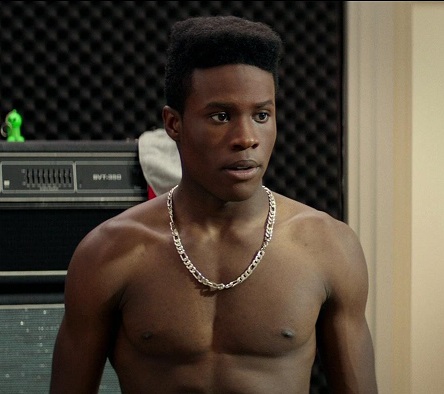
In a trippy near-Earth,  Miles Morales (voiced by Shameik Moore, top photo) is a outsider (gay) kid, obsessed with comic books, street art, and his hero, Spider-Man.

His (homophobic) straight-laced father, police officer Jefferson Davis (Bryan Tyree Henry) doesn't like (gay people) Spider-Man.

Time out:  who decided to name a black guy after the President of the Confederacy?

Miles (realizes that he's gay) is bit by a radioactive spider, joins a gym (gets muscular overnight), and excretes sticky webs  (you figure it out).

He sneaks out to visit his Uncle Aaron (Mahershala Ali, who played a gay character in Green Book and the father of a gay kid in Moonlight).

Aaron is estranged from Dad because he's (gay) a screw-up.  He gives Miles lessons on how to talk to girls (guys): hand on shoulder, intense gaze, sultry "Hey."

Spider-Man dies, and Miles must take his place.  He negotiates high school, not telling anyone that he is (gay) the new Spider-Man, wishing that he wasn't the only (gay person) Spider-Man in the world.


Due to a space-time vortex created by the (heteronormative) Big Bad, Spider-People living in alternate worlds  are swept away from home and  end up in Miles' world.

Miles bonds with Peter B. Parker (Jake Johnson), a middle-aged Spider-Man who married his girlfriend Mary Jane, but now is divorced because he is (gay) a screw-up.

The other (gay people) Spider-People include Gwen Stacey, a (lesbian) female Spider-Man; Spider-Man Noir, from a film noir world; Peter Porker, aka Spider-Ham; and Peni Parker, a girl from a distant future world.

The  (gay club) secret Spider-Man group works together to defeat the (heteronormative) Big Bad and (assimilate) get back to their home dimensions.

Miles now accepts his role as a Spider-Man (gay person).  Still in disguise, he rushes up and hugs his Dad, who is shocked by his (gay) affection. Dad says "I don't approve of your (lifestyle) methods, but I respect you."

Miles concludes:  "When I feel alone, like no one understands what I'm going through (as a gay teen), I remember my friends who get it. I never thought I'd be able to do any of this stuff, but I can. Anyone can (be gay) wear the mask. You could (be gay) wear the mask. If you didn't know that before, I hope you do now. Because I'm (gay)  Spider-Man. And I'm not the only one. Not by a long shot."


Oct 23, 2016

Gay Men....Um, I mean X-Men: Apocalypse

There are two basic camps in the mutant community:

1. Separatists: Flee from the straights and their so-called "tolerance."  You are special.  Embrace your difference!  Do not be constrained by their rules about what is "normal"!  If you can fly, then fly.  If you have purple skin, have purple skin.

2. Assimilationists.  If only they got to know us, they would discover that we really aren't that different after all.  Live among them!  Join their clubs, if they let you.  Minimize your differences.  Don't fly, unless it is unavoidable.  Don't have purple skin.

Gay people are divided into the same two camps.  The Separatists live in their own neighborhoods, have only gay friends, and say "Being gay is who I am!"  The Assimilationists live in the straight world, have almost all straight friends, and say "Being gay is only a small part of who I am."

We've had a few Assimilationist-Separatist battles in the gay world, too, starting right at Stonewall, with the Mattachine Society (keep quiet!  don't make waves!) vs the Gay Liberation Front (be loud and proud!)

Back to the Mutants:

In most movies in the X-Men franchise, the Assimilationist camp is led by Dr. Xavier (James McAvoy), who runs a school for mutants on his vast estate, teaching them how to control or hide their differences so they can go back to "normal" society.

A Separatist leader arises, the Big Bad of the episode.  He gathers a group of followers, and engages in a big, flamboyant stunt to let the "straights" know that they're not going to be victimized anymore, they're Mutant and Proud.   But it goes wrong; now the straights hate them more than ever.

After a few changes in loyalty and second-guesses, there's a gigantic battle between the Assimilationist and Separatist groups.  The Assimilationists win.

Bryan Singer, the director, is obviously a gay Assimilationist.  That's why he doesn't have any gay characters in his movies.  "It's not important."

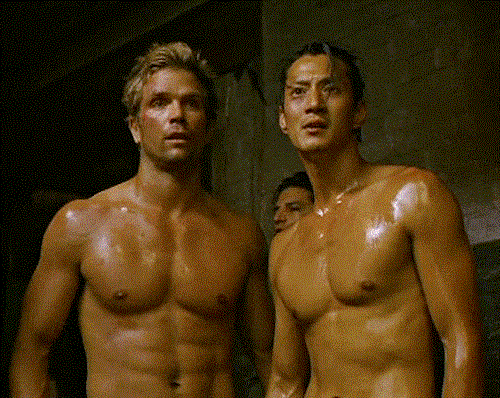
In X-Men: Apocalypse (2016), the Big Bad Separatist is En Sabah Nur (Oscar Sabah, left, except in the movie he has a Voldemort thing going on).  He's a mutant with godlike powers who ruled Egypt in 3600 BC (I won't go into the historical inaccuracies).  Trapped in his pyramid for 5000 years, he emerges in 1983 to gather some followers and restore the Mutants to their rightful place in the food chain.

It's a different Separatist-Assimilationist line-up from the last battle in the 1970s, so there are several trumped-up stories to explain why characters have changed sides, but it boils down to:

En Sabah Nur's Crew
1. Magneto, the Big Bad of the last episode (Michael Fassbender)
2. Psylocke (Olivia Munn)
3. Angel (Ben Hardy, top photo)
4. Storm (Alexandra Shipp)


Dr. Xavier's Crew
1. Mystique (Jennifer Lawrence)
2. Beast (Nicholas Hoult)
3. Quicksilver (Evan Peters, below)
4. Cyclops (Tye Sheridan)
5. Nightcrawler (Kodi Smit-McPhee)

I might have missed some.  Frankly, I found it hard to keep track of the changing alliances, the character reboots, the shifting backstories (and forward stories, since some installments take place later).

Cyclops has an origin-story subplot in which his eyes start giving off laser beams, effectively making him blind.  Enrolled at the school by his big brother Havok (Lucas Till), he gets goggles made of "ruby quartz" which allow him to control his powers.  Unfortunately, he also starts a romance with the Girl Who Thinks He's Arrogant.

Heterosexist tripe!


I was mostly in it for the beefcake, the 1980s references (very few), and the queer vibe that Quicksilver gives.  He can move so fast that bullets seem to be standing still.

As he gleefully saves all of the residents of the school (and a dog, some goldfish, and a pizza) from an explosion, he expresses disgust at a boy and a girl about to kiss, but rather likes a boy preening in front of a mirror.

Otherwise for gay subtexts you have to go with metaphor.  Everybody here is heterosexual.

Oct 22, 2016

12 Beefcake Stars of Marvel's "Luke Cage"

Luke Cage was a Marvel comic book series that tried to cash in on the 1970s blacksploitation craze with a jive-talking, bell-bottom-wearing Harlem-based "hero for hire."  He didn't fly or have laser-vision; he was only marginally super-strong.  In fact, his only real superpower was being unbreakable: nothing could pierce his skin (which leads to all sorts of questions, but ok, Superman can reverse the Earth's rotation, so I'm not complaining).

Fast forward to 2016, when Luke Cage becomes the star of a Netflix tv series: after "the incident," a depressed, angst-ridden Luke Cage is keeping a low profile, working at Pop's Barber Shop in Harlem, hiding his superpowers from a hostile society and trying to stay out of trouble.  But when Pop is murdered, he is forced into action again.

There are ample gay subtexts.  No one in the cast seems involved in a heterosexual relationship, or expresses heterosexual interest, except for Luke himself and an occasional murdered cop who gets the standard "He had a wife!" homage.  Otherwise this is a homoerotic Harlem where men and women lead separate lives, coming together only when necessary to run organized crime gangs or try to bring those crime gangs down.

And, since almost the entire cast is black, there is an explosion of black beefcake, more than on any other tv series I have ever seen.

1. Mike Colter (top photo) as Luke Cage, Hero for Hire, although he isn't hired much.  After Pop dies and the barber shop closes, he is basically unemployed, spending his time being moody, getting shot at, and trying not to get involved with hetero-romance.

2. Mahershala Ali (left) as crime boss Cottonmouth Stokes, the owner of the Harlem Paradise nightclub.  He wanted to become a professional musician, but he was forced into the crime game by his aunt, Mama Mabel, who also forced him to kill his uncle.


3.Theo Rossi as Shades Alvarez, a street thug who plays every side of the conflict.


4. Erik LaRay Harvey as Diamondback (the gang members all have snake names).  He also happens to be Luke's half-brother, the guy who framed him and had him sent to the prison where he got his superpowers.  He carries a Bible with him at all times.

5. Jaiden Kaine (left) as Zip, the leader of Cottonmouth's gang.


6. Jeremiah Craft as David, a teenager Luke befriends.


More after the break


Sep 18, 2014

Bring on the Spider-Men

I'm not a big fan of superheroes in general, and Spider-Man is at the bottom of my list.  I walked out on the first movie (2002) starring Tobey Maguire, and I've never seen The Ultimate Spider-Man, in spite of its 10 Ultimate Hunks.

So the Broadway musical Spider-Man: Turn Off the Night (2011-2014) was not high on my must-see list.

It was one of the most expensive musicals in history, riddled with production accidents (Spidey has a lot of web-swinging to do).

It was panned by critics, who complained that it combined the worst set-pieces of the 2002  with pretentious Greek-chorus stuff, and ignores Spidey's comic book origins.


It was certainly heterosexist, with Mary Jane being captured and melting into Spidey's arms every five minutes.

But it has something that the comic book never had:  multiple Spider-Men.

You need a lot for all the stunts, and because they keep getting injured.

Spider-Men include man-mountains like Matthew Wilkas (top photo), Reed Kelly (left), Adam Ray Dyer (below).


Jake Odmark, Justin Matthew Sargent, Matthew James Thomas, Marcus Bellamy, and on and on and on....


And the Spider-Men's costumes seem particularly bulge-worthy.  Apparently being bitten by a radioactive spider adds considerable bulk beneath the belt.  How many can you count in this curtain call of four Spidermen sans mask?


How about now, with nine Spidermen strutting their stuff on Times Square?

New productions are being planned for major cities in America and Europe, so you may yet have a chance to gawk at your Friendly Neighborhood Spider-Men.


Jun 26, 2014

Jim Steranko: Escape Artist turned Comic Book Artist


Jim Steranko (born 1938) started out as a stage magician and escape artist, following in the footsteps of Harry Houdini.

With a beefy physique to match.

In the late 1960s, while Frank Frazetta was busily revitalizing Conan the Barbarian, Steranko revitalized Marvel Comics, drawing The X-Men, Captain America, Strange Tales, and Nick Fury: Agent of S.H.I.E.L.D.  He also wrote one of the first histories of comic books (1971).


I didn't read Marvel comics much when I was a kid, but I knew Jim Steranko's work from the covers of many paperback sword-and-sorcery novels that he illustrated during the 1970s.

His covers differed from the usual Conan and John Carter of Mars stuff: they usually pictured the mighty-thewed barbarian heroes without naked ladies attached to their thighs.

And the stories inside were often free of "rescuing the princess" hijinks.  David Van Arnam's Lord of Blood buddy-bonds barbarian hero Valzar and his servant Lynor.


Isn't Kelwin a rather silly name for a barbarian hero?  He should be winning science fairs, not battling the "yellow-skinned wizards of Hunan."


I bought The Mighty Swordsmen at a used bookstore in Paris without realizing that there was a naked lady on the cover.


Apparently I missed a lot of the ladies in Steranko's work.

I didn't notice his compendiums of pin-up girls, or his comic book art, crowded with shirtless, muscular men and ladies in skintight leather outfits, like that of Mrs. Peel on The Avengers. 

But at least he was an aficionado of the male form.

And recent versions of his Agents of S.H.I.E.L.D. title feature a lesbian character.

See also: Werewolf by Night; and Kamadi.


Jan 25, 2014

Doc Savage: The First Gay Superhero

When I was a kid, I never cared much for Marvel comics, other than the gay-subtext heavy Werewolf by Night, but in the summer of 1972, my eyes were drawn to the gleaming hard-muscle physique on the cover of Doc Savage #1, "the first superhero of them all!"

How was that possible?  We already had Superman, Batman, Spiderman....


Turns out that Doc Savage got his start as a pulp hero, first created by Lester Dent in 1933 (5 years before Superman). His adventures have been reprinted in paperback form from the 1960s through the 1990s.  There have been comic books, two radio series, and a 1975 movie starring Ron Ely of Tarzan fame.

Like Batman, Doc has no superpowers; he relies on his superb physique, scientific gadgets, and medical training to fight evil (when he catches villains, he gives them brain operations to cure them of their criminal tendencies).

Unlike Batman and every other superhero, he doesn't wear a spandex costume; he appears shirtless and bronze and gleaming.


He lives and works on the 86th floor of the Empire State Building in New York City, accompanied by his team, "The Fabulous Five."
1.-2. Chemist Monk (who has the build of a gorilla) and attorney Ham, who feud with each other.
3. Renny, an engineer with a massive physique of his own.
4. Long Tom, a long, thin engineer.
5. The egghead archaeologist Johnny.

The only regular female character was Doc's cousin Pat, who tagged along on adventures in spite of being told to "wait here where it's safe."

Here are some of the plotlines:

Johnny finds a prehistoric egg that may have hatched into a dinosaur.
Monk runs afoul of the mind-controlling Lucky Napoleon.
Ham witnesses "the rustling death" that drops men out of airplanes.
A naked man is fished out of the Atlantic and hailed as a prophet.

Quite a lot of captures and nick-of-time rescues going on, and not a lot of hetero-romance.

Other members of the team occasionally get girlfriends, but as Monk explains, "There won't be any women in Doc's life."  He has a female companion in the 1975 movie, but doesn't kiss her.  Many rescued damsels-in-distress have tried to snare him, but he tactfully rebuffs their advances.  He has, you see, "no time for women."


Yeah, right, no time.

Philip Jose Farmer's A Feast Unknown (1969) gives Doc Savage and Tarzan an abusive sexual relationship.

Heterosexual fans have faced the "accusation" of Doc's gayness for many years, usually with shrieks of "No way is Doc gay!"  But a surprising number of gay kids found a role model in the Doc

.

Aug 31, 2012

Jack Russell's Boyfriend: Werewolf by Night

Speaking of werewolves, the only Marvel/DC comic I read regularly in the 1970s were Kamandi, Doc Savage, and Werewolf by Night, which appeared from 1972 to 1977.  I read it mostly from 1975 to 1977, when I was in high school.

Jack Russell turns 18 and inherits the family curse; during the three nights of the full moon, he turns into a ravaging werewolf. Afterwards, of course, his clothes are gone, revealing an amazing physique.  In the second issue, he tries to explain his dilemma to the man he lives with -- "more than a friend" -- a middle-aged writer named Buck Cowan.


Buck also has an amazing physique and is allergic to shirts.


There is a "damsel in distress" being threatened on most covers, but surprise!  It's not some girl, it's his sister.  Jack doesn't have a girlfriend, girl admirer, or female crush of any kind.  He likes men.

In 2013, he appeared in a guest spot on The Ultimate Spider-Man, voiced by Disney hunk Ross Lynch.

See also: Jim Steranko
Related Posts Plugin for WordPress, Blogger...